
7 Ply vs 8 Ply Skateboard Deck: Which Is Right for You?
This post contains affiliate links. As an Amazon Associate, we earn from qualifying purchases.
A 7-ply deck uses seven veneers of Canadian hardrock maple in a crossbanded layup and is the default for street skating. An 8-ply deck adds a layer, increasing stiffness and weight, and is recommended for heavier skaters or specialty applications. Ply count alone doesn’t decide “better”, veneer thickness, glue, and pressing matter just as much.
That gap between “stiffer” and “heavier” is where the choice lives, and the debate over a 7 ply vs 8 ply skateboard deck is central to it. An 8-ply isn’t just a stronger 7-ply; it’s a different tool for a different job, and the wrong pick costs you pop and control.
What follows: the exact construction specs, a clear weight and feel comparison, the brands actually making 8-ply decks, and the high-tech alternatives that change the whole equation.
Key Takeaways
- The standard 7-ply construction uses seven layers of Canadian maple and a cold-press process lasting 1.5-2 hours.
- An 8-ply deck is heavier and stiffer, best suited for big-boned skaters or those wanting a more stable platform for transition skating.
- Ply count is not the only factor in strength; veneer quality, adhesive, and pressing method significantly impact durability and feel.
- Advanced composites like Dwindle’s Impact tech or Skate One’s FLIGHT deck offer strength-to-weight ratios that traditional ply decks can’t match.
- For most street skaters, a quality 7-ply maple deck from a brand like Real or Element offers the best balance of pop, weight, and cost.
The 7-Ply Standard Construction Explained
Most decks start here. A traditional 7-ply skateboard deck is laminated from seven sheets, or plies, of Canadian hardrock maple (Acer saccharum). The magic lies in the alternating grain direction, not simply stacking seven identical sheets.
A common 7-ply reference layup is: face / long-grain core / crossband / long-grain core / crossband / long-grain core / face. The long-grain plies run nose-to-tail for lengthwise strength, while the crossband plies run widthwise to balance the construction and resist twisting.
This crossbanded structure is what gives a deck its predictable flex and snap. Manufacturers use various pressing methods; Point Distribution uses a cold-pressing process lasting 1.5-2 hours at room temperature, while NHS uses a cold press method without heat and glue instead of epoxy. The uncut laminated blank then cures in a stack for 4 to 7 days.
The result is a deck with a familiar, lively feel. You get a certain amount of give on impact, followed by a return of energy, that’s the “pop” everyone talks about. It’s why Point Distribution states their 7-ply maple construction is ‘by far our most popular’ for professional use, while other sources note 7-ply birchwood is designed for younger and smaller skateboarders.
Where this goes sideways: Assuming all 7-ply decks are identical. Veneer thickness, glue quality, and the specific mold’s concave all change the result.
The 8-Ply Deck: When You Need More Board
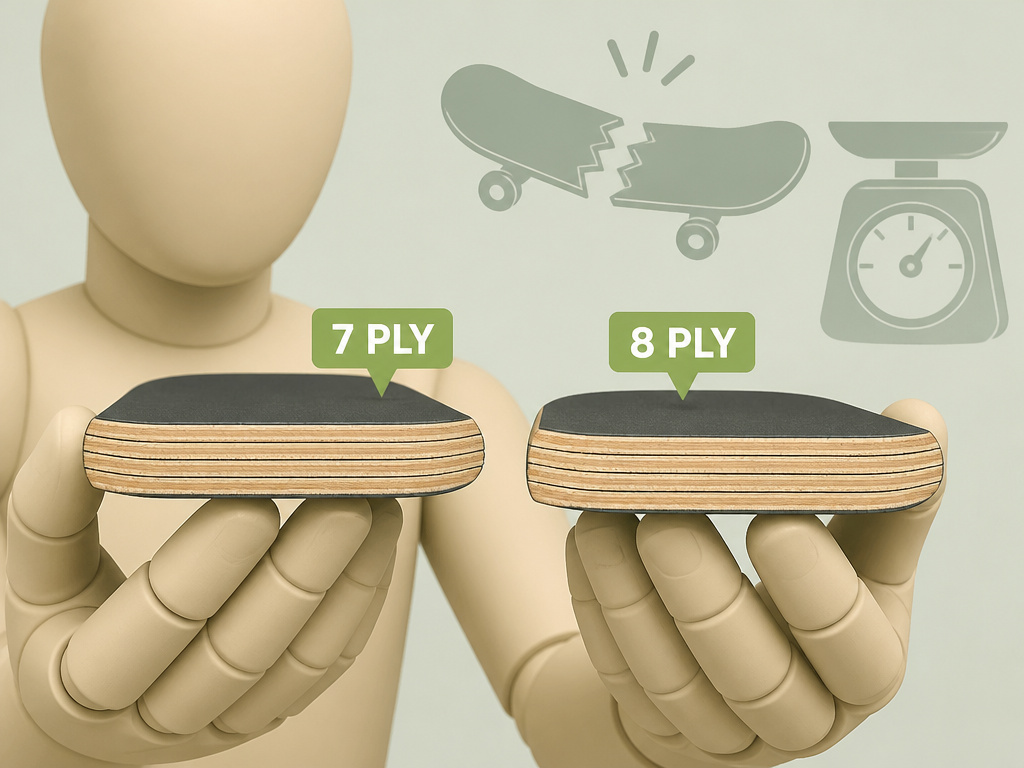
An 8-ply deck inserts an extra veneer into the layup sequence. This isn’t just a marketing gimmick; it’s a calculated trade-off. The added layer increases the deck’s thickness and stiffness.
Think of it like adding a support beam. The deck becomes more resistant to bending under load, which is why the skatedeluxe blog/wiki explicitly recommends “deck structures with an 8-ply construction” for “big-boned skaters” to increase resilience against breaking. For heavier or ‘big-boned’ skaters, the 7 ply vs 8 ply skateboard deck decision matters because that extra ply can increase resilience against breaking.
Common mistake: Choosing an 8-ply deck because you think it’s inherently “stronger.” Empire Skate Manufacturing is clear: “Ply count alone does not determine whether one deck is ‘better.’ Veneer thickness, grain, mold geometry, adhesive, pressing and the finished shape all change the result.” A poorly made 8-ply can be worse than a well-made 7-ply.
The trade-off is weight and feel. That extra ply adds mass. On flat ground, you might not notice. But when you’re trying to flick the board for flip tricks, the added weight matters. The deck also loses some of the subtle flex that gives a 7-ply its lively feedback.
| Aspect | 7-Ply Deck | 8-Ply Deck |
|---|---|---|
| Typical Weight | Lighter | Heavier |
| Stiffness | Standard flex, lively pop | Increased stiffness, dampened feel |
| Best For | Street skating, technical tricks, average-weight skaters | Heavier skaters (200+ lbs), transition/pool skating, specialty applications |
| Common User | Majority of street skaters, beginners to pros | Bigger riders, skaters prioritizing durability over flick speed |
Weight, Feel, and Pop: The Riding Experience
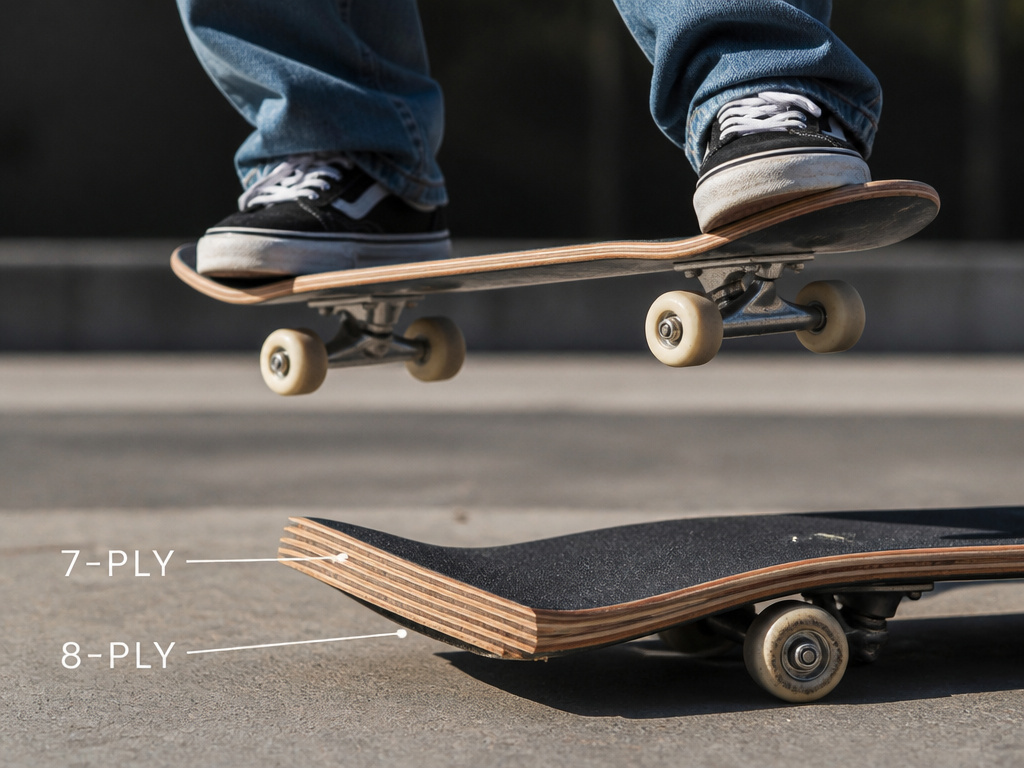
The difference hits you in the first five minutes of a session. On flat ground, that weight translates to stability. The board feels planted, less twitchy. For carving in a bowl or pool, that’s a benefit.
The real test is the ollie. A 7-ply deck has a certain springiness. You load the tail, feel it give, and then it snaps back, propelling the board upward. An 8-ply deck resists that initial give. The pop feels more like a thud than a snap. It’s not worse, just different.
For flip tricks, the weight is the enemy. If you’re used to the light, quick rotation of a 7-ply, it can throw your timing off for weeks.
It’s a small thing, but that acoustic feedback is part of the board’s feel. Losing it makes the deck feel less connected to the ground.
Suitability: Matching the Deck to the Skater and Terrain
This is about what is right or wrong for the job, not a simple good or bad distinction.
Choose a 7-ply deck if:
- You primarily skate street, ledges, stairs, flatground.
- You value a lighter board for flip tricks and quick footwork.
Consider an 8-ply deck if:
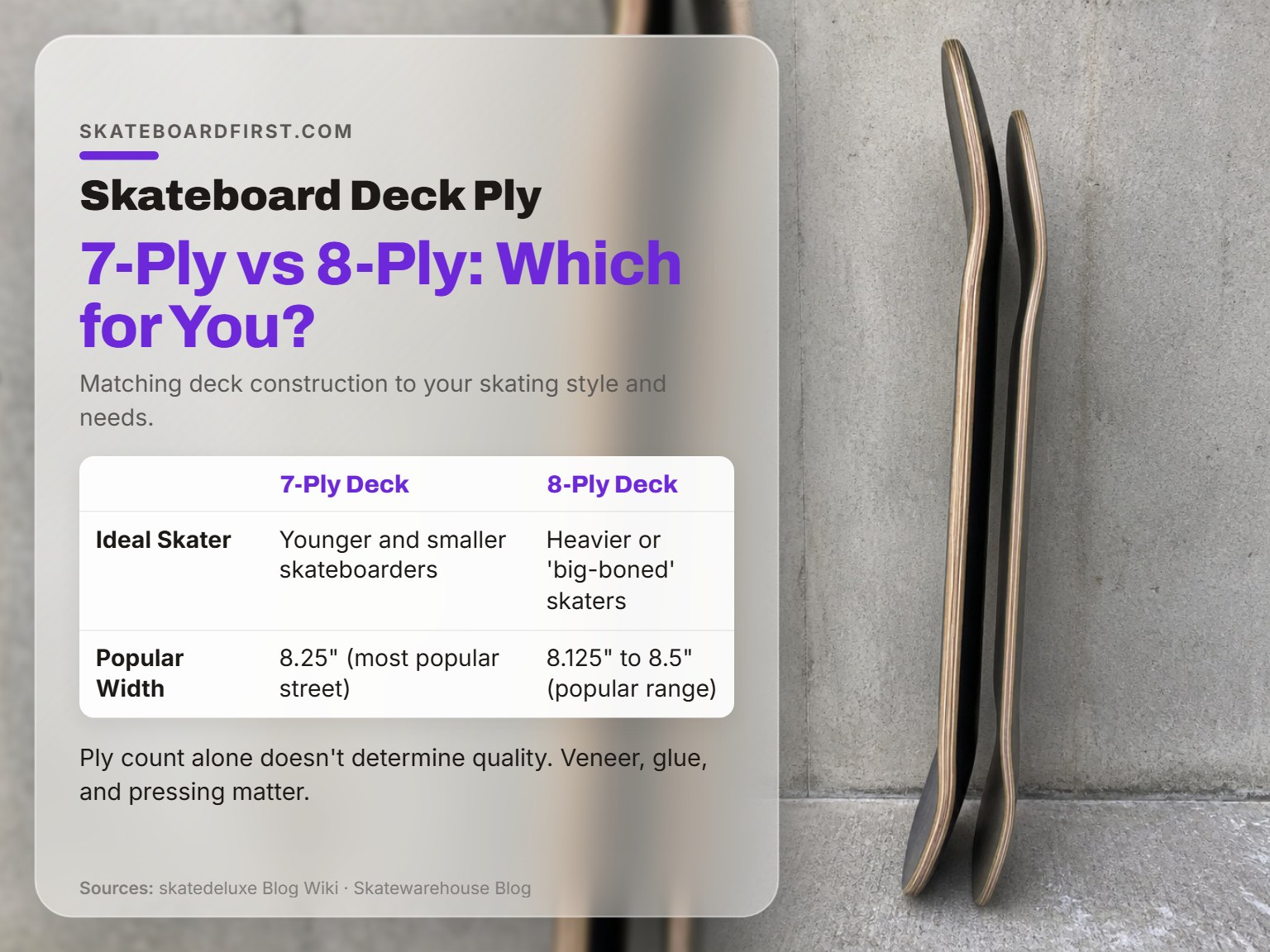
- You are a heavier or ‘big-boned’ skater. The added stiffness directly counters the increased force you’re putting on the deck.
- You mostly skate transition, ramps, bowls, pools. The stability at speed and resistance to tail blows are advantages.
- The extra durability is a logical upgrade.
- You specifically want a stiffer, more dampened board feel, even at the cost of flick speed.
Quarter Distribution’s Superply catalog states the most popular deck sizes today are 8.125″ to 8.5″, while the Skatewarehouse Blog notes 8.25″ is the most popular street deck width. For street, the Skatewarehouse Blog notes 8.25″ is the most popular.
Advanced Tech: The 8-Ply Alternatives and Composites
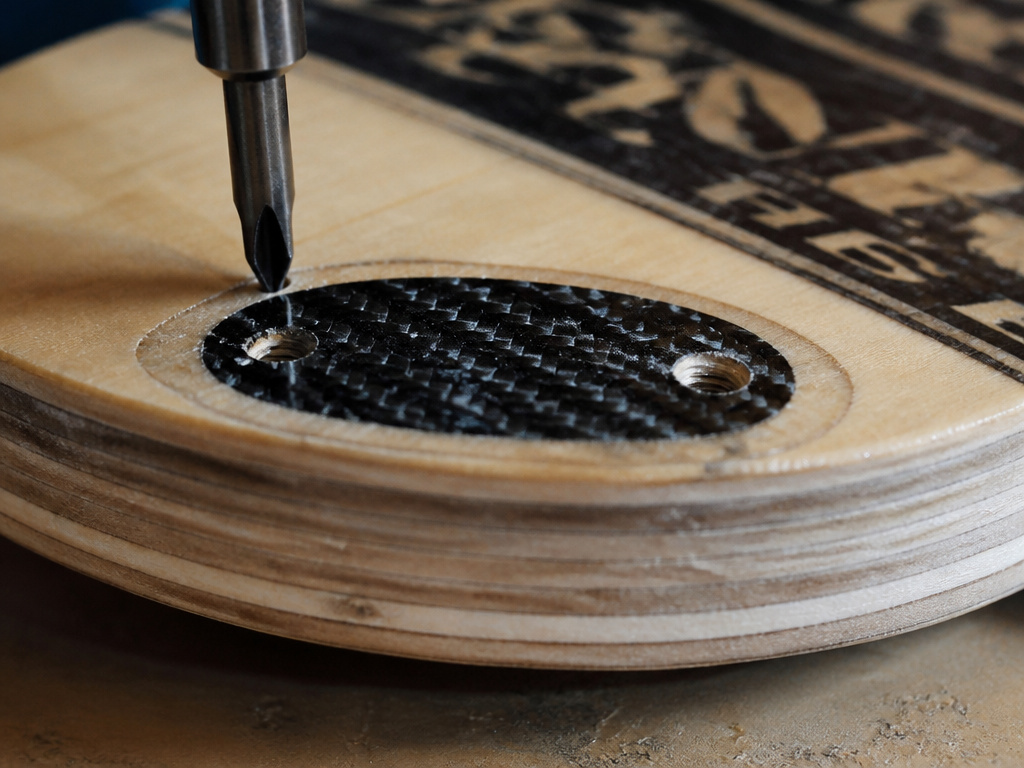
Sometimes, the question concerns traditional wood versus high-tech composites, not 7-ply versus 8-ply. These options sidestep the ply-count debate entirely by changing the material.
Dwindle Distribution’s Impact Technology: This uses an 8-ply maple core but laminates epoxy resin and carbon fiber discs at the truck mounting points. The goal isn’t just overall stiffness; it’s to reinforce the high-stress areas where decks typically crack, creating a deck that’s more impact-resistant than a standard 8-ply.
Skate One’s FLIGHT Deck: This is a different beast. It uses an epoxy-infused, fiber-reinforced composite structure that’s thinner than a phone. Skate One claims it’s “more than twice as strong in our tail break tests” and “don’t break in two like a 7-ply.” Team testing suggests they “last several times as long.” Skate One claims FLIGHT decks ‘don’t break in two like a 7-ply’ and last longer.
Hybrid Constructions: Brands like FYS Board Factory patent mixes like a 7-ply stack of 5 bamboo, 1 wood, and 1 fiberglass veneer. Pyle USA even sells a complete with a hybrid “7 Layer Canadian Maple, 1 Lay Bamboo” deck. These aim to blend the lightness and flex of bamboo with the structure of maple.
I skated a FLIGHT deck for a month. It lasted forever, but I missed the feel of wood.
These represent a different category, not merely “better 8-ply” decks. They solve the durability problem without simply adding more wood, which is why Point Distribution states that in their tests, “carbon fiber doesn’t make a better skateboard deck than 7-ply hard maple.” It makes a different one.
Making Your Choice: A Practical Buyer’s Guide
Forget ply count for a second. Start with what you know.
First, get your width right. Match it to your shoe size and the terrain you skate most. An 8.25″ deck is a safe, popular start for street.
Second, buy from a brand like Real, Element, or Baker that sources quality Canadian maple. A 7-ply from Real, Element, or Baker will outperform a cheap, soggy 8-ply every time. Your money is better spent on verified deck quality than on an extra ply of questionable wood.
Third, only step up to an 8-ply if you have a confirmed need. Have you broken two 7-ply decks in quick succession? Are you over 200 lbs and feeling excessive flex? If yes, look at brands that specialize in durable constructions, like certain NHS shapes or brands offering explicit 8-ply models.
For everyone else, the standard 7-ply is the engineered sweet spot. It offers the best balance of deck flex, weight, and pop that the sport has settled on over decades. The quest for a lighter skateboard often leads back to optimizing other parts of your setup before changing the deck’s core construction.
Frequently Asked Questions
Is a 7 ply skateboard good?
Yes, it’s the standard for a reason. A quality 7-ply maple deck from a reputable manufacturer is excellent for the vast majority of skaters. It provides the right combination of strength, weight, and responsive pop that works for street, park, and most transition skating.
Is 8.5 too big for street skating?
Not necessarily, but it changes the game. An 8.5″ deck is wider and offers more stability, which is great for bigger skaters or those who prefer a more planted feel. However, it will be heavier and slightly harder to flip than a narrower deck like an 8.25″. For pure technical street skating, many prefer 8.25″ or 8.125″. For all-around use, 8.5″ is a great, versatile size.
Should I get an 8.25 or 8.5 deck?
Choose 8.25″ if your priority is technical street tricks and a lighter, quicker board. Choose 8.5″ if you want more stability, have larger feet (size 11+), skate transition, or prefer a more comfortable, forgiving platform. The 0.25″ difference is noticeable in both feel and deck lifespan, with wider decks often enduring more wear.
Is a 7.5 deck too small?
For most adult skaters today, yes, it’s likely too small. Deck widths have trended larger over the years. A 7.5″ deck is now considered niche, best for very small, light skaters or those seeking extreme flick speed for technical flatground tricks. It offers less stability and foot space, which can hinder control for beginners and larger riders.
Before You Go
One rule cuts through the specs: if you haven’t broken a deck in the last six months, you don’t need more plies. Your problem is probably setup, technique, or simply needing a fresh standard deck.
The 7-ply maple deck is a masterpiece of simple engineering. The 8-ply is a valid, heavier-duty variant. But chasing ply count as a proxy for strength misses the point. A well-made deck from good deck materials matters more than whether it has seven or eight layers.
For the big rider who’s been through three decks this year, the 7 ply vs 8 ply skateboard deck question makes trying an 8-ply or a composite like FLIGHT a logical experiment. For everyone else, spend that mental energy on your trucks and bushings. A quarter-turn adjustment there will change your ride more dramatically than an extra ply ever could.
