
How to Choose Skateboard Wheel Durometer: A Simple Guide
This post contains affiliate links. As an Amazon Associate, we earn from qualifying purchases.
To choose skateboard wheel durometer, match the hardness rating to your primary skating surface and style. For street tricks and smooth parks, wheels above 98A (like Spitfire Formula Four 99A) provide speed and slide. For cruising on rough pavement, softer wheels between 78A and 90A (like Ricta Clouds 86A) absorb vibration and grip better. The Shore A scale measures hardness from 0 to 100, with higher numbers meaning a harder, faster, less grippy wheel.
The range from 78A to 101A covers most skateboard wheels, though some specialized wheels are harder. Understanding how to choose skateboard wheel durometer is one of a few points that make a real difference in how the board feels under your feet.
This guide walks through what durometer numbers actually mean, how they change your ride, and the specific wheels that fit common skating scenarios, answering the how to choose skateboard wheel durometer question. You’ll learn why a 101A wheel buzzes on rough ground, how the Bones B scale converts, and where most beginners should land.
Key Takeaways
- Wheel durometer is measured on the Shore A scale, where higher numbers (like 101A) mean harder, faster wheels, and lower numbers (like 78A) mean softer, grippier wheels.
- Sources like CCS and Skate Warehouse recommend wheels harder than 98A for street/park, and wheels between 78A and 90A for cruising, though specific ranges vary.
- Harder wheels (99A and up) are faster and offer less grip, making slides more predictable, but transmit every bump; softer wheels (78A–87A) absorb vibration and grip better but can feel sluggish for tricks.
- The Bones B scale reads 20 points below the A scale (an 84B wheel is comparable to a 104A wheel).
- Ignore cool graphics and check the number printed on the wheel; a 101A wheel on cracked asphalt will make you quit before you start.
What Is Durometer, and What Does the A Scale Mean?
Durometer is a measurement of hardness for materials like rubber and urethane. For skateboard wheels, it tells you how much the wheel will compress under your weight and the pavement. That compression dictates grip, speed, and shock absorption.
The standard is the Shore A durometer scale. It runs from 0 to 100, with higher numbers indicating greater hardness. A 78A wheel is considered soft. A 101A wheel is considered hard. Most wheels fall between 78A and 101A.
The Shore “A” durometer reads from 0 to 100, with higher numbers denoting greater hardness. Skateboard wheels are measured on this scale.. Exploratorium
This scale isn’t just marketing. It’s a physical test of a material’s resistance to indentation. A harder wheel deforms less, so more of your push energy goes into forward motion instead of squashing the urethane. That’s why hard wheels are faster on smooth concrete. But there’s a trade-off.
How Durometer Affects Your Ride: Grip, Speed, and Slide
The durometer number decides three things: how much the wheel grips the ground, how fast it rolls, and how easily it slides.
A softer wheel compresses more under your weight. This creates a larger contact patch with the ground, which means more grip. It also acts like a mini shock absorber, soaking up vibrations from rough pavement or pebbles. The trade-off is energy loss. Some of your pushing force goes into deforming the wheel, which then has to rebound. That costs a little speed.
A harder wheel barely compresses. It maintains a smaller, more consistent contact patch. This reduces rolling resistance, so it feels faster and more efficient on smooth terrain. It also slides predictably because there’s less rubber grabbing the ground. The downside is a harsh ride. Every crack and pebble transmits directly to your feet and trucks.
The sweet spot depends entirely on what you’re skating. If your local spot is buttery-smooth park concrete, a 101A wheel will feel lightning fast. If you’re navigating sidewalks with expansion joints and tree roots, that same wheel will rattle your fillings loose within two blocks. That buzzing sensation in your feet is the hard wheel refusing to absorb impact.
| Durometer Range | Best For | Feels Like | Compromise |
|---|---|---|---|
| 78A – 87A | Cruising, rough pavement, longboarding | Smooth, quiet, grippy | Slow, grippy for slides, can feel sluggish for tricks |
| 90A – 97A | Hybrid/all-around, rough street, beginners | Balanced grip and slide | “Mediocre at both” – not great for pure cruising or high-performance park |
| 99A – 101A+ | Street tricks, skateparks, smooth concrete | Fast, responsive, slides easily | Harsh on rough ground, less shock absorption |
The 78A–90A Sweet Spot for Cruising and Rough Ground
If your goal is transportation or skating over less-than-perfect pavement, this is your range. Wheels between 78A and 90A are the default for cruisers, longboards, and filmer setups.
The physics are straightforward: a softer wheel deforms over bumps and cracks, maintaining contact and smoothing out the ride. According to the BASF polyurethane guide, comfortable longboard wheels usually come between 78 and 90 A. They prioritize grip and vibration damping over outright speed.
I learned this after buying a set of 101A wheels purely for the graphic. On my neighborhood’s patchy asphalt, my feet buzzed after ten minutes. I spent an evening loosening and tightening my trucks, thinking they were the problem. The real issue was the wheel hardness. Switching to an 86A wheel made the board enjoyable for getting around, instead of a chore.
For a good cruising wheel, choose something between 78A and 90A. Popular picks in this category include the Ricta Clouds 86A and OJ Super Juice 78A. These wheels will roll over cracks and debris that would stop a hard wheel dead. Their quiet, smooth ride is why they’re also called filmer wheels, you can push less and maintain speed for longer shots.
Where this goes sideways: Choosing a 78A wheel for learning kickflips at the park. The extra grip will hang up on every ledge and make slides nearly impossible, adding an unnecessary obstacle to progression.
The 99A+ Zone for Street and Park Skating
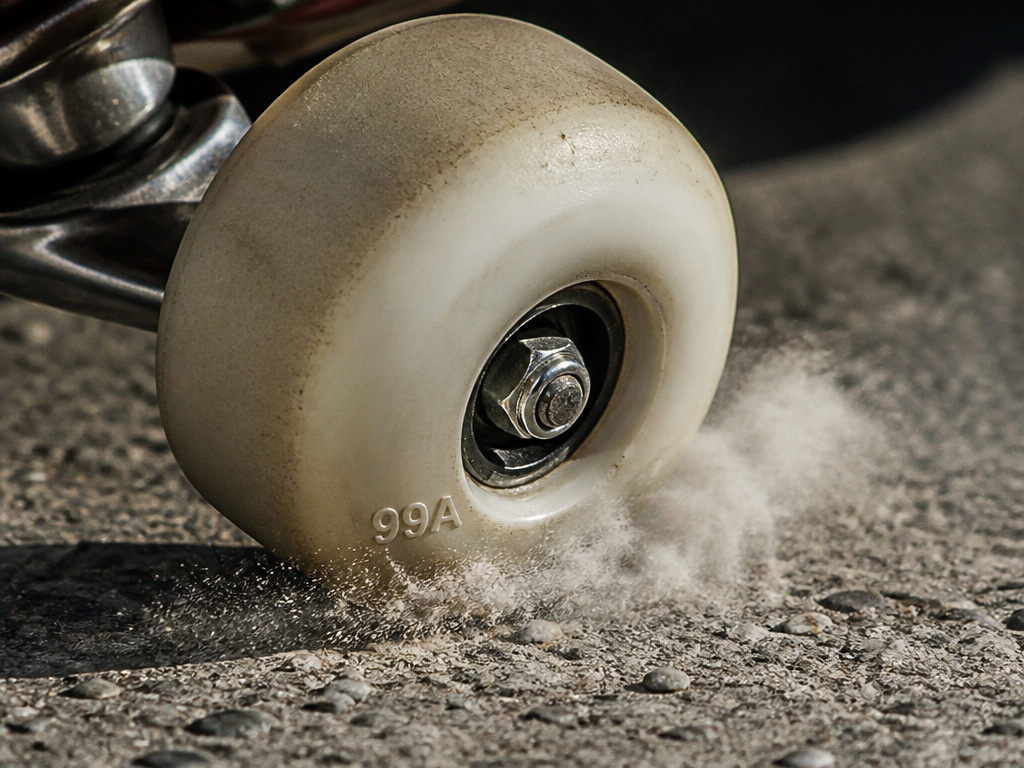
For technical street skating, park riding, and any trick that involves a slide, you want a hard wheel. The consensus across buyer guides is that wheels harder than 98A are the standard for street and transition.
Hard wheels are preferred because they slide predictably. When you powerslide or board slide, you want the wheel to break traction cleanly, not grip and chuck you. They also feel more responsive. Since they don’t compress much, the energy from your pop transfers directly to the board, giving a snappier feel for ollies and flip tricks.
CCS states that almost all street and transition wheels are harder than 98A. Skate Warehouse specifies that wheels with a durometer rating of 99a and up are ideal for the skatepark and doing tricks in the streets.
The most popular wheel in this category is arguably the Spitfire Formula Four 99A. Many skaters, even on rough East Coast asphalt, swear by them. The Formula Four urethane has a slightly different rebound formula, which is why riders report they “feel quite comfy” for a hard wheel. They slide predictably, wear slowly, and handle a surprising amount of surface texture.
CCS suggests beginners focused on tricks stick with something around 101A, while Skate Warehouse recommends 99a and up. Going softer might seem forgiving, but it teaches bad habits, you’ll rely on grip instead of proper foot placement.
What About the Bones B Scale and “Hybrid” Wheels?
You’ll occasionally see wheels rated on a B scale, most notably from Bones Wheels. This isn’t a different property; it’s just another way to measure the same thing on the hardest end of the spectrum.
The B scale reads 20 points below the A scale. So a Bones 81B wheel is equivalent to a 101A wheel. An 84B wheel, as Skate Warehouse notes, is comparable to a 104A wheel. This scale exists mainly because the A scale tops out at 100, but urethane formulas can be made harder. The B scale is used for very hard wheels, such as those for aggressive inline skating.
Then there’s the murky middle ground: the 90A to 97A “hybrid” or “all-around” wheel. Skate Warehouse defines wheels from 90a to 97a as hybrid or ‘all-around’ wheels. They can be a good choice if you genuinely split your time 50/50 between cruising rough streets and hitting a smooth park. But they’re a compromise. They won’t grip as well as a true soft wheel for rough ground, and they won’t slide as easily as a true hard wheel for park laps.
For most skaters, it’s better to pick a lane. Get a dedicated set of street wheels for the park and a separate set of soft wheels for cruising. Swapping wheels takes five minutes with a skate tool.
Matching Durometer to Your Surface: A Decision Guide
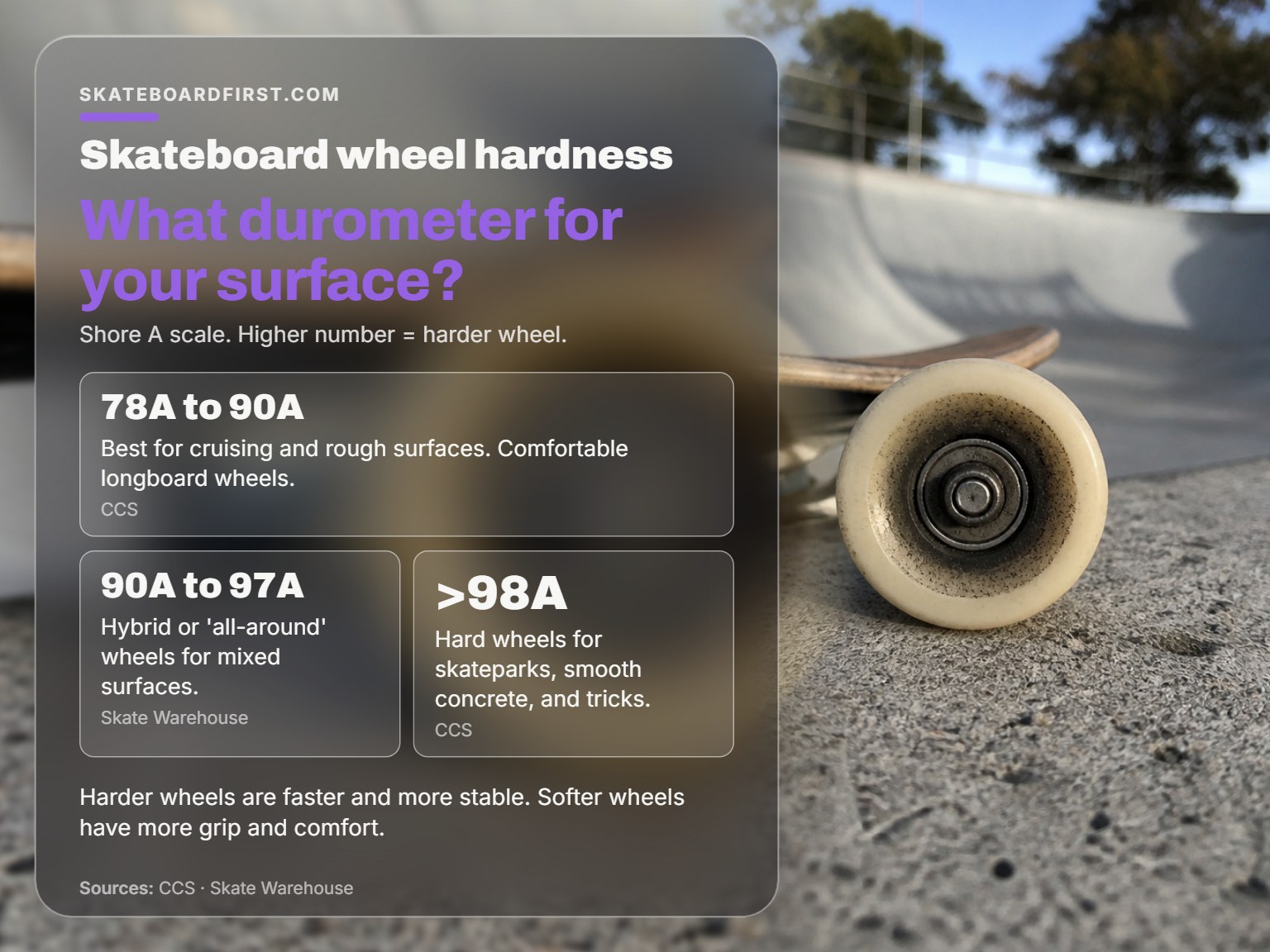
The best durometer is the one that matches the ground you actually skate, which is the core of how to choose skateboard wheel durometer. Here’s how to decide.
Skateparks, smooth concrete, and well-paved plazas: This is hard-wheel territory. A 99A or 101A wheel will feel fast and responsive. You’ll appreciate the easy slides and crisp pop. Brands like Spitfire (Formula Four 99A) and Bones (STF 101A) dominate here.
Rough streets, sidewalks with cracks, and asphalt paths: You need a softer wheel. If you’re doing basic ollies and riding around, a wheel in the 90A-97A range might work. For pure cruising comfort, choose wheels in the 78A to 90A range. Wheels like Ricta Clouds (86A) or OJ Hot Juice (87A) are built for this.
A mix of both, or you’re not sure yet: Start with a hybrid wheel in the 92A-95A range. It’s a safe, if unexciting, starting point. As you progress, you’ll quickly realize whether you crave more speed (go harder) or more comfort (go softer).
Your weight plays a secondary role. A heavier rider will compress a soft wheel more, increasing grip and slowing it down slightly. A lighter rider might find a hard wheel even harsher. It’s a minor factor, but if you’re at an extreme, consider it.
Don’t forget wheel size and wheel shapes. Larger wheels (55mm+) roll faster and handle cracks better, complementing a softer durometer. Smaller wheels (50mm-53mm) are more maneuverable for tricks, pairing well with a harder durometer. A wide, square-lipped wheel has more grip; a narrow, rounded-lipped wheel slides more easily.
What size wheels should I get for street or cruising?
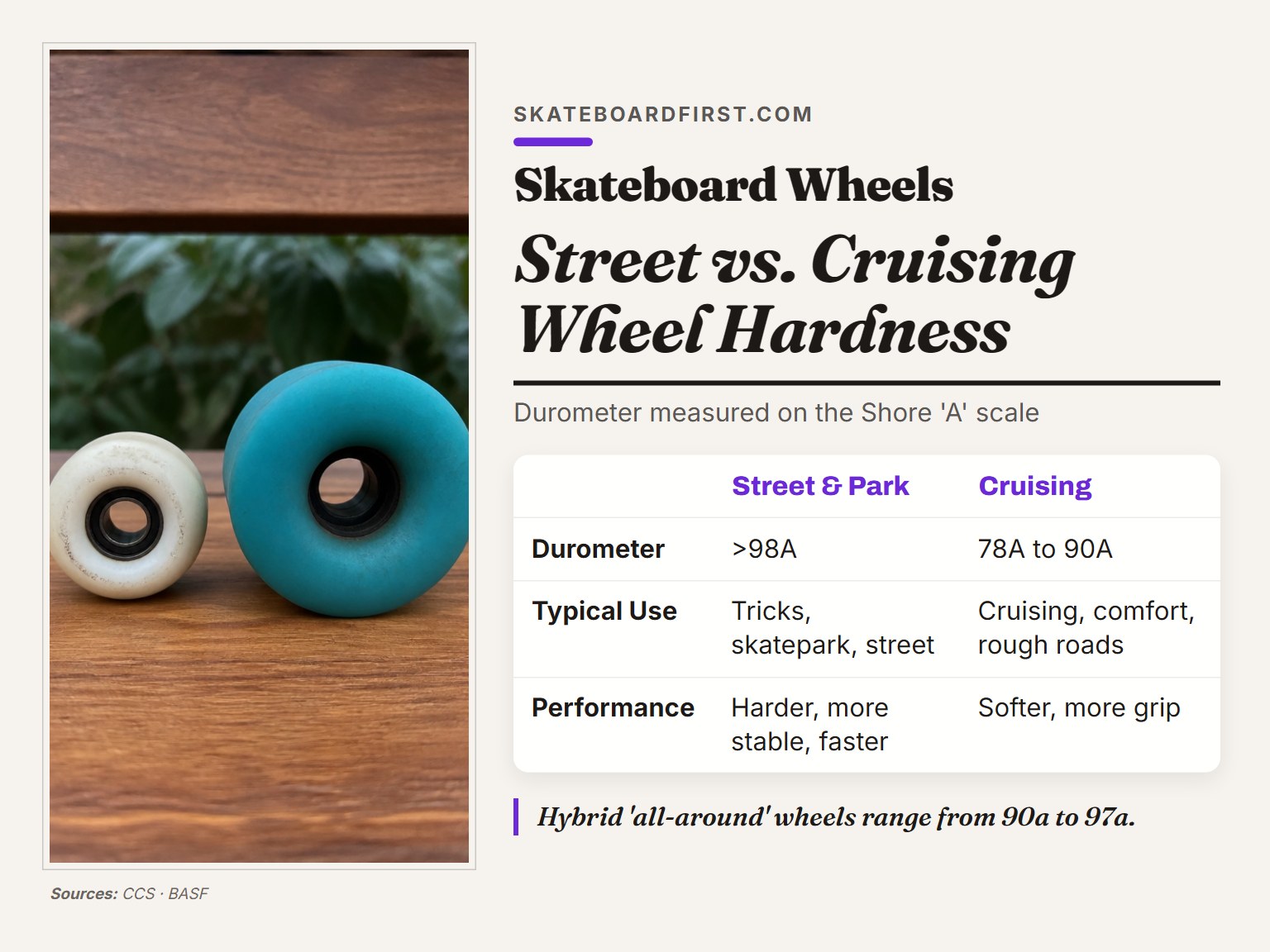
Skateboard wheel diameter is measured in millimeters. The general size range spans from 49mm to 75mm. For longboard wheels, which are often used for cruising and comfort, the typical diameter is larger, usually between 60 and 80 millimeters. Larger wheels roll faster and handle cracks and rough pavement more easily, making them a common choice for cruising. Smaller wheels are lighter and provide a lower center of gravity, which many skaters prefer for technical street tricks and flip tricks where board control is paramount.
What wheels are best for a beginner?
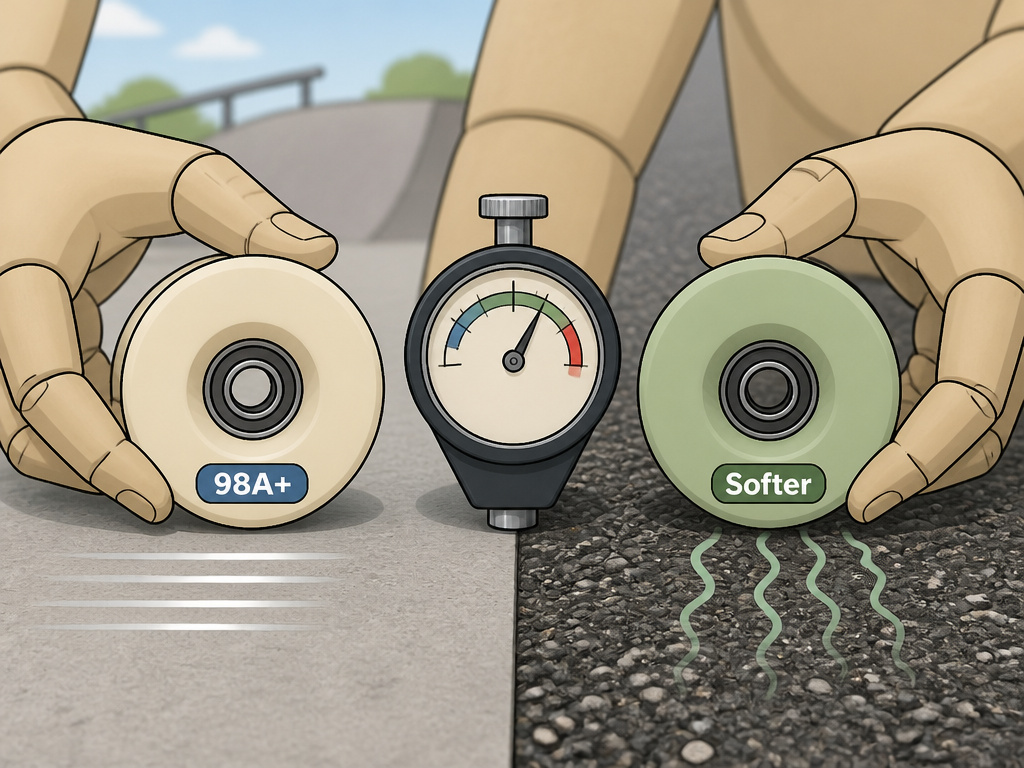
For a new skater focused on learning tricks, it is smart to stick with a harder wheel. Wheels with a durometer rating above 98A will perform well in the street or in the park. These harder wheels are faster and can be more stable, but offer less grip. They slide more predictably than soft wheels, which is helpful when learning powerslides and reverts. If your primary goal is cruising around town, you should choose a wheel between 78A and 90A. These provide more grip and absorb vibrations from rough pavement, making for a much smoother and more comfortable ride.
Frequently Asked Questions
Is 99A too hard for street?
For smooth street spots, no, 99A is the gold standard for street skating. It provides the right balance of speed and slide. However, if your “street” is heavily cracked, patched asphalt, 99A will be uncomfortably buzzy. In that case, consider a slightly softer wheel (like 95A) or a larger diameter to help roll over imperfections.
Are 78A wheels soft?
Yes. Wheels rated 78A are on the very soft end of the spectrum for skateboarding. They are designed specifically for cruising and longboarding, offering maximum shock absorption and grip. They are too soft and grippy for most street or park trick skating.
What is the difference between 101A and 103A?
103A wheel is harder than a 101A wheel, which generally means less grip and easier sliding. For most beginners and intermediates, the difference is negligible. Stick with 101A unless you’re fine-tuning for competition-level park performance.
Can I use skateboard wheels for a cruiser/longboard?
Absolutely. Most cruiser and longboard wheels fall in the 78A-90A range. The key is to match the durometer to your terrain. A longboard used for downhill racing might use a harder wheel (85A-90A) for stability, while a pintail cruiser for boardwalk riding would use a softer wheel (78A-83A) for comfort.
How does durometer affect wheel wear?
Softer wheels may wear differently than hard wheels depending on the surface and use. Rotating your wheels every few sessions evens out the wear.
The Bottom Line
Check the number, not the graphic. The durometer rating printed on the wheel, 78A, 95A, 101A, is the single most important spec for how your board will feel.
If you skate smooth ground and want to do tricks, buy wheels harder than 98A. If you skate rough ground and want to cruise comfortably, buy wheels between 78A and 90A. The middle zone exists, but it’s for indecisive moments, not peak performance.
One rule most guides skip: if you buy a 101A wheel and your local pavement is rough, you’ll hate skating within a week. The reverse is also true, trying to learn slides on an 86A wheel is an exercise in frustration. Match the tool to the job. Start with a wheel suited to your most common terrain, and adjust from there as your skills and spots change.
