
Allen vs Phillips Skateboard Hardware: The Bottom Line
This post contains affiliate links. As an Amazon Associate, we earn from qualifying purchases.
Allen head skateboard hardware uses a hexagonal socket drive, which Tactics says is less prone to stripping under high torque, while Phillips head hardware uses a cross-shaped drive, which Tactics says is quicker to install with a common screwdriver. Some sources, like Thunder Trucks, recommend Allen for aggressive use, while others, like CCS and Jenkem Magazine, recommend Phillips for beginners and casual street skating where quick, tool-light tweaks are common.
The difference isn’t just about the tool in your hand. It’s about how the bolt head handles force when you’re leaning on a wrench, and what happens when grit gets in the threads, a key point in the allen vs phillips skateboard hardware debate.
What follows is a breakdown of stripping risk, tool reality, and the one spec that matters more than head type. We’ll name the brands that get each type right, walk through swapping them yourself, and land on a clear pick for different skating styles.
Key Takeaways
- Tactics states that Allen head bolts distribute force more evenly and are less likely to strip, making them a strong choice for high-torque applications, while Independent Truck Company states that its Phillips hardware offers bulletproof reliability for most skaters.
- Phillips head bolts are easier to install quickly and are the standard choice for beginners due to ubiquitous tool availability.
- A skate tool with a socket is recommended for either bolt type.
- For aggressive skaters or anyone who tweaks their setup often, Thunder 1″ Allen Hardware is the performance pick.
- For beginners, street skaters valuing quick fixes, or traditionalists, Independent 1″ Phillips Hardware remains bulletproof.
The Stripping Risk: Allen vs Phillips
You feel it before you see it: the sickening, loose spin of a driver slipping in the bolt head. Stripping a hardware bolt isn’t just annoying. It turns a five-minute truck swap into a thirty-minute extraction battle, often ending with a drill.
The core mechanical difference in the allen vs phillips skateboard hardware is in the drive design. A Phillips head is designed to cam out, to slip, under excessive torque. This was originally a feature to prevent factory workers from over-tightening assemblies. On a skateboard, it becomes a bug. When a Phillips driver meets resistance from a rusted nut or caked-on dirt, it can jump out of the cross, rounding the soft edges. An Allen head, with its hexagonal socket, has six flat walls for the tool to push against. This distributes the turning force more evenly, making it much harder for the tool to slip and chew up the bolt.
Where this goes sideways: Using a short L-key on a stubborn Allen bolt. The short lever arm and flex in the cheap metal concentrate force on two points of the hex, not six. That’s how you round out a supposedly strip-resistant head. I’ve done it. The fix is a proper skate tool with a dedicated, rigid Allen key end.
This isn’t theoretical. Brands stake their reputation on it. Thunder Trucks explicitly states its Allen hardware “handles high torque better than Phillips alternatives” and is “impact tested” for skaters who “ride hard and land harder.” Meanwhile, Independent calls its Phillips hardware “bulletproof reliability for the vast majority of skaters,” emphasizing its role as the standard, go-anywhere choice.
So who’s right? It depends on your use case.
| Scenario | Phillips Head Risk | Allen Head Advantage |
|---|---|---|
| High-Torque Tightening (e.g., securing loose trucks mid-session) | High risk of cam-out and stripping. | Low risk; hexagonal socket grips the tool securely. |
| Removing Seized/Rusty Hardware | Very high risk of stripping, often requiring destructive removal. | Higher chance of success without stripping, provided the hex is clean. |
| Frequent Truck Swaps/Adjustments | Cumulative wear on the cross-head increases stripping risk over time. | Socket design withstands repeated use with less wear on the drive. |
The community is split. Forum veterans argue that high-quality Phillips heads from reputable brands can be resistant, and that user error is often the real culprit. The takeaway is that both can be reliable, but Allen gives you a wider margin for error when you’re applying force.
Tool Reality: Convenience vs. Control
The best bolt in the world is useless if you can’t turn it. Tool availability defines the allen vs phillips skateboard hardware debate.
A Phillips screwdriver is a common tool. You can find one in a gas station, a friend’s kitchen drawer, or a office supply closet. This makes Phillips hardware incredibly convenient for street skaters. If a bolt works loose during a session, the fix is rarely more than a block away. This convenience is why brands like Independent and guides from retailers like CCS recommend Phillips for beginners, it lowers the barrier to basic maintenance.
An Allen key is a more specialized tool. While most “decent skate tools,” as one Reddit user noted, come with both a Phillips driver and an Allen key, you’re far less likely to borrow one from a bystander. The trade-off is control. An Allen key or the Allen end of a skate tool gives you a positive, full-socket grip. You’re not fighting cam-out, so you can focus on applying steady, perpendicular force.
I prefer Allen over Phillips. Phillips heads cam out when they get dirty or rusty, and I’ve watched a driver slip and gouge the grip tape twice. Allen heads grip better, but only if you clear the grit out of the hex first with a pin.
The real pro move isn’t about the driver on top, but the wrench below. The golden rule for tightening either type is to turn the wrench on the nut, not the screwdriver. Hold the driver steady to prevent the bolt from spinning, and apply your torque with the 9/16 inch socket on the locknut underneath. This technique eliminates the twisting force on the bolt head that leads to stripping. It’s the single most important piece of hardware technique most guides skip.
Performance and Feel: Does Hardware Matter?
You won’t notice a difference in pop or flip speed because of your bolt heads. Hardware’s job is to clamp your trucks to your deck, not to influence trick mechanics. Where you might feel a difference is in vibration and security.
A bolt that isn’t fully seated, where threads are exposed between the deck and the truck baseplate, can create a tiny gap. A bolt that isn’t fully seated can create a gap. This is why bolt length is a critical spec. According to SkateboardHQ, standard hardware is 1 inch for decks without riser pads. Using the correct length ensures the truck is pulled snugly against the deck without leaving threads in the shear zone.
Some brands design for this. Independent’s Phillips hardware features an “extended unthreaded shaft” near the head. This smooth section sits in the deck hole, protecting the wood from being worn away by threads and providing a more solid clamp. The material matters, too. Fireball Dragon Stainless Steel Hardware uses full stainless steel bolts, which resist corrosion from wet pavement and sweat far better than standard coated steel. Tensor uses heat-treated steel for added strength.
The aesthetic is a personal call. Some skaters dislike the look of an Allen head’s exposed socket and the extra threads visible above the nut. They prefer the cleaner, flush look of a Phillips head. Others don’t care, prioritizing the mechanical advantage. There’s no performance penalty for either preference.
Brand Showdown: Specific Picks for Each Type
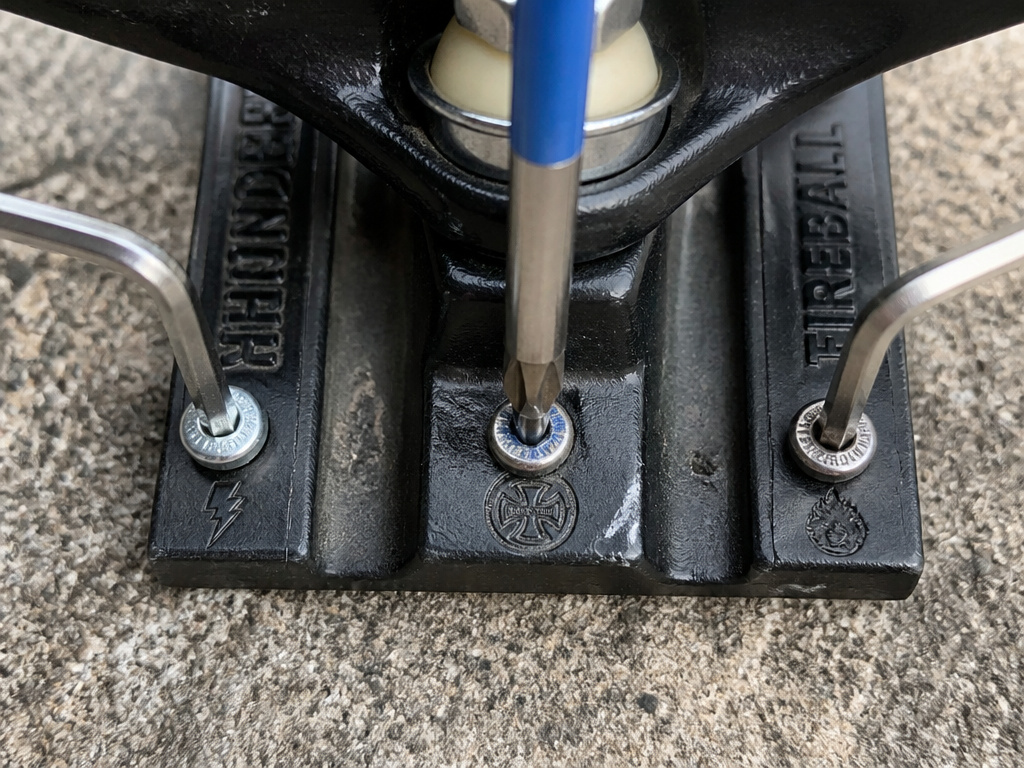
You can talk about types in the abstract, but you buy a specific product in a package. Here are the standouts for each category, drawn straight from manufacturer specs.
For Allen Head Performance: Thunder 1″ Allen Hardware
Thunder doesn’t mess around. Their 1-inch Allen set includes 8 bolts and 8 nuts, built explicitly for “high torque resistance.” Thunder Trucks states its Allen hardware is built for skaters who ride hard and land harder. If you’re an aggressive skater, frequently adjusting trucks, or just want the most strip-resistant option on the shelf, this is it.
For Phillips Reliability & Tradition: Independent 1″ Phillips Hardware
Independent’s kit is the classic standard for a reason. It includes 8 blue bolts, 2 black bolts, and 8 lock nuts. Independent’s Phillips hardware is made from anodized steel and features an extended unthreaded shaft. For a beginner or street skater, Independent positions its Phillips hardware as a bulletproof, widely compatible choice.
For Corrosion Resistance: Fireball Dragon Stainless Steel Hardware
If you skate in wet conditions or just want hardware that won’t rust, Fireball’s offering is full stainless steel bolts with zinc-coated nuts. It comes in a flat Allen head (1.0 inch length), giving you the material benefits with an Allen drive.
The Hybrid Wildcard
A niche product exists: Independent’s combination Allen/Phillips bolts. These have a Phillips cross cut into an Allen socket head. The idea is that any tool works. They’re rare, but a segment of skaters swears by them for their versatility, as noted in Reddit discussions.
Step-by-Step: Switching Your Hardware

Swapping from one head type to the other is straightforward. The only specs that must remain constant are the thread (10-32 UNC) and the length.
What You’ll Need:
- A skate tool (with Phillips driver, Allen key, and 9/16″ socket) or separate tools.
- Your new hardware set (8 bolts, 8 locknuts).
-
A rag or brush.
-
Remove the Wheels. Take off all four wheels to access the inner truck bolts easily. This prevents the board from rolling around and gives you clear access.
- Loosen the Locknuts. Using the 9/16″ socket on your skate tool, loosen each locknut underneath the board. Hold the bolt head steady with the appropriate driver (Phillips or Allen) to prevent it from spinning.
- Remove Old Bolts and Nuts. Once all nuts are loose, unscrew them completely and pull the bolts down through the deck. Keep the old hardware if it’s still good for spares.
- Clean the Contact Areas. Wipe any dirt or old gunk from the truck baseplate and the deck holes. Grit here can prevent a flush fit.
- Insert New Bolts. Drop your new bolts through the deck from the top. Ensure they are the correct length, the bolt should protrude through the truck baseplate enough for the nut to fully engage without leaving more than a thread or two exposed.
- Thread On the Nuts. Start each nut by hand to avoid cross-threading. The standard thread is 10-32 UNC, so they should spin on smoothly.
- Tighten in a Star Pattern. Once all nuts are finger-tight, use your skate tool to tighten them further. Use a criss-cross “star” pattern (like tightening a car wheel) to ensure even pressure. Remember the rule: hold the driver still on the bolt head and turn the socket on the nut. Tighten until the nut is snug and the truck has no play.
Which looks cooler?

This choice is purely personal. Some skaters prefer the classic, clean look of a Phillips head, which sits flush with the deck surface. Others like the industrial, tool-focused appearance of an Allen socket. The visual difference is tied to the head design: a Phillips bolt shows a simple cross, while an Allen bolt has a recessed hexagonal hole. Your preference might come down to whether you want your hardware to blend in or to have a more technical, modern look. It comes down to what you think looks best on your setup.
Frequently Asked Questions
Which type of skateboard hardware is better, Allen or Phillips?
There is no universal “better.” Allen head hardware is mechanically superior for applying high torque and resisting stripping, making it better for aggressive skaters and frequent adjustments. Phillips head hardware is more convenient due to common tool availability, making it better for beginners and street skaters who might need a quick fix away from their main tool.
What is the best hardware for skateboards?
The “best” depends on your needs. For performance and durability: Thunder 1″ Allen Hardware. For tradition and beginner-friendly convenience: Independent 1″ Phillips Hardware. For corrosion resistance in wet climates: Fireball Dragon Stainless Steel Hardware (Allen head).
Does hardware matter on a skateboard?
Yes, but not for flashy reasons. Good hardware of the correct length keeps your trucks securely attached, prevents damaging vibration, and saves you from the headache of stripped bolts. Cheap, soft-metal hardware can fail, but any reputable brand’s product is sufficient for the job. The choice between Allen and Phillips matters most for your maintenance experience, not your board’s pop or flip.
What is the difference between Phillips and hex head screws?
Phillips head screws have a cross-shaped drive and are designed to cam out (slip) under high torque to prevent over-tightening. Hex head (Allen) screws have a six-sided socket drive that distributes force evenly, offering greater torque application and resistance to stripping. The thread (10-32 UNC) and length standards are the same for skateboard use.
The Bottom Line
The Allen vs Phillips choice comes down to your relationship with your skate tool. If you live out of your backpack and tweak your setup constantly, invest in a skate tool and run Allen heads, the control is worth the slight tool inconvenience. If you’re a beginner or a street skater who just wants to ride and make occasional adjustments, stick with the Phillips standard; it works, and a screwdriver is never far away.
A skate tool with an Allen key end and a socket is recommended. Tighten from the nut and keep the hex clean.
Start with the basics. Get the right length, use the right tool, and you can stop worrying about your hardware and focus on your skating.
