
How to Lose Fear of Falling Skateboarding: Step-by-Step
This post contains affiliate links. As an Amazon Associate, we earn from qualifying purchases.
To lose your fear of falling skateboarding, you must practice falling safely before you try any trick. One-third of all skateboarding injuries happen in the first week, according to the American Academy of Pediatrics. The fear is rational, but you can disarm it by turning falling into a rehearsed skill on soft ground, then gradually raising the stakes.
That one-week window is where most beginners get hurt. It’s also where they quit. The instinct is to avoid the ground at all costs, which locks up your muscles and guarantees a worse fall when it finally happens. The fix isn’t bravery. It’s a specific, low-risk training sequence that replaces panic with a practiced physical response, and the core of this method is learning how to lose fear of falling skateboarding.
What follows: the exact stats on why early weeks are dangerous, a breakdown of the two conflicting ways experts say you should fall, and a five-step progression method that moves you from practicing on grass to rolling out of a fall down a three-stair set.
Key Takeaways
- One-third of skate injuries happen in the first week of learning; accepting that falling is a normal, frequent part of the process is the first mental hurdle.
- Practice falling on grass first, focusing on the roll-out technique recommended by UPMC Sports Medicine to absorb impact and avoid broken wrists.
- Learn foot-braking as your first “trick”; controlling your speed is the single biggest factor in preventing panic-induced falls.
- Helmets are essential and must meet CPSC or Snell safety standards; a properly fitted hard-shell helmet changes the psychological cost of a fall.
- If you feel your muscles lock up mid-trick, that’s the “freezing response” – stop and use deep breathing to reactivate your parasympathetic system before trying again.
Why the First Week is the Most Dangerous
The numbers are blunt. The American Academy of Pediatrics notes that one-third of skateboard injuries happen in the first week of learning the sport. The UPMC Sports Medicine flier refines that: first-time boarders (those skating for less than a week) account for one-third of the 50,000 skateboarding injuries treated each year in emergency departments.
The cause isn’t a lack of talent. It’s a predictable collision between undeveloped skills and undeveloped fear management. Beginners have a higher center of gravity, poorer balance, and slower reaction times. They also haven’t learned how to fall. So when a wheel catches a crack or speed wobble starts, the reaction is to stiffen – a guaranteed path to a harder impact.
Common mistake: Trying to ollie before you can roll comfortably. You spend two weeks frustrated and falling. Once you go back to pushing, turning, and stopping, the tricks come much faster.
The gear advice here is straightforward, but it’s the foundation everything else builds on. The U.S. Consumer Product Safety Commission is clear: wear protective gear when riding — especially a helmet. Their fact sheet states wearing a helmet can mean the difference between life and death. For skateboarding, that means a hard shell with foam interior. All helmets should meet or exceed the safety standards of the CPSC or the Snell Memorial Foundation.
A properly fitted helmet should be positioned according to safety standards: the U.S. Consumer Product Safety Commission advises it should be level with the head, not tilted back, while UPMC Sports Medicine advises it sits low on the forehead. It should have side straps that form a ‘V’ around each ear and fasten tightly with room for only two fingers between strap and chin. Replace it at least every five years. Pads for knees, elbows, and hands are also mandatory, along with closed, slip-resistant shoes. Wrist guards are especially important, per the CPSC.
This isn’t about looking cool. It’s about changing the cost-benefit analysis in your brain. When you know a fall onto pavement will likely just scuff a pad, not grind skin off your elbow, the fear of trying shrinks.
The Two Ways to Fall (And Why Experts Disagree)
Here’s where the standard advice splits. You’ll find two competing philosophies on hand placement during a fall, and choosing one depends on your skill level and the type of fall.
The first method, endorsed by UPMC Sports Medicine, is the roll-out. “When starting to fall, skateboarders should crouch down on the board to reduce the distance to the ground. They should try to roll and use their arms to absorb the force of the fall.” The goal is to distribute the impact across your shoulder, back, and hip, not concentrate it on a single joint like your wrist or ankle. This is the safer method for higher-speed spills and is foundational in sports like judo.
The second method comes from professional skate instructors. A coach writing for Schoolofskate.co.uk advocates actively “using your hands ride at floor level” and states “you have to use your hands – that they need to have at least one hand on the floor at times to succeed.” This is about managing low-speed, technical bails where you’re already close to the ground, like during a trick attempt on a curb or stair set. It’s a controlled brace, not a flailing catch.
| Fall Type | Recommended Technique | Risk of Wrong Technique |
|---|---|---|
| High-speed spill (e.g., speed wobble) | Roll-out (UPMC method) | Stiff, outstretched arm leads to broken collarbone or wrist. |
| Low-speed technical bail (e.g., missed ollie) | Hand-brace (Pro method) | Trying to roll from a standstill can slam your back into the ground. |
| Transition/ramp fall | Roll across the slope | Catching an edge and tumbling awkwardly, risking neck/back injury. |
The disagreement highlights a key point: “learning to fall” isn’t one skill, which is central to the how to lose fear of falling skateboarding process. You need a drill for each scenario. The roll-out is your emergency parachute for when things go wrong at speed. The hand-brace is your daily tool for pushing your limits on new tricks.
The 5-Step Progression Method (From Grass to Concrete)
This is the core practice routine. It takes the abstract fear of falling and turns it into a series of manageable, progressively harder tasks. The principle is from the professional instructor’s method: start with a curb, then a ‘two set’ (two-stair drop), and finally a ‘three stair set’.
Step 1: Practice the Posture on Grass.
Find a patch of grass or use a crack to hold the board still. Don’t even move. Just practice getting low. Squat down on your board, touching the ground for ten seconds, then a minute. Build the leg strength to stay close to the ground. This directly counters the “freezing response” – the physiological stiffening that happens when fear activates your sympathetic nervous system.
Step 2: Simulate a Fall on Grass.
With the board stationary on grass, intentionally step off or let it tip. Practice the roll-out. Focus on tucking your chin, leading with your shoulder, and letting your body roll across your back. Do this ten times. Then practice the low hand-brace, placing a hand down gently as you step off. The grass removes the fear of impact, letting you focus on the motion.
Step 3: Learn Foot-Braking on Pavement.
Before you ever attempt a trick, master this. UPMC calls foot-braking the first “trick” to learn when boarding. Turn your front foot forward, transfer most weight to it, and lightly drag the sole of your back foot. Learn it at a comfortable speed, then work up to stopping from faster speeds. Controlling your speed is the ultimate fear-reducer.
Step 4: Intentional Low-Speed Falls on Smooth Pavement.
In a clear, smooth parking lot, push once and then practice stepping off the board as if it stopped suddenly. Use the hand-brace method. Then, at a slightly faster pace, practice the roll-out. You’re not trying to crash; you’re programming the muscle memory for when a real fall happens.
Step 5: Graduate to a Curb, Then Stairs.
Find a low curb. Practice rolling off it, focusing on keeping your weight centered and knees bent to absorb the landing. Once that feels comfortable, find a two-stair drop. The goal isn’t to jump down it, but to roll off it and land in your foot-brake stance. This progressive exposure is how you systematically dismantle fear, answering the how to lose fear of falling skateboarding question.
How to Handle the “Freezing Response” and Mental Blocks

Sometimes, you know what to do, but your body won’t listen. You’re at the edge of a drop-in, or about to try an ollie over a crack, and your legs lock. This is the “freezing response,” a well-documented physiological state where fear causes sympathetic nervous system activation and stiffens muscles mid-trick.
The mitigation isn’t physical. It’s neurological. Stop. Step off your board. Do some deep breathing and light stretching. This activates your parasympathetic system, the “rest and digest” counterpart to the “fight or flight” freeze. It’s the same reason a deep breath calms you before a public speech.
Where this goes sideways: Pushing through a full freeze. If your muscles are locked, your coordination is gone. You will fall awkwardly. The fix is to break the trick down further or drop back to a previous progression step.
Mental recovery after a bad fall is its own skill. The fear spikes. The instinct is to pack up and go home. Don’t. Sit for a minute. Then do three things you’ve mastered perfectly: push, turn, foot-brake. Re-establish competence. End your session on that positive note. This builds the resilience you need for long-term progression, which is why a structured approach to overcoming skateboarding anxiety matters more than raw courage.
Gear That Actually Helps (Beyond the Helmet)

Your setup can either amplify or dampen your fear. The right gear provides feedback and control, not just padding.
Helmets: Check for the CPSC or Snell certification sticker inside. Look for helmets that meet CPSC or Snell safety standards. Fit is everything – it should not rock when you shake your head.
Pads: Use pads for knees, elbows, and hands that stay securely in place. Use pads with a secure strap system for elbows and wrists. Bulk doesn’t equal safety; mobility matters more.
Board Setup: The CPSC notes that longer boards increase stability and boards with wider hangers give riders greater control. For a beginner, a longer, more stable board with wider hangers, as noted by the CPSC, is more forgiving than a narrow, steep street deck. Loose trucks are terrifying; a moderate tightness helps with predictability.
Shoes: Wear closed, slip-resistant shoes for proper board control and protection. Feeling connected to your board improves balance and reaction time.
This isn’t about buying the most expensive stuff. It’s about eliminating variables that shake your confidence. A wobbly board from a toy store will make learning harder and reinforce fear.
How to build physical toughness for skateboarding
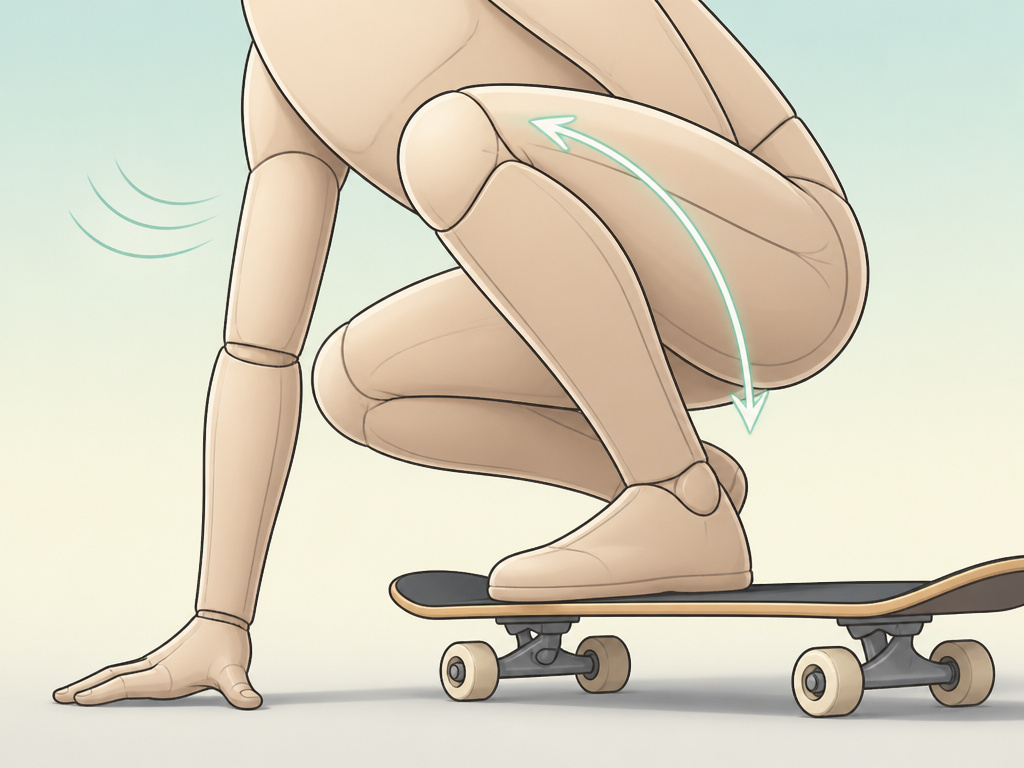
Your body’s ability to handle a fall starts with conditioning. A professional instructor’s method involves building strength and flexibility in the muscles that keep you close to the ground. Try squatting down on your board and touching the ground, holding that position for ten seconds to a full minute. This builds the leg strength and balance needed to stay low, which reduces the distance to the ground if you fall. Combine this with light stretching and deep breathing before a session to counteract the muscle-stiffening ‘freezing response’ that fear can trigger. The goal is to make your body resilient and your reactions calm.
Frequently Asked Questions
How do I stop being scared of falling when skating?
You stop being scared by making falling a practiced, controlled action instead of a surprise. Start by rehearsing falls on grass, wear all your protective gear so the consequence of a mistake is lowered, and follow a progression that slowly increases the challenge. Fear diminishes with familiarity and a sense of control.
Is it normal to fall a lot when skateboarding?
Yes. Falling is a normal part of skating and the primary mechanism for learning. Every skater, at every level, falls. The goal isn’t to avoid falling, but to fall correctly and get up efficiently. This process of trial and error learning is built into the sport.
What is the safest way to fall to avoid injury?
For most falls at speed, the safest way is the roll-out technique: crouch low to reduce distance, tuck your chin, and let your shoulder, back, and hip absorb the impact in a roll. For low-speed trick bails, using a hand to brace yourself close to the ground is safer. Always avoid sticking a straight arm out to catch your full weight.
How can I build confidence after a bad fall?
After a painful fall, your confidence will be shot. The recovery process is deliberate. First, sit and let the adrenaline pass. Then, perform three basic skills you know you can do perfectly (like pushing or a gentle turn). End your session on that success. Getting back on the board the next day is also crucial – don’t let the memory solidify.
Should children learn differently to overcome fear?
Yes. The American Academy of Pediatrics states children younger than age 5 years should not ride skateboards. Children’s supervision needs vary by source: the American Academy of Pediatrics states children aged 6 to 10 years should have close adult supervision, while the U.S. Consumer Product Safety Commission recommends children under 8 years old be supervised closely. Use the same progression method but spend more time on steps 1 and 2 (grass practice) and emphasize fun over achievement.
Before You Go
The line between fear and progress is a specific training schedule. If you only remember one thing, let it be this: spend your first five sessions without attempting a single trick. Use that time to push, turn, foot-brake, and practice falling on grass. You’ll build the foundational board control and muscle memory that makes fear irrelevant.
The conflicting expert advice on how to fall isn’t a problem – it’s a menu. Learn the roll-out for high-speed emergencies. Learn the hand-brace for low-speed trick attempts. Having both tools makes you adaptable.
Finally, trust the numbers. One-third of injuries happen in week one. That’s not a warning to avoid skating; it’s a map. If you can safely navigate those first seven days by prioritizing safe falling technique over heroics, you build a habit that protects you for years. Now go push down the block once today.
