
Skateboard Bushing Hardness Guide: How to Choose
This post contains affiliate links. As an Amazon Associate, we earn from qualifying purchases.
Skateboard bushing hardness is measured on a durometer scale from 0–100, with higher numbers meaning harder urethane. Many reverse kingpin trucks come stock with approximately 90a bushings, but the right choice depends on your weight, truck width, and whether you prioritize easy turning or stable, snappy response. RipTide Sports considers 90–97.5a hard, 80–88a medium hard, 70–78a medium soft, and 60–68a soft.
That 90a starting point is what comes stock on most reverse kingpin trucks, but it’s a single setting on a wide dial. It works for a lot of people, but it’s not a law. The real question is what happens when you move away from it, softer for lighter riders, harder for wider trucks, or a special formula for a specific feel. This skateboard bushing hardness guide walks through the numbers, the shapes, and the fine-tuning that turns a generic setup into one that fits you.
What follows: a breakdown of the durometer scales (including the confusing B-scale), a table of conflicting weight recommendations, the three bushing shapes and what they change, and how to adjust the kingpin nut without wrecking your parts.
Key Takeaways
- The durometer A scale runs 0–100; Warehouse Skateboards states the B scale is 20 points lower, so an 80b equals 100a in hardness, but many riders and other sources find 80b feels significantly harder.
- The Stoked Ride Shop Ultimate Bushing Calculator states most reverse kingpin trucks come with approximately 90a as the stock bushing, and that traditional kingpin trucks’ bushings may start a little harder than 90a.
- RipTide Sports recommends looking at their weight charts to get an idea of what each durometer will feel like depending on your weight.
- Wider trucks often run slightly harder bushings than narrower ones to maintain the same turning feel under the increased mechanical advantage.
- Never overtighten the kingpin nut to stiffen soft bushings. If you can see threading or the bushing deforms under the washer, you need harder bushings.
What Does Durometer Mean?
Durometer is the scientific measure for hardness in urethanes and rubbers. For skateboard bushings, it’s the number that tells you how much the bushing will resist deforming when you lean into a turn. A higher number means a harder bushing, which translates to more stability and a snappier return to center. A lower number means a softer bushing, which makes initiating a turn easier and gives a more fluid, carvy feel.
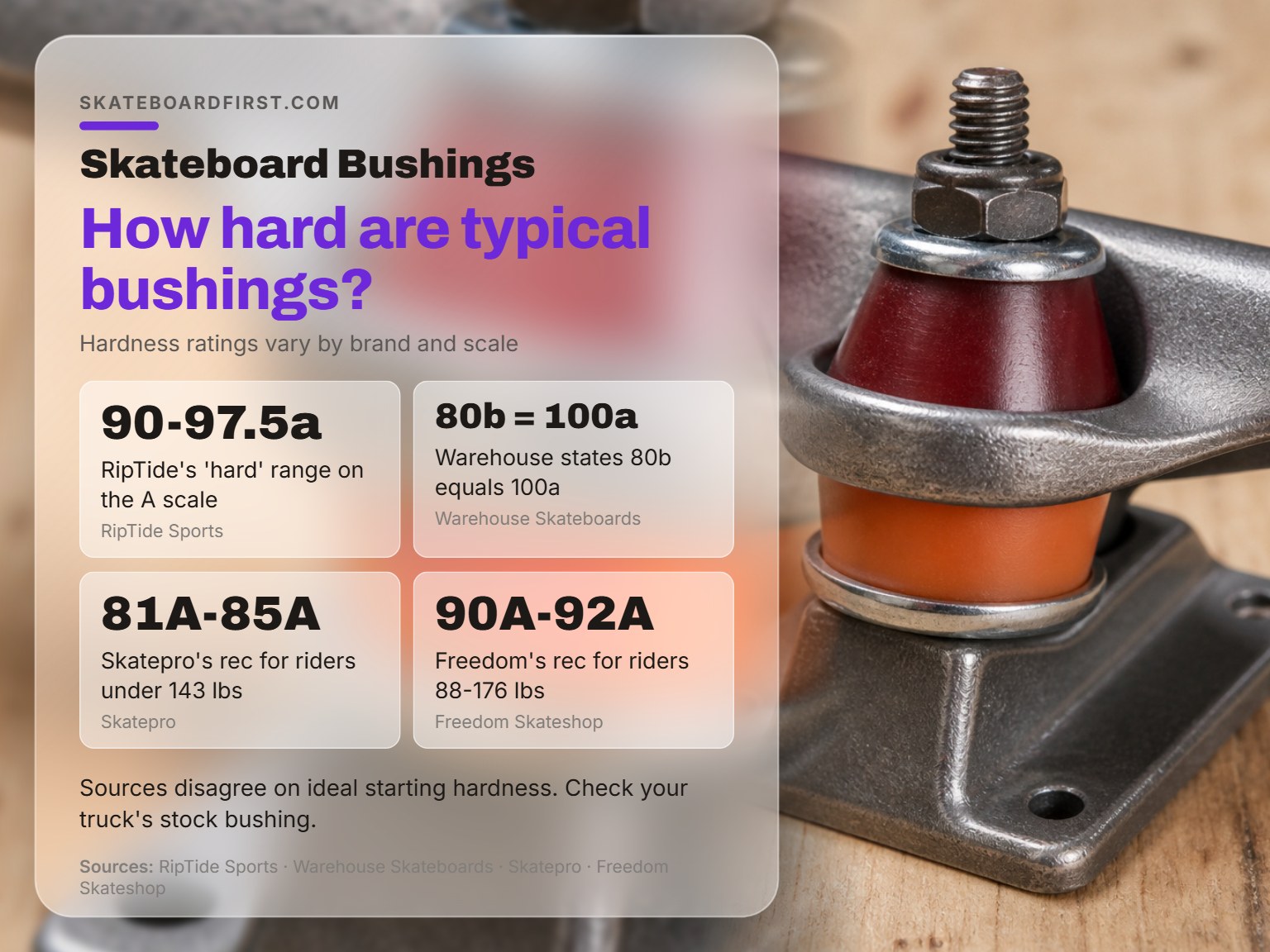
Durometer is measured on a scale from 0 to 100, with 100 being the hardest. The A scale is most common for skateboarding. The B scale measures 20 points lower than the A scale, allowing an extra 20 points for harder bushings. According to Warehouse Skateboards, an 80b durometer is the same as a 100a durometer.
This is where it gets tricky. While Warehouse Skateboards states that 80b equals 100a, the skating community often reports that an 80b bushing feels significantly harder. This is likely because the B scale uses a different indentor and spring force in the testing apparatus. Treat any B-scale rating with caution, it’s not a simple, direct conversion.
RipTide Sports, a major bushing manufacturer, breaks down the A scale into practical categories in their skateboard bushing hardness guide: they consider 90–97.5a hard, 80–88a medium hard, 70–78a medium soft, and 60–68a soft. This is useful because it frames the numbers. A 95a bushing isn’t just “harder” than an 85a; in their system, it’s in the “hard” bracket while the 85a is “medium hard.”
Most complete skateboards and new trucks come with bushings pre-installed. The Stoked Ride Shop Ultimate Bushing Calculator notes that most reverse kingpin trucks come with approximately 90a as the stock bushing. Traditional kingpin trucks, like those on a standard street deck, may start a little harder. If you’ve never changed yours, you’re probably riding around 90a.
How Hard Should My Bushings Be? (Weight & Riding Style)
Your weight is the biggest lever in choosing bushing hardness. A heavier rider applies more force to the bushings, so a harder duro is needed to prevent the truck from turning too easily or feeling unstable. A lighter rider needs a softer duro to get the same amount of turn from less force. Sounds simple, right? Here’s the first crack in the consensus.
| Source | Weight Range | Recommended Hardness | Notes |
|---|---|---|---|
| Skatepro | Under 143 lbs (65 kg) | 81A–85A | For a softer setup. |
| Freedom Skateshop | 40–80 kg (88–176 lbs) | 90A–92A | General recommendation. |
| RipTide Sports | N/A (See weight charts) | 90–97.5a is “hard” | Defines categories, not a starting point. |
Skatepro recommends 81A–85A for riders under 143 lbs. Freedom Skateshop suggests 90A–92A for riders 40–80 kg. Those are different worlds. A lighter rider following Skatepro’s recommendation would choose a bushing in the 81A–85A range, which RipTide categorizes as ‘medium hard.’ Following Freedom Skateshop’s recommendation might lead to a 90A–92A bushing, which RipTide categorizes as ‘hard.’
Who’s right? It depends on the feel you want. The Skatepro recommendation leans toward a more turnable, carvy board for lighter riders. The Freedom Skateshop recommendation aims for a stable, all-around feel. Your best reference is actually your current bushings, as noted in any good skateboard bushing hardness guide. If you know their durometer, you can move up or down the scale from there.
Common mistake: Choosing bushings based solely on a generic weight chart. Your riding style, whether you’re cruising, carving, doing street tricks, or pushing long distances, matters just as much.
For specialized riding like Long Distance Pushing (LDP), the Stoked Ride Shop calculator explicitly states its general recommendations don’t apply. LDP setups often use split duros (different hardness top and bottom) and specific formulas for maximum energy return. For general skating, start with the chart, but treat it as a suggestion, not a mandate.
The Three Bushing Shapes: Barrel, Conical, Eliminator
Hardness is only half the story. The shape of the bushing determines how the urethane deforms under load, which changes the turning profile. There are three basic shapes.
Barrel Bushings are straight-sided cylinders. They offer the most support and stability because they have a large surface area contacting the truck’s bushing seat and washers. A barrel bushing provides a linear, predictable turn and a strong return to center. They’re almost always used as the bottom bushing in a standard setup.
Conical Bushings are shaped like a cone. They have less urethane to displace at the tip, so they initiate a turn more easily and offer a more progressive, carvy feel. Because they’re less supportive, they can make the truck feel looser even at the same durometer. They’re typically used as the top bushing.
Eliminator Bushings (sometimes called Fat Cones or Chubbies) are a hybrid shape, wider at the base like a barrel but tapered like a cone. They’re designed to offer a sharp initial turn like a cone but then hit a wall of support for stability at deep lean angles. They’re popular for downhill and high-speed carving.
A common setup is a cone top with a barrel bottom. This balances easy initiation with a stable base. Swapping to a double barrel setup increases stability dramatically, which is why park and bowl skaters often prefer it. A double cone setup is exceptionally carvy and loose, best for slow-speed cruising and carving.
Fine-Tuning with the Kingpin Nut and Washers

You’ve chosen a hardness and shape. Now you dial in the feel with the kingpin nut. This nut compresses the bushings, pre-loading them. A few turns can make a soft bushing feel tighter, or a hard bushing feel more responsive.
The goal is to tighten the nut until the bushings make full contact with the washers and the truck’s hanger, with no visible gap. Then, give it another quarter to half turn. This provides a baseline where the bushings can do their job. From there, you can go slightly tighter for a more stable feel or slightly looser for more turn.
Where this goes sideways: Overtightening soft bushings to make them feel hard. If you can see the threading on the kingpin coming out of the nut, or if your bushings look deformed where the washer presses down, you need harder bushings. Cranking the nut further will only destroy them.
Overtightening soft bushings to make them feel hard is a common mistake that can lead to the bushings becoming crushed and cracked. The fix is to switch to a harder bushing.
Washers matter too. They distribute the force from the kingpin nut evenly across the bushing’s face, preventing deformation. Most trucks come with two washers per bushing (top and bottom). Using aftermarket washers with a larger diameter can further support the bushing and create a more precise feel, especially for downhill setups.
When to Replace Your Bushings (And What to Buy)

Bushings are consumable parts. Urethane degrades over time, losing its rebound and becoming brittle or mushy. Here are the signs it’s time for a change:
- Visible cracking or splitting. This is the most obvious sign. Small surface cracks might not affect performance much, but deep splits compromise the bushing’s integrity.
- Flattening or deformation. The bushing no longer holds its shape, appearing squashed. This leads to a dead, unresponsive feel and excessive truck play.
- A persistent “speed wobble” that wasn’t there before, especially if tightening the kingpin nut doesn’t fix it.
- The truck feels loose and wobbly even after tightening the kingpin nut. This was my own experience. I nearly bought new trucks before realizing the $10 bushings were shot.
When you replace them, consider stepping away from generic stock bushings. Brands like RipTide, Bones, and Venom offer formulas tuned for different performance. For example, RipTide’s KranK formula hardens when tightened, giving you a wider tuning range from one set. Bones Hardcore bushings have a hard inner core designed to isolate compression, which many street skaters prefer for flip tricks.
For a reliable upgrade, many street skaters choose aftermarket bushings from specialized brands. They’re widely available, durable, and work in most truck brands. For a more carvy, surfy feel on cruisers or longboards, bushings designed for carving in a cone/barrel combo let you fine-tune by shape and formula.
Are skateboard bushings a universal size?
While bushing hardness varies widely between brands, the physical size of standard street skateboard bushings is largely universal. Most traditional kingpin trucks use the same conical and barrel bushing shapes, allowing you to mix and match brands freely. This means you can experiment with a harder barrel from one manufacturer and a softer cone from another to fine-tune your turn and rebound. However, some specialty or older truck models may use proprietary sizes, so it’s always wise to check your specific truck’s requirements. The real differences come from the urethane formulas and durometer scales, not the physical dimensions for standard setups.
Frequently Asked Questions
Are 85a bushings soft?
According to RipTide Sports’ categorization, 85a falls into the “medium hard” range (80–88a). Most riders would feel 85a as a medium, balanced hardness, softer than the common 90a stock bushing, but not dramatically soft. For a rider under 140 lbs, 85a could feel just right; for a rider over 180 lbs, it might feel too turnable.
What are the hardest skateboard bushings?
The hardest commonly available bushings are typically rated 100a or above on the A scale, or 80b+ on the B scale. Solwave/Skatecruise lists a 100a bushing as the default for their Stinger model. For extreme hardness, some riders use precision machined aluminum or brass spacers, but these eliminate turning entirely and are not recommended for general skating.
Should I get hard or soft bushings?
Get harder bushings if you are a heavier rider, skate primarily for technical street/park tricks where stability is key, or experience speed wobbles. Get softer bushings if you are a lighter rider, prioritize easy turning and carving for cruising, or find your current setup too stiff to turn comfortably.
Can I mix different hardnesses top and bottom?
Yes, this is an advanced tuning technique. A common mix is a harder barrel bottom (for stability) with a softer conical top (for easy turn initiation). This can create a very precise, carvy feel. Start with a difference of 5–10 points on the durometer scale (e.g., 95a bottom, 90a top).
The Bottom Line
Ignore anyone who gives you a single magic number. Your perfect bushing hardness lives at the intersection of your weight, your trucks, and what you want the board to do. Many riders start with the stock bushing hardness, which is often around 90a for reverse kingpin trucks. If it feels vague or twitchy, go up 5 points. If it feels like turning a boat, go down 5 points.
The one rule that isn’t flexible: if you’re cranking the kingpin nut down to the threads to feel stable, stop. You don’t need more torque; you need a harder bushing. That simple switch, listening to what the hardware is telling you, is what separates a board you fight from a board that feels like an extension of your feet. Tighten your kingpin a quarter turn from snug and go roll. Your knees will tell you the rest.
