
Skateboard Concave Explained: Types, Feel, and Choosing
This post contains affiliate links. As an Amazon Associate, we earn from qualifying purchases.
Skateboard concave is the longitudinal curvature of the deck from rail to rail. According to Open Source Skateboards, the concave drop is the vertical difference in height between the rail and the center of the board. This curve, typically between 0.3″ and 0.5″ deep for street decks, locks your feet in for control and leverage, adds board stiffness for better pop, and changes how the board feels underfoot for an entire session.
While Open Source Skateboards emphasizes concave drop as a physical spec, general marketing and guides often describe concave in qualitative terms like “mellow,” “medium,” or “deep” without specifying a pre-finishing measurement. The concept of skateboard concave explained is that a 0.5″ drop feels steep and aggressive on a narrow 7″ board but almost flat on a wide 10″ cruiser.
What follows: the exact numbers from manufacturer molds, how concave depth translates to foot fatigue and trick power, and a clear path to picking your first or next deck based on how you actually skate.
Key Takeaways
- Concave is a physical measurement, not just a feel. The “concave drop” is the height difference from the deck’s center to its rail before rounding.
- Shallower feels forgiving; deeper locks your feet in for flip tricks and rail stands.
- Concave stiffens the deck. More curve means more pop retention and a longer-lasting board, but can lead to foot fatigue on long pushes.
- Your foot arches over the curve. On mellow concave, your foot sits flat; on deep concave, the ball and heel press down while your arch bridges the gap, which can cramp after 20 minutes.
- Width changes everything. A mold built for 0.5″ drop on a 7″ deck yields a deeper feel on an 8″ deck cut from it, and a shallower feel on a 6″ deck.
What Skateboard Concave Actually Is (And How to Measure It)
Forget “mellow,” “medium,” and “deep” for a second. Those are useful shortcuts, but they hide the real spec. According to Open Source Skateboards, concave drop is the vertical difference in height between the side of the board and its center. That’s the number, in inches or millimeters, that defines the curve.
In the SK8CAD design standard, concave drop is measured before the deck’s sharp rails are rounded over with a router or sander. The finishing process reduces the final rideable measurement by about 0.05″ to 0.1″. So if you want a deck with a 0.4″ final concave, you’d design it with a 0.45″ to 0.5″ drop in the software.
This matters because two decks marketed as “medium” could feel different if one started with a 0.4″ pre-rounding drop and another with a 0.35″ drop, a nuance central to the skateboard concave explained. The first will ride slightly deeper. When you’re holding a new deck, run your hand from the center out to the rail. The steeper the climb, the deeper the concave. If it’s a gentle, almost flat ramp, you’ve got a mellow board.
The 0.3″-0.5″ Range That Defines Street Concave
Open Source Skateboards lists the typical concave drop for street decks as 0.3″ to 0.5″. That’s your baseline. Anything below 0.3″ enters “mellow” territory, common on old-school shapes and cruisers. Anything above 0.5″ is aggressively deep, favored for technical street and park skating where foot lock is essential.
But width warps this number. A 0.5″ drop across a narrow 7.25″ deck creates a steep, canyon-like feel. That same 0.5″ drop stretched across a 10″ longboard deck is barely perceptible. This is why mold stretching happens: a manufacturer might use the same concave mold for multiple deck widths. As Open Source notes, a mold built for 0.5″ drop on a 7″ deck will yield more than 0.5″ drop on an 8″ deck cut from it. The curve gets stretched, making it feel deeper on the wider board.
| Concave Feel | Typical Drop Range | Best For | A Named Example |
|---|---|---|---|
| Mellow / Low | Under 0.3″ | Cruising, comfort, beginners | HLC ‘Low Concave’ (M0135) |
| Medium | 0.3″ – 0.4″ | All-around street, learning tricks | Woodsen Medium-1 concave |
| Deep / High | 0.4″ – 0.5″+ | Technical street, flip tricks, park | Skate One K15 mold |
How Concave Changes the Ride (The Why Layer)
Concave isn’t decoration. It changes three things mechanically: foot grip, board stiffness, and your connection to the trucks.
Foot Grip and Leverage: The curve creates a pocket. Your foot arches over it, with the ball and heel pressing down on the rails. This locks you in during ollies and kickflips, your foot has something to push against. Skaterbuilt says this provides “increased grip and control.” In a rail stand (board-side), deeper concave widens the points of contact with the ground, adding stability. It also helps prevent wheel bite by lifting the deck center further from the wheels.
Board Stiffness and Pop: Think of a sheet of paper. Flat, it bends easily. Curved into an arch, it resists bending. Concave works the same way. Arbor Collective notes it increases strength like a Roman arch. A stiffer deck retains its “pop”, the snappy rebound off the tail, longer and is harder to break. Skaterbuilt directly links deep concave to a board that “lasts longer, retains its pop longer.” If you want more flex for a cushier ride, you need shallower concave.
The Sensory Reality: Foot Fatigue
This is the part most guides skip. On a deep concave deck, your foot doesn’t sit flat. The ball and heel bear your weight, while your arch bridges the gap. After extended periods of pushing and carving, that arch can start to ache. On a mellow concave deck, your foot distributes weight evenly, which is why long-distance pushers and commuters prefer it. The Parsec Aero Pro deck uses a “large-radius concave” with a wide, flat center.
Where this goes sideways: Choosing a deck with deep concave because it’s “pro.” If you’re skating for an hour at a time and mostly cruising, that deep pocket will cramp your feet by session’s end. Your first deck should be mellow or medium.
Concave vs. Kick: They’re Different
Don’t confuse concave with nose and tail kick. Concave is the rail-to-rail curve. Kick is the upward angle at the ends of the deck, used for popping tricks. As Empire Skate Manufacturing states, perimeter (shape) and concave are different things. You can have a steep kick with mellow concave, or a mellow kick with deep concave. Most street decks combine medium-to-deep concave with steep kicks (19º-22º), like the Skate One K12 mold.
Mellow, Medium, and Deep: Picking Your Curve
Your skating style, and your foot comfort, dictate the choice. Here’s how the three main categories break down.
Mellow (Low) Concave
- Feels like: A gentle dish. Your foot sits almost flat.
- Best for: Beginners learning to push and turn, cruisers, long-distance pushers, and anyone prioritizing comfort over explosive trick performance.
- Trade-off: Less foot lock means less power for flip tricks. The board may feel less responsive during sharp carves.
- A real example: The HLC ‘Low Concave’ deck (model M0135) is 8.0″ wide with a 31.85″ length. Its mellow curve is designed for comfort.
Medium Concave
- Feels like: A noticeable pocket. You feel the rails under your ball and heel.
- Best for: The majority of street skaters. It offers a balance of comfort and control, good for learning ollies, kickflips, and skating parks.
- Trade-off: It’s a jack-of-all-trades. It won’t lock your feet as securely as a deep concave for technical flip tricks, nor will it be as comfortable as mellow for long sessions.
- A real example: Many shop “blanks” and core brand decks use medium concaves. The Woodsen Medium-1 mold is a typical example.
Deep (High) Concave
- Feels like: A steep canyon. Your foot is cradled aggressively.
- Best for: Technical street skaters who rely on precise foot placement for flip tricks, skaters who frequent bowls and ramps where foot lock is critical, and those who want maximum board stiffness for pop.
- Trade-off: Can cause foot fatigue quickly. It has a steeper learning curve and feels less forgiving for beginners.
- A real example: The Skate One K15 mold features a “deep center concave” and is used for many pro-model street decks. The Skaterbuilt SB1/Bellmar mold is also promoted as a “world-famous deep linear” concave.
How to Choose Your Next Deck’s Concave
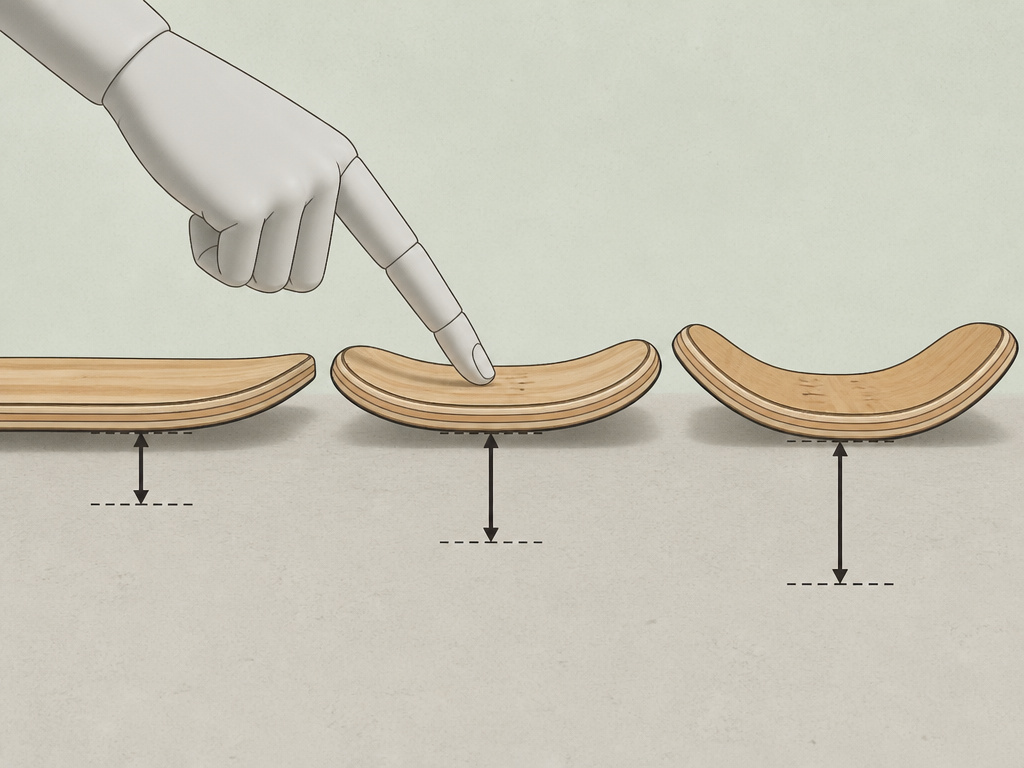
Don’t just grab a deck for the graphic. Your current board is your best guide for the skateboard concave explained.
- Assess Your Current Deck. Is the concave visible from a few feet away? If not, it’s mellow. Can you easily feel the rails under your feet while riding? That’s medium. Does your foot feel tightly locked in, almost restricted? That’s deep.
- Match Your Progression. If you’re comfortable on your board and starting kickflips, you might consider a medium or deep concave. A deeper concave can provide more foot lock, which may help with board control during tricks. If your feet ache, go shallower.
- Consider the Width. Remember, concave is tied to width. Switching from an 8.0″ to an 8.5″ deck? Even if the concave type is the same, the wider deck will feel different because the curve is stretched; a mold built for a 0.5″ drop on a 7″ deck yields more than 0.5″ drop on an 8″ deck.
- When in Doubt, Go Medium. For a first real deck or if you’re unsure, a medium concave on an 8.0″ to 8.25″ width is the safest, most adaptable choice. It’s the standard for a reason.
I got this wrong for a year. Some skaters choose a deck with a deep concave based on pro models. My flip tricks improved, but I dreaded pushing to the store. My feet would become numb quickly. I switched back to a medium concave and learned a simple truth: progress beats perfection. A deck that lets you skate longer is better than one that looks pro but cuts your session short.
The Stiffness Trade-Off and Board Life
Here’s a concrete reason to care about depth beyond feel: deck longevity. A deeper concave creates a stiffer deck. A stiffer deck is harder to break and retains its snappy pop longer as the wood fatigues. A deeper concave creates a stiffer deck, which can be harder to break and may retain its pop longer. Conversely, if you want a softer, more forgiving ride, A mellow concave allows more flex, which can contribute to a softer ride.
This is also why understanding deck flex matters. They’re connected. A flexy deck almost always has a shallower concave.
Which Brands Make Which Type of Concave?
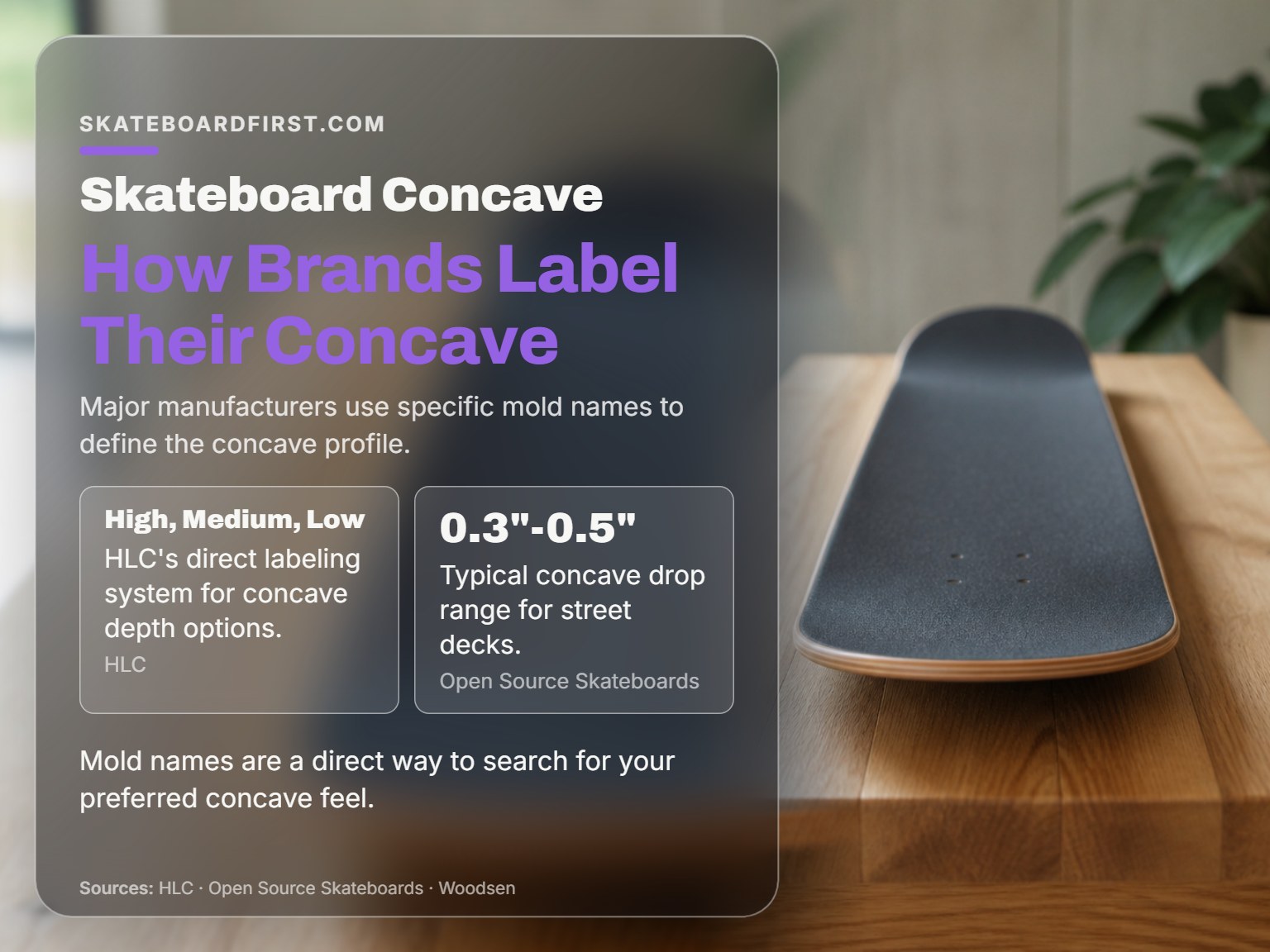
Different manufacturers use specific molds that define their concave profiles. Skate One’s catalog shows this variety clearly. Their K15 mold has a deep center concave with medium nose and tail, while the K7 mold offers a shallow center with deep nose and tail. For a mellow feel, the K20 mold uses a subtle nose and tail with a medium-deep center. HLC labels its decks directly as ‘High’, ‘Medium’, and ‘Low’ concave, offering clear options. Woodsen also provides a diverse range, naming their molds Mellow, Deep, and Medium. These mold names from major manufacturers give you a direct way to search for the concave feel you want, beyond just a brand’s general reputation.
Frequently Asked Questions
What does skateboard concave do?
Concave locks your feet in place for control during tricks, adds stiffness to the deck for better pop and longevity, and provides stability during rail stands. It also subtly affects comfort, with deeper concaves potentially causing foot fatigue on long pushes.
What is the difference between a steep concave and a mellow concave?
Steep (deep) concave has a greater vertical drop from center to rail, creating an aggressive pocket that securely locks your feet. A mellow concave has a minimal drop, resulting in a flatter, more comfortable standing platform. Steep concave excels for technical tricks; mellow concave is better for cruising and comfort.
Is concave the same as the deck shape?
No. As Empire Skate Manufacturing clarifies, concave is the three-dimensional curved surface of the deck. The shape (or perimeter) is the two-dimensional outline you see from above. You can change a deck’s shape, making it wider or adding a fishtail, while keeping the same concave mold.
How do I know what concave my deck has?
Look at the deck from the side. The more pronounced the curve from the center to the edge, the deeper the concave. Feel it with your hands. If you’re buying online, check the manufacturer’s description for terms like “low,” “medium,” or “deep,” and cross-reference with the deck’s intended use (e.g., street vs. Cruiser).
What concave is best for beginners?
Mellow to medium concave is best for beginners. It’s more forgiving and comfortable as you learn to balance, push, and turn. A deep concave can feel overly restrictive and unstable when you’re just finding your footing. Start with a standard medium concave on an 8.0″ deck; it’s the default for a reason.
Before You Go
One rule most guides skip: if you’re switching from a mellow to a deep concave deck, give yourself an adjustment period. Your feet will feel sore, your flip tricks may feel different as you adjust to the new curve. That’s normal. Your muscle memory is built on a different curve.
If you’re choosing your first real street deck, ignore the hype around ultra-deep molds. Grab a 7-ply maple deck with a medium concave in a standard width. By then, you’ll know exactly what you want from your next deck, whether you stick with medium or venture into deeper territory for your flip tricks. The evolution of skateboard deck design has settled on these curves for a reason. They work.
For park and bowl skating, where foot lock is everything, a deeper concave like the Skate One K15 can make a big difference. But for the vast majority of skaters, the middle path, the 0.3″ to 0.4″ drop, is where you’ll find the perfect balance of control, comfort, and session length. Trust the process, one push at a time.
