
Skateboard Slang Guide: A to Z Glossary and Terms
This post contains affiliate links. As an Amazon Associate, we earn from qualifying purchases.
A skateboard slang guide covers the essential terms for board parts, tricks, stances, and safety. You need about twenty core words to start: deck, trucks, wheels, bearings, grip tape, nose, tail, regular, goofy, fakie, switch, ollie, kickflip, grind, and bail. The rest you’ll pick up by listening at the park.
That short list is the skeleton. The meat is knowing which terms are technical specs, which are trick families, and which are pure culture, as defined in any good skateboard slang guide. Mix them up and you’ll sound like a kook, someone who talks the talk but can’t walk the walk.
What follows: a breakdown of board anatomy with the exact measurements that matter, the trick families that define street skating, the stance terms that trip up every beginner, and the safety vocabulary that keeps you rolling. By the end, you’ll be able to decode a setup thread, understand a trick tip, and know why everyone yells “bail!”
Key Takeaways
- Learn your board anatomy first, deck, trucks, wheels, bearings, grip tape, because every setup discussion and repair tip uses those exact names.
- Stance is everything: regular means left foot forward, goofy means right foot forward, fakie is rolling backwards in your natural stance, and switch is riding in your opposite stance.
- ABEC bearing ratings (like ABEC 7) measure precision, not necessarily skate performance; a higher number isn’t always better for street skating according to bearing experts.
- Always check for the ASTM F1492-22 certification when buying a skateboard helmet, it’s the official standard for impact protection.
- If you hear “bail,” “eat concrete,” or “slam,” it means a fall; knowing these terms helps you understand risk and communicate injuries.
Skateboard Anatomy: The Core Vocabulary
Your board isn’t just a “board.” It’s a collection of specific parts, each with a name and a job. Getting these wrong marks you as a newbie faster than wearing a helmet crooked.
The deck is the wooden platform you stand on. The grip tape is the sandpaper-like sheet glued on top for traction. The nose is the front kicktail, and the tail is the rear kicktail, on many modern boards, the nose is slightly longer.
The part nobody mentions: Grip tape wears out. Over time, the grit of grip tape can wear smooth under your front foot’s ball. The board feels slippery on pop, and you’ll catch yourself checking your shoes for dust. Fresh tape fixes it in ten minutes.
The trucks are the T-shaped metal assemblies bolted underneath. They hold the wheels and let you turn. Inside each truck are rubber bushings that control how easily it leans. Tighten the kingpin nut and the board turns slower; loosen it and you get a surfy, wobbly carve.
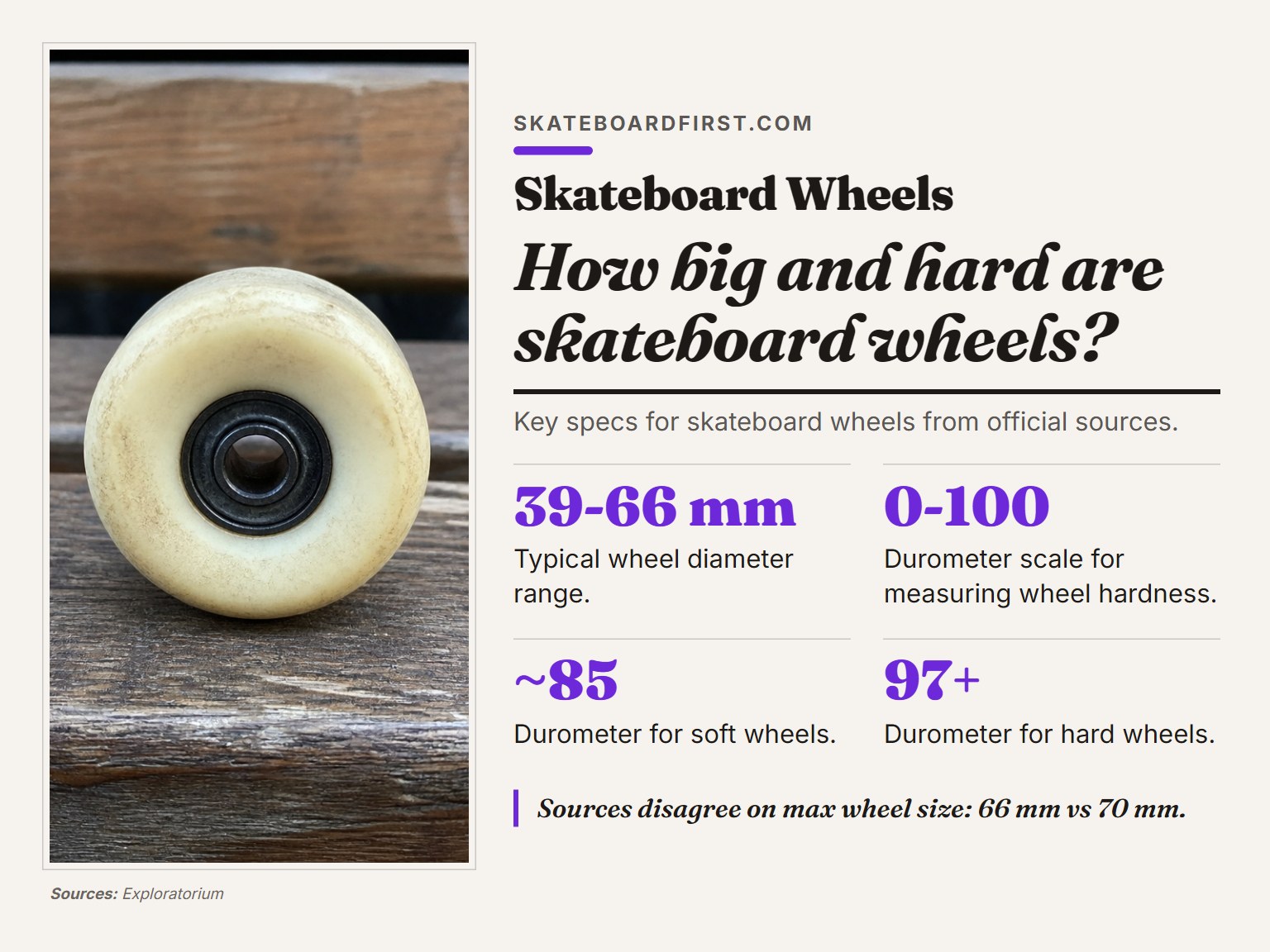
Sources disagree on the typical size range for skateboard wheels: the Exploratorium states wheels are sized between 39 and 66 millimeters, while Surfertoday.com states they are sized between 39 and 70 millimeters. Their hardness is measured by durometer, a number from 0 to 100. Soft wheels for cruising have a durometer around 85; hard wheels for tricks have a durometer of 97 or higher. The Exploratorium’s skateboarding glossary lists these exact specs.
Bearings are the small metal rings inside the wheels. They’re rated on the ABEC scale. Here’s where it gets tricky: a higher ABEC rating (like ABEC 9) means tighter manufacturing tolerances, not necessarily a faster or more durable bearing for skateboarding. Sources disagree on bearing performance: a general commercial assumption is that a higher ABEC rating (e.g., ABEC 9) universally equates to better performance, while Dose Skateboarding notes that ABEC 7 bearings could be worse than ABEC 3.
| Part | What It Is | Spec to Know |
|---|---|---|
| Deck | The wooden board | Width (varies by rider preference and style) |
| Trucks | Axle assemblies for turning | Hanger width should match deck |
| Wheels | Polyurethane rollers | Diameter (39–70 mm), Durometer (soft wheels ~85, hard wheels 97+) |
| Bearings | Rings that enable wheel spin | ABEC rating (precision, not speed) |
| Grip Tape | Sandpaper top surface |
This vocabulary helps you navigate any skate spot. You can’t read a spot if you don’t know what your board is made of.
Stance and Direction: Regular, Goofy, Fakie, and Switch
This is where most beginners get tangled. The terms sound similar, but they describe four completely different ways of standing on the board.
Regular stance means you ride with your left foot forward, pushing with your right. Goofy stance is the opposite: right foot forward, left foot pushing. There’s no “correct” one, it’s whichever feels natural the first time you step on.
Fakie is riding backwards in your natural stance. If you’re regular, you’re rolling tail-first with your left foot still in front. Switch is riding in your opposite stance, a goofy rider skating switch has their left foot forward. Switch is harder because it uses your non-dominant muscles.
Common mistake: Calling switch “fakie.” They’re different. Fakie is your normal stance, backwards. Switch is your opposite stance, forwards. Mix them up and the trick name you’re trying to learn won’t match the tutorial.
Why does this matter? Every trick has a stance modifier. A “switch kickflip” is a kickflip performed in switch stance. A “fakie bigspin” is a bigspin started while rolling backwards in your regular stance. Getting the prefix wrong means you’re practicing a different trick.
Trick Terminology: Ollies, Flips, Grinds, and Slides
Trick names are a compressed language. Once you know the root words, you can unpack most combinations.
The ollie is the fundamental jump. It’s the engine for every aerial trick. A kickflip is an ollie where the board flips laterally along its long axis from a flick of the toe. A heelflip is the same motion but flicked with the heel.
Grinds involve sliding the truck’s hanger on a curb or rail. A 50-50 grind uses both trucks. A 5-0 grind is on the back truck only. Slides use the deck’s bottom. A boardslide slides the deck’s center on a rail.
| Trick Family | Root Move | Example Variation |
|---|---|---|
| Ollie | Jumping the board | Nollie (off the nose), Fakie Ollie |
| Flip | Board rotates laterally | Kickflip, Heelflip, Varial Flip |
| Grind | Truck contacts edge | 50-50, 5-0, Nosegrind |
| Slide | Deck contacts edge | Boardslide, Lipslide, Noseslide |
The naming follows a kind of grammar. “Frontside” and “backside” describe your body’s orientation to the obstacle. If your chest faces the obstacle as you approach, it’s frontside. If your back faces it, it’s backside. A “frontside boardslide” and a “backside boardslide” are two distinct tricks.
You don’t need to memorize every type of trick on day one, according to a basic skateboard slang guide. Learn the ollie first. The rest of the tree grows from there.
Skatepark and Obstacle Lingo
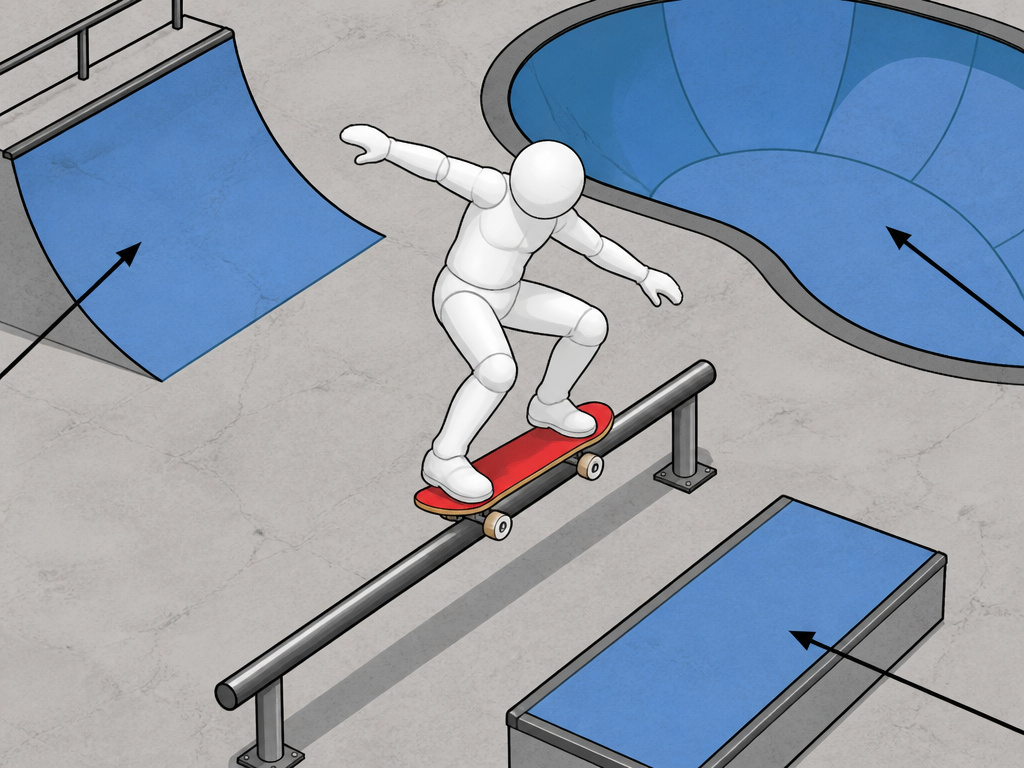
A skatepark isn’t just a place with ramps. It’s a landscape with specific features, each with a name.
A bowl is a drained swimming pool shape for carving. The coping is the metal pipe at the top edge. A quarter pipe is a single curved ramp. A funbox is a flat-topped obstacle with ramps on the sides. A rail is a metal bar for grinding.
DIY spots are skater-built obstacles, often in hidden urban spaces. The terminology here is more organic, but knowing the core park features helps you follow directions. If someone says “session the bowl” or “hit the funbox,” you know where to go.
The culture of building and finding spots is a huge part of skateboarding culture. It’s not just about the tricks; it’s about the space you do them in.
The Language of Falling: Bail, Eat Concrete, and Slam
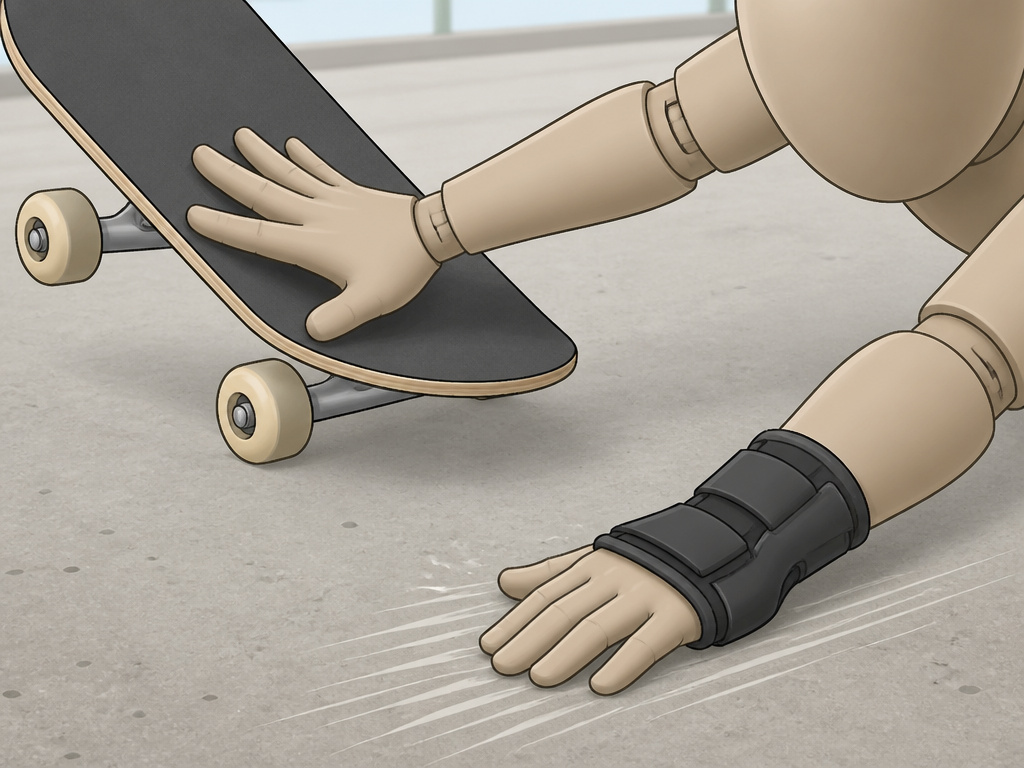
Falling is part of skating. The slang around it is blunt and physical because it needs to communicate fast.
To bail is to abort a trick mid-attempt, usually jumping off the board to avoid a worse fall. Eat concrete (or “eat shit”) means to fall hard onto the pavement. A slam is a high-impact fall. If someone “took a slam,” they probably got bruised or scraped up.
These terms aren’t just descriptive. They’re a way for skaters to talk about risk and consequence without getting overly dramatic. Hearing “he bailed” tells you the skater made a choice to jump off. Hearing “he ate concrete” tells you the skater didn’t have that choice.
Wrist guards are especially important for protection, as noted in the CPSC skateboarding safety fact sheet. That sheet is a primary source for the physical consequences the slang describes.
Gear and Setup Shorthand
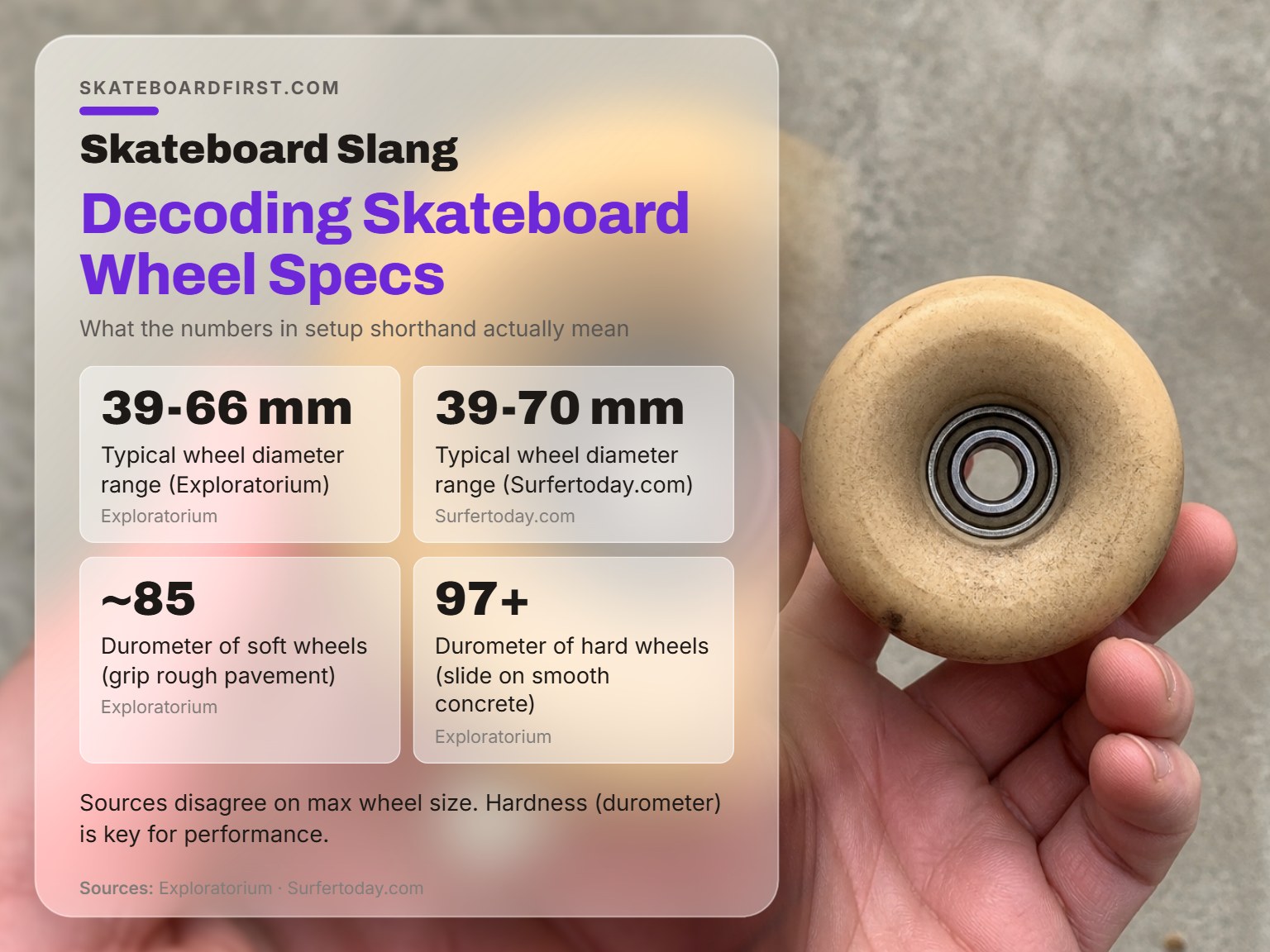
When skaters talk about their setups, they use a compressed code. “I ride an 8.25 with Indys and 54mm 99a” translates to an 8.25-inch wide deck, Independent brand trucks, 54-millimeter diameter wheels with a 99 durometer hardness.
The durometer number is key. Softer wheels (lower number) grip more and absorb rough pavement. Harder wheels (higher number) slide easier and are faster on smooth concrete. For street skating, riders often use hard wheels with a durometer of 97 or higher.
The ABEC rating debate shows up here. While a bearing might be marketed as ABEC 9, many experienced skaters prioritize brand reputation (like Bones Reds or Bronson G3) over the ABEC number. The performance difference for most street skating is negligible compared to keeping your bearings clean.
A complete is a pre-assembled board. A pro model deck is designed with input from a professional skater. These terms help you navigate buying gear. Knowing this shorthand helps you participate in forum discussions and understand skate video descriptions where riders list their setups.
Safety and Etiquette Terms
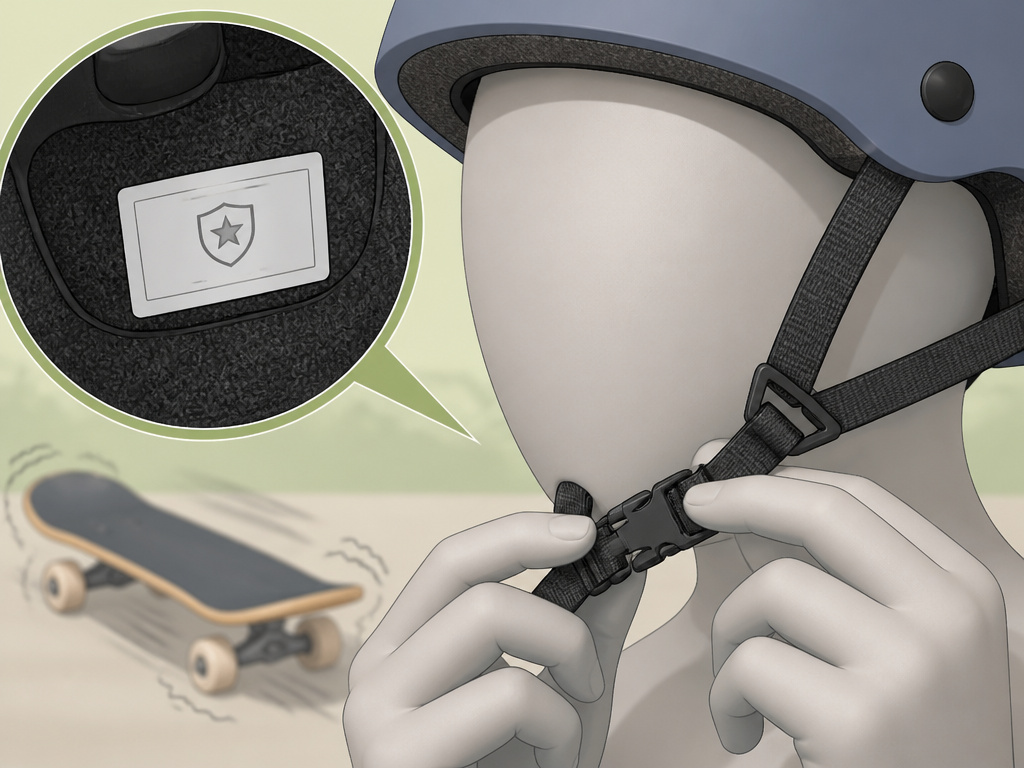
Skateboarding has risks. The vocabulary around safety is essential.
Helmet certification means looking for the ASTM F1492-22 label. That’s the ASTM skateboard helmet standard for impact protection. A helmet should fit snugly with the chin strap fastened and sit level on your head.
Speed wobble is a violent, uncontrollable shaking of the board at high speed. The CPSC guide states longer boards increase stability, and boards with wider hangers (wheels that are farther apart) give riders greater control, which can help manage speed wobble.
Other safety terms are about awareness. Skitching is illegally hitching a ride on a moving vehicle, a major cause of collisions. Seshing is having a skate session. It’s good etiquette to not snake someone (cutting in front of their run) during a shared skate sesh.
Skateboard Slang Glossary A to Z
This is your quick reference for common skateboard terms. A deck is the wooden platform you stand on. Grip tape is the sandpaper-like sheet on top for traction. The front kicktail is the nose, and the rear is the tail. Bearings are often rated on the ABEC scale for precision. For safety, a proper helmet fits snugly and level on your head with the chin strap fastened. Always check your board for excessive play and broken parts before riding, and inspect the area for hazards like rocks and debris.
Frequently Asked Questions
What are some famous skateboard catchphrases?
“Do a kickflip!” is the universal heckle/call from non-skaters and skaters alike. “Sick!” or “Rad!” are general exclamations for a trick. “Yew!” is an enthusiastic shout of celebration. These phrases are less about dictionary definitions and more about the energy of the moment.
What is a common nickname for a skateboarder?
Skater” is the standard term. “Shredder” refers to someone who skates aggressively and well. “Kook” is a derogatory term for a poser or someone with poor park etiquette. Nicknames are often personal and based on a skater’s style or name, like “Tony Hawk” being “The Birdman.
What’s the difference between “fakie” and “nollie”?
Fakie is riding backwards in your natural stance. Nollie is an ollie performed off the nose of the board while moving forward. Both involve the nose leading, but fakie is a stance, and nollie is a specific trick takeoff. Confusing them will mislabel your trick attempts.
Why do skaters say “bail”?
Bail means to abort a trick attempt by jumping off the board. It’s a safety instinct. Saying “I bailed” communicates that you recognized the trick was going wrong and chose to avoid a worse fall. It’s a term of practicality, not failure.
Are expensive bearings worth it for beginners?
For a true beginner, no. Expensive, high-ABEC-rated bearings offer marginal gains that a new skater won’t feel. A budget bearing like Bones Reds will spin freely and last long enough to learn the basics. Invest the saved money in better wheels or a helmet designed for skateboarding.
The Bottom Line
You don’t need to memorize two hundred terms. Start with the twenty that let you name your board, describe your stance, and understand a basic trick tip. The rest will come from listening at the park and watching skate videos.
One rule to cut through the noise: if a term doesn’t help you identify a part, perform a trick, or stay safe, file it away for later. The slang is fun, but the mechanics are what get you rolling. Go push down the block once today. The words will find you there.
