
Skateboard Travel Bag Guide: The 3-Step Airport Checklist
This post contains affiliate links. As an Amazon Associate, we earn from qualifying purchases.
A skateboard travel bag is a specialized bag that safely carries your board and gear, with options ranging from 25L backpacks to 65L wheeled duffels. The right choice depends on your board size, how you’re traveling, and whether you need to bring protective gear or clothes for a trip. For most flyers, disassembling the board and packing it in a checked bag under 130cm long is the most reliable method.
That last point is the difference between a smooth airport run and a last-minute argument at the check-in counter. Most guides tell you to “get a skate-specific bag,” which is true but misses the real travel hurdles: airline size limits, the weight a complete board adds to a pack, and the specific materials that survive grip tape rubbing against them for more than a week. For these details, consult a thorough skateboard travel bag guide.
What follows is a breakdown of the four main bag types, the specs that actually matter (not just marketing), and a three-step checklist from a skateboard travel bag guide for getting your board on a plane without extra fees or damage. This isn’t about finding the most expensive bag; it’s about matching the right bag to your actual trip.
Key Takeaways
- For air travel, disassemble your board and pack it in a checked bag. One anecdotal tip suggests keeping it under 130cm long to avoid oversized fees.
- A complete skateboard strapped to a backpack adds 5 to 10 pounds to your carry load, which changes your balance when skating to a spot.
- Look for rubberized skate straps or Hypalon reinforcement on contact points to prevent grip tape from shredding your bag’s fabric within a few uses.
- Wheels on a bag add weight (the Ocean & Earth wheeled bag weighs 6kg) but are worth it for airport terminals; the Skatesauce Travel Bag offers a clever alternative by letting you use your skateboard’s own wheels.
- The Decathlon SC500 (48L) is built for two boards and gear, while the Db Skateboarding Pro Travel Pack 65L is the volume king for longer trips with a single board.
The 3-Step Airport Checklist
Before you even look at bags, you need a plan for the airport. The stories vary wildly: some skaters breeze through with a board strapped to their backpack, while others get hit with a $150 oversized baggage fee. The inconsistency is the problem. Based on the most reliable traveler reports, here’s the sequence that works nearly every time.
Step 1: Disassemble and Distribute. Remove your trucks. Pack the deck and trucks separately in your main luggage. This does two things. It keeps your luggage profile slim and avoids the “sports equipment” label airlines use to charge extra. It also means if your checked bag gets lost, you haven’t lost a complete, ready-to-ride board. One traveler’s tip from a forum: pack the trucks in your carry-on and the deck in your checked bag. That way, you always have the most expensive parts with you.
Step 2: Choose Your Bag Based on Length. Your checked bag should not exceed 130cm in length. This is a hard ceiling mentioned by experienced longboard travelers. Many wheeled board bags, like the Ocean & Earth Wheelie Triple Shortboard Travel Bag, hit 2032mm (over 200cm) and are designed as dedicated sports equipment. For a standard skateboard, a large duffel like the Db Skateboarding Pro Travel Pack 65L (85cm long) or the Decathlon SC500 (83cm long) gives you plenty of room for the deck, trucks, shoes, and pads while staying under the radar.
Step 3: Master the Check-In Counter Script. When asked what’s in the bag, say “a skateboard.” Not a longboard, not a sports board. Just a skateboard. If they call it sports equipment, politely mention that their customer service line stated a skateboard is considered a toy. Be kind, be confident, and have your printed airline policy handy. This approach, documented by a longboard traveler who has flown to six continents, has a much higher success rate than trying to carry on a complete board, which they call “a gamble.”
Where this goes sideways: Checking a complete board without a padded bag. Baggage handlers throw items. Without padding on the nose, tail, and rails, your deck will be chipped by the first connection. The Ocean & Earth bag uses 10mm shock-absorbing foam and an extra 20mm on the impact zones for this exact reason.
The 4 Main Types of Skateboard Travel Bags
You’ll see four distinct shapes on the market. Picking the right one isn’t about quality—it’s about matching the bag’s design to whether you’re commuting, going on a weekend trip, or flying overseas.
1. The Backpack (25L-32L): For the Commuter or Day Trip
This is your “session-to-session” workhorse. It carries your board strapped to the outside and holds your tools, water, and a change of clothes inside. The key here, as any good skateboard travel bag guide will note, is balance and strap design.
The Decathlon BP500 Backpack holds 25L (27L with the rolltop expanded) and includes a built-in skate tool with an Allen key and Phillips head. You’ll never arrive at a spot with a loose truck and no tool again. The Dakine Mission Street Pack DLX 32L takes a different approach with its “rubberized coated web” on the skate straps. This material is designed to resist abrasion from grip tape. Without it, the coarse grip sandpaper will fray standard nylon straps within a month of daily use.
A backpack with a board strapped on changes your center of gravity. When you’re pushing, you’ll feel the water bottle shift in the side pocket with each kick. A slim pack, worn tight, is better for skating than a loose, bulky one.
2. The Duffel / Carry Bag (47L-65L): For the Weekend Warrior or Flyer
When you need to bring more than just a board—helmets, pads, multiple decks, shoes, clothing—this is your category. These are the bags you check at the airport.
The Decathlon SC500 Skateboard Transport Bag is a standout for two-board travel. Its 48L volume (47L per their design story) holds up to two complete skateboards (max width 9″). It uses Hypalon reinforcement in the board compartment, a rugged synthetic rubber that laughs at grip tape. Inside, a Velcro divider and modular foam let you organize pads and clothes like a camera bag. A crucial note from its product page: it is not suitable for longboards or surf skates.
For even more gear, the Db Skateboarding Pro Travel Pack 65L has a large capacity. It holds boards up to 85cm long and features a “Protected sleeve” and “Patented Rib-Cage Construction™.” Think of it as a mobile locker for a skate trip.
| Bag Model | Best For | Volume | Key Feature | Watch Out For |
|---|---|---|---|---|
| Decathlon BP500 | Daily commuting, tool-free fixes | 25L (27L expanded) | Built-in skate tool | Limited space for extra gear |
| Dakine Mission Street Pack DLX | Durability for daily board carry | 32L | Rubberized grip-tape resistant straps | Higher price point |
| Decathlon SC500 | Flying with 2 boards & full gear | 48L | Hypalon reinforcement, holds 2 boards | Not for longboards |
| Db Skateboarding Pro Travel Pack | Extended trips, maximum cargo | 65L | Largest capacity, rib-cage protection | Can be bulky when empty |
3. The Wheeled Bag: For Pain-Free Airport Navigation
Hauling a 65L duffel stuffed with gear from check-in to the oversize belt is a workout. Wheeled bags solve that. The Ocean & Earth Wheelie Triple Shortboard Travel Bag (6’6″ model, wheeled version) weighs 6kg and has large, inline-style wheels. The trade-off is the added weight of the wheels and frame.
Sources disagree on wheels. The reviewer of the Ocean & Earth bag calls them “a no brainer,” while others argue the extra weight and frame aren’t justified. Your call depends on how much other luggage you have and your tolerance for shoulder strain.
4. The Creative Solution: Using Your Board as the Wheels
Why add wheels when your board already has four? The Skatesauce Travel Bag and some longboard-specific bags use a clever hack. They have straps on the bottom to attach your skateboard, turning the bag into a pull-along trolley using your board’s own wheels. Similarly, the Original longboard bag has two zips on the bottom that let the trucks poke out, so you can roll the bag directly on your board’s wheels.
This method saves weight and cost. The downside is you can’t ride the board while it’s attached to the bag. It’s a brilliant solution for getting to and from your destination, but not for the time in between.
Materials & Durability: What Actually Lasts
A bag’s fabric isn’t just about looks. It’s about surviving the three main destroyers of skate travel bags: grip tape abrasion, airport handling, and weather.
Polyester is the most common material, prized for its strength and water resistance. Decathlon’s entire new bag collection uses durable, water-resistant polyester. Nylon is tougher and even more water-resistant but often heavier. Leather appears on some high-end bags.
The real magic happens at the stress points. Look for:
- Hypalon: This synthetic rubber, used on the Decathlon SC500, is almost impossible to wear through. It’s a synthetic rubber used for high-abrasion areas.
- Rubberized Coatings: The Dakine Mission Street Pack uses this on its straps. It creates a barrier that grip tape struggles to bite into.
- Reinforced Bottom Panels: A bag dragged on pavement needs a thick, often rubberized, bottom layer.
Common mistake: Choosing a bag based on volume alone. A 65L bag made of thin polyester will have its straps shredded by grip tape long before you fill it. The material where the board touches the bag matters more than the total capacity.
What to Pack Inside: Beyond the Board
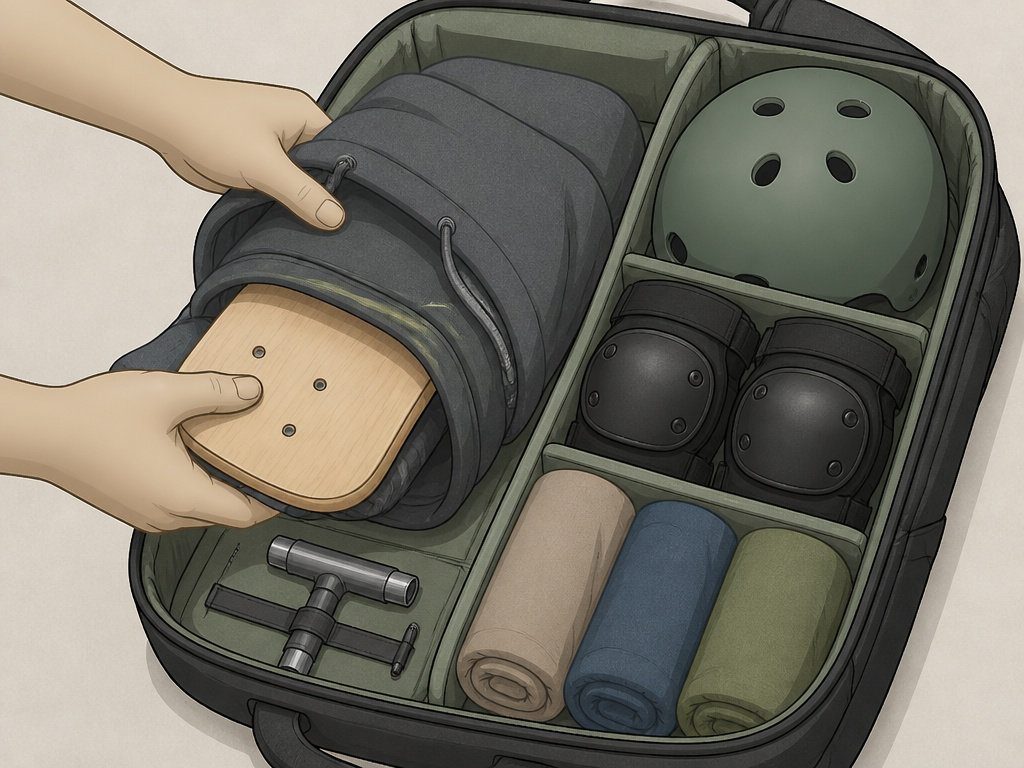
Filling your bag correctly protects your gear and can save a session. Here’s a prioritized packing list.
- The Board (Disassembled): Deck, trucks, wheels, bearings, hardware. Wrap the deck in a towel or clothing for padding.
- Skate Tool: Essential. The built-in tool in the Decathlon BP500 is included.
- Protective Gear: Helmet, knee pads, elbow pads, wrist guards. These are rigid and should be packed to create a protective shell around your deck.
- Footwear: At least two pairs of socks and your skate shoes. Pack shoes along the rails of the deck to add more impact buffer.
- Clothing: Use soft items like t-shirts, hoodies, and pants as filler padding. Roll them to fill empty spaces that would let your deck rattle.
- First-Aid & Maintenance: A small kit with bandages, antiseptic wipes, and a spare set of bearings and kingpin nuts can turn a trip-ending incident into a minor delay.
Frequently Asked Questions
Can I bring a skateboard on a plane as a carry-on?
You can try, but it’s a risk. Some airlines and TSA agents allow it; others strictly forbid it and will make you check it at the gate, potentially for a high fee. The most consistent success comes from disassembling the board. The deck alone can often be carried on, while the trucks go in your carry-on backpack.
What are the best skateboard travel bag brands?
Decathlon offers bags (SC500, BP500) with features like built-in tools and Hypalon. Db Skateboarding offers a 65L Pro Travel Pack. Dakine uses rubberized straps on its skate packs.
How do I protect my board in a checked bag?
Use the “board as the core” method. Disassemble it. Place the deck in the center of your bag. Surround it with your softest items (clothes, towel). Place your hard protective gear (helmet, pads) around the deck’s nose and tail to create a bumper. Your shoes and trucks can fill the remaining gaps. This creates a padded cocoon.
Are wheeled skateboard bags worth it?
For airport travel, yes. The convenience of rolling a heavy bag through a terminal outweighs the extra weight of the wheels for most people. For non-flying travel or if you’re very weight-conscious, a standard duffel or the skateboard-wheel hack is a better choice.
How do I choose between a backpack and a duffel?
Ask one question: Will I be skating with this bag on my back to get to a spot? If yes, you need a skateboard backpack like the Dakine or Decathlon BP500. If you’re traveling from your home to a destination via car, train, or plane, and then unloading your gear, a duffel or wheeled bag is more practical for its larger volume.
The Bottom Line
The best skateboard travel bag is the one you’ll use correctly. For most people flying, that means a 48L-65L duffel under 130cm long, with abrasion-resistant patches where the straps meet the board. Disassemble your setup, pack it tight with clothes as padding, and know your airline’s policy before you reach the counter.
Skip the fancy extras if you’re on a budget—a simple durable duffel and smart packing beats an expensive, poorly packed bag every time. Your goal isn’t to have the coolest bag at the airport; it’s to have your board arrive safely, ready to roll at your destination. Now go check your airline’s sports equipment page.
