Surfskate vs Skateboard: Which Should You Buy?
This post contains affiliate links. As an Amazon Associate, we earn from qualifying purchases.
A surfskate uses a specialized front truck system that allows deep, surf-like carving and generates speed through pumping, while a skateboard uses a fixed truck setup designed for stability, pop, and technical street or park tricks. For surf training, flow, and cardio on flat ground, choose a surfskate. For learning ollies, kickflips, and skatepark progression, a skateboard is the clear winner.
That split in front truck design changes everything, how you turn, how you get speed, and what kind of riding feels natural. One board feels alive under your feet, responding to weight shifts with a wave-like flow. The other is a precise, predictable tool built for snapping into the air and landing on a specific spot. The core difference is best understood as surfskate vs skateboard.
What follows is a breakdown of the three specs that matter most: the truck mechanism, the wheel choice, and the deck shape. We’ll also cover the real-world trade-offs for beginners, the maintenance you’re signing up for, and a simple checklist to match you with the board you’ll actually ride.
Key Takeaways
- The front truck system is the defining difference: surfskates use a pivoting, spring, or bushing-based mechanism for deep lean, while skateboards use a fixed TKP truck for stability and pop.
- Surfskates excel at pumping and carving on flat ground and are validated as a surf training tool by a peer-reviewed study in the Journal of Sports Sciences.
- Skateboards are built for technical tricks; their fixed trucks and smaller, harder wheels make ollies, kickflips, and grinds significantly more consistent.
- According to community forums, many experienced riders argue that very loose, spring-based systems can be ‘twitchy’ and ‘unstable’ for first-timers, recommending more stable bushing-based systems (like Carver CX) as true entry points, while manufacturer marketing often positions surfskates as intuitive for beginners.
- Wheel size and hardness dictate terrain: surfskate wheels (65-75mm, 78A-83A) grip and roll over cracks; skateboard wheels (50-55mm, 99A-101A) slide and pop.
The Front Truck: The Core Difference
The truck is where these two boards divorce. It’s not a minor tweak; it’s a different philosophy of motion.
A standard skateboard truck, like those from Independent Truck Company, is a TKP (Traditional Kingpin) design. It has a fixed kingpin angle, typically 50° for street. When you lean, the hanger pivots on a central bushing, giving you a controlled, relatively wide turn. This setup prioritizes stability for landing tricks and a predictable feel for technical control.
A surfskate truck introduces a second axis of movement or a specialized spring mechanism, allowing the front wheels to turn significantly further in response to lean. This creates the deep, rail-to-rail carving that mimics surfing a wave.
Surfskate systems achieve this in different ways. Carver’s C7 truck uses a patented 360-degree pivot and a progressive spring. YOW’s S5 system features a spring mechanism and a double-axis pivot. SmoothStar’s Thruster #77 relies on a torsion spring and adjustable tension. Even bushing-based systems like the Carver CX use a reverse kingpin geometry to dramatically increase turn range without a spring.
The mechanical result is simple: on a surfskate, a small weight shift creates a big, fluid turn. On a skateboard, the same input yields a tighter, more controlled arc. One feels reactive and flowy; the other feels direct and planted.
Wheels: Grip vs Slide
Your wheels decide what the ground feels like and what you can do on it.
Surfskate wheels are built for connection and roll. They’re larger, typically 65mm to 75mm in diameter, and much softer, with a durometer (hardness) rating of 78A to 83A. Carver’s own Roundhouse wheels, for example, are listed as 69mm and 80A. This combination helps the wheels grip the pavement during deep carves and roll smoothly over cracks and pebbles. You maintain momentum because the wheels don’t get hung up on small imperfections. The trade-off is they don’t slide easily, which is fine because sliding isn’t the point of a surfskate.
Skateboard wheels are the opposite. For street and park skating, they’re small (50mm to 55mm) and hard (99A to 101A). The classic Spitfire Formula Four 99d wheel is 52mm and 99a. The wheel’s hardness allows it to slide predictably during grinds and powerslides. The small size keeps the board’s center of gravity low, which is critical for flip tricks, a larger wheel would make the board feel top-heavy and slow to pop. The downside is you feel every bump, and maintaining speed on rough pavement requires constant pushing.
| Wheel Spec | Surfskate | Skateboard |
|---|---|---|
| Typical Size | 65–75mm | 50–55mm |
| Typical Hardness | 78A–83A (Soft) | 99A–101A (Hard) |
| Primary Purpose | Grip, smooth roll, momentum | Slide, pop, trick consistency |
| Terrain Suitability | Rough pavement, flat ground, bowls | Smooth concrete, skateparks, street obstacles |
Where this goes sideways: Putting hard skateboard wheels on a surfskate. You’ll lose the grip needed for pumping and carving, turning the board into a slippery, unpredictable mess. The pump that generated speed now just makes the wheels skid.
Decks and Dimensions: Stance and Stability
While trucks and wheels do the heavy lifting, the deck platform sets your stance and influences stability.
Most professional skateboard decks are 7-ply maple and follow a familiar “popsicle” shape: symmetrical with a kicktail and nose, one of several different skateboard styles. This compact, lightweight form is designed for flipping the board and precise foot placement for tricks.
Surfskate decks are often wider and shaped differently. They borrow from surfboard and cruiser designs, with more pronounced concaves and sometimes a directional shape (wider nose, narrower tail). The Carver Greenroom 33 measures 33 inches long and 10 inches wide. The YOW La Santa Snappers is 32.5 inches long and 10 inches wide. That extra width provides a more stable platform for the deep, leaned-over carves and pumping motions.
Common mistake: Placing your front foot too far forward on a surfskate. As noted by riders, your front foot should be just behind the front deck bolts. Putting it on the nose makes the board overly twitchy and harder to control.
Performance and Purpose: What Each Board Does Best
This isn’t about which board is “better.” It’s about which tool is right for the job you want to do today.
Surfskates are for flow, feel, and fitness. Their core function is generating speed through pumping, using your body’s compression and extension to carve S-curves without ever pushing. This makes them phenomenal for flat-ground cruising, a killer cardio workout, and, critically, surf training. A 2021 study in the Journal of Sports Sciences used Carver surfskates to quantify and improve surfers’ “bottom turn execution,” validating their use as a dry-land tool. In bowls, they allow for deep, continuous carves where you can maintain speed without kick-turns. Think of it as drawing lines on the ground with your body.
Skateboards are for technique, tricks, and terrain. Their stability and pop are engineered for ollies, kickflips, grinds, and precise landings. They’re the vehicle of street skating and technical park riding. While you can carve on a skateboard, the turn is tighter and requires more effort to initiate. Their agility and low center of gravity make them ideal for navigating stairs, ledges, and the features of a skatepark. The learning curve for tricks is steeper, but the ceiling is the vast catalog of modern skateboarding.
| Use Case | Better Choice | Why |
|---|---|---|
| Surf Training / Wave Feeling | Surfskate | Truck design mimics surfboard rail-to-rail lean and pumping. |
| Learning Ollies & Flip Tricks | Skateboard | Fixed trucks and hard wheels provide consistent pop and stable landings. |
| Bowl/Pool Riding (Carving Focus) | Surfskate | Enables speed maintenance through deep carves without pushing. |
| Bowl/Pool Riding (Trick Focus) | Skateboard | Predictable for grinds (50-50s, smiths) and aerial maneuvers. |
| Flat-Ground Cardio & Cruising | Surfskate | Pumping is efficient and fun; large wheels handle rough pavement. |
| Street Skating & Park Obstacles | Skateboard | Lightweight, precise, and built for impact and technical control. |
Which is Easier for Beginners?
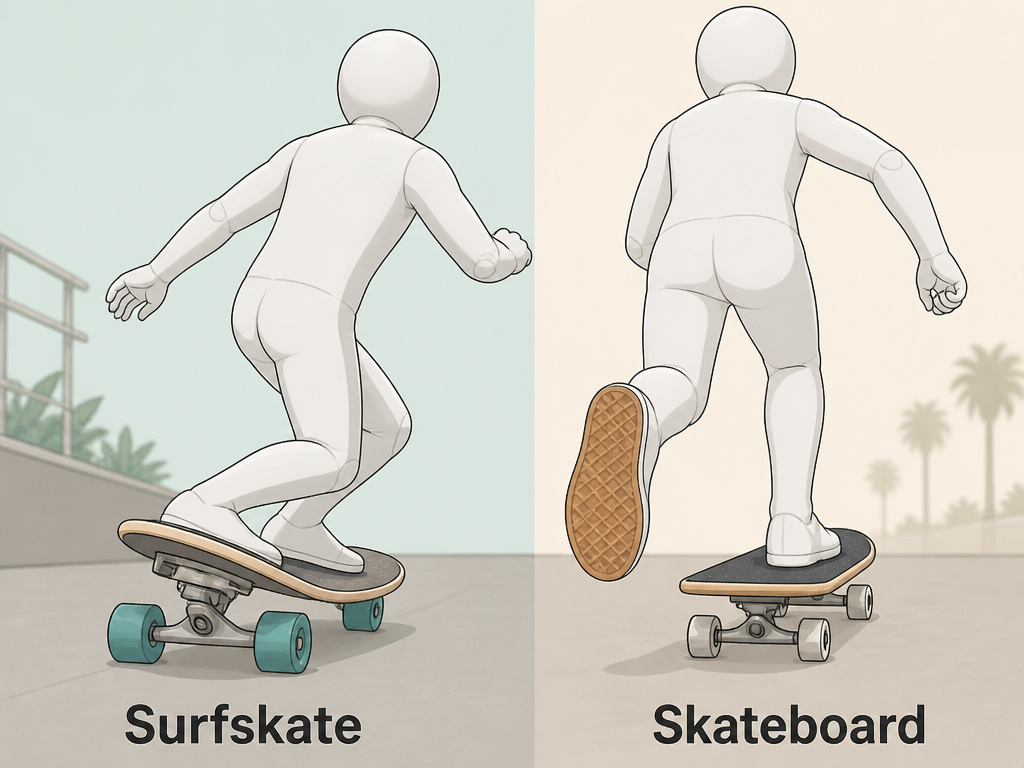
The answer is frustratingly nuanced because “easy” means different things.
For simply standing on the board and making it go, a surfskate can feel more intuitive. The pumping motion is natural for anyone who surfs or snowboards. You can get moving and turning quickly, which delivers that “instant stoke” ACTA recommends for beginners (ACTA recommends a 31″ surfskate, while brands like Carver and YOW offer models at 33″ and 32.5″). However, according to community forums, that loose, responsive front truck can also feel twitchy and unstable to a first-timer, while manufacturer marketing often positions surfskates as intuitive for beginners.
For building foundational board control that transfers to all riding, a skateboard might be the better teacher, especially one of the best skateboards for tricks. Learning to push, balance, and steer on a stable platform ingrains a feel for the board that makes every subsequent skill easier. ACTA suggests a complete 7.75″ or 8″ skateboard for building solid all-around skills, while Steve Palmer (Surfskate Love) recommends beginners, especially from a skateboarding background, start on a Carver CX or Slide surfskate.
My take? Your background decides it. If you’re coming from surfing or just want to carve for fun, a Carver CX (a bushing-based, more stable surfskate system) is a fantastic entry point. If you’re brand new to board sports and dream of street tricks, start with a quality skateboard complete from our list of beginner skateboards for adults. The worst beginner move is buying a twitchy, spring-based surfskate because it looks fun, then spending your first week fighting for basic stability.
Maintenance and Upkeep: What You’re Signing Up For
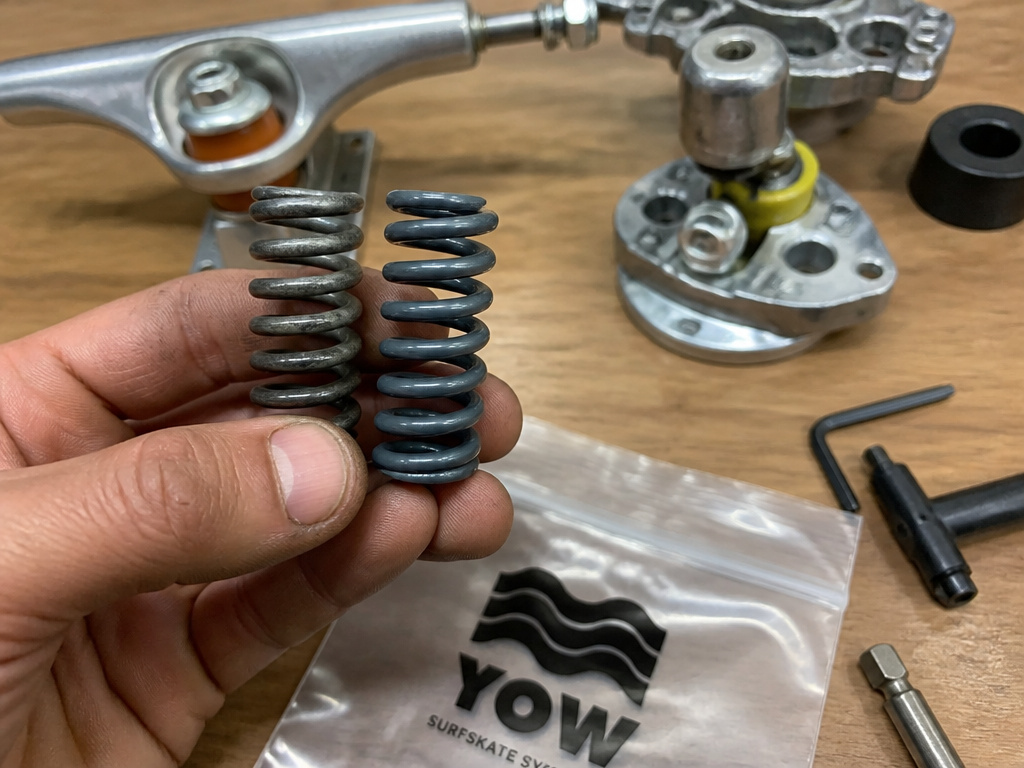
A surfskate asks for more attention than a skateboard. It’s a more complex machine.
Skateboard maintenance is straightforward. You’ll replace worn-down grip tape, swap out chipped or coned wheels, and occasionally change battered bearings. Trucks last for years, with only the rubber bushings needing replacement if they split or deform.
Surfskate trucks have moving parts that can wear. Spring-based systems (YOW S5, Carver C7) can experience spring fatigue over time, leading to a soggy, less responsive feel. Bushing-based systems (Carver CX) are more similar to standard trucks but still have specific, often proprietary, replacement parts. You can’t just walk into any shop and grab a replacement spring for a YOW truck. You’re ordering from the manufacturer or a specialized retailer. It’s not a deal-breaker, but it’s a real cost and hassle factor.
Worth knowing before you start: A gummed-up surfskate pivot point doesn’t squeak, it just feels dead. The carve that used to be crisp now requires more effort, and you’ll lose pumping efficiency long before anything visibly breaks.
Transitioning Between the Two
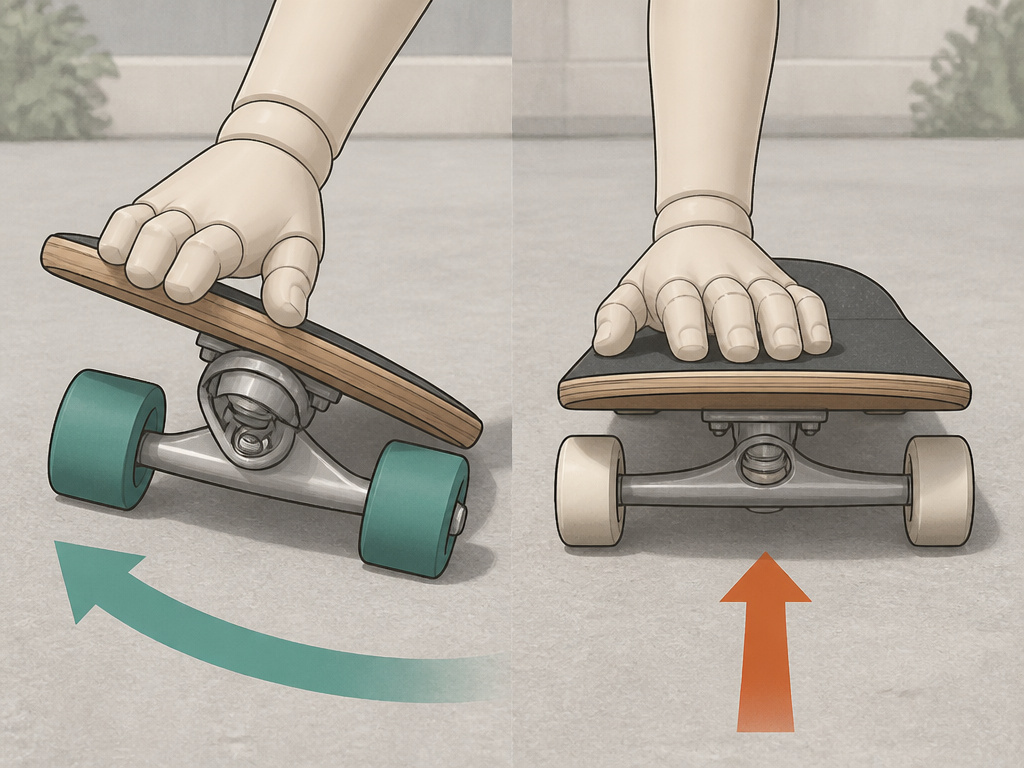
Many riders end up owning both. The skills transfer, but with a catch.
Balance, commitment, and reading terrain are universal. The foot placement and weight distribution you learn on one board will inform your riding on the other. However, the muscle memory is different. The explosive, straight-up pop of a skateboard ollie is useless on a surfskate. Conversely, the full-body, flowing pump of a surfskate will over-rotate a skateboard turn.
When you switch, give yourself a ten-minute adjustment period. Your first few carves on a skateboard after riding a surfskate will feel unresponsive. Your first attempt to pump a surfskate for speed will feel like you’re fighting a wet noodle. That’s normal. Let the board tell you what it wants, and you’ll adapt faster than you think.
Frequently Asked Questions
Is surfskate good for beginners?
It can be, but choose carefully. Very loose, spring-based systems can be twitchy and intimidating. Beginners, especially those with a skateboarding background, often find more stable, bushing-based systems like the Carver CX a better entry point. The goal is a board that feels fun, not frightening.
What’s the difference between a surfskate and a skateboard?
The core difference is the front truck. Surfskates use a specialized pivoting or spring mechanism for deep, surf-like carving and pumping. Skateboards use a fixed TKP truck for stability, pop, and technical trick execution. This leads to different wheels, decks, and riding styles.
Can you surfskate with a normal skateboard?
Not really. A normal skateboard’s fixed truck cannot replicate the deep lean and pumping generation of a surfskate system. You can carve, but you will not be able to generate meaningful speed without pushing. For proper surfskating, you need the specialized truck.
Is it harder to surf or skateboard?
They’re difficult in different ways. Surfing has the added variables of ocean conditions, paddling, and wave selection. Skateboarding demands precise, repetitive technique for tricks and carries high-impact consequences for failure. A surfskate helps you practice the carving and weight-transfer parts of surfing on predictable, solid ground.
Before You Go
Don’t get lost in the specs. Answer one question: what do you want to feel when you ride?
If you want the board to disappear under you, becoming an extension of your body as you flow through turns, get a surfskate. Start with a stable model like a Carver CX complete. If you want the board to be a tool you command, snapping it into the air and landing on a specific spot, get a skateboard. Pick a reputable complete from a local shop.
Then, go roll. The differences on paper are academic until your feet are on the grip tape. The right board is the one that makes you want to go back outside and try again tomorrow. Everything else is just noise.
