
Skateboard Helmet Certifications Explained: How to Choose
This post contains affiliate links. As an Amazon Associate, we earn from qualifying purchases.
Skateboard helmet certifications are defined by three main labels: CPSC 16 CFR 1203 for bicycle helmets, ASTM F1492 for skateboarding-specific impacts, and Snell N-94 as a rigorous voluntary standard. A helmet marketed exclusively for skateboarding is exempt from CPSC rules, but sources disagree on multi-use helmets: the CDC states a multi-use helmet must have an ASTM F1492 label, while CPSC regulation requires it to comply with CPSC 16 CFR 1203.
That exemption is where most people get tripped up. A “skate-style” helmet sold at a big-box store might only carry the CPSC bicycle certification, which doesn’t test for the angled curb strikes a skater’s head actually hits. Understanding skateboard helmet certifications explained is key to making a safe choice.
This guide walks through what each standard physically tests, the anvils, the drop heights, the g-force limits, and where they overlap or conflict, serving as your complete skateboard helmet certifications explained. By the end, you’ll be able to read any helmet’s label in ten seconds and know exactly what it’s rated to protect against.
Key Takeaways
- A helmet marketed exclusively for skateboarding is exempt from the CPSC bicycle helmet standard, but the CDC says a multi-use helmet used for skating must have an ASTM F1492 label.
- ASTM F1492 tests against three specific anvil types (flat, cylindrical hazard, triangular hazard) to simulate curb and rail strikes, where CPSC 16 CFR 1203 uses mostly flat anvils for road impacts.
- Peer-reviewed data shows even certified helmets have degraded performance on a second impact; the CPSC states protection is for “only a limited number of impacts.”
- For activities capable of maintained speeds of at least 20 mph, the CPSC advises a bicycle helmet may not be appropriate, a critical note for electric skateboarders.
- Always store a helmet in a room-temperature area away from direct sunlight; the CDC explicitly warns against leaving it in a hot car.
CPSC 16 CFR 1203: The Bicycle Helmet Mandate
The U.S. Consumer Product Safety Commission (CPSC) standard 16 CFR 1203 is a federal law for bicycle helmets. Its testing is brutal and specific. Manufacturers must submit at least eight helmets of each size. Two get baked between 117°F and 127°F (47°C and 53°C) for up to a day. Two get frozen between 1°F and 9°F (-17°C and -13°C). Two soak underwater. Each one must be impact-tested within two minutes of coming out of its conditioning chamber.
Technical Snippet: CPSC 16 CFR 1203 testing requires a minimum of 8 helmets per size. Conditioning includes 4-24 hours at extreme temperatures (1–9°F and 117–127°F) and underwater immersion. Impact tests use primarily flat anvils to simulate pavement, and retention straps must not stretch more than 1.2 inches (30 mm) under load.
The key twist for skaters is in the exemption. CPSC regulation exempts helmets marketed exclusively for skateboarding from the CPSC bicycle helmet standard (16 CFR 1203). That sounds like a pass. But if you buy a “multi-sport” helmet and use it for skateboarding, the rule flips: it must comply. This creates a gap a lot of big-box store helmets fall into. They look like skate helmets but only have the CPSC bike certification, leaving you without the specific curb-strike protection you need.
Where this goes sideways for electric skateboarders is speed. The CPSC’s own helmet selection brochure notes that for activities “capable of maintained speeds of at least 20 mph,” a bicycle helmet may not be appropriate. If you’re riding an e-skate that hits 22 mph, your certification choice just got more complicated.
ASTM F1492: The Skateboard-Specific Standard
This is the standard written for what skaters actually hit. Where CPSC tests focus on flat pavement, ASTM F1492 skateboard helmet standard adds two more anvil shapes: a cylindrical hazard and a triangular hazard. Think of the edge of a curb or the corner of a concrete ledge. The standard is revised every five years, and a helmet passes or fails completely, there’s no partial compliance.
ASTM F1492 testing includes impacts against three anvil types to simulate curb and rail strikes. The CPSC brochure notes a helmet complying with ASTM F1492 is “designed to withstand more than one moderate impact, but protection is provided for only a limited number of impacts.” That “limited number” is vague because it depends on force. A 2020 study in the British Journal of Sports Medicine recorded peak accelerations at different drop heights and found all helmets showed degraded impact performance on a second impact. They dropped certified helmets from different heights and measured the g-forces transmitted.
| Drop Height | Peak Acceleration Range (g) | Real-World Simile |
|---|---|---|
| 0.8 m (~2.6 ft) | 114–148 g | A low-speed fall from a push or failed trick. |
| 1.5 m (~4.9 ft) | 173–220 g | A fall from a mid-height ramp or obstacle. |
| 2.0 m (~6.6 ft) | 219–259 g | A high-impact fall from a significant height. |
The study found all helmets showed degraded impact performance on a second impact, a key point in any skateboard helmet certifications explained. The foam liner compresses. It doesn’t fully rebound. This is why the standard exists, and why replacing a helmet after a solid hit isn’t just cautious, it’s following the physics.
Snell N-94 and Other Certifications
Snell N-94 is a voluntary standard, not a U.S. legal requirement. The Snell Memorial Foundation is a non-profit that sets often more stringent benchmarks. The CPSC lists it as an applicable standard for skateboarding helmets alongside ASTM F1492. If you see a Snell sticker, you’re looking at a helmet that passed a separate, rigorous private testing protocol.
Then there’s NOCSAE (National Operating Committee on Standards in Athletic Equipment), which is referenced in some CPSC brochures. It’s a standard often associated with team sports like football and baseball, but its certification can be applied to skate helmets by the manufacturer or the Safety Equipment Institute (SEI). It’s another layer in a market with multiple, overlapping seals.
For skaters in Europe or those buying European brands, EN 1078 is the key. This European Standard specifies requirements for helmets used by pedal cyclists, skateboarders, and roller skaters. It’s a single standard covering those activities, which simplifies things compared to the U.S. Landscape.
So which is better? It’s the wrong question. ASTM F1492 is designed for the specific hazards of skating. Snell N-94 often represents a higher tier of performance. For a skater, ASTM F1492 is the essential baseline. Snell or dual certification (like ASTM + Snell) is a premium upgrade.
Decoding the Multi-Use Helmet Dilemma
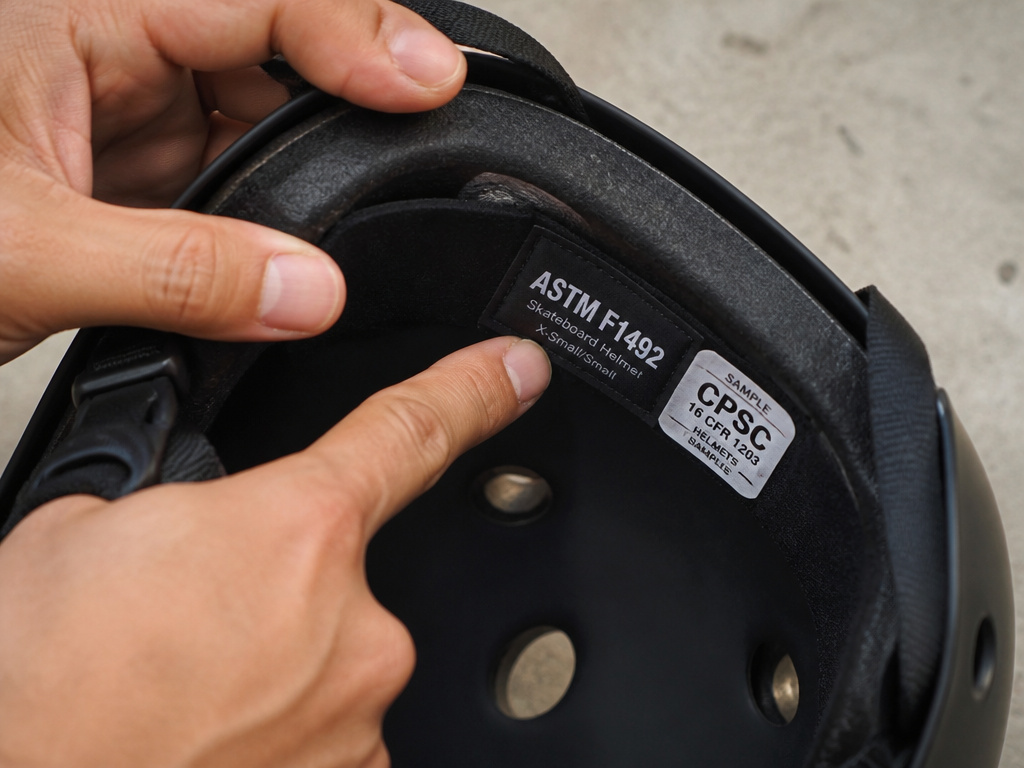
Here is where official sources disagree, and it’s a critical gap for buyers. The CDC’s skateboard helmet fact sheet is direct: “A multi-use helmet must have an ASTM label certifying it for skateboarding.” Meanwhile, the CPSC regulation says helmets marketed exclusively for skateboarding are exempt from the CPSC bicycle standard.
This creates a potential gap in certification requirements. A parent buys a “multi-sport” helmet at a general sporting goods store. It has a CPSC 16 CFR 1203 sticker for biking. They assume it’s fine for the skatepark. But without that ASTM F1492 label, it hasn’t been tested against the cylindrical or triangular hazard anvils that simulate curb and rail impacts. The helmet may not be tested against the specific anvil types used in ASTM F1492 for skateboarding impacts.
Common mistake: Assuming a CPSC-certified bicycle helmet is sufficient for skateboarding. For a multi-use helmet, the CDC mandates an ASTM F1492 label. Missing it means missing specific curb-strike tests.
The fix is simple but requires diligence: ignore the “skate style” marketing. Turn the helmet over and look for the certification label sewn into the liner or stamped on the polystyrene that says “ASTM F1492”. The words “ASTM F1492” need to be there. If you’re also biking, look for a dual-certified helmet that carries both CPSC 16 CFR 1203 and ASTM F1492 labels. Some brands offer models with both certifications.
What to Look for on the Label (And What to Ignore)
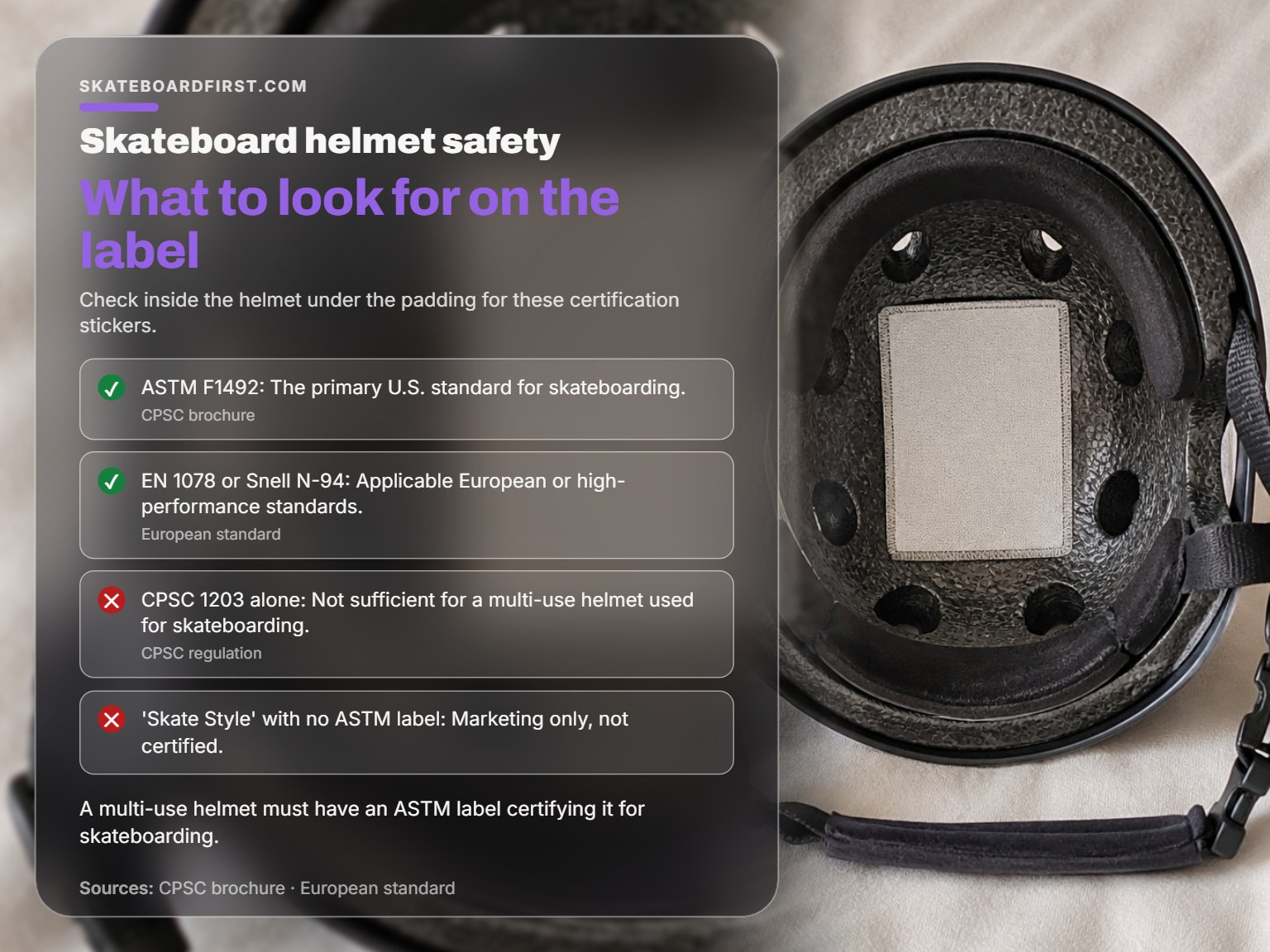
Certification stickers are your only source of truth. They’re usually located inside the helmet, under the comfort padding. Certification labels should list the specific standard(s) the helmet meets.
Here’s a quick-reference table to cut through the noise:
| Label Says | What It Means | Is It Sufficient for Skateboarding? |
|---|---|---|
| CPSC 16 CFR 1203 | Meets U.S. Federal standard for bicycle helmets. Tested primarily against flat anvils. | No, unless also ASTM F1492. A multi-use helmet needs the ASTM label per CDC guidance. |
| ASTM F1492 | Meets U.S. Standard for skateboarding/trick roller skating. Tested against flat, cylindrical, and triangular hazard anvils. | Yes. This is the primary certification you need. |
| Dual Certified (CPSC + ASTM) | Meets both bicycle and skateboarding standards. | Yes, and ideal for someone who also rides bikes. |
| Snell N-94 | Meets voluntary, often more stringent Snell Foundation standard for skateboarding. | Yes, and a mark of higher performance. Often found alongside ASTM F1492. |
| EN 1078 | Meets European standard for cycling, skateboarding, and roller skating. | Yes, for European market. Equivalent to a combined CPSC/ASTM scope. |
| “Skate Style” or “Multi-Sport” (no ASTM label) | Marketing term only. Indicates shape, not certified performance. | No. This is the most common misleading label in big-box stores. |
Beyond the label, fit is everything. The CDC guide is specific: the chin strap should fit snugly, so that no more than one or two fingers fit between the chin and the strap. A helmet that can shift side-to-side or rock forward over your eyes upon impact is just a plastic hat.
How Certifications Connect to Real-World Protection
Certifications are a baseline, not a force field. The same 2020 BJSM study that gave us the g-force numbers also found head injuries comprised up to 75% of all injuries in skateboarding, yet helmet use was less than 35%. Among competitive athletes, it was below 5%.
The standards are designed to prevent skull fractures and severe traumatic brain injury. They are not designed to make you concussion-proof. A concussion is caused by the brain moving inside the skull, which can happen at acceleration levels below those that cause a fracture.
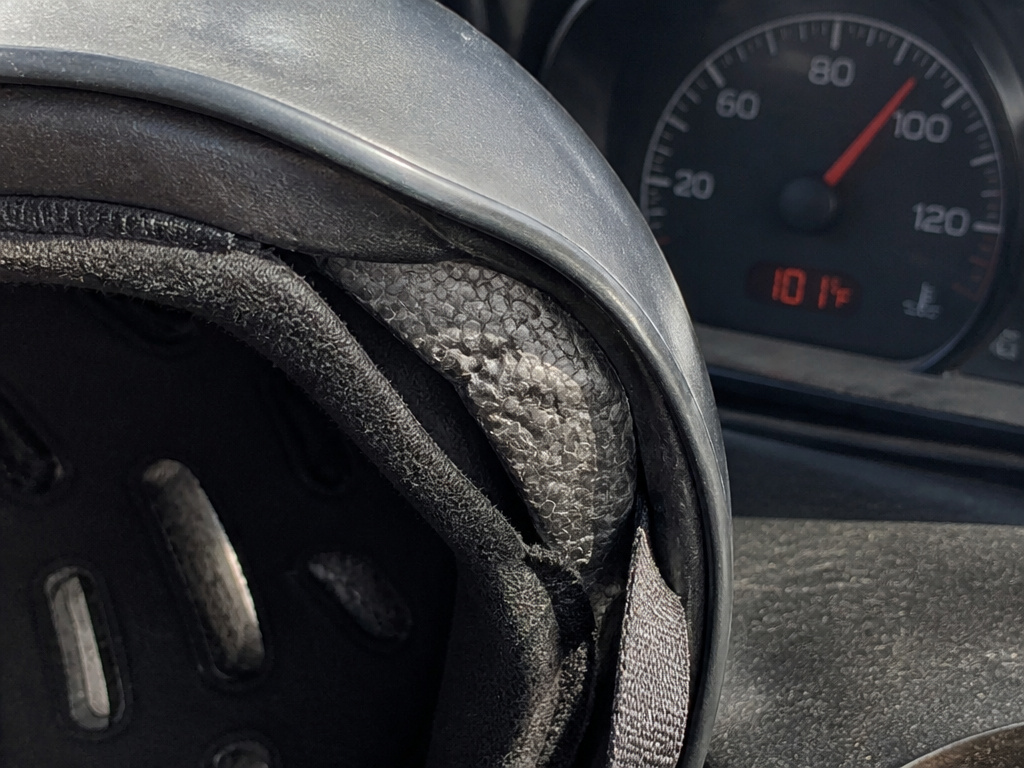
Where this goes sideways: Storing a helmet in a car. The CDC explicitly advises against it, stating it should be kept in a room-temperature area away from direct sunlight. The CDC advises against storing a helmet in a car; it should be kept in a room-temperature area away from direct sunlight.
Replacement timelines are another gray area. The CPSC advises that without manufacturer guidance, “it may be prudent to replace your helmet within 5–10 years of purchase.” That’s a huge window. The real triggers are more immediate: any visible damage (cracks, crushed foam), a significant impact (even if it looks fine), or if there is any other sign of damage or degradation.
Frequently Asked Questions
Is Snell or ASTM better for skateboarding?
ASTM F1492 is the activity-specific standard, so it’s the necessary foundation. Snell N-94 is a voluntary standard listed by the CPSC as applicable for skateboarding helmets. A helmet can be certified to both ASTM F1492 and Snell N-94. For pure skateboarding, ASTM is the must-have; Snell is a excellent plus.
Can I use my bike helmet for skateboarding?
You can, but you shouldn’t unless it is also dual-certified with ASTM F1492. A CPSC-only bicycle helmet hasn’t been tested against the cylindrical and triangular hazard anvils that simulate curb and rail strikes common in skating. For a multi-use helmet, the CDC specifically states it must have an ASTM label certifying it for skateboarding.
What does dual certification mean?
It means the helmet has been tested and passed two separate standards. The most common and useful combination for skaters is CPSC 16 CFR 1203 (bicycle) + ASTM F1492 (skateboard). This means it’s legally certified for biking and specifically tested for skateboarding hazards. It’s the best choice for anyone who does both activities.
Are more expensive helmets safer?
Not necessarily. A $50 helmet with a valid ASTM F1492 certification has passed the same baseline impact tests as a $150 helmet. The certification label, not the price tag, indicates the helmet has passed required impact tests. The certification label, not the price tag, is the primary indicator of safety performance.
How do I know if my helmet is certified?
Look inside the helmet, under the comfort liner. You should find a permanent label or stamp listing the standard(s) it meets (e.g., “CPSC 16 CFR 1203,” “ASTM F1492”). If you can’t find a clear, specific label, assume it is not certified for impact protection.
Before You Go
The rule is simpler than the alphabet soup of certifications makes it seem. For skateboarding, you need a helmet with an ASTM F1492 label inside it. If you also ride a bike, make sure it has a CPSC 16 CFR 1203 label right next to it. That’s dual certification, and it’s what you should be hunting for.
Ignore the shape, ignore the “skate style” marketing, ignore everything except that sewn-in tag. Check it before you buy. Then, adjust the fit so the chin strap is snug, allowing no more than one or two fingers between the chin and strap.
One thing most guides skip: if you’re riding an electric skateboard that can hold 20 mph or more, re-read the CPSC note about bicycle helmets potentially not being appropriate. The CPSC advises that for activities capable of maintained speeds of at least 20 mph, a bicycle helmet may not be appropriate. The standards are a minimum. Your head deserves the maximum you can find within them.
