Are Skateboard Helmets Required by Law? Legal Consequences
This post contains affiliate links. As an Amazon Associate, we earn from qualifying purchases.
Skateboard helmet laws are not uniform; they vary by state and sometimes by city. Currently, only a few states have explicit mandates: Hawaii (under 18), Rhode Island (15 or younger), and New York (under 14) have laws. Virginia authorizes local ordinances for those 14 or younger, and North Carolina requires helmets at all skateparks. The legal requirement is almost always tied to a specific safety standard, most commonly the CPSC bicycle helmet standard or ASTM F1492 for skateboarding.
That patchwork of rules means your legal obligation changes the moment you cross a city or state line. A skater who is legal in one town might be ticketed in the next.
This guide walks through each state’s law verbatim, explains how to check your local ordinance, and details the real-world consequences, from fines to park ejection, you face if you ride without one where it’s required.
Key Takeaways
- State helmet laws target minors, with age limits varying from under 14 to under 18.
- Legal standards vary by state, with some requiring CPSC standards, others referencing ASTM or other certifications.
- Fines for violations are typically levied against parents or guardians, ranging from $25 to $50, and are often suspended for first-time offenders who buy a helmet.
- Public skateparks, especially unsupervised ones, frequently have stricter rules than the surrounding city, requiring full pads for entry.
- Legally, a multi-sport or bicycle helmet is often sufficient, but safety experts insist on a label certifying it for skateboarding use.
Which States Have Skateboard Helmet Laws?
You will not find a federal law requiring skateboard helmets. The rules are a scattered mix of state statutes and local ordinances. Four states have clear, active laws on the books, and one has a unique rule for skateparks. Here is the breakdown, sourced directly from each state’s legal code.
The technical snippet: Hawaii Revised Statutes §291C-139.5 mandates helmet use for persons under 18 on public property. Rhode Island General Laws § 31-19-2.1 applies to those 15 or younger on public rights-of-way. New York State law, per the Department of Health, requires helmets for children under 14. Virginia Code § 46.2-906.1 authorizes localities to enact ordinances for those 14 or younger. Each law references compliance with a recognized safety standard.
It requires any skateboarder under 18 on public property to wear a helmet that has been tested by a nationally recognized agency. The law is new, so enforcement patterns are still emerging.
Rhode Island has one of the clearer statutes. Its law covers anyone 15 or younger using a skateboard on a public highway, path, or park. The key clause is that the helmet must meet the standards set by the United States Consumer Product Safety Commission (CPSC) or subsequent standards. This directly ties the legal requirement to a specific, verifiable certification.
New York presents a live disagreement between current law and a pending bill. The New York State Department of Health states the law requires helmets for children under 14. However, a 2023 Senate bill proposes raising that age to under 18. For now, the New York State Department of Health states the law requires helmets for children under 14, while a proposed bill seeks to raise the age to under 18. The state health department recommends a CPSC-certified helmet, while the proposed bill references ANSI Z 90.4, Snell, and ASTM standards.
Virginia takes a different approach. The state code doesn’t impose a blanket rule. Instead, it gives every city, county, and town the authority to create its own ordinance requiring helmets for skateboarders 14 or younger. If your locality has such an ordinance, the helmet must at least meet the CPSC standard.
North Carolina stands out with a law focused on venues, not individuals. The state mandates that all skatepark operators, including towns running unsupervised public parks, require every user to wear a helmet, elbow pads, and kneepads. This turns helmet use into a condition of entry, enforced by the park itself.
| State | Age Requirement | Helmet Standard Cited | Key Details |
|---|---|---|---|
| Hawaii | Under 18 | Tested by a national agency (e.g., NHTSA) | Applies on all public property. |
| Rhode Island | 15 or younger | CPSC standard or subsequent | Covers public rights-of-way, paths, and parks. |
| New York | Under 14 (law) / Under 18 (proposed) | CPSC (current) / ANSI, Snell, ASTM (proposed) | $50 fine for parents; law is currently under 14. |
| Virginia | 14 or younger (if local ordinance exists) | CPSC standard | $25 fine, often suspended if a helmet is purchased. |
| North Carolina | All skatepark users | Not specified in statute | Law targets park operators, who must enforce helmet and pad rules. |
The Legal Consequences of Not Wearing One
The penalty for breaking a helmet law, when are skateboard helmets required by law, almost always falls on a parent or guardian, not the young skater. Fines are the primary tool, and they are designed to encourage compliance, not punishment.
In New York, the Health Department notes parents could face a $50 fine if their child is caught riding without a helmet. The Virginia code sets a lower baseline: violation of a local ordinance is punishable by a $25 fine. However, Virginia’s law has a built-in off-ramp. That fine is suspended for first-time violators and for anyone who, after being cited but before the fine is imposed, goes out and purchases a compliant helmet.
Where this goes sideways: Assuming a warning is guaranteed. Police and park officials can issue a citation on the first contact, especially if the violation is part of a broader crackdown or if the skatepark has posted, unambiguous rules.
Beyond fines, the more immediate consequence is ejection from a skatepark. Under laws like North Carolina’s, the park operator is legally obligated to ensure everyone wears a helmet. If you do not have one, you simply cannot skate there. Private skateparks have the same right to refuse service for safety violations.
For adults, the legal risk shifts from fines to liability. If you are injured while skating without a helmet in a jurisdiction with a helmet law, your failure to follow the law could be used against you in a personal injury lawsuit to argue contributory negligence.
How to Find Your Local Ordinance
State laws are easy to look up. Local ordinances are trickier. Your city or county can have rules that are stricter than state law, or it might be the only authority with any rules at all, as in Virginia.
Here is a practical, three-step method to find the rule that applies to you.
- Search Your City’s “Code of Ordinances.” Go to your city or county government website. Look for a section titled “Code,” “Municipal Code,” or “Ordinances.” Use the site’s search function. Good search terms are “skateboard,” “helmet,” “toy vehicle,” or “bicycle helmet.” The law is often grouped with bicycle and scooter regulations.
- Check Parks and Recreation Department Rules. If the city code is silent, the specific rules for public skateparks are usually set by the Parks and Rec department. These are often listed as “Park Rules” or “Facility Guidelines” on their website. This is where you will find mandatory pad rules.
- Call or Visit. If online searches fail, a direct call to the non-emergency police line or the parks department can get you an answer in minutes. Ask: “Does [City Name] have a law requiring helmets for skateboarders, and if so, what are the age and helmet standard requirements?”
I learned this the hard way: I assumed my mid-sized city had no helmet law because none of my friends wore one. I was stopped by a community service officer while practicing in an empty school parking lot. He was polite, explained the local ordinance for skaters under 16, and sent me on my way with a warning. The lesson was not about the fine, it was that I had been unknowingly breaking a rule for months. Now I check.
CPSC vs. ASTM: Which Standard Makes It Legal?
This is the most common point of confusion. The answer depends on whether you are satisfying the law or following best safety practice. They are not always the same thing.
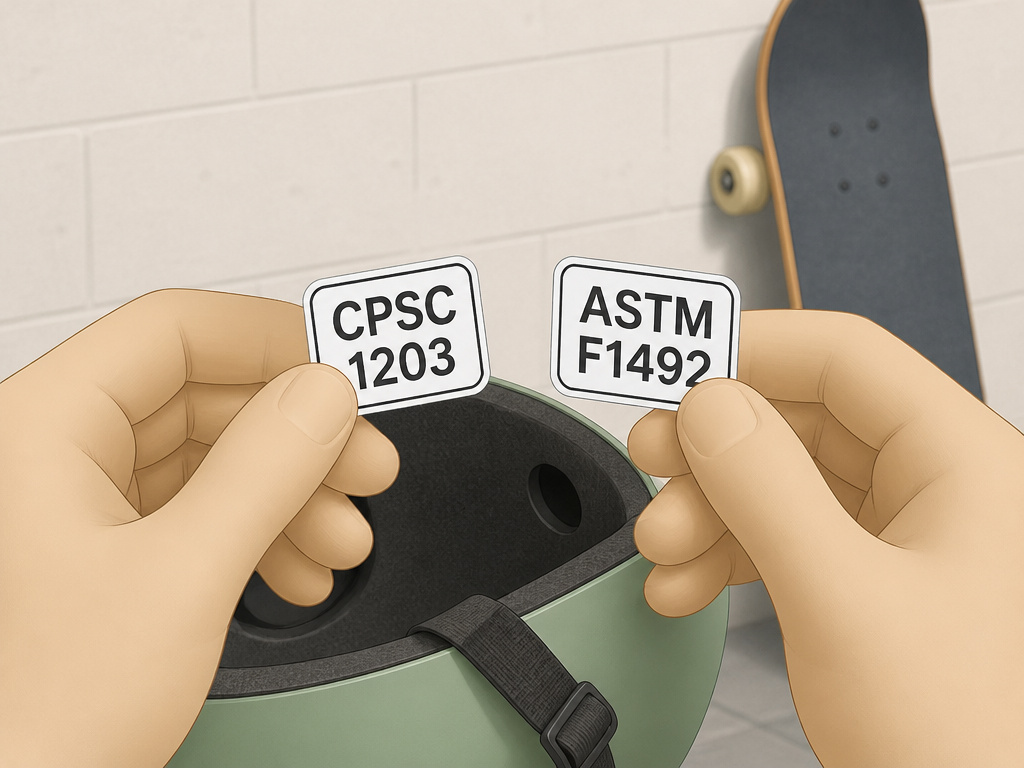
For legal compliance, most state laws point to the CPSC bicycle helmet standard (16 CFR 1203). This is the standard referenced in the Rhode Island and Virginia laws. It is a federal safety benchmark designed for impact protection in bicycle falls. If a law specifies the CPSC standard, a CPSC-certified helmet meets that requirement, but other laws may reference different standards like ASTM or Snell.
For skateboarding-specific safety, experts point to ASTM F1492. The CPSC states that for skateboarding, the applicable helmet standard is ASTM F1492 and Snell N-94. Why the difference? Skateboard falls often involve multiple impacts on the same spot, sliding out on a ramp, for example. ASTM F1492 helmets are designed to withstand more than one moderate impact, whereas bicycle helmets are optimized for a single, severe crash.
Common mistake: Buying a helmet that only meets the CPSC standard for a young skater who spends all day at the park. It is legally sufficient, but it may need replacing after a single hard slam, while an ASTM F1492 helmet could survive that session.
The safest, most hassle-free choice is a dual-certified helmet. Many brands make helmets that carry both CPSC and ASTM F1492 certifications. This covers you legally in virtually all jurisdictions and gives you the added durability skateboarding demands. Look for both labels inside the helmet.
Why Many Skaters Still Don’t Wear Helmets
The law is one thing; culture is another. On any given day at a public park, you will see more skaters without helmets than with them. This resistance is not just about rebellion. It comes from a mix of practical and historical reasons.
Comfort and perception are the biggest factors. A helmet can feel hot, limit peripheral vision, and mess with your balance if it is not fitted perfectly. For experienced skaters used to the feeling of the wind, adding a helmet changes the entire sensory experience of the sport. There is also a strong cultural legacy. Street skating grew as a counterculture activity, and helmets were associated with organized, sanctioned sports, the opposite of skating’s DIY ethos.
The “look” still matters, too. Despite brands making sleeker, well-ventilated helmets, many skaters feel helmets are uncool. This is especially potent for teenagers, who are both the primary target of helmet laws and the most sensitive to social perception.
What most people get wrong: Thinking this is only about young rebels. I hear from adult beginners all the time who feel embarrassed to gear up. They worry they will look like a nervous rookie. My stance never changes: looking like a careful beginner is smarter than looking like a hospital patient.
The discussion in skating communities is slowly shifting. High-profile injuries and the visibility of protective gear in events like the Olympics are making pads and helmets more common.
Safety Recommendations vs. Legal Requirements
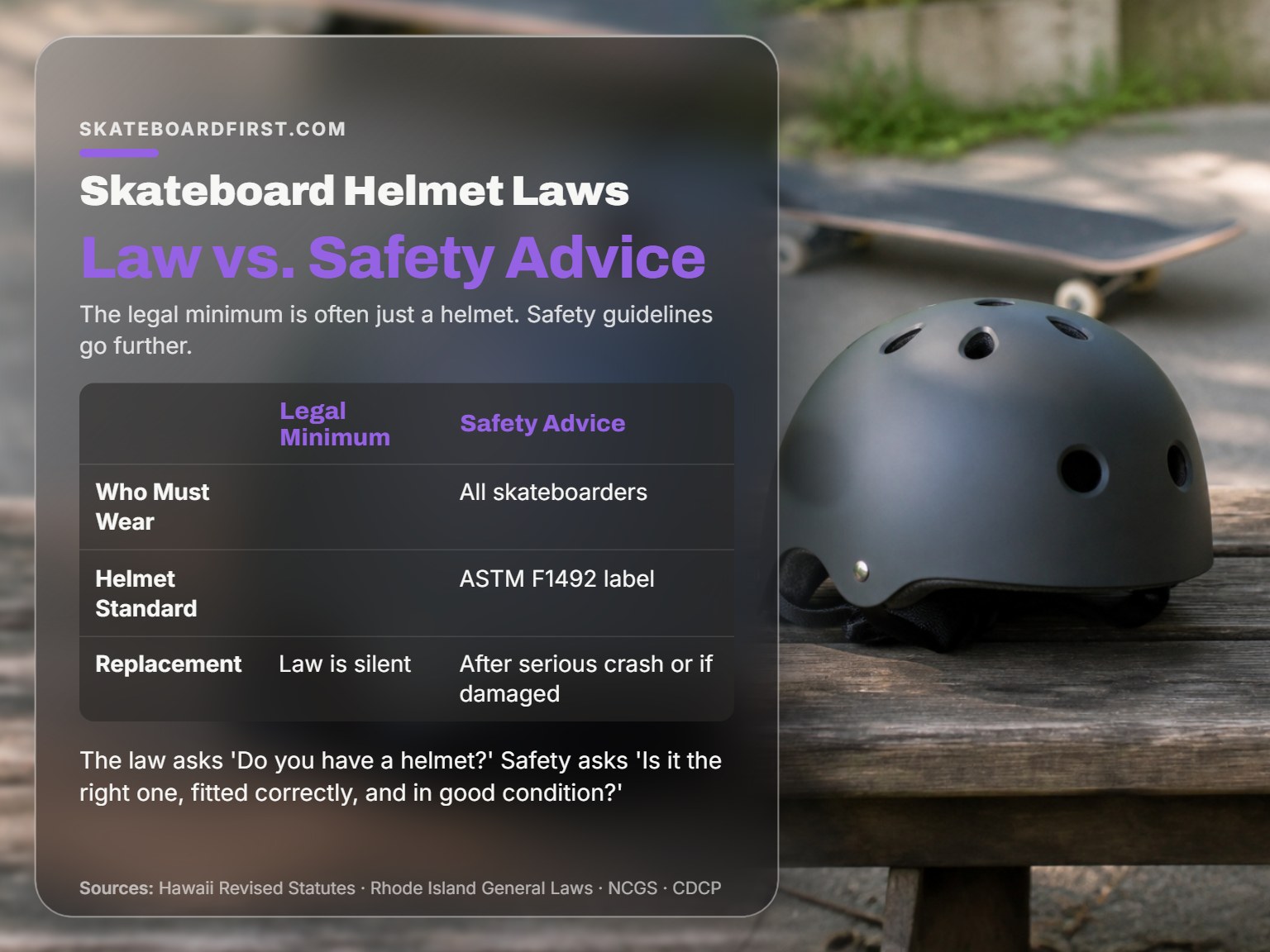
The law sets a minimum floor. Safety organizations set a higher bar. It is crucial to know the difference so you can make an informed choice for yourself or your kids.
The legal requirement varies, sometimes mandating only a helmet for a certain age group, while other laws require additional protective gear at skateparks. The safety recommendation is more comprehensive. The CDC and CPSC advise not just any helmet, but one stored properly (not in a hot car), replaced after any serious crash, and never decorated with paint or stickers without checking with the manufacturer first.
Here is where the advice goes beyond the law:
- Full Protective Gear: The law might only demand a helmet. The New York Department of Health recommends wearing elbow and knee pads, and the CPSC suggests wrist guards are especially important for skateboarders. Wrist guards are singled out as especially important.
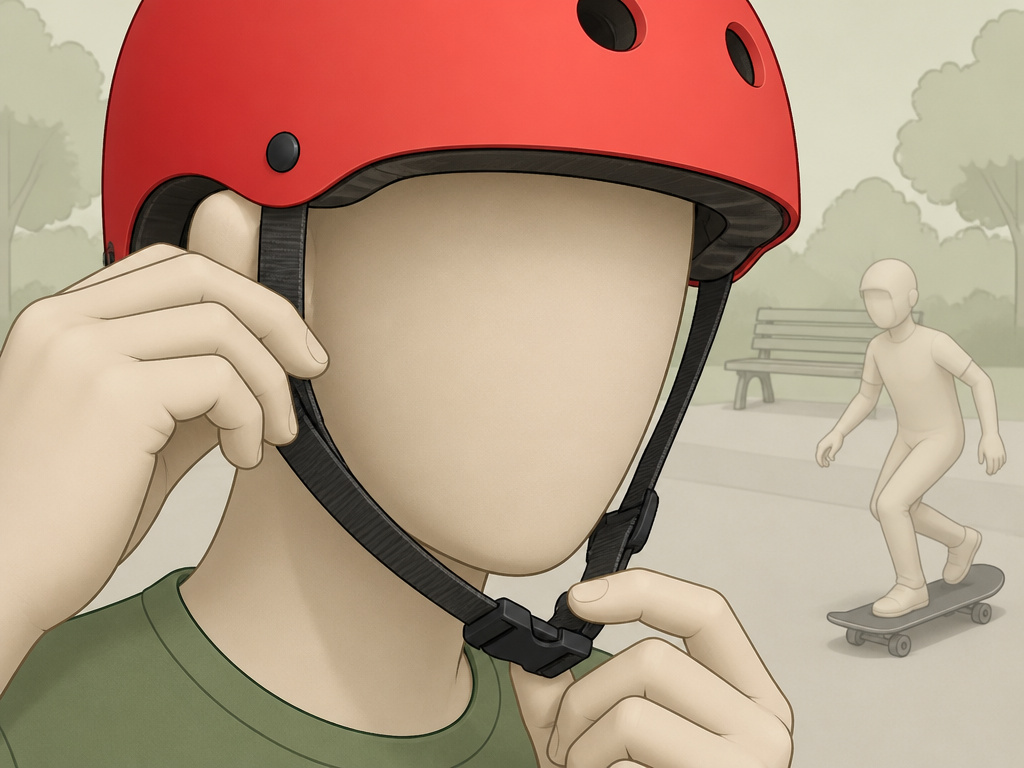
- Helmet Fit: A legally compliant helmet is useless if it flies off. The CPSC states it must fit snugly with the chin strap fastened and sit level on the head, not tilted back. The New York Department of Health advises that helmets should fit two finger widths above your eyebrow.
- Replacement Timeline: The law is silent on this. The CPSC advises that in the absence of manufacturer guidance, it may be prudent to replace a helmet within 5–10 years of purchase. The CDC states a skateboard helmet MUST be replaced if it has been involved in a serious crash or is damaged.
Think of it this way: the law asks, “Do you have a helmet on?” The safety guidelines ask, “Is that helmet the right one, fitted correctly, and in good condition to actually protect you?”
Are helmets enforced at skateparks?
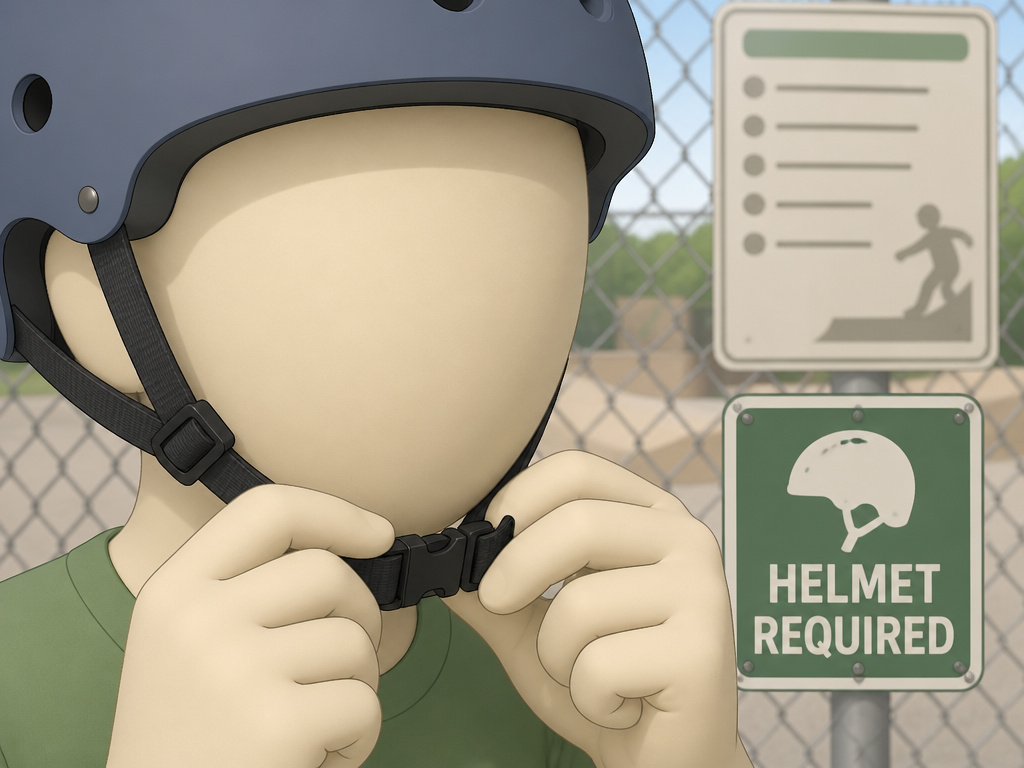
Enforcement depends heavily on location. Some states have specific laws governing skatepark use. North Carolina law mandates that operators of skateboard parks require all users to wear a helmet, elbow pads, and kneepads. In other states, a local ordinance might apply if the skatepark is on public property. For example, Virginia authorizes localities to enact such ordinances for younger riders. In practice, enforcement often falls to the park operator or local authorities, and compliance can vary. Checking posted park rules or contacting your local parks department is the best way to know the specific requirements and how strictly they are enforced.
Frequently Asked Questions
Is it legal to ride a skateboard without a helmet?
In most of the United States, yes, it is legal for adults. For minors, it depends entirely on your state and city laws. As outlined above, states like Hawaii, Rhode Island, and New York have laws prohibiting it for certain age groups. Always check your local ordinance.
Why do skaters refuse to wear helmets?
The reasons are cultural, practical, and historical. Many skaters view helmets as uncomfortable, restrictive to vision and balance, and uncool within the sport’s counterculture identity. Street skating’s roots as a rebellious activity also fostered a tradition of going without “official” safety gear.
Can I use my bike helmet for skateboarding?
For legal compliance, often yes, if the law specifies the CPSC standard, a bike helmet meets it. For safety, maybe not. Bike helmets are designed for a single severe impact. Skateboarding involves repeated, lower-impact slams. A helmet certified to the skateboard-specific ASTM F1492 standard is safer for the sport.
Can police take your skateboard?
Police generally cannot confiscate your skateboard simply for not wearing a helmet. Penalties can include fines for parents or guardians, as seen in New York and Virginia laws. However, if you are violating a local ordinance that prohibits skateboarding entirely in a certain area (like a business district), police could potentially cite you for trespass or confiscate the board as evidence under local nuisance laws, but this is rare for a simple helmet violation.
Before You Go
The essential advice comes as a checklist. First, satisfy the law: know your local age rule and buy a helmet that meets the cited standard (usually CPSC). Second, respect the sport’s demands: choose a dual-certified (CPSC/ASTM F1492) helmet from a brand like Triple Eight for better impact management. Finally, follow the expert advice that goes beyond the law, get the fit right, add wrist guards, and replace the helmet the moment its liner shows damage.
Do not assume your community has no rules. A five-minute search of your city’s code could save you a fine and, more importantly, set a safer example for every skater who watches you roll by.
