
How Often Should You Replace a Skateboard Helmet?
This post contains affiliate links. As an Amazon Associate, we earn from qualifying purchases.
Replace a skateboard helmet after a serious crash, when you see visible damage like cracks or crushed foam, or based on age according to manufacturer guidance, as sources suggest intervals ranging from 3 to 10 years. Official sources like the CDC and CPSC mandate replacement post-impact, while manufacturers like Powerslide cite a 3-5 year shelf life for plastics and foams.
The plastic shell and the energy-absorbing EPS foam inside can dry out, turn brittle, and lose their ability to compress on impact over time. A common question is how often should you replace a skateboard helmet. A helmet that looks fine on the outside can be useless inside.
What follows is a clear breakdown of the replacement rules from the agencies that write them and the brands that build the gear. We will explain the simple 2-2-2 rule for easy recall, the specific signs of damage that mean ‘replace it now,’ and how to handle conflicting advice from different sources.
Key Takeaways
- A serious impact means any fall where you think, “I’m glad I was wearing a helmet.” The CDC skateboard helmet fact sheet states replacement is mandatory after a serious crash.
- Check the date of manufacture label inside the helmet. Manufacturers like Powerslide advise a 3-5 year lifespan, while the CPSC helmet selection guide suggests 5-10 years if the maker gives no guidance.
- Inspect the foam liner by removing the comfort pads. Look for stress fractures, a soft or crumbly texture, or a permanent dent, these are clear replace-now signals.
- Storage kills helmets faster than skating. Leaving a helmet in a hot car trunk or in direct sunlight accelerates the breakdown of the materials.
The Official Standards: What ASTM F1492 Actually Says
A true skateboard helmet must meet the ASTM F1492 helmet standard. This specification requires impact testing on three anvil types, flat, cylindrical hazard, and triangular hazard, and is designed for multiple moderate impacts. The standard itself does not set a replacement schedule; it defines pass/fail performance criteria.
If your helmet has a sticker inside certifying it to ASTM F1492, it’s built for the repeated small hits of skateboarding. This is different from a bicycle helmet standard (CPSC 1203), which is for a single major impact. That’s why you can’t just grab any “skate-style” lid, you need the right certification.
The standard is reviewed every five years, which hints at the industry’s own view on product evolution and material science. But the label doesn’t tell you when your specific helmet is done. For that, you need to combine the standard with the manufacturer’s care instructions and your own honest inspection of how often should you replace a skateboard helmet.
The Multi-Impact Myth
A common misunderstanding is that “multi-impact” means indestructible. The ASTM standard is for multiple moderate impacts. A “moderate” hit is the kind you shrug off. A slam that rattles your teeth or leaves you seeing stars is severe, and the foam liner is likely compressed in that spot. It might not show from the outside, but its job is done.
I see skaters at the park wearing the same scarred helmet for years, convinced it’s still good because it’s “multi-impact.” The shell can take scratches, but the foam inside has a memory. After a couple of real knocks, it’s time for a new one. This is where a good helmet damage inspection habit pays off.
The 2-2-2 Rule for Helmet Replacement
You don’t need to memorize a manual. This simple mnemonic covers the three most common replacement triggers.
Two Years of Heavy Use
If you’re skating multiple times a week, the sweat, UV exposure, and general wear add up. The CPSC helmet selection guide notes that plastics can become brittle and foams can degrade. After years of heavy use, the helmet may need replacement. For normal use, manufacturers like Powerslide cite a 3-5 year lifespan.
Two Serious Crashes
This is the big one. The CDC skateboard helmet fact sheet is unambiguous: a helmet must be replaced after a serious crash. What’s “serious”? If your head hit the ground with force and you felt the impact through the helmet, it counts. Don’t gamble on the second one. The foam compresses once to save your skull; it can’t reliably do it again in the same spot.
Two Finger-Widths Too Loose
Fit is safety. If you can slide the helmet more than two finger-widths on your forehead or if it shifts easily when you shake your head, it’s not protecting you. This can happen as the internal padding compresses over time or if you’ve changed your hairstyle. A proper helmet fitting is your first step, and an annual fit check should be part of your routine.
| Replacement Trigger | What To Look For | Immediate Action |
|---|---|---|
| Serious Impact | Any head strike with force. “I’m glad I had my helmet on” moment. | Replace immediately. |
| Visible Damage | Cracked shell, crushed or cracked foam liner, frayed straps, broken buckle. | Replace immediately. |
| Poor Fit | Helmet slides easily; forehead exposure exceeds two finger-widths. | Adjust fit pads or replace. |
| Age & Wear | Faded color, stiff or brittle plastic, odor from degraded foam. | Replace within manufacturer’s window (3-5 yrs). |
When Sources Disagree: Making Sense of the Timelines
Here’s where it gets practical. The official advice doesn’t always match, and your decision sits in the middle.
The CPSC, a U.S. Regulator, gives a wide 5-10 year guideline if the manufacturer is silent. Helmet maker Powerslide says 3-5 years of normal use. Retailer SkatePro says five years. Industrial safety brand KASK claims a 10-year shelf life from the manufacture date. Who’s right?
They all are, for their context. The CPSC’s conservative range covers all helmet types. Powerslide is speaking specifically about skate helmets exposed to sun and sweat. KASK’s longer lifespan assumes controlled storage and less frequent impacts. For a skateboard helmet living in your trunk and getting weekly park sessions, the shorter 3-5 year window is the safe bet.
Where this goes sideways: Assuming “multi-impact” means you never need to replace it after a crash. The Bicycle Helmet Safety Institute, an advocacy group, says you don’t need to replace it every time you crash, but “after some good hits you will.” This contrasts with the CDC’s absolute “MUST be replaced” after a serious crash. Sources disagree on post-impact replacement; the CDC mandates replacement after a serious crash, while others suggest replacement after severe impacts or visible damage.
Your best path is to use the most conservative guideline that applies to your situation, including the core question of how often should you replace a skateboard helmet. If you took a hard slam at month 4, the crash rule overrides the age rule. If your helmet is seven years old but has been in a closet, the material degradation rule might still apply. Check the helmet certifications label, then follow the maker’s care sheet if you have it.
Inspecting for Invisible Damage: A Step-by-Step Check
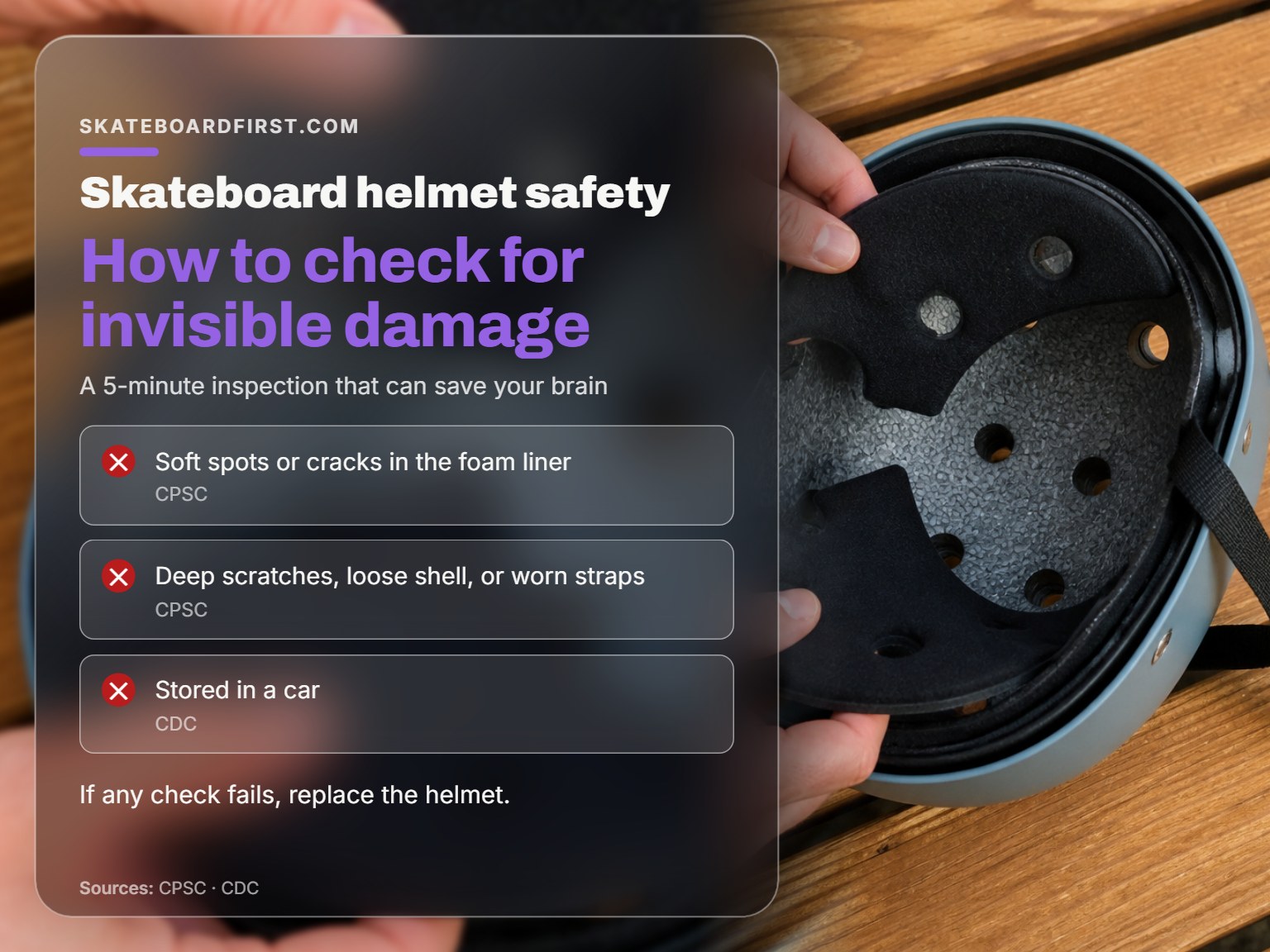
You can’t see the most critical damage. The EPS foam liner crushes to absorb energy, and that crush might not be visible without removing the comfort pads. Here’s how to check.
- Remove All Padding. Take out the soft, removable comfort pads. This exposes the hard foam liner.
- Flex and Feel. Gently press on the foam with your thumbs in different areas. It should feel uniformly firm. A soft spot or a area that gives more easily is a compression zone from an old impact.
- Look for Fractures. Examine the foam under good light. Look for fine, spider-web-like cracks or lines. This is stress fracturing, and it means the foam’s structure is compromised.
- Sniff Test. A sour, chemical, or “off” smell from deep inside the helmet can indicate the foam is breaking down from sweat and bacteria.
- Check the Shell and Hardware. Look for deep scratches that might be cracks, a shell that feels loose from the liner, and ensure all straps and buckles work smoothly.
If any of these checks fail, the helmet is done. This visual guide complements a more thorough how to tell if a helmet is damaged inspection. It takes five minutes and can literally save your brain.
The Storage Problem
A helmet ages more quickly in a car trunk. The CDC explicitly says not to store a skateboard helmet in a car. Extreme heat softens the shell and accelerates the breakdown of the foam’s polymers. When it cools, it becomes brittle. That thermal cycling is brutal. Store your helmet indoors, at room temperature, and out of direct sunlight. A simple habit that easily adds years of safe use.
How to Choose a Replacement Helmet
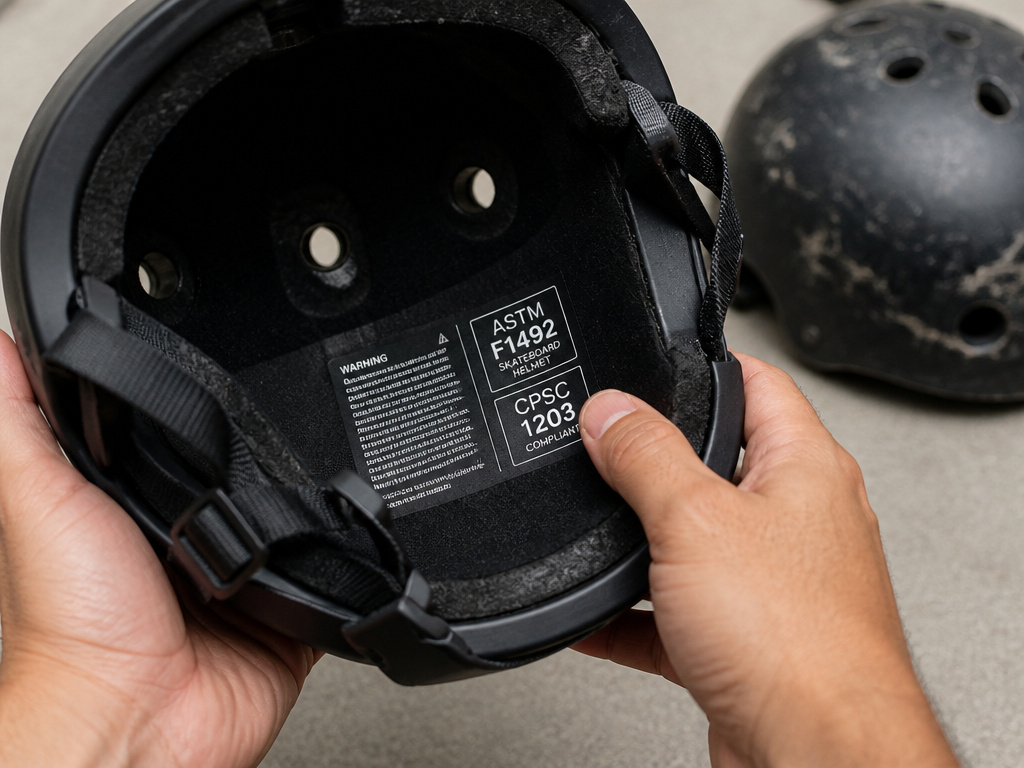
When the time comes, buy with purpose. Some advocates, like the Bicycle Helmet Safety Institute, recommend dual-certified helmets (ASTM F1492 for skating and CPSC 1203 for cycling) if you also ride bikes. Brands like Triple Eight and Pro-Tec make reliable, certified options.
Fit is critical. It should sit level on your head, covering your forehead, with no spaces between the foam and your skull. Use the helmet fitting guide to get it right.
Once you have it, maintain it. Clean the liner regularly with mild soap and water to prevent sweat from degrading the foam. Avoid paints and stickers unless the manufacturer approves them, solvents can weaken the shell. For a deep clean, follow a dedicated helmet cleaning routine.
Frequently Asked Questions
What is the 2-2-2 rule for helmets?
It’s a simple mnemonic: Replace your helmet after 2 years of heavy use, 2 serious crashes (where your head hits with force), or if it becomes 2 finger-widths too loose on your head. It’s a practical, easy-to-remember summary of the more detailed guidelines from safety agencies.
Is a 10-year-old helmet still good?
Almost certainly not for skateboarding. Even if stored perfectly, the plastics and foams undergo chemical changes over a decade. The CPSC suggests a 5-10 year guideline in the absence of manufacturer guidance.
Do helmets expire after 5 years?
Many do, based on manufacturer policies. Some retailers and brands recommend replacement at five years. Always check for a date-of-manufacture label and the maker’s specific care sheet.
Can I just replace the padding in an old helmet?
No. The replaceable comfort pads are for fit, not protection. The safety-critical part is the hard EPS foam liner fused to the shell. You cannot replace that. If the liner is aged or damaged, the entire helmet must be replaced.
Are more expensive helmets safer?
Not necessarily. A $50 helmet that meets the ASTM F1492 standard and fits you perfectly is safer than a $150 helmet that doesn’t fit or lacks the proper certification. The price often pays for features like better ventilation, lighter weight, or brand name. Focus on certification, fit, and condition first.
Before You Go
The single most important thing you can do is to start using the 2-2-2 rule today. The next time you finish a session, take two minutes to check your helmet’s fit and look for any new scuffs or dents. Mark your calendar to re-check the date of manufacture in six months.
If you’re skating in an old helmet you can’t remember buying, err on the side of caution and start looking at helmet recommendations for a new one. Your brain doesn’t get a second chance. Replace a helmet if you are unsure about its condition or age.
