
What Pads Do Beginner Skateboarders Need: How to Choose
This post contains affiliate links. As an Amazon Associate, we earn from qualifying purchases.
Beginner skateboarders need four pieces of protective gear: a certified helmet, knee pads, elbow pads, and wrist guards. The U.S. Consumer Product Safety Commission (CPSC) specifically recommends wrist guards to reduce fracture risk, alongside knee and elbow pads, while a helmet is absolutely essential for head safety.
That list isn’t a suggestion, it’s the baseline. The first time you step off a moving board, your hands and knees hit the ground before anything else. Wrist guards with a splint stop the hyperextension that snaps bones. Knee pads absorb the direct impact your joints can’t handle. A helmet is the one piece you never get a second chance with. This is what pads do beginner skateboarders need.
What follows is a breakdown of why those four pads are required, how to read the safety certifications on the label, the practical choices between a budget set and investing in gear that lasts, and a definitive answer to what pads do beginner skateboarders need. You’ll also learn how to adjust them so they stay put during a fall, because a sliding pad is a useless one.
Key Takeaways
- Start with four essential pads: a CPSC-certified helmet, knee pads, elbow pads, and wrist guards with splints.
- Look for the EN 14120 standard on pad packaging; it certifies the gear for roller sports and defines performance levels and user categories.
- Fit is everything. Pads must be snug enough not to slide, but not so tight they cut circulation, adjust straps before every session.
- Wrist guards prevent the most common beginner break, a forward fall onto an outstretched hand, making them arguably more critical than elbow pads at first.
- A basic pad set from reputable skate brands offers proven protection without the premium cost of pro-level gear.
The Essential 4 Pads Every Beginner Needs
Safety organizations provide recommendations for protective gear. The U.S. Consumer Product Safety Commission (CPSC) recommends wrist guards, knee pads, and elbow pads, and strongly recommends a helmet for skateboarding. Their fact sheet calls out wrist guards as “especially important for reducing the risk of fractures.” A separate CPSC publication for inline skating states a helmet, elbow pads, knee pads, wrist guards and gloves should always be worn. For a beginner, merging these lists gives you the four required items, which is the precise answer to what pads do beginner skateboarders need: helmet, knees, elbows, wrists.
A helmet, elbow pads, knee pads, wrist guards and gloves should always be worn for inline skating.. U.S. Consumer Product Safety Commission (CPSC) Publication 5014
Helmets are the one piece where “optional” isn’t a word. Head injuries don’t grade on a curve. For knee and elbow pads, the job is impact absorption on bone. Wrist guards are different. They have a rigid splint that runs along your palm to stop your hand from bending back too far during a fall, the mechanism behind most beginner wrist fractures. That’s why agencies single them out.
Why-Layer: When you fall forward, your instinct is to put your hands out. The force travels up your arm and concentrates at the wrist joint, which can hyperextend. A wrist guard’s splint acts as a lever, distributing that force along the length of the splint instead of letting it focus on the joint, which dramatically reduces the chance of a break or severe sprain.
How to Decode Skate Pad Standards and Labels
When you pick up a set of pads, the most important marking isn’t the brand logo. It’s the safety standard. In the U.S. And Europe, the key standard for skate pads is EN 14120:2003+A1:2007. This European norm covers wrist, palm, knee, and elbow protectors for roller sports. Brands like TSG and Roces design their products to meet it.
This standard does two critical things. First, it defines two performance levels. Level 1 is for normal roller sports. Level 2 is for acrobatic or high-speed use. Sources disagree on which level is suitable for skateboarding: Roces states its Level I protectors are NOT suitable for skateboarding, while Universal states its protectors ARE suitable for skateboards. Second, EN 14120 classifies pads by the wearer’s body mass into ranges, such as Category 1 for regular use. Your pad size must match your weight range for the certification to be valid.
Common mistake: Buying pads sized only by age (e.g., “Youth Medium”). The EN 14120 weight ranges (A, B, C) are the true determinant of whether the pad will perform as tested. A heavy kid in a Range A pad is not covered.
Another crucial label is the CE mark, which denotes compliance with the Personal Protective Equipment Regulation (EU) 2016/425. If you see that and the EN 14120 standard, you know the pad has passed impact absorption and strap-strength tests in a lab. It’s not a marketing term. It’s a verification that the product meets a defined set of safety requirements.
| Standard / Marking | What It Means | Why It Matters for Beginners |
|---|---|---|
| EN 14120:2003+A1:2007 | European standard for roller sports protectors. | Confirms the pads are designed for the impacts of skateboarding, not just general play. |
| CE Mark (PPE Reg. 2016/425) | Product complies with EU Personal Protective Equipment rules. | Indicates independent testing and certification by a “Notified Body.” |
| Performance Level (I or II) | Level I = normal use; Level II = acrobatic/high-speed. | Beginner pads are universally Level I. Level II is for advanced park/vert skating. |
| Weight Range (A, B, C) | Certifies protection based on user body mass (A: ≤25kg, etc.). | Ensures the pad’s construction is rated for your weight. Sizing by age alone can miss this. |
Wrist Guards vs. Knee Pads: Which is More Critical?
This is where my stance gets specific, and it’s grounded in the CPSC’s own priority. Their fact sheet highlights wrist guards for fracture prevention. In my experience teaching beginners, wrist guards prevent the most likely serious injury. A broken wrist sidelines you for weeks. A scraped knee hurts, but you can often skate the next day.
The mechanics tell the story. Beginners fall in two primary ways: forward onto hands, or sideways onto hips and knees. The forward fall is more frequent when learning to push, balance, and stop. Your hands shoot out instinctively. Without a guard, the wrist takes the full force. I’ve seen more people leave a session with a wrist injury than any other. That’s why I tell every new skater to put their wrist guards on before their helmet. It sounds extreme until you’ve helped someone with a swollen, aching wrist who skipped them.
Knee pads are a very close second. They protect a complex joint from direct impact and gravel burns. For learning to knee-slide, a fundamental bail technique, they’re mandatory. But if budget forces a choice, get the helmet and wrist guards first, then knee pads, then elbow pads. Elbow pads protect a smaller, less-frequently-impacted area for beginners. You can often tuck and roll to avoid elbow strikes; it’s harder to avoid landing on your hands.
How to Choose Pads That Fit (And Stay On)
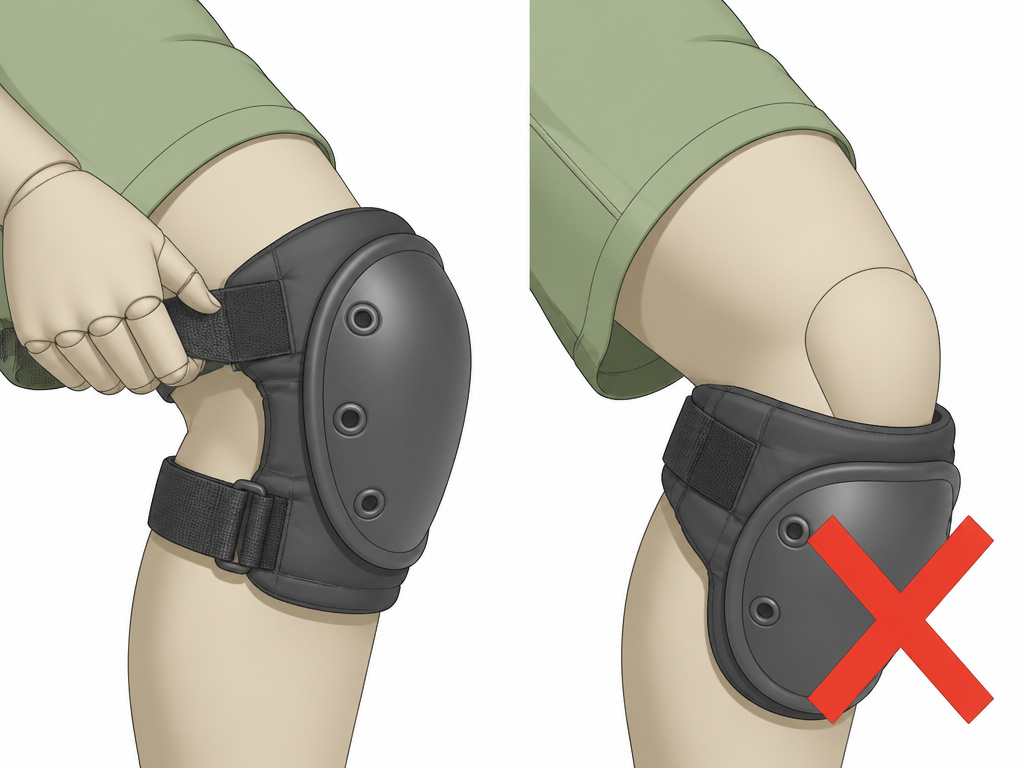
The best pad in the world is worthless if it slides off during a fall. Fit isn’t about comfort first; it’s about security. The Roces manual puts it simply: “The protector should fit tightly (not too lightly or too loose).” Universal’s advice is more detailed: “Knee and arm guards must fit firmly to avoid slipping off and to assure the best protection. Don’t tighten them too firmly to avoid blocking of blood circulation.”
Here’s the sensory reality check you need: once the pads are on, move. Jump, squat, swing your arms. Do they shift? Do the knee pads sag down your shin when you bend? That’s a fail. You should feel the cap seated solidly over your kneecap and the straps gripping, not pinching. A properly fitted knee pad won’t spin around your leg.
The 3-Point Fit Checklist:
- Cap Coverage: The hard plastic shell must completely cover the bone you’re protecting (kneecap, elbow point, wrist bone). No part of the bone should be exposed at the edge of the cap.
- Strap Security: After fastening, tug on the strap. It shouldn’t come loose. Velcro must engage fully along its length. If the strap ends are excessively long and overlapping, the pad might be too small.
- Range of Motion: Can you bend your knee or elbow fully without the pad binding or cutting in? Can you move your wrist freely? If not, adjust or try a different size. Protection shouldn’t immobilize you.
Where this goes sideways: Buying pads a size too big “to grow into.” A loose pad will rotate or slide on impact, exposing the joint. The protection is literally somewhere else when you need it. Always fit for now.
This is where a dedicated guide on wearing skateboard pads becomes invaluable, moving from theory to the actual steps of threading straps and seating caps correctly.
Buying Pads as a Set vs. Individually
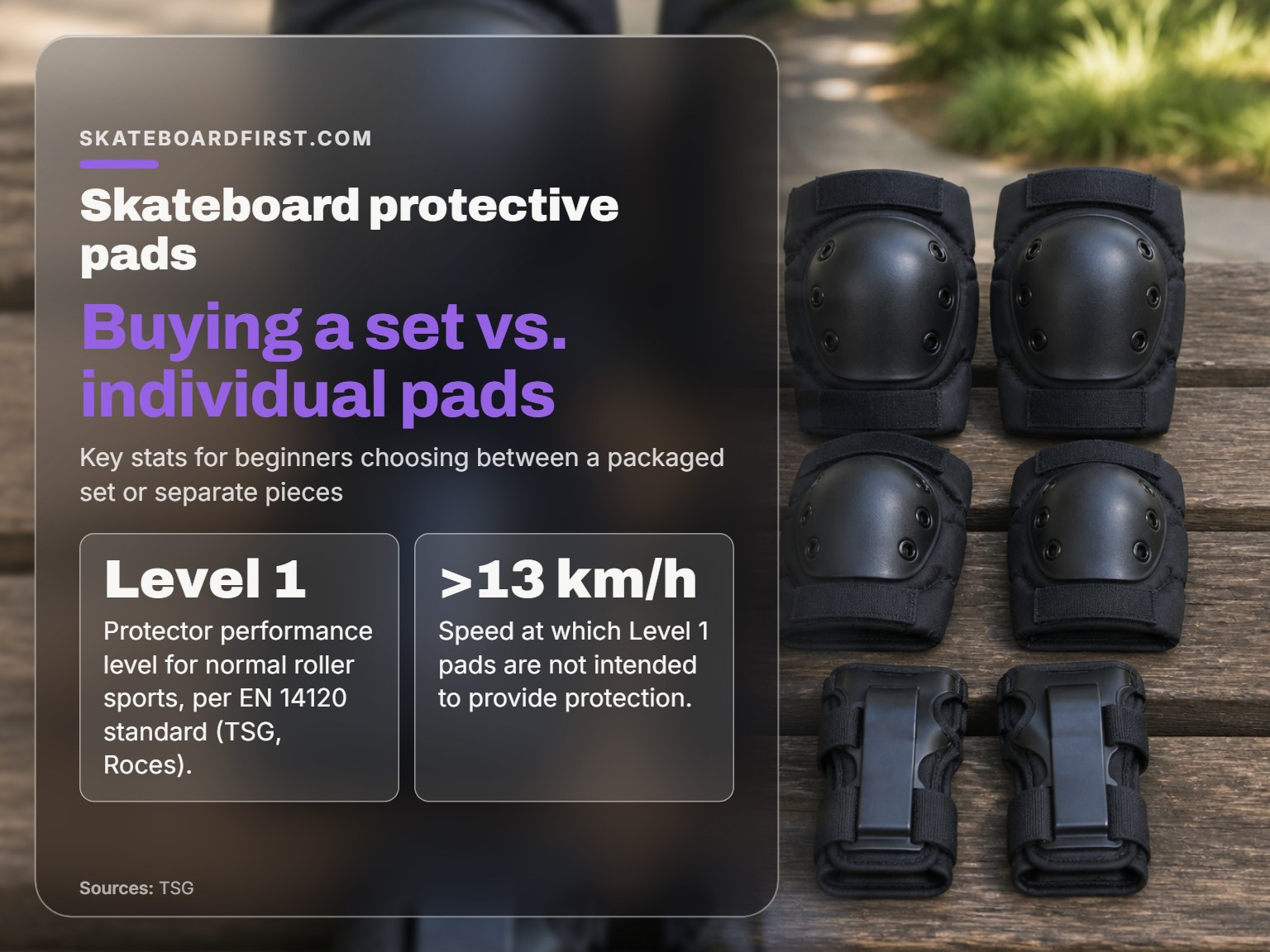
For a beginner, a packaged set is almost always the right answer. Brands like 187 Killer Pads, Triple Eight, and Pro-Tec sell “6-packs” or “3-packs” that include knee, elbow, and wrist pads. The advantages are clear: cost savings, guaranteed matching quality, and one less decision to make. A complete pad set gives you a coherent system.
Buying individually makes sense only in two scenarios. First, if your body proportions are unusual, very large knees but slender elbows, for instance. Second, when you’re ready to upgrade a specific piece. You might want heavier-duty knee pads for park skating while keeping your older, lighter elbow pads. But for day one, a set eliminates confusion.
| Buying Approach | Pros | Cons | Best For |
|---|---|---|---|
| Complete Set | Cost-effective, coordinated protection level, simpler purchase. | Less flexibility for odd-sized body parts. | >95% of beginners. |
| Individual Pads | Perfect fit for each joint, ability to mix performance levels. | Significantly more expensive, requires more research. | Beginners with atypical proportions or those replacing a single damaged pad. |
The packaging will also tell you if the set is designed for the weight range you need. This ties back to the EN 14120 standard. A set that meets EN 14120 Level 1 will indicate its weight range (B and C are common for teen/adult sets). This is more reliable than a vague “Adult Medium” label.
Recommended Brands and What to Look For
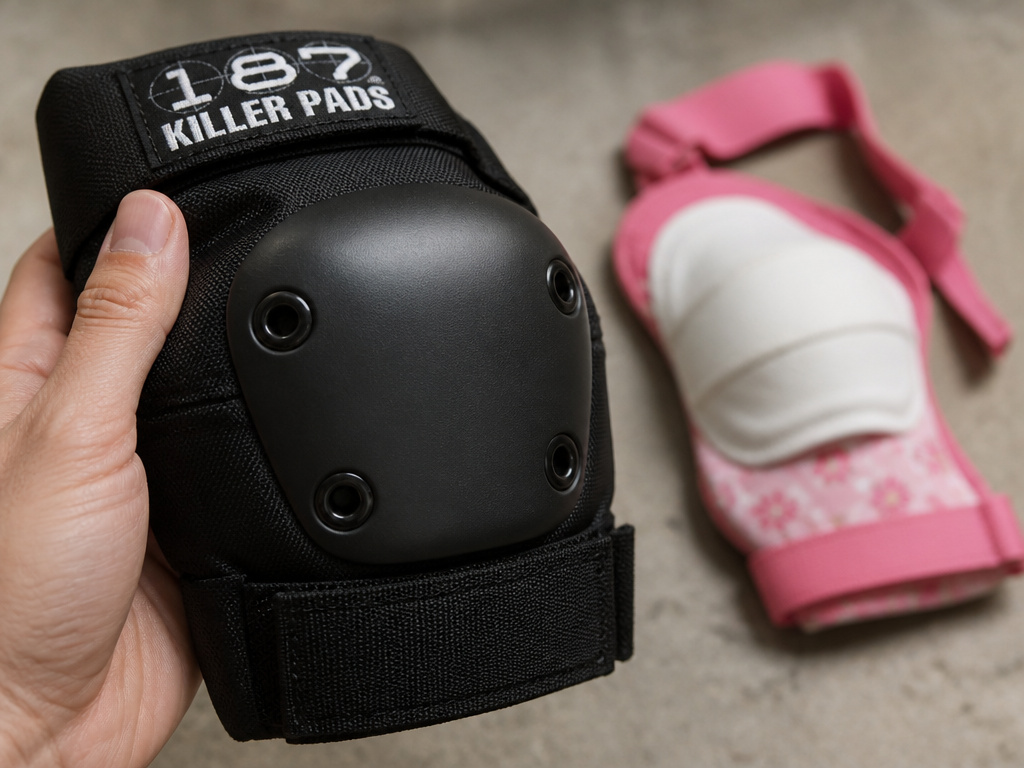
I reach for established skate brands when asked for a recommendation. They’ve been in the game for decades, their products consistently meet the EN 14120 standard, and they offer specific beginner sets. This isn’t a paid endorsement; it’s what you see at skateparks and what the best skateboard pads reviews consistently highlight.
187 Killer Pads are known for durable construction with ballistic nylon and robust stitching. Their “Six Pack” set is a staple. Triple Eight often leads in comfort and low-profile design, with their “Saver Series” being a popular entry point. Pro-Tec offers solid, no-fuss protection, like their “Spade Series” pack. You can’t go wrong starting with a basic set from any of them.
What you’re avoiding are generic, toy-store pads. They might have plastic caps, but the foam is thin, the straps are weak, and they almost never carry a real safety standard certification. They slip constantly and breed a dislike for wearing gear. Investing in a set from a skate brand means the pads will stay put, absorb a real impact, and last more than a few weeks. It’s the difference between gear that protects and costume pieces that pretend.
Remember, as the TSG manual explicitly states, even certified pads have limits. They “are not intended to provide protection in the event of a serious fall when travelling at speeds more than 13km/h.” They’re for the inevitable learning spills, not high-speed collisions.
What’s the difference between hard and soft skate pads?
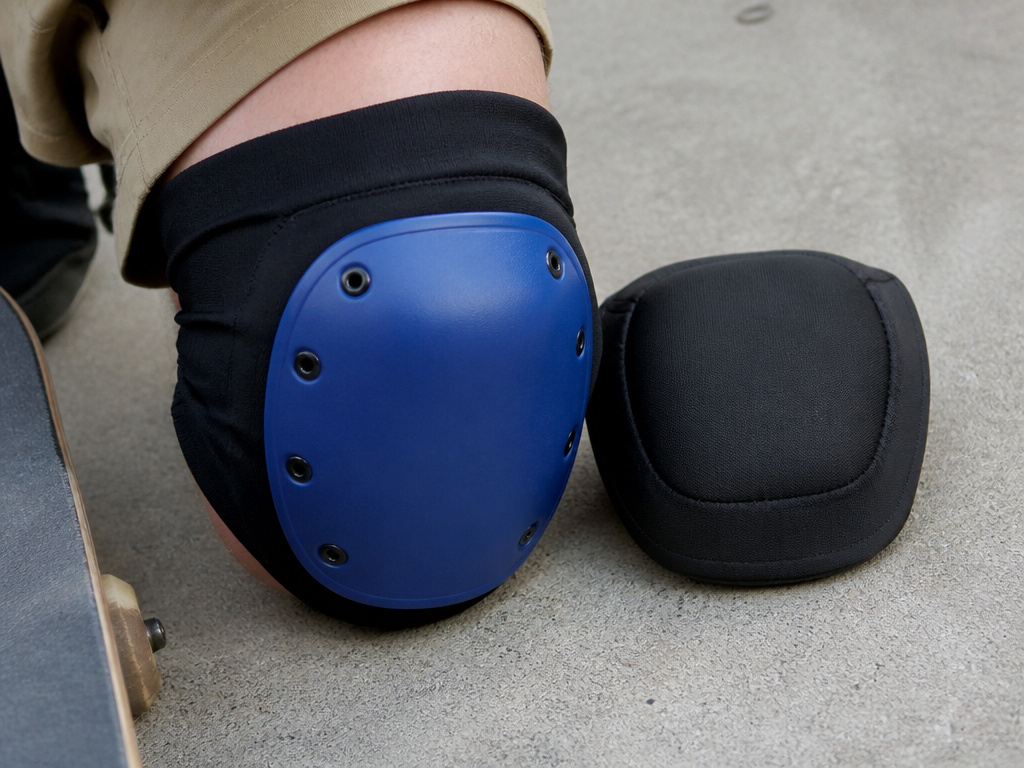
Protective pads for skateboarding are designed to different levels. Some are made for normal roller sports, which includes basic skateboarding. These are often marked as Level 1 protectors. Sources disagree on suitability: Roces states its Level I protectors are not intended for high-speed or acrobatic skating, while Universal states its protectors are suitable for skateboarding. The key difference you’ll see is in the construction: some pads have a hard plastic shell, or cap, designed to slide on impact, while others use softer, padded materials. For a beginner, a set with a hard cap on the knee and elbow pads can offer better impact dispersion on concrete. Regardless of style, all pads must fit firmly without cutting off circulation to work properly.
What pads should kids, teens, and adults wear?
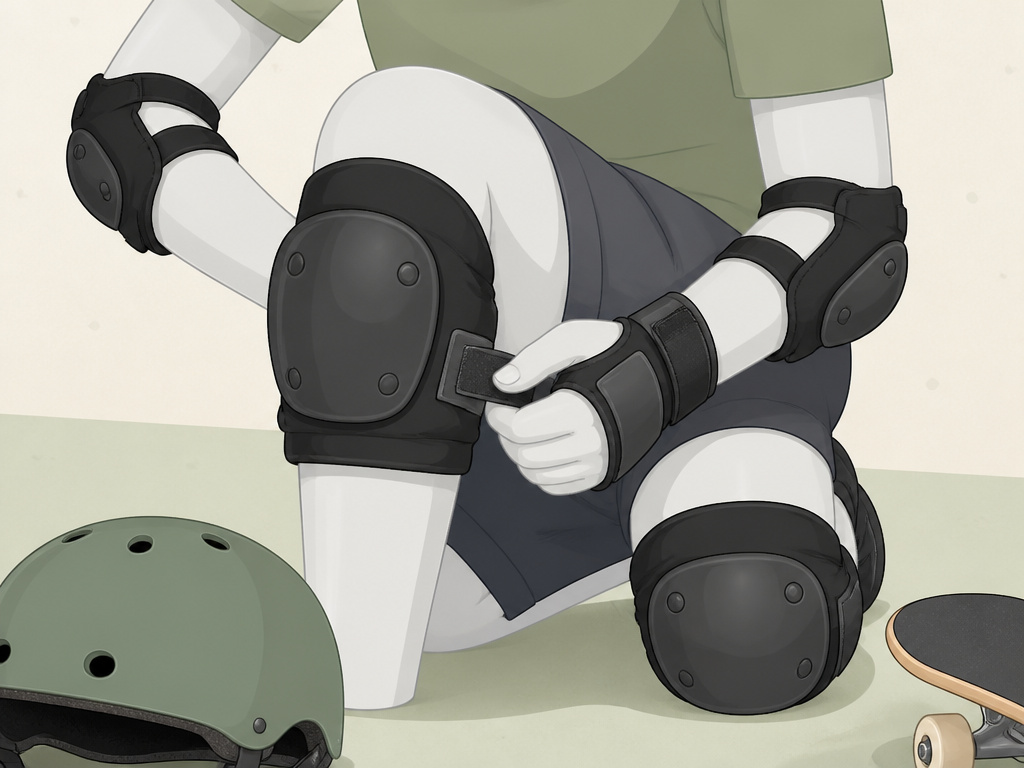
The core protective gear is the same for all ages: a helmet, wrist guards, knee pads, and elbow pads are essential. For kids and teens, proper fit is the most critical factor. Pads must be snug to stay in place during a fall but not so tight that they restrict movement or blood flow. The straps should be adjusted correctly, not too short or left overlapping. Adults should follow the same fitting principles. Safety organizations consistently recommend this full set of pads for anyone on a skateboard, emphasizing that wrist guards are especially important for reducing the risk of fractures common in beginners of any age.
Do I need different pads for park, street, or vert skating?
For a beginner, the foundational pad set remains the same whether you’re at a skatepark, on the street, or trying a ramp. You need a helmet, wrist guards, knee pads, and elbow pads. The main consideration is the protection level. Most beginner pads are designed for normal roller sports, which covers basic park and street skating. They are not suitable for high-speed or acrobatic disciplines. As your skating progresses to faster or more vertical styles, you may need equipment built for higher impacts. Always ensure your pads fit firmly to avoid slipping, as a sliding pad offers no protection during a fall.
Frequently Asked Questions
What does a beginner skateboarder need?
Beyond the board itself, a beginner needs the four core pads: a CPSC-certified helmet, knee pads, elbow pads, and wrist guards. Flat-soled skate shoes are also essential for board control and foot protection. Learning to push, turn, and stop safely is more important than any trick.
Is 27 too late to start skateboarding?
No. It’s a fantastic time to start. Your judgment is better, and you can afford proper protective gear, which you should wear without embarrassment. The learning curve is the same; your recovery time might be a bit longer, so pads are even more important.
What pads does Tony Hawk wear?
Tony Hawk wears pro-grade pads tailored for vert ramp skating, which involves high falls and high speeds. He typically uses bulky, knee-and-shin combo pads and heavy-duty wrist guards designed for Level II (acrobatic) impacts. Beginners should not use these as a benchmark; they are overkill and restrictive for learning flat-ground basics.
What board should a beginner skater get?
Beginner should get a complete skateboard from a skate shop or brand. Get a deck width between 8.0 and 8.5 inches for stability, medium-hard wheels (around 99a-101a) for a blend of roll and slide, and trucks that match the deck width. A shop-built complete ensures all components work together.
Do skateboard pads expire?
Yes, pads degrade. The Roces manual states a last utilization date from the date of production. UV light, sweat, and impact stress degrade plastics and foams. Inspect pads regularly for cracked caps, compressed foam, or frayed straps. If they’re damaged or overly aged, replace them. Your pads’ lifespan is finite.
Before You Go
Start with a complete pad set from a known brand. Check for the EN 14120 standard and match the weight range to your body. Before your first session, spend ten minutes putting everything on and adjusting all straps. Move around. Make sure nothing slides. That ritual matters more than the brand name on the cap.
One rule most guides skip: if you take a solid impact on a pad, inspect it right after. Look for deep cracks in the plastic or foam that no longer springs back. A pad that has done its job once might be compromised for the next hit. Gear is a consumable. Your bones are not.
