Skateboarding for Kids Guide: Safety, Gear and First Steps
This post contains affiliate links. As an Amazon Associate, we earn from qualifying purchases.
To start a child skateboarding safely, you need three things: a real skateboard (not a toy), a certified helmet that fits, and a flat, traffic-free practice area. The American Academy of Pediatrics says children under 5 should not skateboard, and kids aged 6 to 10 need close adult supervision. A real board has a 7-ply maple deck, metal trucks, and urethane wheels, which are essential for control and safety.
That last point about the board is where most parents trip up. A toy-store board with plastic wheels and a flimsy deck feels unstable from the first push, which makes learning frustrating and can actually increase the risk of a fall. The difference isn’t about price; it’s about how the board responds to a child’s weight and movement, a key principle in any good skateboarding for kids guide.
What follows: the specific safety standards from the CPSC and CDC, a breakdown of what makes a board “real,” a progression of skills that builds confidence instead of fear, and the one field-tested rule for keeping sessions fun so your kid wants to go back out.
Key Takeaways
- The American Academy of Pediatrics says children under 5 should not ride skateboards, while the CPSC advises close supervision for children under 8.
- Always use a skateboarding-specific helmet certified to a recognized standard like ASTM F1492 or Snell B-95 — a bike helmet won’t protect the back of the head the same way.
- Skip toy-store boards; a beginner setup with a 7-ply maple deck, metal trucks, and urethane wheels provides proper control.
- Teach how to fall safely before any tricks; learning to roll disperses impact and is the single best way to prevent serious injury.
- Keep early sessions short and focused on fun rolling; pushing for tricks before comfort breeds frustration and quitting.
The Safety Non-Negotiables
I’ll start with the most important safety rule. I’ve seen too many kids show up with a bike helmet and a board from a big-box store. That combo sets them up for a bad time. The authorities are very clear on this.
The U.S. Consumer Product Safety Commission (CPSC) states you should always wear protective gear when riding — especially a helmet. They call out wrist guards as especially important. This isn’t just good advice; in places like New Jersey, it’s the law for anyone under 17.
Before you start: A head injury can happen on flat ground from a simple loss of balance. A helmet designed for skateboarding has a hard shell and foam interior that extends lower in the back to protect against backward falls, which are common. A bike helmet doesn’t offer the same coverage.
The 3-Step Helmet Fit Check
You can’t just buy a helmet and hope it fits. The CDC’s Heads Up program has a specific checklist, and it’s the one I use every time I help a new skater get geared up.
First, the helmet must sit level on the head. The front rim should align with the eyebrows. If it’s tilted back, the forehead and the back of the skull are exposed. Second, the side straps should form a “V” shape under and slightly in front of the ears. Third, the chin strap must be snug. The CDC says no more than one or two fingers should fit between the strap and the chin.
My experience helping at local clinics taught me that helmet sizes vary wildly by brand. The number on the box is a suggestion, not a guarantee. You have to bring the child with you to try it on, with their hair styled how they’ll skate.
| Fit Check | What to Look For | What Happens If It’s Wrong |
|---|---|---|
| Position | Rim aligns with eyebrows, back covers the skull. | A tilted-back helmet exposes the forehead to impact; a too-low helmet blocks vision. |
| Strap “V” | Straps meet under and in front of the ears. | Loose side straps let the helmet shift on impact, reducing protection. |
| Chin Snugness | One or two fingers max between strap and chin. | A loose strap means the helmet can fly off in a fall, rendering it useless. |
For certification, look for a sticker inside stating it meets the ASTM F1492 standard for skateboarding helmets. Some older guides mention the Snell B-95 standard, but ASTM F1492 is the current, active specification that requires impact testing against flat, cylindrical, and triangular hazards.
Supervision and Age: What the Sources Actually Say
This is where you’ll find conflicting numbers, and it’s crucial to present them honestly. Different authoritative bodies give different age thresholds, and your approach should follow the stricter one.
The American Academy of Pediatrics is the most conservative: “Children younger than age 5 years should not ride skateboards. Children aged 6 to 10 years should have close adult supervision.” The CPSC uses a slightly older threshold, advising that “children under 8 years old should be supervised closely.”
My stance? I follow the AAP’s guidance. If your child is under 5, wait. For those 6 to 10, “close supervision” means you’re in the same paved area, watching, not on a bench looking at your phone. This age is about building confidence in a controlled setting, and your presence is the biggest part of that safety net. For more on this, our article breaking down the best age to start covers the developmental reasons behind these guidelines.
The Right Board: Skip the Toy Store
This is my biggest rant, and it comes from a place of bruised shins and frustrated kids. The character-branded board from the toy aisle is a liability. It’s not a skateboard; it’s a decoration with wheels.
Portland Parks & Recreation, which runs youth skate programs, is direct: “We recommend that participants in our skate programs do not use toy skateboards during instruction.” They cite weak components that won’t respond to stance, balance, or movement, which slows skill development and increases injury risk.
A real skateboard is built from specific, serviceable parts. Here’s what you’re looking for, straight from that same municipal guide:
- Deck: Made of wood. The industry standard is 7 plies of Canadian Maple. It should not flex much when your child stands on it. Decks from reputable skate brands make great, durable beginner decks.
- Trucks: The metal axles. They should be solid metal, not plastic. Look for a brand name stamped on the trucks.
- Wheels: Must be urethane, not plastic. Urethane grips the ground and absorbs vibration. Hardness is measured in durometer (the “a” scale). Softer wheels are easier on rough pavement; harder wheels are for smooth skateparks.
- Bearings: There are two per wheel, eight total. They need to spin freely. Expensive bearings are overkill for beginners; keeping them clean and dry matters more.
A toy board’s plastic wheels sound like a coffee grinder on pavement—a loud, chattering buzz. Urethane wheels have a smooth, quiet hum. That sound difference is the first clue your kid has a board that can actually roll and turn.
A pre-assembled “complete” board from a real skate shop is the best start. It guarantees the parts are compatible and of reasonable quality. Our dedicated guide to the best skateboards for kids lists vetted, shop-quality options.
First Skills: Rolling Before Tricks
The goal of the first ten sessions isn’t to kickflip. It’s to make rolling feel as natural as walking. Pushing for tricks too early is the most common mistake I see from eager parents.
Finding a Stance and First Push
Don’t overthink “regular” (left foot forward) or “goofy” (right foot forward). Have your child step onto the board on grass or carpet. Whichever foot they naturally put forward first is their likely stance. Let them switch and experiment; being comfortable pushing with both feet early is a huge long-term advantage.
The CDC’s BAM! Guide gives a clean sequence for the first push:
- Put one foot on the board, toward the front.
- Push off the ground with the other foot.
- Place that foot on the rear of the board and glide.
- Push again when you slow down.
The real skill here is weight distribution, a key focus in any good skateboarding for kids guide. Most beginners lean too far back, which makes the board shoot out ahead of them. Coach them to keep their weight centered, knees bent.
The Critical Skill: How to Fall Safely
You will fall. Everyone does. Teaching a child how to fall is the most important safety lesson after helmet use, and most guides gloss over it, a gap our skateboarding for kids guide aims to fill.
I teach a simple drill on grass: tuck and roll. When balance is lost, practice dropping into a crouch and rolling onto the shoulder and back, dispersing the force along the body instead of taking it on a wrist or knee. Wrist guards are vital, but they’re a backup, not a license to stick your hands out straight. A stiff-armed fall is a great way to break a wrist or collarbone. We have a full guide with step-by-step drills on teaching kids to fall safely.
Turning and Stopping
Turning comes from the trucks. Lean on your heels or toes to make the board carve. For sharper kicks-turns, they’ll learn to lift the front wheels slightly by pressing down on the tail.
The first brake is the foot brake. Teach them to step their back foot firmly onto the ground, letting the sole drag to slow down. The emergency brake is simply stepping off the board while it’s moving slowly, letting it roll away.
Keeping It Fun (The Real Challenge)
Skateboarding is hard. The initial wobbles and falls can be discouraging. Your job as a parent isn’t coach; it’s morale officer.
- Session Length: Start with 15-20 minutes. End on a high note, even if it’s just one good push across the lot. Quit before frustration sets in.
- Focus on Feel, Not Form: Praise effort, not perfection. “You stayed on for three pushes that time!” beats “You need to bend your knees more.”
- Warm-Up Games: Make it play. Set up a chalk target to push toward, or see who can roll the farthest in three pushes. This gets them moving without the pressure of “skateboarding.”
- Watch for Frustration Signs: Clenched jaw, throwing the board, sitting down and refusing to continue. That’s your cue to pack up and try again tomorrow. Forcing it breeds resentment.
I learned this the hard way helping a neighbor’s kid. We drilled pushing for 30 minutes in the summer heat until he sat down, near tears, and said he hated his board. We took a week off, came back with a water balloon target game, and he was laughing and rolling within minutes. The skill was there; the context was wrong.
When to Move to a Skatepark
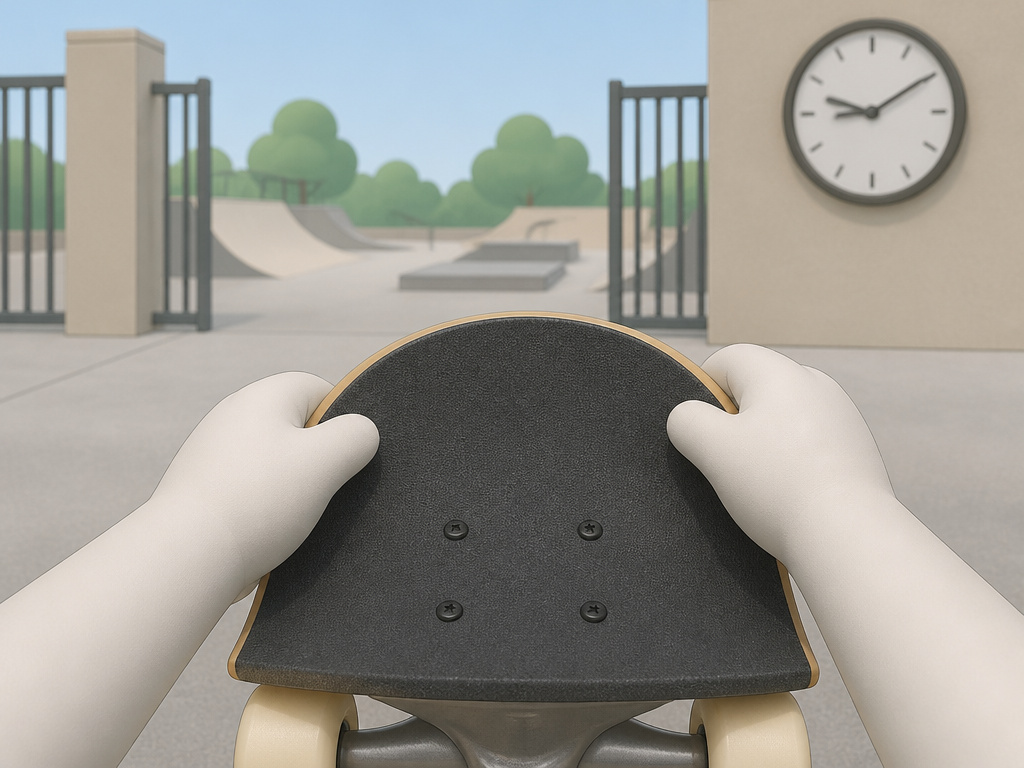
The street or an empty lot is the best classroom. The CDC is blunt: “Street skating is best left to the pros — it’s very dangerous.” Cars, curbs, and unpredictable surfaces are major hazards.
A skatepark is the next step, not the first. The benchmark for readiness is simple: Can your child control their speed, steer to avoid others, and stop reliably on flat ground? If yes, they have the basic control needed for a park.
The first park visit should be during a quiet time (weekday morning). Go with them. Your role is to help them read the flow of the park and understand the unspoken rules: wait your turn, don’t snake other riders, and watch out for others. Our guide covering supervising kids at the skatepark includes etiquette and how to spot safe zones.
What shoes are best for skateboarding
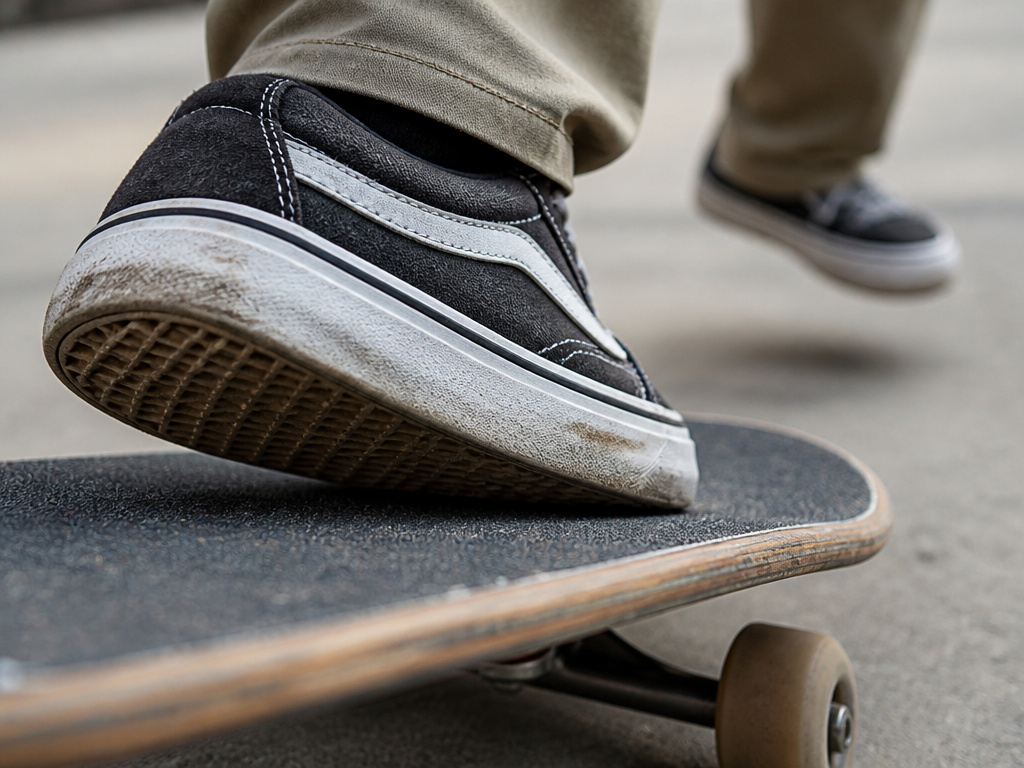
Good skate shoes are a key piece of gear. You need footwear that helps you grip the board. Look for shoes with flat soles made from a grippy, non-slippery material. This gives you the control you need for pushing and for keeping your feet planted for tricks. Avoid shoes with deep treads or heels, as these can catch on the board. The right shoes protect your feet and help you feel connected to your skateboard, which builds confidence with every push.
What are the parts of a skateboard
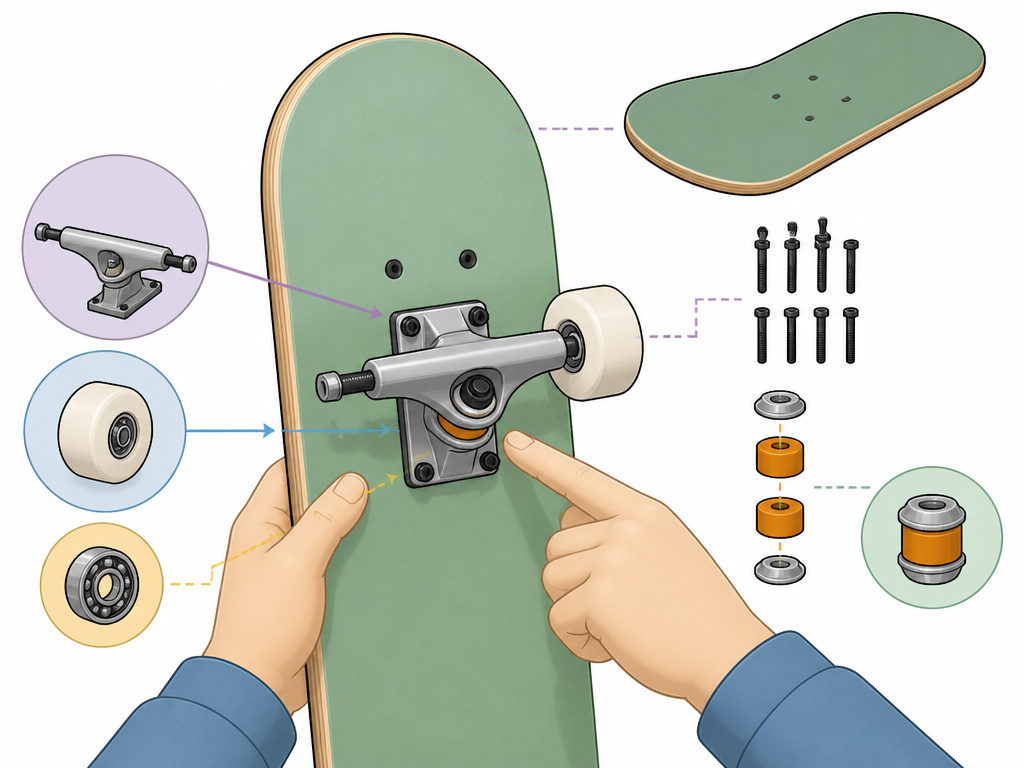
The deck is the wooden board you stand on; it should be stiff and not flex too much when you stand on it. The trucks are the metal axles that attach the wheels to the deck. They have urethane bushings inside that affect how the board turns. The wheels are also made of urethane, not plastic. Softer wheels handle rough pavement better, while harder wheels are for smooth surfaces like skate parks. Each wheel spins on two bearings, making eight in total, which need to be kept clean and dry.
Frequently Asked Questions
What age should a child start skateboarding?
According to the American Academy of Pediatrics, children under 5 years old should not ride skateboards. For children aged 6 to 10, close adult supervision is required. The CPSC uses a similar guideline, suggesting close supervision for kids under 8. It’s less about a magic birthday and more about maturity, coordination, and the ability to follow safety instructions.
What is the best beginner skateboard for a kid?
Avoid toy-store boards with plastic parts. Look for a pre-assembled complete skateboard from a skate brand like Powell Peralta, Element, or Zero. It should have a 7-ply maple wood deck, metal trucks, and urethane wheels. A deck width appropriate for the child’s shoe size is typical for younger kids.
How do I teach my kid to skateboard?
Start on flat, smooth, traffic-free pavement. Focus entirely on the basics: standing on the board, pushing, gliding, and stepping off safely. Use games to keep it fun, keep sessions very short (15-20 minutes), and teach them how to fall safely by rolling on grass before you even hit pavement. For a detailed progression, see our step-by-step guide to teaching kids.
What safety gear is absolutely necessary?
A helmet is essential. It must be a skateboarding helmet (not a bike helmet) certified to the ASTM F1492 standard. Wrist guards are the next most important, as wrist fractures are very common. Knee and elbow pads are highly recommended, especially in the beginning. Properly fitted, a complete set of safety gear drastically reduces the risk of serious injury.
How can I make skateboarding fun so my kid sticks with it?
Prioritize fun over progress. End each session before they get tired or frustrated. Celebrate small wins—even just standing on the board. Incorporate simple games like pushing to a target. Let them set the pace, and never push them into trying tricks before they are confidently rolling and stopping. If they’re ready for tricks, our list featuring easy tricks for kids starts with the simplest, most achievable moves.
The Bottom Line
Your child’s first skateboard should be a real tool, not a toy. Pair it with a certified helmet that fits today, not one they’ll grow into. Start on silent, empty asphalt, not a busy street or a crowded skatepark.
The official thresholds are clear: wait until at least age 5, and provide hands-on supervision through age 10. But the real rule is simpler. Watch their eyes. If they’re wide with focus and then crinkled with a smile after a push, you’re doing it right. If they’re scrunched with frustration, it’s time to carry the board home and try again tomorrow.
One push today is better than none. Let that be the measure.
