
How to Find Skate Spots in a New City: Step-by-Step
This post contains affiliate links. As an Amazon Associate, we earn from qualifying purchases.
To find skate spots in a new city, combine digital scouting with Google Maps and dedicated apps like ShredSpots, then verify with physical reconnaissance. Your success hinges on understanding local skate laws, where enforcement is often discretionary, and evaluating surface quality, traffic, and security before you session. The ShredSpots app connects you to a community of over 200,000 skaters who have mapped more than 100,000 spots globally, giving you a massive head start.
That head start matters because the legal landscape is a minefield. Many cities have no-skateboarding ordinances with boundaries even local police don’t fully understand. You can be technically illegal but tolerated, or vice-versa, based on an officer’s discretion. Scouting digitally first helps you find possible zones without attracting notice, so your in-person check concentrates on skateability and risk, not just finding a place. A key part of this process is learning how to find skate spots in a new city.
What follows is a two-phase system for how to find skate spots in a new city: digital tools to build your target list, then physical methods to test them. This guide explains the apps with real user counts, the legal details most guides skip, how to judge a spot’s potential, and what to do when your search yields nothing. By the end, you’ll have a repeatable process for any city.
Key Takeaways
- Start with digital scouting using Google Maps satellite view and community apps like ShredSpots, which indexes over 100,000 global spots from a 200,000+ skater community.
- Always verify spots in person before a session, surface cracks, security presence, and pedestrian traffic can’t be fully assessed online.
- Understand that skateboarding ordinances are often discretionary; enforcement depends more on perceived recklessness than the letter of the law.
- For dense urban cores, physical scouting on foot or bike beats digital maps, as spots require “liberating” and are hidden in plain sight.
- When no spots exist, creating DIY obstacles with a rub brick and wax on a safe curb is a legitimate, often necessary, step for progression.
The Digital Scout: Maps and Apps First
Your phone is the most powerful spot-finding tool you own. It connects you to a global network of skaters who have already done the legwork. Starting here saves hours of blind exploration and immediately shows you where the community is active.
The ShredSpots app is a prime example. Its Google Play listing reports a community of 200,000+ skaters who have contributed more than 100,000 skate spots worldwide. You can filter spots by obstacle type, stairs, ledges, gaps, and see user-added notes on “bust risk” and skatepark setups. This isn’t a speculative directory; it’s a live map maintained by people who session these places. For a broader park index, For a broader park index, SkateSeek lists 624 skate parks across 211 cities in 31 states, with detailed breakdowns like 131 parks in California and 84 in Texas.
Before you start: Never rely solely on digital pins for session planning. A spot marked “smooth ledge” online might be capped with metal anti-skate devices, have a new “No Skateboarding” sign, or be under constant security patrol. Digital scouting builds your target list; physical verification decides if it’s session-worthy.
Google Maps is your other essential. Use satellite and street view to scan industrial areas, school parking lots after hours, and the plazas behind shopping centers. Use satellite and street view to scan for the telltale grey of smooth concrete and the geometric shapes of potential obstacles. A guide from Monster Children recommends dropping pins on your map at known locations for easy sharing and to visualize what’s in each zone. I’ve wasted trips to “perfect spots” only to find the concrete was painted with a gritty, unskateable coating, something street view can’t show you. Always cross-reference with a community app to see if others have flagged such issues.
Where digital scouting may fall short is in dense urban cores. The Monster Children guide states that in the city, “looking around while walking or skating is better than using Google Maps,” while general web research consensus recommends using Google Maps satellite/street view to look for smooth, open pavement. The environment changes too fast, new construction, temporary barriers, liberated ledges, for a static satellite image to be useful. Your digital map is a foundation, not the finished blueprint.
Which Apps Give You Real-Time Intel?
While ShredSpots offers a massive database, other platforms specialize in different intel. FindSkateSpots.com operates like a community detective board, showing spots added “7 hours ago” or “a day ago.” It has a “Help Identify Spots” feature for mysterious locations and a “Top Solvers” leaderboard, turning discovery into a game. This is invaluable for seeing what’s freshly skateable. For pure park data, SkateSeek’s state-by-state index (e.g., 28 parks in Arizona, 35 in Colorado) is unmatched for planning a road trip.
Your goal for how to find skate spots in a new city is to layer information. A spot on ShredSpots gets you there; recent activity on FindSkateSpots tells you it’s still active; and a quick street view check gives you the approach. This multi-app check takes five minutes and prevents a 45-minute journey to a dead zone.
| Digital Tool | Best For | Key Limitation |
|---|---|---|
| ShredSpots App | Global spot database with obstacle filters & bust risk | Relies on user updates; some spots may be old |
| Google Maps | Scouting terrain, satellite view, saving personal pins | Can’t assess surface quality or recent changes |
| FindSkateSpots.com | Real-time, recently added spots & community sleuthing | Smaller, more niche community |
| SkateSeek | Comprehensive index of public skateparks by state/city | Only covers parks, not street spots |
The Physical Recon: Eyes on the Ground
Digital maps tell you where to look. Your eyes and your board tell you if it’s skateable. Physical reconnaissance is where you separate potential from session.
The most effective method is riding a bike or walking. As the Monster Children guide puts it, riding a bike is “arguably the best method.” You cover ground efficiently, can dart down alleys and pedestrian paths a car can’t, and you don’t have the start-stop rhythm of parking. On foot, you notice the texture of the pavement under your shoes, hear the security guard’s radio before you see him, and spot the perfect metal edge hidden behind a dumpster. Many skaters advise simply keeping your “eyes peeeeeeled” during daily errands, checking loading docks and parking garages.
I learned this the hard way scouting a promising plaza from my car. From the driver’s seat, the ground looked flawless. When I stepped out, my shoes crunched on a layer of fine gravel spread like sand across the entire lot. Unskateable. You have to get out and walk the land.
Your scouting kit is simple: your phone, comfortable shoes, and a mindset to observe. Take photos of every spot you encounter, even the mediocre ones. As the guide suggests, create a “spot folder” on your phone. A ledge that seems too high today might look perfect in a photo tomorrow, once you’ve imagined a different angle of approach. This also helps when sharing spots with friends later, a picture is far clearer than directions.
The City vs. The Suburbs Strategy
Your tactics change based on geography. In suburban or industrial areas, digital scouting reigns supreme. Wide parking lots, empty school yards, and warehouse districts are easily visible from above. Here, your process is digital first, physical verification second.
In the dense urban core, flip the script. Digital maps are nearly useless. Spots here are about “liberating” – uncapping a ledge, moving a temporary barrier. They exist in the nooks between buildings, in overlooked public plazas. The Monster Children guide warns that a newly liberated spot “can become hotspots within days” because it’s now visible to every pedestrian. Your job is to find these hidden gems before they get popular, or busted. This requires walking the grid, looking up side streets, and seeing the skate potential in ordinary urban furniture.
The Legal Lowdown: Don’t Get Kicked Out
Finding a spot is only half the battle. Keeping it is about understanding the unspoken rules. The Public Skatepark Development Guide lays out the messy reality: skateboarding outside a park is often a violation of local ordinances, but enforcement is discretionary. A “No Skateboarding” sign might be a landlord’s liability shield, not an active prohibition. Police might ignore you for weeks, then ticket you because a business owner complained.
This creates a high-risk, unpredictable environment. The guide categorizes 72% of skateboarding as ‘Transportation Skating’ (casual) and only 28% as ‘Trick Skating’ (core). In the eyes of the law and the public, you’re often seen as a nuisance first, an athlete second. Skating in a vehicle lane is “illegal almost everywhere,” but skaters do it when sidewalks are congested. The boundaries of these ordinances are “seldom understood by skaters, and sometimes not even by the police.”
Where this goes sideways: Assuming a spot is legal because others skate it. Tolerance can vanish overnight with a new property manager or a single complaint. You session at the community’s discretion, not by right.
Your best defense is low-impact scouting and respectful sessioning. Scout new spots alone or with one friend to minimize attention. Session early in the morning or later in the evening when foot traffic is low. If security or police ask you to leave, do so politely, arguing turns a warning into a citation and burns the spot for everyone. The goal is to fly under the radar, not test the limits of the law. For a deeper dive on managing these interactions, our guide on skating street spots without getting kicked out breaks down the etiquette.
Reading the Room: Spot Viability Checklist
Before you unstrap your board, run through this mental checklist. It turns a guess into a calculated risk.
- Surface: Is the pavement smooth, or is it cracked, gravel-strewn, or painted with abrasive coating? Run your hand over it.
- Security: Are there cameras, “No Trespassing” signs, or regular security patrols? Is there a business nearby that would care?
- Traffic: What’s the pedestrian and vehicle flow? A busy sidewalk means constant interruptions and higher visibility.
- Escape Routes: If you need to leave quickly, are there multiple exits? Don’t get cornered.
- Community History: Does the spot appear in apps? Are there recent photos or comments about busts?
A spot that scores poorly on more than two of these points is a high-risk session. It might be worth a few quick tries, but don’t plan an all-day shoot there. Sometimes, the best find is knowing when to walk away.
Matching Spots to Your Skill Level
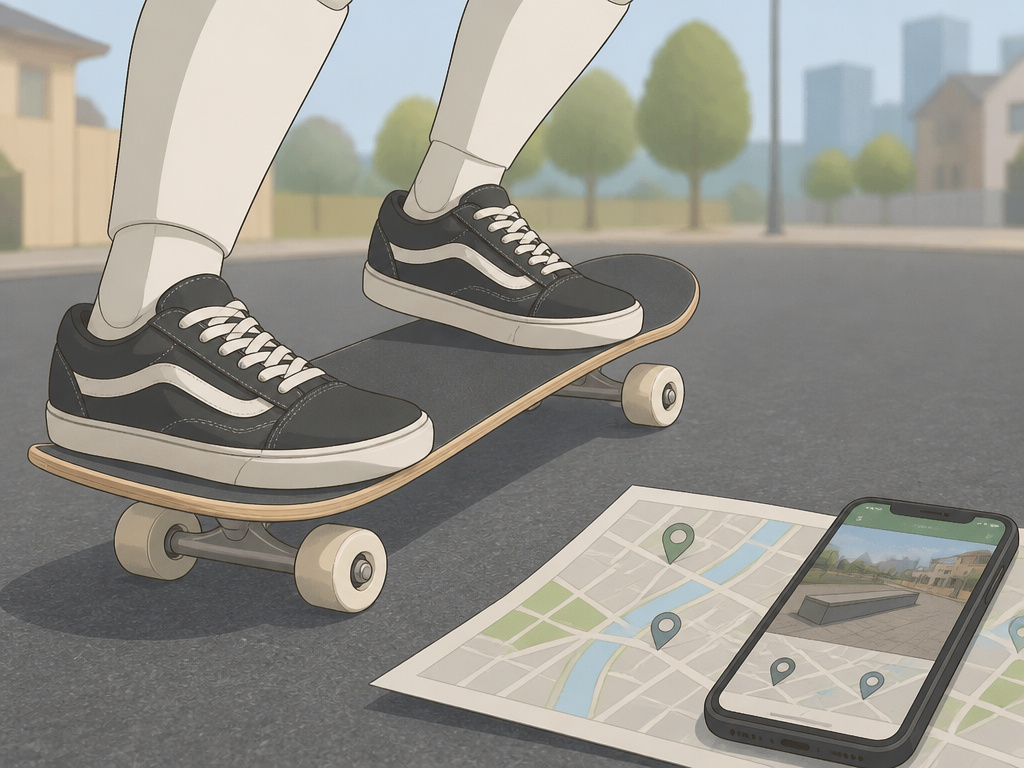
A spot is only good for you, not in a vacuum. A beginner staring down a famous 10-stair is just looking at a fast way to get hurt. Many new skaters in small towns or mountains struggle to find “spots that are on my level.”
For beginners, your spot checklist is different. You need space, smoothness, and minimal pressure. Think:
- Empty tennis or basketball courts (smooth, enclosed, flat).
- School parking lots on weekends.
- Freshly paved residential streets with little traffic.
- The perimeter of a public skatepark, away from the advanced features.
The smooth ground allows you to concentrate on pushing, turning, and developing board control without dealing with cracks or pebbles. A very gentle slope can be more helpful than a dead-flat lot for some learners; the mild, constant speed helps find balance without having to push constantly. It was a “spot on their level” they created by rethinking the terrain.
For intermediate skaters, you’re hunting for specific obstacles: a manageable 3-stair, a low ledge, a manual pad. Your digital filters on ShredSpots become crucial. Your physical scouting should assess the obstacle’s condition (is the ledge waxed? Are the stairs even?) and the run-up/run-out space.
Advanced skaters often hunt for novelty or specific challenge, the unique gap, the perfect rail. Your process might involve more social intelligence: talking to local skaters, watching recent video parts from the area, and deciphering the cryptic clues on spots like FindSkateSpots.com.
The key is to be honest with yourself. Skating a spot that’s wildly above your ability isn’t productive; it’s discouraging and dangerous. If your town seems to have nothing, that’s your cue to get creative or look at the terrain with a beginner’s eye again. Our comparison of skatepark and street skating for beginners can help decide where to focus your early efforts.
When the Search Comes Up Empty: Create Your Own
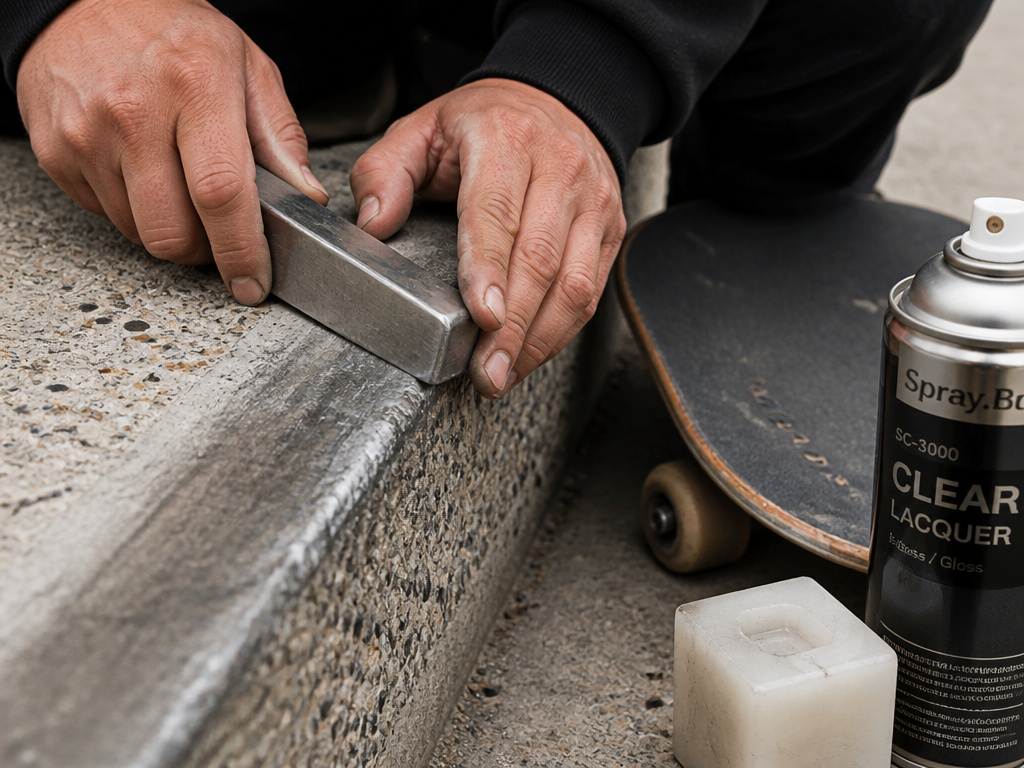
You’ve scoured the apps. You’ve walked the grids. The results are a handful of distant, bust-heavy parks and zero viable street spots. This is common in smaller towns, rural areas, or places aggressively hostile to skating. Your next move is to build.
DIY spot creation is a skateboarding tradition. It starts with the humble curb. A rub brick (a masonry tool for smoothing concrete), some wax, and maybe a clear lacquer spray can transform a rough, unskateable curb into a slidable ledge. The process is simple: sand the top edge smooth with the brick, apply a base layer of wax, and session. It’s temporary, low-cost, and teaches you how a spot works.
Common mistake: Building or modifying a spot in a highly visible, high-traffic area. You attract immediate attention and guarantee a quick end to your project. Seek out low-visibility locations, behind warehouses, in unused service alleys, where your creation might survive more than a few days.
Beyond curbs, you can construct simple obstacles. A sturdy wooden pallet becomes a manual pad. A small, angled piece of plywood secured against a curb creates a bank. The materials are often free or cheap from construction sites (always ask first) or hardware stores. The act of building also deepens your connection to the spot; you’re not just consuming terrain, you’re creating it.
This is also the moment to advocate. The Public Skatepark Development Guide is a primary resource for understanding what goes into public skatepark planning. If your area truly has nothing, learning how to plan a skate trip to a nearby city with better infrastructure might be your best short-term solution, while you gather local support for a park project long-term.
How to find skate spots by watching local videos
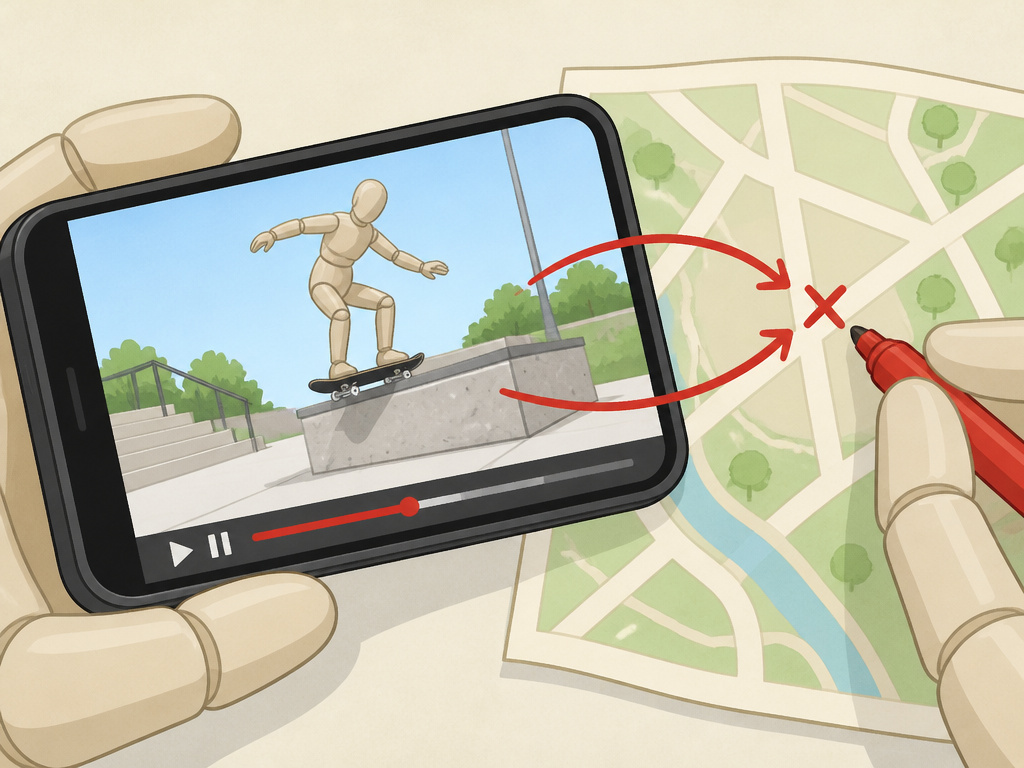
Local skate videos are a direct line to a city’s skate scene. Watch for the spots in the background and the terrain they’re skating. You’ll see ledges, banks, and gaps that might not be listed anywhere. Pay attention to the specific neighborhoods and types of architecture featured. This visual research gives you a feel for the local style and the kind of spots that are possible there. It turns abstract searching into a targeted hunt for similar ledges, stair sets, or plazas. Use what you see to build a mental map, then go out and look for those kinds of spots yourself.
Frequently Asked Questions
Is there an app for finding skate spots?
Yes. ShredSpots is a dedicated app with a community of over 200,000 skaters who have mapped more than 100,000 spots worldwide. You can filter it by obstacles like stairs and ledges and check user notes on ‘bust risk.’ Other resources include FindSkateSpots.com for real-time additions and SkateSeek for a complete index of public skateparks.
How do I know if a spot is safe to skate?
You can’t know fully until you visit. Check the surface for cracks, gravel, or slippery paint. Look for security cameras, “No Trespassing” signs, and note the pedestrian and vehicle traffic. Apps can provide hints, but a personal visit is essential. For a systematic approach, learn how to read a skate spot before you session.
What’s the best way to find skateparks in a new state?
Use SkateSeek’s online index. It lists 624 skate parks across 211 cities in 31 states, broken down by location. For example, it shows 131 parks in California and 84 in Texas. This data is more reliable and searchable than generic Google results for finding free skateparks.
Is it illegal to skateboard on the street?
In most cities, yes, to some degree. Many have ordinances against skating in vehicle lanes, on certain sidewalks, or in commercial districts. However, enforcement is often discretionary and based on complaints or perceived recklessness. The legal boundaries are frequently unclear even to law enforcement, creating a “tolerated but illegal” gray area you must navigate carefully.
How can I meet skaters in a new city to find spots?
Use the community features in apps like ShredSpots to see who’s skating nearby. Check for local skate shops or groups on Instagram. Attending a session at a known skatepark is the most direct method. Being friendly and respectful is the fastest way to tap into the local knowledge network and make skate friends who can show you the hidden gems.
The Bottom Line
Finding spots in a new city is a skill, not luck. It combines digital research with old-fashioned exploration, all filtered through an understanding of local skate law, which is often more about perception than statutes. Start with the apps to build your list, but never skip the in-person verification. The texture of the ground under your feet is the final judge.
If your search yields nothing, remember that skateboarding’s history is built on making something out of nothing. A rub brick and some wax can turn a forgotten curb into your personal training ground. And if you find a great spot, contribute back to the community by adding it to an app or sharing it respectfully. That’s how the map grows from 100,000 spots to 200,000.
Your final step before rolling out: open ShredSpots or Google Maps right now. Drop a pin on one place you’ll check this week. Then go look at it, even if you don’t skate it yet. The habit of looking is what separates a visitor from a local.
