
Skatepark vs Street Skating for Beginners: Which Is Safer?
This post contains affiliate links. As an Amazon Associate, we earn from qualifying purchases.
Skatepark users have significantly lower odds of a severe traumatic brain injury compared to non-skatepark users, with an odds ratio of 0.58. For beginners, a well-designed skatepark is the safer, more controlled choice over unpredictable streets, but it’s not always the best place to learn your very first push.
That injury statistic flips the script. It means the dedicated concrete space isn’t just a nicer option; it’s a public health intervention that cuts the worst head-injury risk nearly in half. The street offers creative freedom and real-world obstacles, but it comes with variable surfaces, security, and traffic, half of all skateboarding deaths are from vehicle collisions. This is a key consideration in the debate of skatepark vs street skating for beginners.
What follows: a breakdown of the injury data you won’t find in a typical gear guide, the official design specs that make a park beginner-friendly, and the one piece of gear that matters more than your deck graphic. By the end, you’ll know whether to lace up for the park or scout a parking lot, and how to do either without setting your progress back.
Key Takeaways
- Skatepark users have significantly lower odds of a severe traumatic brain injury (OR: 0.58) than those skating on streets.
- Modern public skateparks are often designed with a 50/50 mix of street and transition elements, as recommended by The Skatepark Project and Dallas Parks Dept. Guidelines, to cater to all styles.
- Fractures and dislocations make up about 59% of skatepark injuries, but only 9% of those require hospitalization.
- For true first-timers, skateparks can be intimidating; smooth, flat ground elsewhere is often better for mastering the basics.
- Helmet use at a skatepark with mandatory, enforced policy jumps to nearly 91%, cutting severe brain injury risk dramatically.
The Injury Math That Changes the Game
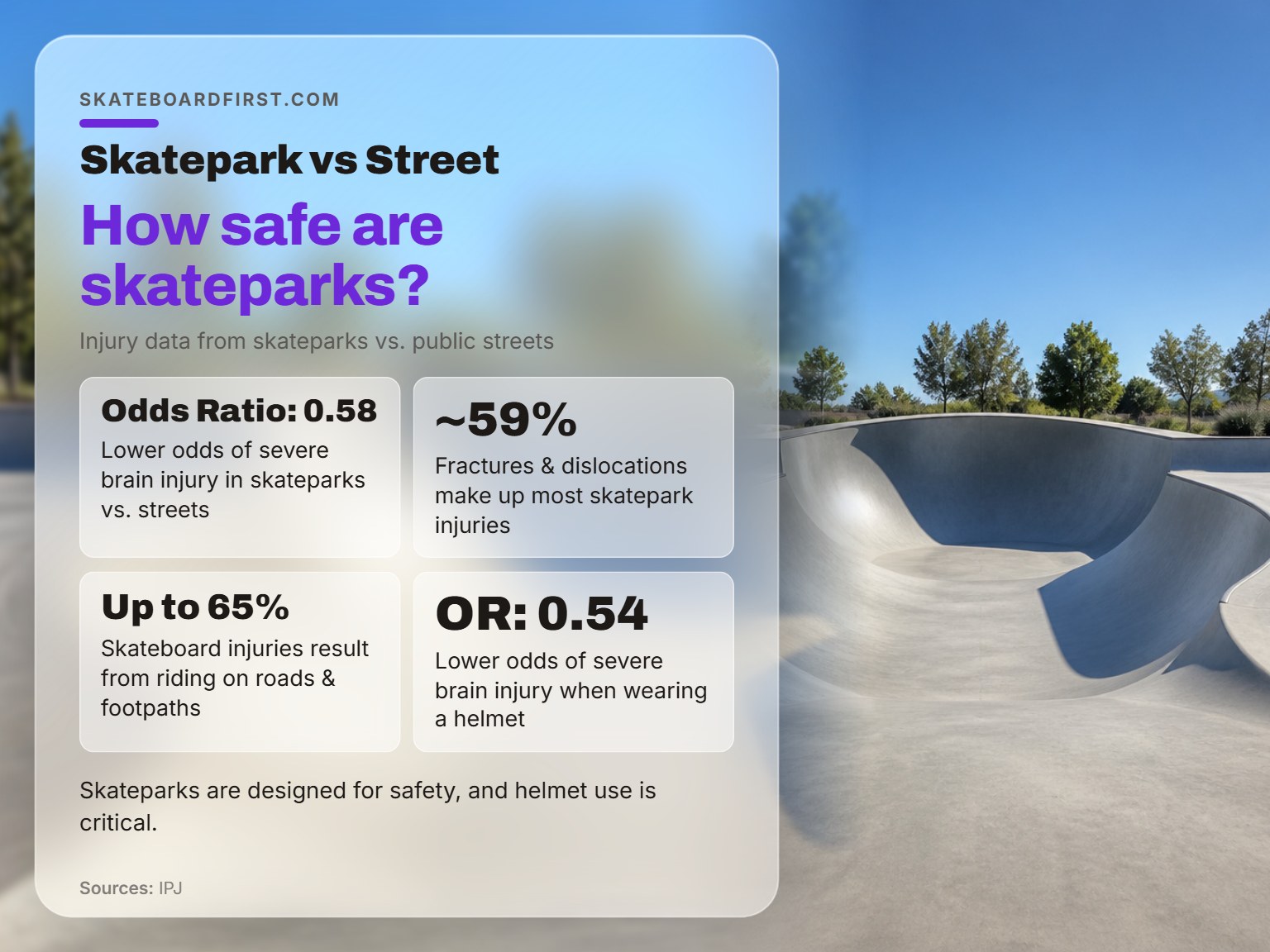
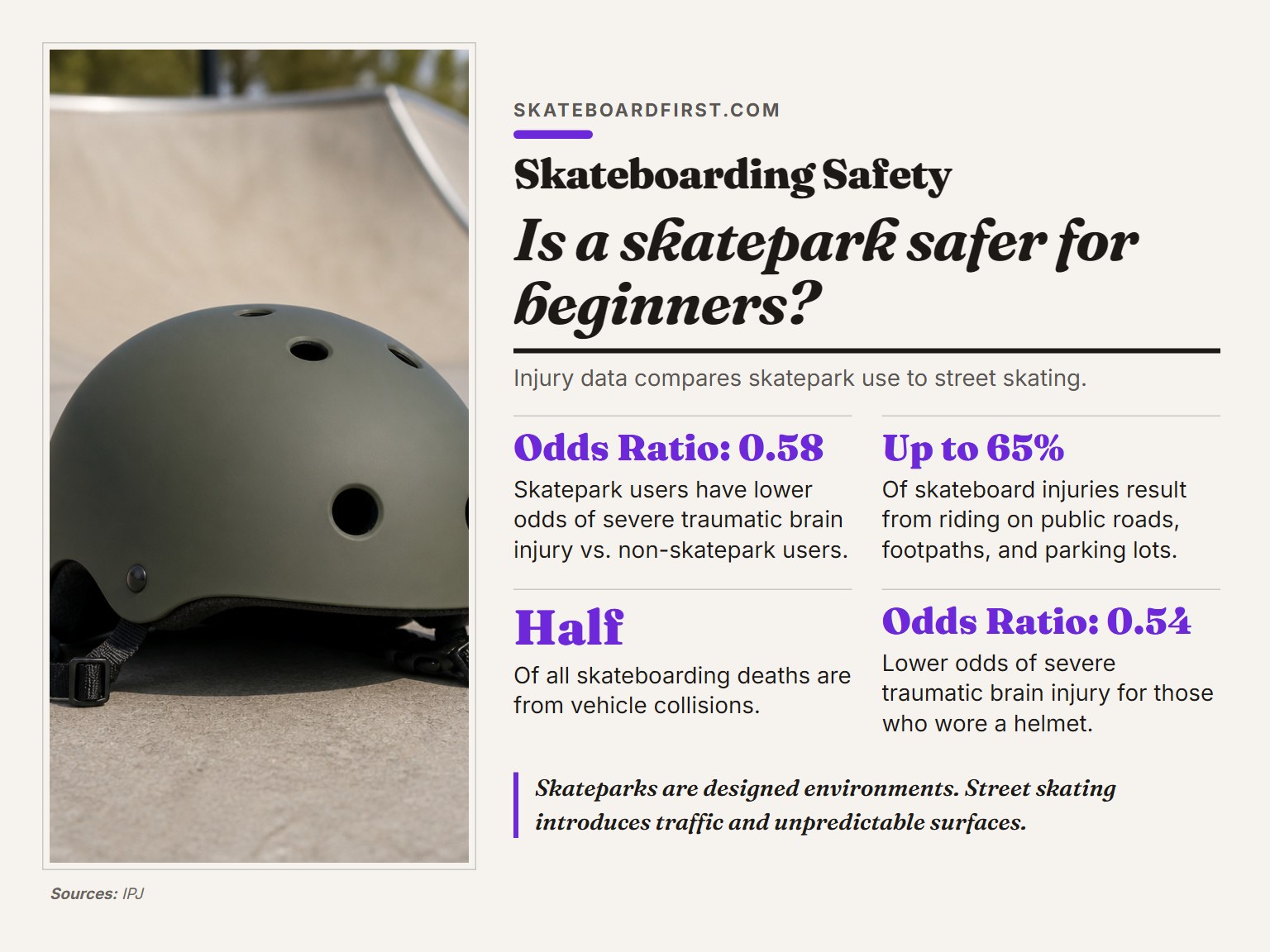
The number that should settle any debate about skatepark vs street skating for beginners is this. A peer-reviewed study in Injury Prevention found skatepark users had significantly lower odds of a severe traumatic brain injury compared with non-skatepark users. The odds ratio is 0.58. Put plainly, skating at a designed facility nearly halves your risk of the most severe head trauma.
The part nobody mentions: Up to 65% of skateboard injuries happen on public roads, footpaths, and parking lots. Half of all skateboarding deaths result from vehicle collisions. A skatepark physically separates you from traffic, which isn’t just convenient, it’s a statistical lifesaver.
The study notes that fractures and dislocations comprise about 59% of skatepark injuries, with about 9% of those requiring a hospital trip. Ramps and bars see more incidents than half-pipe or bowl features. This isn’t to say parks are injury-free zones. They’re controlled environments where the most common outcomes are broken wrists and ankles, not concussions from a car bumper.
Why does this matter for a beginner? You are far more likely to fall. A park gives you a predictable, smooth surface to fall on. The concrete is often finished to a specific standard, like those outlined in the ASTM F2480 concrete skatepark standard, which aims to create a consistent surface. That slide can be the difference between a scab and a dislocation.
Is a Skatepark Actually Good for a First-Timer?
Here’s where the consensus cracks. While some general articles present skateparks as the obvious beginner venue, official guidelines like those from Sport New Zealand tell a different story. Official guidelines tell a different story. Sport New Zealand’s skate provision guidelines state plainly that skateparks “are not always the best place for learning the basics.” The reason? A lack of open, smooth, flat ground and simple graduated features. They can be intimidating.
My own start mirrored this. I found an empty office parking lot for my first month. Early weekday mornings were quiet. I could wobble, put a foot down, and bail without an audience. I found that shorter, more frequent sessions built my leg muscles and confidence effectively.
| Learning Venue | Best For | Biggest Drawback |
|---|---|---|
| Empty Parking Lot / Tennis Court | Absolute first pushes, balancing, safe falls. | Boring, no community, no designed features to progress toward. |
| Skatepark (During Off-Hours) | Observing others, learning park flow, trying small banks. | Intimidating when busy; features are often too big for day one. |
| Smooth Street Spot | Applying basics to real-world textures and slopes. | Unpredictable cracks, debris, and potential security issues. |
Where this goes sideways: Thinking you must start on a ramp. The American Academy of Pediatrics recommends children under 10 shouldn’t use skateboards without close adult supervision, and kids under 5 shouldn’t use them at all. A park’s smallest quarter-pipe is still a ramp. Start on flat ground.
So, should a beginner go to the park? Yes, but with a plan. Go during off-peak hours (weekday mornings, for example). Treat it as a field trip to watch how others skate a new skatepark. Stand to the side, get comfortable rolling on the flat bottom of a bowl, and leave before you’re tired. Your goal isn’t to drop in; it’s to normalize the environment.
Street Skating: The Unwritten Rulebook
Street skating is defined by creativity on urban obstacles: stairs, rails, ledges, and benches. The skatepark features you see are often polished copies of these. But the real street adds variables no park can replicate: security guards, inconsistent surface textures, and the psychological pressure of skating where you’re not entirely welcome.
A Reddit thread from r/NewSkaters put it perfectly: “Street skating allows you to practice tricks on small 1′ to 2′ ledges, while in vert [big park ramps], there are no small vertical walls to practice on.” The street allows you to scale obstacles to your level. Find a low curb before a high ledge. A park’s ledge is the height it is.
Common mistake: Taking a park setup to rough streets. Hard wheels are usually preferred for smooth park concrete. On rough asphalt, they vibrate terribly and stop for every pebble. Softer wheels (like 78A-87A) absorb vibration on rough streets but are not typically preferred for smooth park transitions.
The other variable is legality. Learning to skate street spots without getting kicked out is a skill in itself. It involves reading a spot, being respectful, and knowing when to leave. This mental calculus, the “fight for the trick” as one YouTube transcript called it, is what many skaters live for. But for a beginner focused on balance, it’s pure distraction.
When should you start skating street? Once you can ride, stop, and ollie with reasonable consistency. That’s the baseline from experienced street skaters. Before that, you’re just commuting on your board, which is fine, but it’s not “street skating” in the trick-focused sense.
The Gear That Actually Makes a Difference
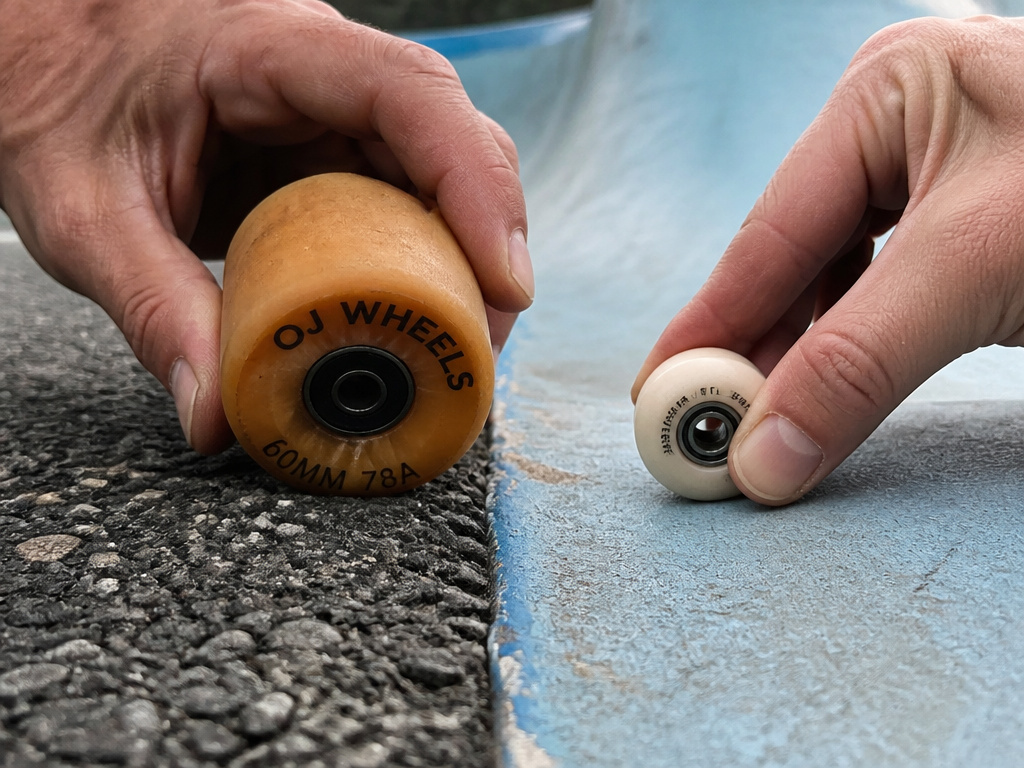
Your board setup decides whether you feel in control or at war with the ground. The Portland Parks & Recreation guide breaks it down: a quality deck is 7 plies of Canadian Maple. Toy skateboards sold at big-box stores are made with inferior materials that “may slow skill development and increase risk of injury.” This is why my strong opinion is to buy a complete from a real skate shop, brands like Element, Santa Cruz, or Powell Peralta, even if it costs more.
Wheels are the most important choice for a beginner. The guide states: “Softer wheels are easier to skate on rougher streets… Harder wheels are usually preferred at smooth skate parks.”
| Wheel Hardness (Durometer) | Best For | Feels Like |
|---|---|---|
| 78A – 87A (Soft) | Rough asphalt, chip seal, sidewalk cracks. | A smooth, quiet roll that absorbs vibration but requires more frequent pushing. |
| 88A – 95A (Medium) | Mixed use: decent streets and smoother park concrete. | A balance of grip and slide; a good “I don’t know yet” choice. |
| 96A – 101A (Hard) | Skateparks, smooth concrete, wooden ramps. | Fast, slick, and loud; they slide predictably for grinds but chatter on rough ground. |
I learned this the hard way. I put 78A cruiser wheels on my everyday board thinking softer meant better. They felt like pillows on rough asphalt, but I had to push more often and they wore down noticeably faster. For smooth parks and decent flat ground, harder wheels are usually preferred. Match the wheel to the ground you’ll skate most.
Helmets are essential, and the data backs it up. The same Injury Prevention study found the odds of severe traumatic brain injury were significantly lower among those who wore a helmet (OR: 0.54). In a skatepark with both mandatory and enforced helmet use policy plus supervision, helmet use increased to nearly 91%. Nova Scotia used education campaigns to increase usage from 74% to 90%, then legislation pushed it to 100%.
How Modern Skateparks Are Designed for You
Gone are the days of parks built solely for expert vert skaters. Modern public skatepark design, guided by advocates like The Skatepark Project, follows a specific ratio. The Dallas skatepark design guidelines recommend a composition of around 50% ‘street’ elements and 50% ‘transition’ elements.
This 50/50 mix is intentional. It ensures that whether you’re drawn to ledges and rails or bowls and quarter-pipes, there’s something for you. When you’re looking to choose a skatepark, this balance is a key indicator of a well-thought-out facility.
Expert Tip: “Look for parks that label the difficulty of their runs or features. The TML Public Skating Guidelines recommend this, and it’s a sign the park was designed with user safety and progression in mind. A ‘beginner’ bank is where you should spend your first session.”
Construction quality matters immensely. Sport New Zealand notes that “the tolerances of skateparks are incredibly low” due to wheel size. Poorly poured concrete with lumps or seams will stop a wheel dead, which is a construction flaw. This is why standards like ASTM F2334 skatepark facility standard for above-ground parks and the European NEN-EN 14974:2019 for safety exist. They define everything from the concrete finish to where expansion joints should be placed “least likely to interfere with a wheel.”
Building Your First Month Plan
Your location decides your first steps. If you have access to a well-designed, modern park, use it, but don’t start on the features. Use the flat bottom of a bowl to practice pushing and turning where the ground is perfectly smooth. Observe the skatepark etiquette rules (wait your turn, don’t snake, respect the flow) from day one.
If your local park is old, poorly maintained, or always crowded, find an alternative. A vacant basketball or tennis court can provide a smooth, bounded surface with no traffic.
- Week 1: The Relationship. Spend 20-30 minutes every other day just standing on your board, rocking side to side, stepping off, and pushing slowly. Get used to the noise of the wheels. The goal is comfort, not distance.
- Week 2: Basic Control. Practice pushing in a straight line, gentle turns by leaning, and stopping with your pushing foot. Find a slight incline and practice rolling down without pushing. This builds balance.
- Week 3: Introducing Obstacles. Find a crack or a painted line. Practice rolling over it. If at a park, find the smallest, mellowest bank and practice riding up and rolling back down fakie (backwards).
- Week 4: Connection. Visit the park with the goal of watching. See how riders read a skate spot, set up for a trick, and fall safely. Then, try your controlled pushes and turns on the park’s smooth concrete.
This kind of structured practice beats random, unfocused sessions. It builds the muscle memory and confidence needed to eventually tackle those street spots or park features.
Frequently Asked Questions
Can I learn skateboarding only at a skatepark?
You can, but it might not be optimal for the very first days. Use the park’s smooth, flat areas to master pushing and balancing before approaching any features. The park becomes essential once you’re ready for ramps, banks, or coping.
Is street skating harder than park skating?
It depends. Park skating has a higher initial fear factor (dropping in) but offers predictable, smooth surfaces. Some argue street skating has a lower entry point (a small curb) but adds unpredictable textures, security, and traffic, while others note both disciplines are difficult to learn initially. The peer-reviewed skatepark safety analysis shows street carries a higher statistical risk of severe injury.
What wheels should a beginner get?
If you’ll skate mostly rough pavement, start with softer wheels (78A-87A). If you have access to smooth concrete parks or lots, start with harder wheels (96A-101A). A middle-ground wheel (88A-95A) offers a balance for mixed use. See our guide on street vs park skateboard wheels for details.
Do I need a different board for park and street?
Not as a beginner. A 7-ply maple complete deck with medium-hardness wheels is versatile. Your first board should be a jack-of-all-trades.
How do I find a good local skatepark?
Search online for “public skateparks” or “[skatepark]” plus your city name. Look for photos that show a mix of street and transition elements (the 50/50 design). Read reviews from skaters, and visit at different times to gauge the crowd vibe.
The Bottom Line
For a beginner, the skatepark is the statistically safer choice. The concrete is designed to specific safety standards, it removes traffic from the equation, and a modern 50/50 layout has features you can grow into. But its biggest advantage, a community of skilled riders, can also be its most intimidating barrier.
Start on the flattest, smoothest ground you can find, even if that’s outside the park gates. Get a real board from a real shop, put a helmet on it, and spend your first month building a relationship with rolling. The park versus street debate isn’t your concern yet. Your only job is to stand up, push, and not hate the feeling.
When you can ride and stop with confidence, then the choice appears. Want flow, air, and predictable surfaces? The park’s your gym. Want creativity, real-world texture, and the thrill of the find? Start learning to assess a skate spot. Both paths are valid, but only one path starts with odds that are objectively better for your long-term health.
