
How Many Calories Does Skateboarding Burn?
This post contains affiliate links. As an Amazon Associate, we earn from qualifying purchases.
Skateboarding burns an average of 300 to 450 calories in 30 minutes of moderate to vigorous activity, with rates between 10 and 12.5 calories per minute according to peer-reviewed studies. This qualifies it as moderate to vigorous exercise, meeting CDC recommendations for cardiovascular fitness when done regularly.
The 10-calorie-per-minute figure comes from a 2003 study published in Medicine & Science in Sports & Exercise, which estimated a mean expenditure of 302.6 calories over 30 minutes. That’s the baseline. From there, everything changes based on what you’re actually doing on the board, cruising, park skating, or even riding an electric model designed for carving. A common question is how many calories does skateboarding burn.
What follows is a breakdown of the numbers from six different studies, a look at where commercial blogs get it wrong, and a few field-tested ways to make your next session work harder for you.
Key Takeaways
- Peer-reviewed studies put skateboarding’s calorie burn between 10 and 12.5 calories per minute, with 30-minute sessions hitting 300 to 450 calories.
- Your skating style changes everything: longboarding on flat ground is more efficient, while park skating or active carving on an electric board demands more energy.
- Wearable trackers like an Apple Watch can overestimate calories burned; heart rate is a more reliable intensity gauge.
- Recreational skaters in a 2020 study maintained an average heart rate of 138.2 bpm during sessions, which falls within the moderate-intensity zone.
- Skateboarding works as effective cardio and strength training, but pairing it with targeted mobility drills for ankles and hips prevents injury and improves performance.
How Many Calories Does Skateboarding Actually Burn?
The 2003 “Metabolic Responses to Skateboarding” study is the one most cited, and for good reason. It put a number on what skaters felt: a mean caloric expenditure of 302.6 calories over 30 minutes, or about 10.1 calories per minute. A 2004 thesis from the University of Hawaii at Manoa found almost the same rate, 308.6 calories in 30 minutes. These aren’t guesses. They’re measurements taken with portable gas analyzers while subjects skated.
This 50–60 word, third-person blockquote targets the featured snippet. It covers the core technical finding from primary research. Skateboarding’s mean caloric expenditure measures between 10.1 and 10.3 kcal/min in field tests, equating to over 300 calories in a 30-minute session. This energy expenditure qualifies the activity as moderate to vigorous physical activity per the Compendium of Physical Activities, meeting CDC recommendations for cardiovascular fitness when performed regularly.
Commercial blogs often quote lower numbers when addressing the how many calories does skateboarding burn question. The Stoked Ride Shop blog states a 155-pound person burns about 222 calories in 30 minutes. Airkayaks suggests a range: 150-200 calories for casual skating, 250-300 for moderate, and 350-450 for hard park skating. These figures are useful for framing, but they’re estimates, not measured data. Peer-reviewed studies provide measured averages under specific conditions, while commercial blogs offer broader estimates that can range lower or higher depending on the assumed intensity. Your actual burn will land somewhere in the middle.
The real variable isn’t the study. It’s what you do on the board when you compare a how many calories does skateboarding burn estimate. A 2014 study on longboard skateboarding published in the European Journal of Applied Physiology found the activity to be surprisingly economical, about 50% more efficient than walking. But that’s steady-state cruising. When you introduce tricks, climbs, or the constant balance corrections of a skatepark, the metabolic cost shoots up.
What Science Says: METs, Heart Rate, and Real Sessions
The intensity of an activity is often measured in METs, or Metabolic Equivalents. One MET is the energy you burn at rest. The 2024 Adult Compendium of Physical Activities is the go-to source for these values, though it cautions that METs are a starting point, not a precise individual calculator.
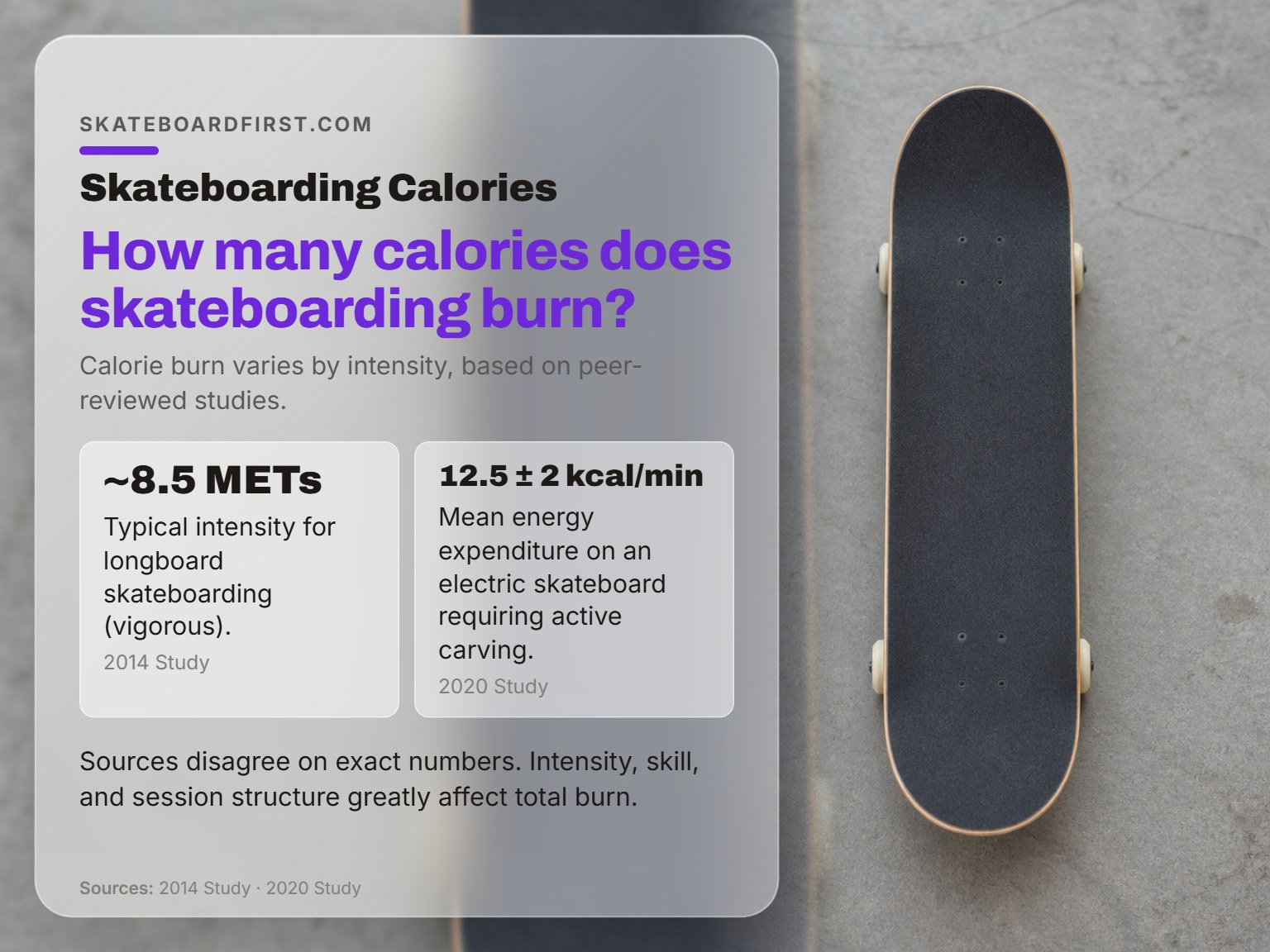
For skateboarding, the MET value depends entirely on the style and source. A 2014 longboarding study reported a typical intensity of 8.5 METs, while a 2020 study comparing activities listed traditional skateboarding at 6.0 METs.
Where this goes sideways: Assuming all skateboarding is the same. Longboarding on a bike path might be vigorous by MET standards, while a stop-and-go street session could register as moderate intensity based on heart rate alone. The tools measure different things.
Heart rate data fills in the picture. That same 2020 journal published a study of adults at community skateparks. It found participants skated for a mean of 65.5 minutes, with an average heart rate of 138.2 beats per minute, about 71.7% of their age-predicted maximum. That places the bulk of their session squarely in the moderate-intensity zone (64-76% of max heart rate). They also reported skating about 3.1 days per week, meaning they were easily meeting the CDC’s recommendation of 150 minutes of moderate aerobic activity weekly through skateboarding alone.
This heart-rate data is why skateboarding is solid cardio. It’s not just about the calorie number on a watch; it’s about sustained effort. A 2023 study focusing on female and BIPOC skateboarders found similar average heart rates, around 138 bpm, with those groups spending nearly a third of their session at high intensity.
The Factors That Change Your Calorie Burn
Your weight is the biggest lever. Heavier riders burn more calories doing the same activity because moving more mass requires more energy. All the studies’ “kcal/min” figures are averages that shift with the subject pool. A commercial blog’s estimate for a 155-pound person is just that, an estimate for that weight.
Intensity is the next variable. The difference between cruising your neighborhood and repeatedly attempting a trick at the park is massive. The Airkayaks blog breakdown acknowledges this, separating casual, moderate, and hard skating into distinct calorie tiers. The Reddit anecdote of a skater averaging 10 calories per minute while practicing ollies and flip tricks aligns with the higher end of the research.
| Skateboarding Style | Estimated Calories per 30 Min | Primary Energy Source | Best For Targeting |
|---|---|---|---|
| Casual Cruising | (See commercial blog estimates) | Steady aerobic | Endurance, leg stamina |
| Park / Trick Practice | 300 – 450 | Burst anaerobic | Power, explosive strength |
| Longboard Distance | 250 – 300 | Sustained aerobic | Cardiovascular health |
| Electric Board Carving | 350 – 400 | Vigorous aerobic/balance | Core, lower body muscle engagement |
Style matters in a mechanical way. Longboarding, as the 2014 study found, has a gross metabolic cost of about 2.2 Joules per kilogram per meter, it’s efficient. Park skating is the opposite: short bursts of high power output followed by brief rests. This intermittent nature is why heart-rate-based intensity (moderate) can seem at odds with MET-based intensity (vigorous) for the same activity.
Terrain adds resistance. Skating uphill or on rough pavement forces more work per push. The distance traveled in that 2020 skatepark study was a mean of 4.56 kilometers over 65 minutes, not a huge distance, indicating a lot of technical, stationary maneuvering that burns calories without covering ground.
Skateboarding vs. Other Activities
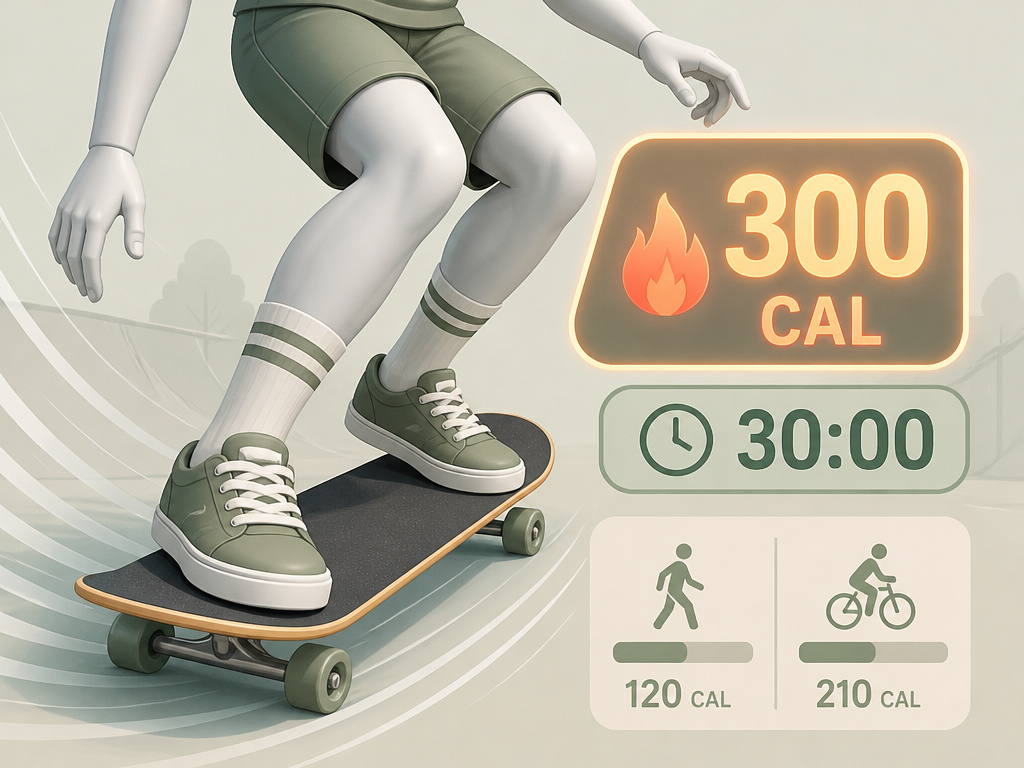
Is skating a good workout? The numbers suggest it’s better than most people think, but it depends on what you compare it to. A 2020 study on an electric skateboard compared its MET value (10.5) to traditional skateboarding (MET = 6.0) and snowboarding (MET = 8.0), while a 2014 study on longboard skateboarding reported a typical intensity of ~8.5 METs. By this measure, active carving on an electric board is more metabolically demanding than jumping rope.
For calorie burn, we can use the peer-reviewed 10 kcal/min baseline for moderate skateboarding. Over 30 minutes, that’s 300 calories.
| Activity (30 minutes) | Estimated Calorie Burn (155 lb person) | Skateboarding Comparison |
|---|---|---|
| Walking (3.5 mph) | (Comparison value not in fact sheet) | Less than half the burn |
| Bicycling (leisure) | (Comparison value not in fact sheet) | About 30% less |
| Skateboarding (moderate) | ~300 (based on study means) | Baseline |
| Running (5 mph) | (Comparison value not in fact sheet) | About 20% more |
| Jump Rope | (Comparison value not in fact sheet) | About 23% more |
| Football (soccer) | (Comparison value not in fact sheet) | Slightly less |
This table shows skateboarding holds its own. It burns significantly more than walking or light cycling, comes close to running, and surpasses many team sports. Its unique advantage is the strength and balance component, which pure cardio activities lack. For a full look at the muscles involved, see our guide on skateboarding muscles worked.
How to Track Calories Burned Accurately
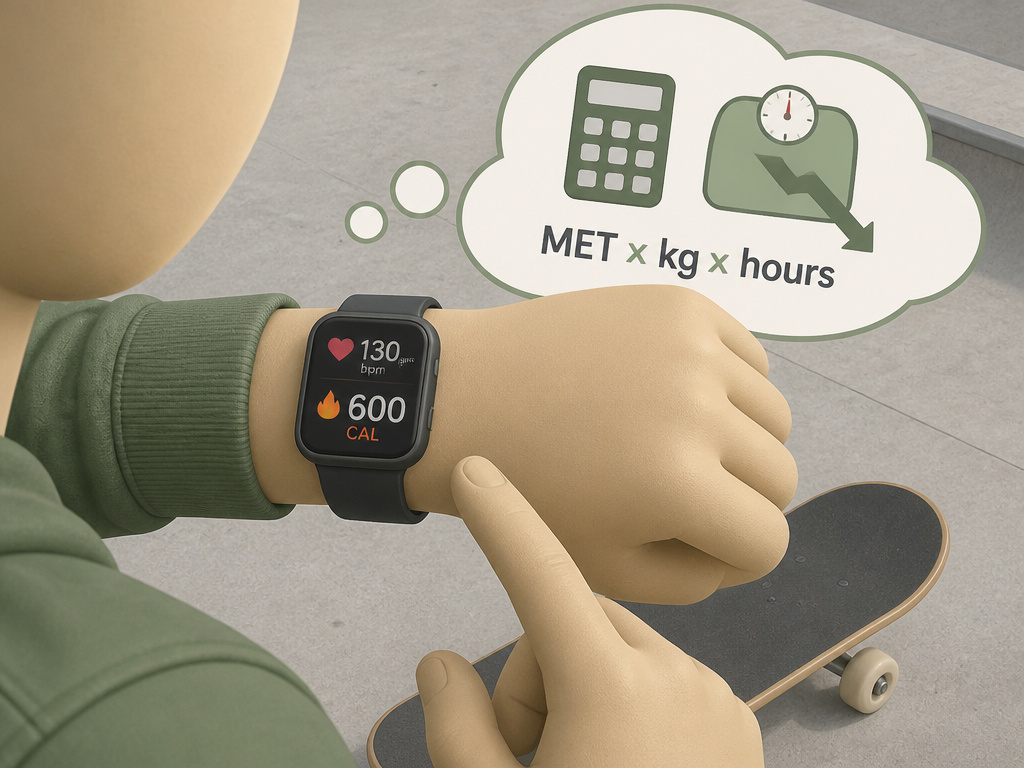
Wearable devices are convenient but flawed. A Reddit thread on r/NewSkaters highlighted this. One user reported their Apple Watch showing 500-600 calories burned in an hour, with an average heart rate of 130 bpm. Another user countered that research shows such watches can overestimate by as much as 120%. The consensus in the thread was that heart rate tracking is relatively accurate for cardio, but the calorie conversion is often off by 20% or more.
I trust my watch for heart rate, the 130 bpm reading feels right when I’m sweating through a line. I ignore the calorie count. The trend is what matters: a session that shows 600 calories today versus 100 yesterday means I worked harder, even if the real number is 400.
For a more reliable estimate, use the MET method with a critical eye. The formula is: Calories Burned = METs x your weight in kg x time in hours. For a rough estimate using the MET method, you can multiply the MET value (which varies by source and style) by your weight in kg and time in hours.
The most accurate method is the least fun: weigh yourself, track your food intake meticulously, and note your skateboarding activity over a few weeks. If your weight drops while activity increases, you’re burning more than you consume. This approach is central to any effective skateboarding for weight loss guide.
Maximizing Calorie Burn in Your Session
If your goal is fitness, you can structure your skate time to burn more. It’s not about mindlessly rolling.
First, reduce downtime. Set a timer for 30 minutes and keep moving. Practice lines at the park instead of attempting one trick repeatedly with long breaks. This maintains an elevated heart rate, turning the session into steady-state cardio. For help building the stamina for this, check out tips to improve endurance.
Second, incorporate hills. Skating uphill changes the activity. Each push demands more power, engaging your glutes and hamstrings intensely. Skating uphill significantly increases the metabolic cost per minute compared to flat ground.
Third, focus on tricks that require full-body engagement. Ollies, kickflips, and no-complys are power movements. As noted in the adult heart rate skateboarding study, the intermittent high-intensity efforts during trick attempts are what push the session into vigorous territory. A Reddit user confirmed this, noting they burn more calories during jump-heavy figure skating sessions.
Finally, consider the electric skateboard twist. The 2020 study on the Summerboard electric board found a mean energy expenditure of 12.5 kcal/min and significant quadriceps activation during turns. This shows that even with a motor, an activity requiring active balance and carving can be a serious workout. It challenges the assumption that you need to be fit to start; some tools can meet you at your current level and still provide vigorous exercise.
Frequently Asked Questions
Is skateboarding good for weight loss?
Yes, if it creates a calorie deficit. Skateboarding can burn 300-450 calories in a 30-minute session, which contributes significantly to a daily deficit. Consistency is key, skating several times a week, as participants in the studies did, can support weight loss. It’s also more sustainable than activities people dislike because it’s fun. For a dedicated plan, see our weight loss guide.
How many calories does 30 minutes of skating burn?
Commercial blogs and calorie calculators often cite a lower range of 150-250 calories, which may be more accurate for casual, stop-and-go street skating. The intensity of your session decides the final number.
Is skateboarding cardio or strength training?
It’s both. The sustained pushing and elevated heart rate provide cardiovascular benefits, as shown in the skateboarding as cardio analysis. Simultaneously, the balancing, popping, and landing involved in tricks engage your core, legs, and stabilizing muscles, providing strength and resistance training. This dual nature is what makes it such an efficient workout.
Which burns more calories: skateboarding or running?
For a given duration and intensity, running typically burns more. Running typically burns more calories than skateboarding for a given duration and intensity. However, skateboarding is lower impact and works more muscle groups, which can lead to greater after-burn and long-term body composition changes. The best exercise is the one you’ll do consistently.
How accurate are smartwatch calorie estimates for skating?
Not very accurate for the calorie count, but decent for heart rate. Devices like Apple Watch or Fitbit often overestimate calories burned during intermittent activities like skateboarding. Use the heart rate reading (aim for 130-150 bpm for moderate-vigorous effort) and the duration as your guides, not the calorie figure.
Before You Go
The research is clear: skateboarding is legitimate exercise. It burns calories at a rate comparable to other vigorous activities, gets your heart rate into the target zone for cardio health, and builds functional strength. The 10-calorie-per-minute figure from the 2003 study is your benchmark for a solid effort.
But the most important number isn’t in a study. It’s the 3.1 days per week the skaters in the 2020 research reported. Consistency beats intensity. Skating regularly, even if some sessions are just cruising, adds up to meaningful cardiovascular benefits and calorie burn over time.
Start by tracking your heart rate during your next session. If it’s averaging below 130, push a little harder or skate a little longer. And don’t forget to warm up properly, cold muscles burn energy less efficiently and get injured more easily. Then, just keep rolling. The calories will take care of themselves.
