
Maple vs Bamboo Skateboard Deck: Which Is Right for You?
This post contains affiliate links. As an Amazon Associate, we earn from qualifying purchases.
A maple skateboard deck is stiff, heavy, and the industry standard for street tricks, while a bamboo deck is lighter, more flexible, and favored for cruising and carving. The choice comes down to your riding style: maple for technical pop and durability, bamboo for a smoother, more forgiving ride.
That stiffness versus flexibility distinction is where the board’s whole personality lives, a key example being the classic maple vs bamboo skateboard deck comparison (see our guide on skateboard deck materials). One is a rigid platform for precise footwork; the other is a springy companion that absorbs road chatter. Picking the wrong one feels like fighting your own equipment.
What follows is a breakdown of the specs that matter: weight, construction, and that elusive “pop.” We’ll also look at what happens when each material fails, how they work as art canvases, and the real story behind bamboo’s green reputation. By the end, you’ll know which deck belongs under your feet.
Key Takeaways
- Bamboo decks weigh approximately 15-20% less than equivalent maple constructions, which changes board feel and trick execution.
- For technical street skating where snappy pop is crucial, sources like Transworld Skateboarding argue pure 7-ply maple is the clear choice, while others like Skateboardershq suggest bamboo-mix decks can also be good due to lightness and pop.
- Bamboo’s natural flex makes it a superior cruiser, absorbing road vibration and reducing foot fatigue.
- The environmental benefit of bamboo is debated: while general marketing repeats the ‘sustainable’ mantra, studies like in the Journal of Cleaner Production find it depends heavily on transportation and adhesives.
- As an art substrate, maple’s smooth surface suits detailed graphics, while bamboo’s textured grain complements organic themes.
The Core Difference: Weight and Feel
Pick up a standard 7-ply maple deck. It weighs between 1 and 1.5 kilograms (2.2 to 3.3 pounds). Now imagine a bamboo deck that’s 15 to 20 percent lighter. That difference isn’t just a number on a scale in the maple vs bamboo skateboard deck debate; it’s in your wrists every time you kickflip and in your shoulders after a long push.
Maple’s heft comes from its density. Maple, the industry standard, has a 30-40 year growth cycle, producing stable wood. That density translates directly to a solid, unyielding platform underfoot. When you ollie, that platform stores energy like a compressed spring and releases it in a sharp, immediate snap. Bamboo, by contrast, is a grass. Its structure is fibrous and long, giving it a natural springiness. Under your weight, it gives a little. That give absorbs the buzz of rough pavement, which is why a long push on a bamboo deck feels less punishing. But that same give steals a fraction of the energy you put into a pop trick. It’s the trade-off.
A 7-ply maple deck provides a stiff, predictable platform ideal for technical footwork. Bamboo, being lighter and more flexible, offers a dampened, lively ride better suited for cruising and carving.
I learned this the hard way trying to learn kickflips on a flexy bamboo hybrid. The board would torsionally twist ever so slightly during the flick, killing the rotation. Switching to a standard maple deck made the trick click within a week. The board wasn’t fighting me anymore.
How They’re Built: 7-Ply vs. Composites
When we talk about a “maple deck,” we’re almost always talking about a specific thing: seven thin layers of maple veneer, laminated together with the grain direction alternating between each ply. This cross-grain construction is a century-old woodworking trick. It prevents warping and provides tremendous torsional strength. That’s why it’s remained the benchmark for decades, it’s a known, reliable engineering solution.
Bamboo construction is less uniform. Bamboo construction is less uniform, with some brands using composite constructions that may include maple or other materials. There’s no universal standard. This variability means the feel and durability of a “bamboo deck” can differ dramatically between manufacturers. One brand’s bamboo cruiser might be pleasantly flexible, while another’s might feel dead and soggy.
The adhesives matter, too. The lamination glue is what holds the plies together under impact in a maple vs bamboo skateboard deck. In a peer-reviewed life-cycle assessment from the Journal of Cleaner Production, the type of adhesive and the energy used in processing were found to significantly impact bamboo’s overall environmental footprint. A deck glued with high-VOC epoxy shipped from Southeast Asia isn’t the green utopia some marketing suggests. Maple, sourced from certified sustainable forests in North America and laminated in local factories, often has a cleaner and more transparent supply chain.
Performance Breakdown: Street vs. Cruise
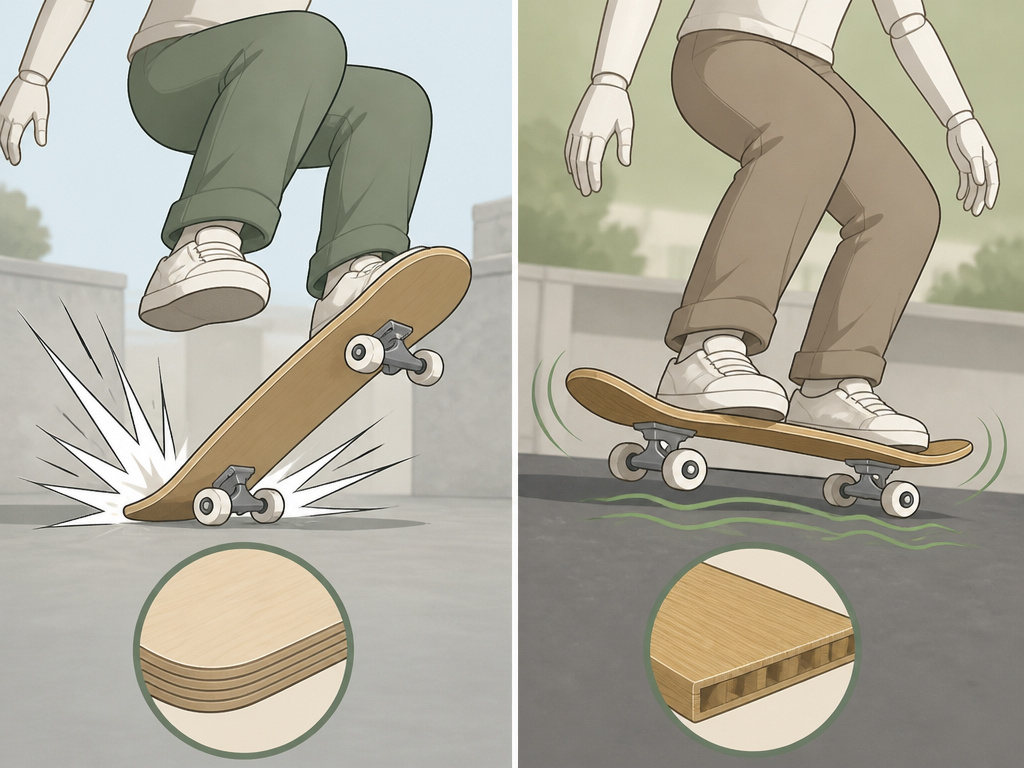
This is where the forum debates get heated, and for good reason. Your riding style decides the winner before you even look at a deck.
For Street and Park Skating: Maple Wins.
The requirement here is immediate, snappy “pop.” When you slam your tail down for an ollie, you want the deck to rebound instantly, launching you and the board into the air. Maple’s stiffness delivers that. It’s a trampoline with no lag. Bamboo’s inherent flex creates lag, the board absorbs some energy before returning it, resulting in a lower, mushier pop (learn more about deck flex explained). Industry magazines like Transworld Skateboarding argue that for technical street tricks, pure maple is the only serious choice, while other sources suggest bamboo-mix decks can be good. The community forums back this up. Users on r/NewSkaters note that for “anything to do with tricks,” they prefer maple for its lack of flex.
For Cruising, Carving, and Commuting: Bamboo Wins.
Here, you want the exact opposite of street performance. You want the deck to absorb road vibration, provide a dampened ride, and maybe even add a playful bounce. Bamboo’s flex makes pushing longer distances less tiring on your feet and knees. That natural shock absorption is why bamboo decks are often marketed as perfect for cruising. On community forums, many riders find bamboo flexier and better for cruising and carving. If your goal is to roll smoothly from point A to point B, bamboo’s forgiving nature is a feature, not a bug.
| Riding Style | Best Deck Material | Why It Works | Risk of Choosing Wrong |
|---|---|---|---|
| Street/Park Tricks | 7-Ply Maple | Stiffness provides instant, high pop for ollies, kickflips, and technical footwork. | A bamboo deck will feel sluggish, reduce trick height, and can fatigue the skater faster. |
| Cruising & Carving | Bamboo | Flexibility absorbs road vibration, provides a smoother ride, and adds a fun, lively feel. | A stiff maple deck transmits every bump, making long pushes uncomfortable and tiring. |
| Downhill/Freeride | Maple or Composite | Stability and torsional rigidity are critical for control at high speeds. | A overly flexible bamboo deck can develop speed wobbles and feel unpredictable. |
| Beginner Learning | Maple (Generally) | Predictable, stable platform helps build fundamental board control and confidence. | A very flexy board can feel unstable under a new skater, hindering balance development. |
Maple vs Bamboo: A Head-to-Head Comparison
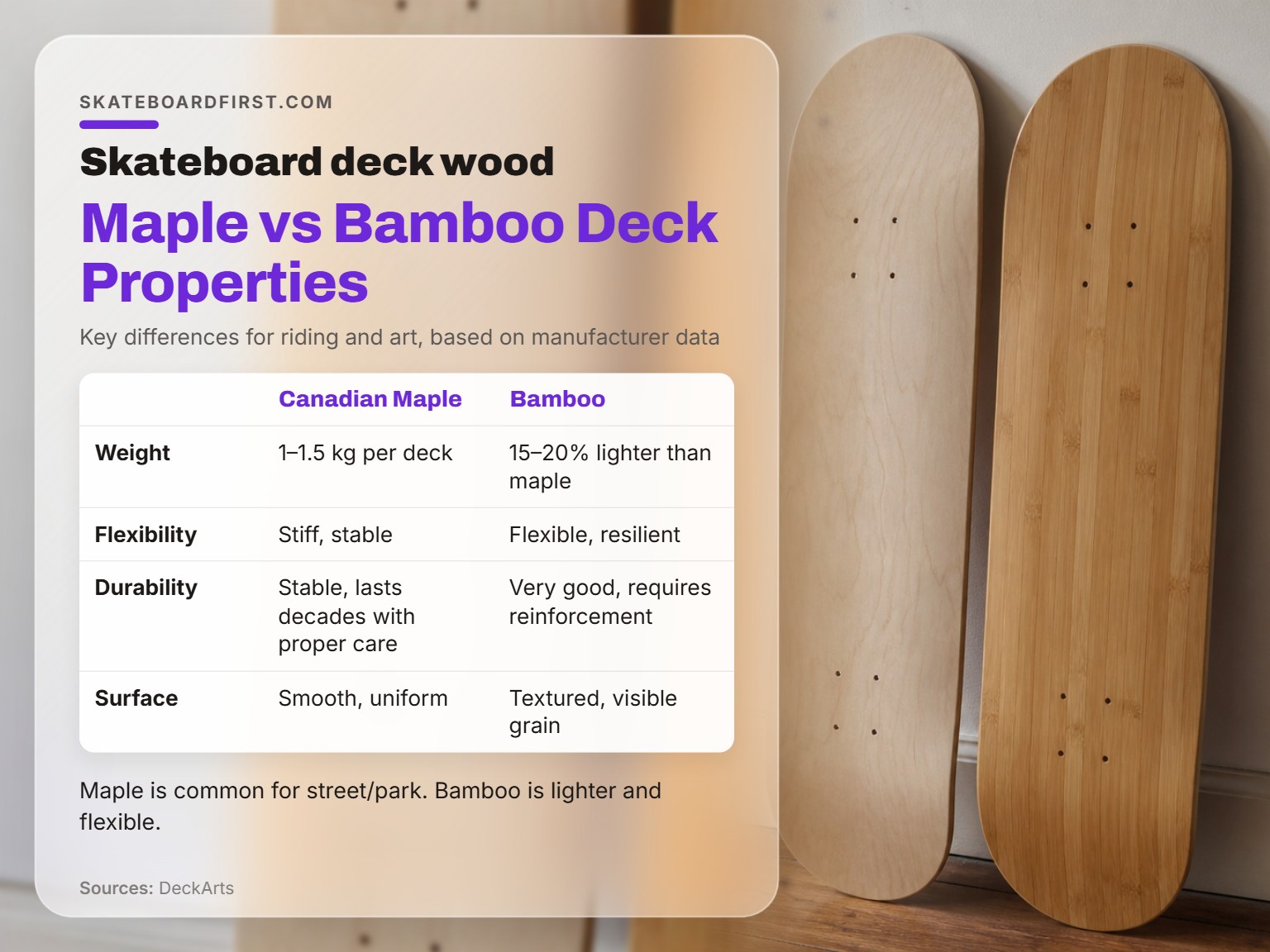
Here are the specifics. The table below pulls data directly from skateboard art manufacturer DeckArts, which details these properties for high-end art applications, the same specs apply to riding decks.
| Property | Canadian Maple | Bamboo | What It Means For You |
|---|---|---|---|
| Weight | 1–1.5 kg (2.2–3.3 lbs) per deck | 15–20% lighter than maple | Lighter is easier to flick and carry; heavier feels more stable. |
| Flexibility | Stiff, stable | Flexible, resilient | Stiffness equals pop; flexibility equals comfort. |
| Durability | Excellent impact resistance | Very good, requires reinforcement | Maple handles curb hits and stair drops better on its own. |
| Surface | Smooth, uniform | Textured with visible grain lines | Smooth is ideal for detailed art prints; texture adds organic character. |
| Moisture Resistance | Moderate (needs climate control) | Good (naturally resistant) | Bamboo handles damp garage storage slightly better. |
| Common Failure Mode | Can delaminate at plies; often repairable with glue/clamps | Can crack lengthwise along grain on major impact | Maple failures are sometimes fixable; bamboo cracks are often terminal. |
| Best For (Art) | Classical art, portraits, detailed graphics | Nature themes, contemporary designs, Asian art | The wood’s base color and grain interact with the artwork. |
Common mistake: Choosing bamboo because it’s “greener” without checking the brand’s sourcing and manufacturing process. The Journal of Cleaner Production study found transportation and adhesive type can negate bamboo’s fast-growth benefit.
The “common failure mode” point is critical and often missed. On forums like Silverfish Longboarding, experienced riders report that when maple decks break, they often delaminate, the glue between plies fails. This can sometimes be repaired with wood glue and clamps. Bamboo, however, tends to crack along its long fibers during a major impact. That crack runs the length of the deck, and there’s no coming back from it. One is a repairable joint failure; the other is a material fracture.
Long-Term Care and What Breaks
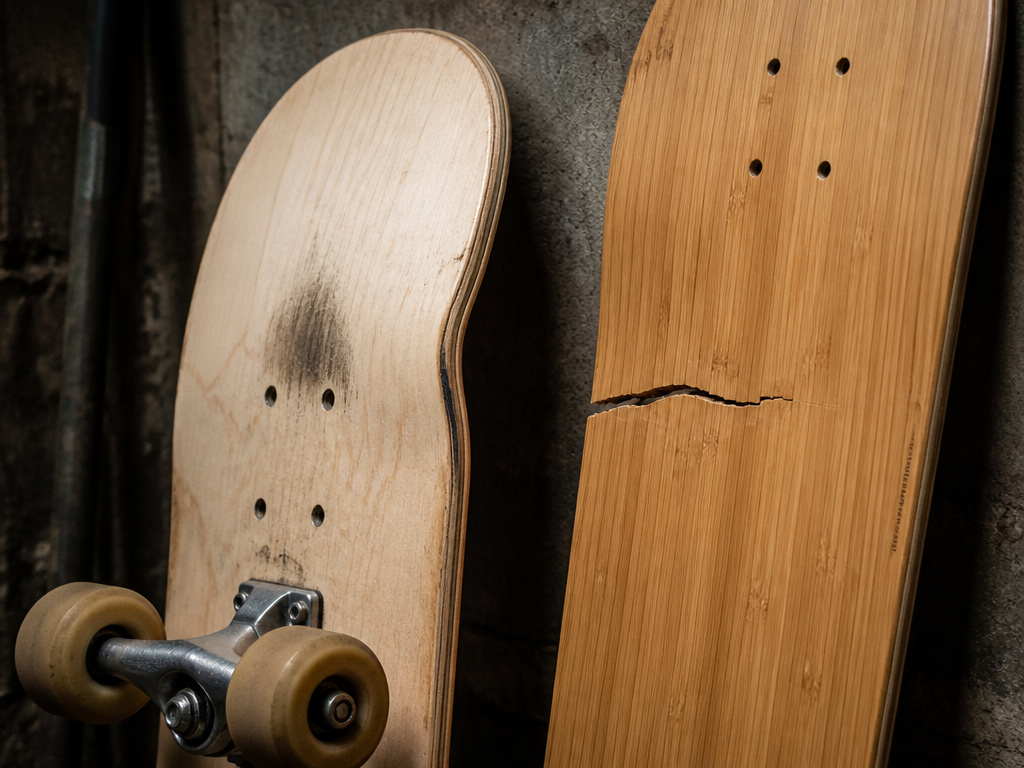
Your deck’s lifespan depends on what you do when you’re not skating. Both materials have specific vulnerabilities.
Maple’s enemy is moisture. The wood is dried to a precise 6–10% moisture content for stability. Leave a maple deck in a damp basement or a hot, humid car, and it will absorb moisture, potentially warping or promoting mold. That “moderate” moisture resistance rating means you need to store it in a controlled environment. Bamboo, being a grass, has better natural resistance to moisture. It can handle less-than-ideal storage a bit better, but it’s not waterproof.
The physical failure points differ, too. As the comparison table notes, maple fails at its laminated joints. You might get a year of hard street skating before you hear the first faint creak of delamination. Bamboo’s failure is more sudden. A hard, direct impact, like landing flat from a high drop, can cause a sharp, splitting crack along the grain. You’ll hear it, and the deck is done.
Skateboard Art: Canvas Matters Too

If you’re buying a deck for wall art, the material choice changes the game. Here, you’re not judging pop or flex, you’re judging how the wood interacts with the printed image.
Maple’s surface is smooth and uniform, with a creamy white to pale yellow base. This neutral, fine-grained canvas is like high-quality art paper. It doesn’t fight the artwork. A detailed portrait or a classic graphic looks crisp and true-to-color. DeckArts recommends maple for classical art, portraits, and detailed graphics because the wood’s subtle grain adds texture without distracting.
Bamboo’s canvas is inherently textured. It has bold, linear grain lines and a warm golden-tan base. This adds a distinct organic character to the print. It works beautifully for nature scenes, contemporary abstract designs, or Asian art themes where the wood grain can become part of the composition. The texture means it’s less ideal for fine details, as the grain pattern can visually compete with them.
For a collector, the advice is straightforward: start with a single maple deck featuring iconic artwork. It’s the accessible, quality standard. As your collection grows, experiment with bamboo pieces for variety and a different aesthetic. The key, regardless of material, is quality printing and proper mounting to ensure the art lasts for decades.
Frequently Asked Questions
What type of wood is best for a skateboard deck?
For the vast majority of skateboarding, especially street, park, and technical tricks, 7-ply Canadian Hard Rock Maple is the best wood. It provides the ideal balance of stiffness for pop, durability for impacts, and predictable performance. Bamboo is best suited for specific use cases like cruising, carving, and commuting where its flexibility is a benefit.
Are bamboo skateboard decks good?
Bamboo skateboard decks are very good for their intended purpose. If you want a deck for smooth cruising, comfortable pushing, and a lively, dampened ride, bamboo is an excellent choice. They are not good, however, for high-impact street skating where snappy pop and maximum durability are required. Always check the construction, as many “bamboo” decks are actually bamboo-maple composites.
Is bamboo or maple better for a beginner?
For a true beginner still learning to balance, push, and turn, a stiff maple deck is generally better. It provides a stable, predictable platform that builds confidence. A very flexy bamboo deck can feel unstable and unpredictable under a new skater’s feet. Once a skater is comfortable cruising and wants a smoother ride, a bamboo deck can be a great second board.
Which is better, bamboo or maple cutting boards?
This article is about skateboard decks! For kitchen cutting boards, the considerations are completely different: knife edge retention, bacterial resistance, and maintenance. Maple is a classic, hard cutting board wood. Bamboo is also popular but can be harder on knives. Don’t use your skateboard as a cutting board.
How long do bamboo skateboard decks last?
With reasonable care and for their intended use (cruising, carving), a bamboo deck can last several years. Under high-impact street skating, an all-bamboo deck may fail faster than a maple deck due to its tendency to crack along the grain. Bamboo-core composite decks reinforced with maple or fiberglass can be much more durable.
The Bottom Line
Here’s the simplest rule: if you’re doing ollies, kickflips, or skating park, get maple. If you’re pushing to class, carving hills, or just rolling for fun, bamboo is worth a look.
My personal take lines up with the evidence. For most skaters, especially those starting or focused on tricks, a plain 7-ply maple deck is the best value (check our best skateboard decks for recommendations). It’s the known quantity. The performance is proven, and the failure modes are understood. Bamboo decks have their place, offering a unique feel that some riders love. But they are a specialty material, not a replacement for the standard.
Before you buy any deck, especially bamboo, do a quick check (see our tips for evaluating deck quality). Look up the brand’s construction details, is it all bamboo or a composite? Read actual owner reviews on forums, not just the marketing copy. And remember, the most sustainable choice is often the durable deck you don’t have to replace next year. Now go roll.
