
How Tight Should Skateboard Trucks Be? Front vs. Rear Tips
This post contains affiliate links. As an Amazon Associate, we earn from qualifying purchases.
The right tightness for your skateboard trucks is the setting that lets you turn comfortably without wobbling at speed, and it’s found by adjusting the kingpin nut in quarter-turn increments, riding between changes, and listening to the feel of the bushings. For most riders, this means the top bushing shows a slight, even compression and the board returns to center when you lean. A common starting point is to back the nut off a quarter-turn from fully tight, then ride and adjust.
That answer is a process, not a single number. The reason is mechanical: the kingpin nut squeezes the urethane bushings, and that compression creates the spring tension that controls your turn. Too loose, and the bushing doesn’t rebound, leaving you unstable. Too tight, and you over-compress it, which kills the turn and shortens the bushing’s life. The feel you’re chasing is the middle ground where the bushing does its job, which is the essence of how tight should skateboard trucks be.
What follows is a walkthrough of that tuning process. This guide explains the quarter-turn method, how to read your bushings, what to do when you hit a limit, and how your wheel size and riding style change the equation. By the end, you’ll know how to dial in any set of trucks.
Key Takeaways
- Adjust your trucks in quarter-turn increments and ride for a few minutes between changes; your body adapts faster than your opinion.
- A visual check for a neutral start: the top bushing shows even, light compression without the washer digging in.
- If you need to tighten past three exposed threads on the kingpin (per Sabre’s manual), switch to a harder bushing instead of cranking further.
- Front and rear trucks can be set differently; a slightly looser front truck is common for better steering.
- Wheel bite is a sign your trucks are too loose for your current wheel size; tightening is one fix, but smaller wheels or harder bushings also work.
The Quarter-Turn Tuning Method
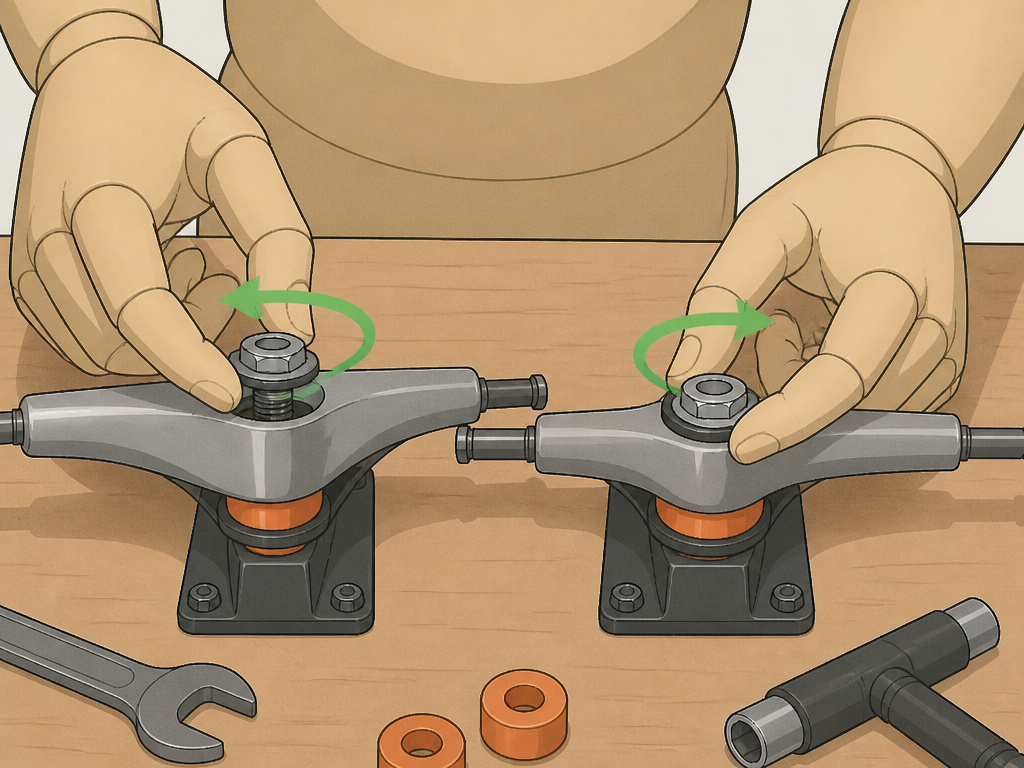
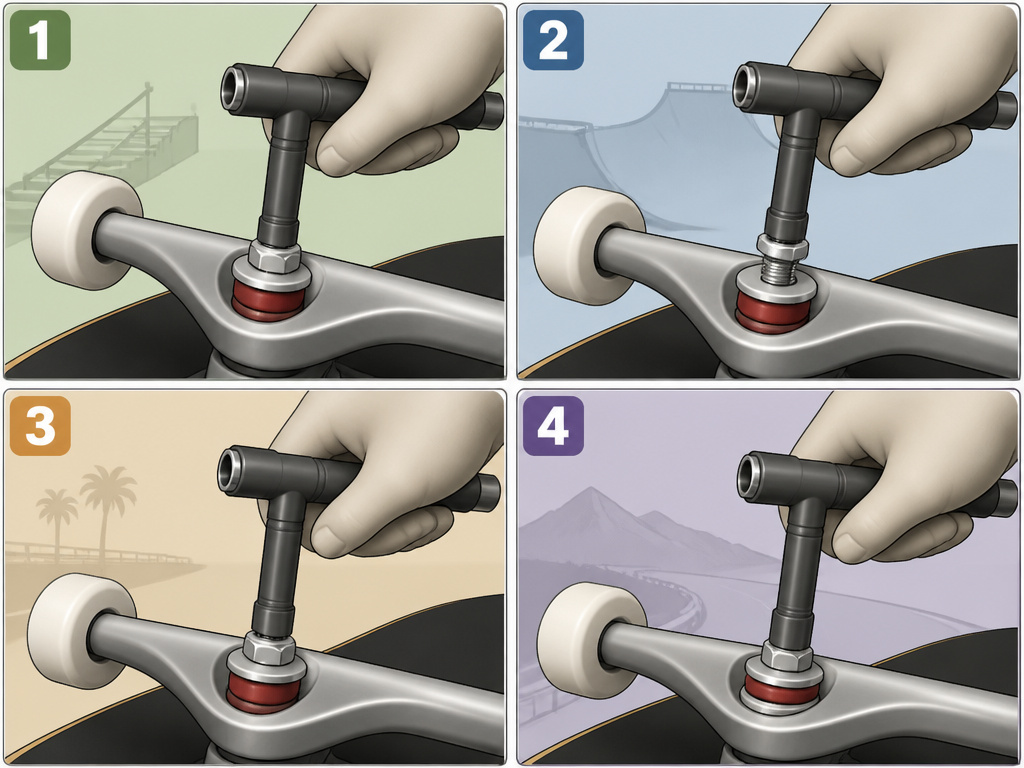
Tighten the kingpin nut and the board gets more stable and harder to turn. Loosen it and carving gets easier, but the board can wobble at speed. Go a quarter turn at a time and ride between changes. Skate Labs advises setting both trucks the same to start, but a 2015 engineering study notes that different stiffness settings on the front versus rear truck are a very common setup among skaters. Skate Labs, “Build and Care for Your Board”
The best way to find your setting for how tight should skateboard trucks be is to treat it like seasoning food. You add a little, taste, then decide if it needs more. Start with both trucks at the same tightness.
Now go skate. Push around, lean into some gentle turns. Notice how the board responds. Does it feel twitchy? Do you have to lean hard to make it turn? Get off, make a quarter-turn adjustment on both kingpin nuts (clockwise to tighten, counter-clockwise to loosen), then skate again for a few minutes. Your muscle memory needs a few minutes to catch up to the new setting. I used to change my trucks and bushings in the same session and learned nothing except new ways to fall. Change one variable, then ride.
Where this goes sideways: Skipping the ride-between-changes step. Your brain will tell you the new setting feels “weird” for the first two minutes, then it normalizes. If you adjust again immediately, you’ll chase a feeling that doesn’t exist and likely over-tighten.
How to Tell If Your Trucks Are Too Loose or Too Tight
Your board gives you physical feedback. Learning to read it saves you a lot of trial and error.
| Symptom | Likely Cause | Quick Fix |
|---|---|---|
| Speed wobbles when pushing or riding straight | Trucks too loose for your speed/weight | Tighten each kingpin nut a quarter turn |
| Wheel bite (wheel touches deck) during turns | Trucks too loose or wheels too large | Tighten trucks, or switch to smaller/harder wheels |
| Board doesn’t return to center after a turn | Bushings are too soft or damaged | Tighten slightly, or replace with harder bushings |
| Turning feels stiff, requires heavy leaning | Trucks too tight, bushings over-compressed | Loosen each kingpin nut a quarter turn |
| Kingpin nut is flush or the washer is bending | Far beyond tight – damaging bushings | Loosen immediately, install harder bushings |
A properly tightened wheel spins freely by hand but has no side-to-side play. If you hear a rattling sound, especially during ollies, your axle nuts might be loose. The Yocaher guide says to grip each wheel and try to shake it; if it slides on the axle, tighten the axle nut until the play is gone, but not so tight that the wheel stops abruptly.
The Bushing’s Role: It’s Not Just the Nut
The kingpin nut is the adjuster, but the bushing is the spring. Its hardness (durometer) determines how much force is required to compress it. A softer bushing is easier to turn than a harder one. This is why two riders with the same nut tightness can have completely different feels.
Stock bushings are a compromise. They’re designed to work for a wide weight range, which often means they’re too soft for heavier riders or too hard for lighter ones.
Common mistake: Cranking the kingpin nut to stop wheel bite on soft stock bushings. You’ll compress the bushing into a pancake, it will crack, and you’ll lose all rebound. The fix is a harder bushing, not more torque.
Here’s a simple rule from the Sabre Trucks manual: if you need to go further than three exposed threads on the kingpin to reduce turn, try a harder bushing instead. That manual exists because overtightening compresses the bushings and “significantly shortens their service life.” Bushings are a consumable part. If they’re cracked, flattened, or no longer hold a setting, swap in a new pair.
Front vs. Rear: Should They Match?
Most guides tell you to start with both trucks the same. That’s good advice for your first setup. But as you get more experienced, you might find a split preference. A 2015 engineering study on skateboard dynamics noted that “different torsional stiffness settings on the front truck versus the rear truck are a very common setup among skaters.” The study modeled front and rear stiffness as independent variables for a reason.
A slightly looser front truck can make steering feel more responsive, especially for carving and bowl riding. A tighter rear truck can add stability for landing tricks or for downhill. The key is to make small, intentional changes. Don’t just crank one side randomly.
Tightness for Different Riding Styles
Your discipline changes the equation. The same tightness won’t work for a technical street skater and a cruiser.
- Street & Technical Tricks: Often prefer a medium-tight to tight setting. It provides a stable platform for pops and precise foot placement for flip tricks. Too loose can make landing off-balance corrections harder.
- Transition & Bowl Riding: Usually benefit from a looser setting. Carving and generating speed in a bowl requires deep, fluid turns. Looser trucks make this easier and can help with pumping.
- Cruising & Commuting: A medium setting is typical. You need enough turn for maneuvering around cracks and pedestrians, but enough stability for pushing comfortably at speed.
- Downhill: Requires a tight setup for maximum stability at high speeds to prevent speed wobbles. Harder bushings are almost always used here.
Remember, these are generalities. Plenty of street pros skate loose trucks, and some bowl riders prefer them tight. Your preference is the final judge.
Tools You’ll Need (And One You Can Improvise)
You don’t need a mechanic’s set. Here’s what actually gets the job done:
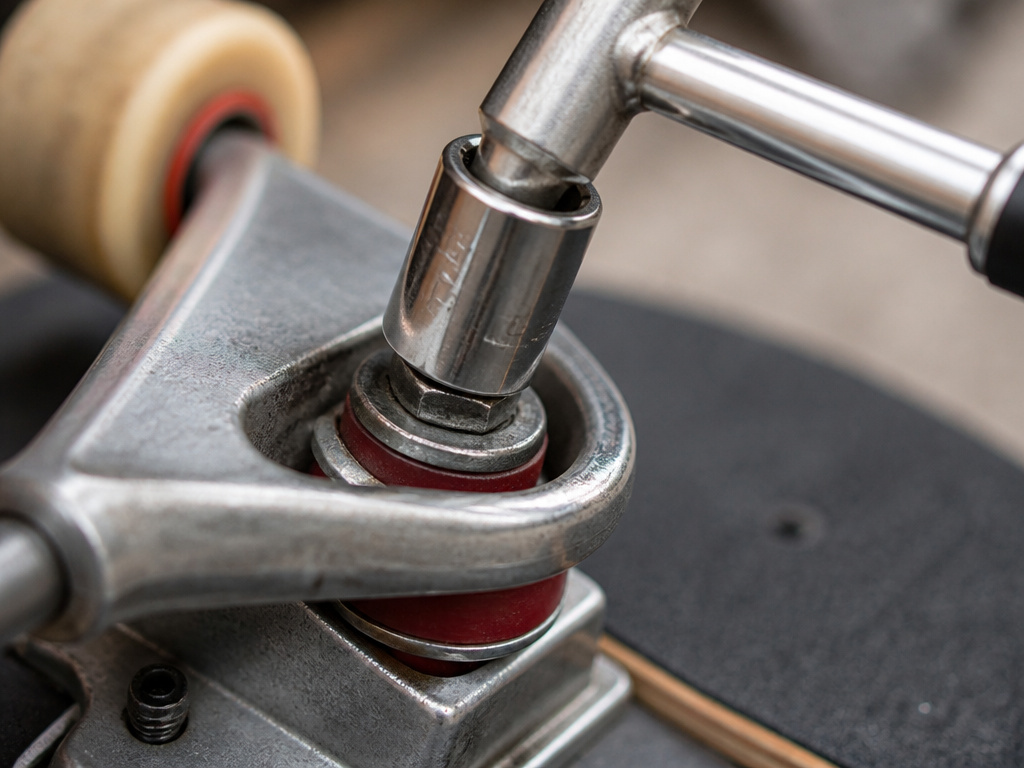
- A Skate Tool: The T-shaped multi-tool is the standard. It has the right-sized sockets for the kingpin nut, axle nut, and hardware nuts and a screwdriver. It’s the single best investment for board maintenance.
- Improvised Method: In a pinch, an adjustable wrench can work on the kingpin nut. A 9/16-inch socket on a ratchet is even better, as the Yocaher guide notes. For axle nuts, the correct size wrench is key. Be careful with pliers – they can round off the nuts.
Before you start: When using any tool, make sure you’re turning the correct nut. The kingpin nut is the large one facing inward between the wheels. The axle nuts are on the ends of the axle. Confusing them leads to a bad day.
The 3-Thread Rule vs. The Feel Rule
Sources disagree on how to measure tightness, and this is the most useful conflict you’ll encounter. It’s a choice between component life and personal feel.
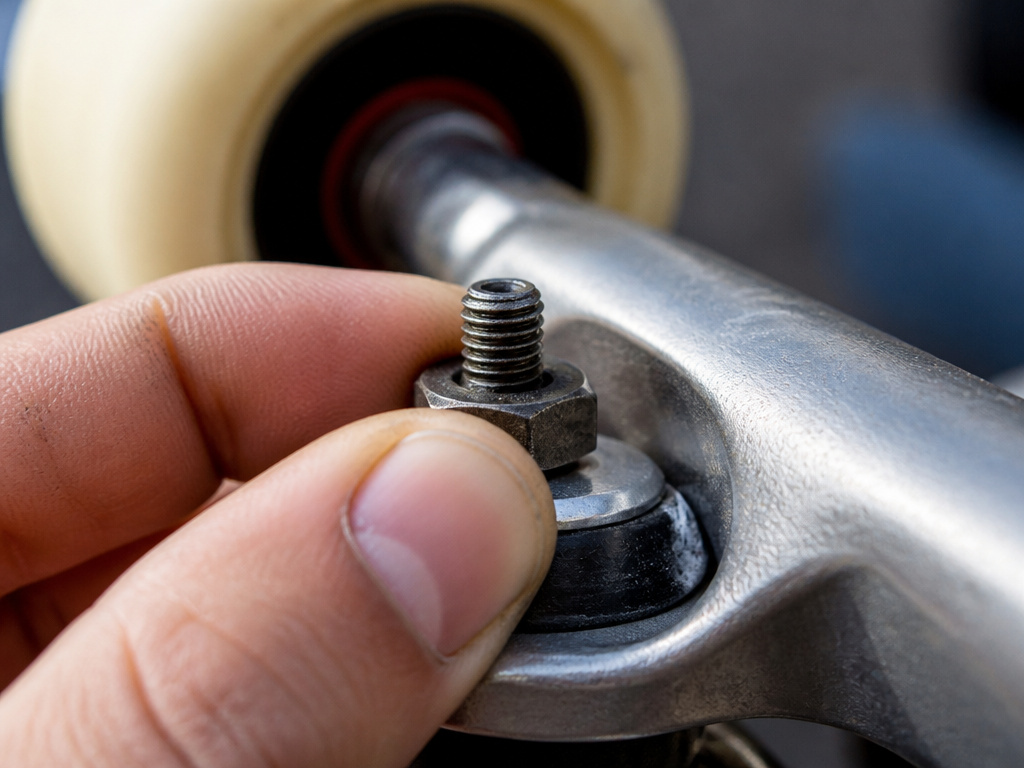
- The 3-Thread Rule (Sabre Trucks): The Sabre Forged Precision Mk3 care manual states: “We recommend no more than THREE threads showing on the kingpin – ideally less than this!” This is a hard mechanical limit to preserve bushing life. It’s a clear, visual checkpoint.
- The Feel Rule (Yocaher, Skate Labs): The Yocaher guide advises: “Pay little mind to the amount of threads that stick out past the nylon on the nut. Instead, roll the board and see how it turns.” Skate Labs says “There’s no right setting, only the one that feels good to you.” This is preference-driven tuning.
Which should you follow? If you own Sabre trucks, respect their limit – they designed it. For other trucks, use the thread count as a warning sign, not a law. If you’re exposing many threads and still want it tighter, the problem is your soft bushings, not the nut. Switch to a harder duro.
Frequently Asked Questions
How tight should trucks be for a beginner?
Start tighter. A stable board is less intimidating when you’re learning to push, balance, and footbrake. As your confidence grows, loosen them in quarter-turn increments to explore turning. Most beginners crank them too tight at first because loose feels scary – that’s fine, just know you’ll likely loosen them later.
Do tighter trucks make tricks easier?
It depends on the trick. Tighter trucks provide a more stable, predictable platform for ollies and flip tricks, which can make them easier to learn initially. However, for technical ledge or manual tricks where you need to steer the board mid-trick, looser trucks offer more control. Many pros land complex tricks on loose setups.
How do I stop wheel bite?
Wheel bite means your wheel is contacting the deck during a turn. You have three options, in this order of simplicity: 1) Tighten your trucks a quarter-turn. 2) Switch to smaller wheels. 3) Install harder bushings to get stability without over-tightening. You can also add riser pads, but they change the board’s pop angle.
Why do my trucks feel different after a week of skating?
Bushings break in. New bushings are often stiff and need a few sessions to soften up and mold to your turning style. This is normal. If they feel drastically looser, check that the kingpin nut hasn’t vibrated loose (uncommon with nyloc nuts). Otherwise, just tighten them a fraction back to your preferred feel.
How often should I check my truck tightness?
Make it part of a quick pre-session check. Before you skate, glance at your kingpin nuts and axle nuts. Give the board a shake – listen for rattling wheels. A regular visual inspection is recommended.
The Bottom Line
Your perfect truck tightness isn’t a secret number, but the answer to how tight should skateboard trucks be. It’s the setting you find when you stop chasing a generic answer and start listening to your board. Use the quarter-turn method, respect the bushing’s role as the true spring, and don’t be afraid to set your front and rear trucks differently.
If you take one thing from this, let it be this: the next time you’re unsure, don’t just crank the nut. Go skate for ten minutes on the current setting. Then decide. Your body knows what feels right long before your brain can explain it. Now go make a quarter-turn adjustment and see what happens.
