
Complete Skateboard vs Custom Build: Which Should You Buy?
This post contains affiliate links. As an Amazon Associate, we earn from qualifying purchases.
A complete skateboard is a pre-assembled, ready-to-ride package best for beginners because it removes guesswork and costs less upfront. A custom build involves selecting each component individually for a tailored setup, which is ideal for intermediate or advanced skaters who know their preferences. For a first-time adult buyer, a complete skateboard is almost always the better starting point.
The cost difference isn’t small. An entry-level complete starts at around $60, while a custom build with quality parts quickly reaches $140 or more, as SkatesUSA notes custom builds start at $140. That gap pays for the learning curve, your first board will take a beating, and replacing a worn $70 complete hurts less than a scratched-up $200 custom.
What follows: a line-by-line cost breakdown, the real performance trade-offs, and the specific upgrade path from a complete to your first custom build. By the end, you’ll know whether to grab a box and go, or spend an afternoon at the shop counter.
Key Takeaways
- For your first board, buy a complete skateboard. Retailers like Skatewarehouse and brands like Dankies Skateboards explicitly state it’s the easiest, most convenient option for beginners.
- Expect to pay $60–$120 for a beginner complete, though sources cite different ranges: Skateboard Trends states $70-$120, while SkatesUSA states $60-$90. Custom builds start around $140 and go up from there, as noted by SkatesUSA’s 2026 pricing guide.
- Truck axle width must match deck width, a 7.75″ deck pairs with a 129mm truck axle, per Independent Truck Company’s sizing standard. Mismatching here is a common first-build error.
- Wheel choice dictates your ride. Hard wheels (99A+) are for tricks on smooth concrete; soft wheels (78A-87A) are for cruising rough pavement, as outlined by Concrete Wave Magazine.
- You can upgrade a complete board piece by piece as parts wear out or your style changes, making it a flexible starting point for long-term skating.
The 4-Part Skateboard Cost Breakdown
We’ll start with the numbers. The price tags tell the story before you ever step on a board.
My first board was a $40 toy-store special. The wheels felt like hard plastic, and the trucks wobbled like a shopping cart with a bad wheel. I spent three weeks convinced my balance was shot. A shop employee finally spun a wheel, it barely made a full rotation. The struggle was the board, not my feet.
Here’s what you’re actually paying for, based on current market data.
| Setup Type | Price Range | What You Get | Best For |
|---|---|---|---|
| Entry-Level Complete | $60 – $90 | Pre-assembled board from a skate brand (e.g., Powell-Peralta Golden Dragon). Functional, matched parts. | First-time buyers, casual riders testing the waters. |
| Mid-Tier Brand Complete | $90 – $140 | Name-brand complete (e.g., Element Section, Santa Cruz Classic Dot). Better trucks, bearings, and deck construction. | Beginners committed to learning, or intermediates wanting a reliable spare. |
| Custom Build (Beginner/Intermediate) | $140 – $240+ | Hand-picked deck, trucks (e.g., Independent), wheels (e.g., Bones), bearings, and hardware. Tailored to your style. | Skaters who know their preferences for street, park, or cruising. |
| Toy Store Board | $25 – $40 | Plastic trucks, non-rolling bearings, heavy wood. Often sold in big-box stores. | Not recommended for actual skating. It’s a toy, not a tool. |
The part nobody mentions: A deck on a complete skateboard typically lasts 6-12 months with regular use before losing pop, according to UDITER’s beginner guide. Wheels can go 1-2 years. You’re not buying a forever board; you’re buying a learning platform. Plan to replace parts as you progress.
When you compare a complete skateboard vs custom build, the jump from a $90 complete to a $180 custom is real. That extra $90 buys you specificity: a deck width that fits your shoe size exactly, truck geometry that matches your turning style, wheel hardness suited to your local pavement. But you need to know what those specifics are before they’re worth the money.
Complete Skateboards: The Fast Track to Riding
A complete skateboard is a box you open, and then you skate. That’s the whole pitch, and for a beginner, it’s enough.
Retailers are unanimous on this. Skatewarehouse calls it “almost always the better starting point” for a first-time adult buyer. Dankies Skateboards says it’s “usually the easiest and most convenient option.” The value isn’t just in saving $50; it’s in skipping a weekend of analysis paralysis over bearing ABEC ratings that seasoned skaters will tell you barely matter.
Why-Layer: Completes work because brands batch-order parts that are dimensionally compatible. They match a deck width to a corresponding truck axle width (like the 7.75″ deck / 129mm truck standard), ensuring the board turns predictably. The wheels are a middle-ground durometer that won’t slide out uncontrollably on smooth concrete but can still handle slightly rough pavement. It’s a one-size-fits-most formula that gets you rolling safely.
Where this goes sideways: Assuming all completes are equal. A $60 Powell-Peralta Golden Dragon is an example of an entry-level complete. A no-name $60 complete from a generic online seller might use proprietary, non-standard parts that are impossible to replace individually. Always buy from a reputable skate brand or shop.
The sensory reality is simple: a complete from a reputable brand rolls smoothly with a quiet, steady hum. A bad one chatters, vibrates, and feels dead under your feet after two pushes. Trust the brands that have been doing this for decades. An Element Section complete or a Santa Cruz Classic Dot is a known quantity. They’re the default picks for a reason.
Custom Builds: Control at a Cost
Building your own skateboard is for when “it rolls” is no longer enough. You want it to roll a specific way.
This is where you match components to a skating discipline. For technical street skating, you’d choose a narrower deck (8.0″-8.25″) with smaller, harder wheels (99A-101A, 50-53mm), as profiled in Thrasher Magazine’s gear reviews. For transition skating in bowls, you’d want larger wheels (54-60mm) and wider trucks for stability, per NHS/Santa Cruz’s guides. For cruising rough streets, softer wheels (78A-87A) are essential.
The assembly is part of the appeal. As one Reddit user put it, “shopping for parts and building a board in your head is an enjoyable process.” It’s a hands-on education in how your board works. You learn that truck axle width must match deck width, that wheel durometer is measured on the A Scale, and that deck construction is typically 7-ply Canadian maple.
Common mistake: Prioritizing high ABEC-rated bearings. Bearing manufacturers promote ABEC 7 or 9 ratings for precision, but the skate community consensus, visible on forums like Skateboard Collective, is that seal quality and lubrication matter far more. A basic ABEC 3 or 5 bearing that’s kept clean will perform identically for skateboarding.
The first-hand observation here is tactile. Threading the kingpin bolt through the baseplate, feeling the bushings compress as you tighten the nut, pressing bearings into wheels until they snap into place, this process connects you to the machine. It demystifies it. If a truck feels too loose, you know how to fix it. If a wheel slows down, you know it might need cleaning, not replacing.
That knowledge is the real value of a custom build. It’s why, after you’ve worn out your first complete, building a skateboard from scratch becomes a logical next step.
Common Beginner Building Mistakes (And How to Dodge Them)
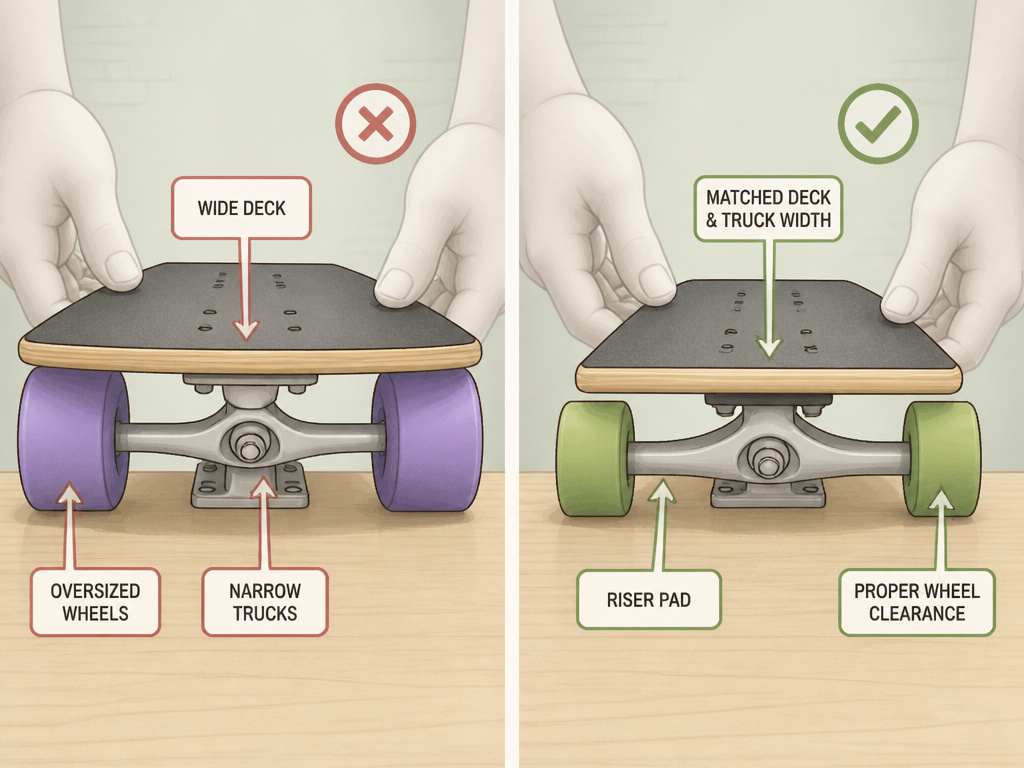
Walking into a shop with a list of dream parts is exciting. Walking out with a board that doesn’t turn right is frustrating. These are the mismatches that waste money.
Mismatching Truck and Deck Width. This is the big one. If your deck is 8.25″ wide, you need trucks with a matching axle width. Putting 129mm trucks on it will make the board feel tippy and unstable. Always reference the manufacturer’s sizing chart, like the one from Independent Truck Company.
Ignoring Wheel Bite. Larger wheels (above 54mm) or very soft, wide wheels need more clearance from the deck. If you don’t add riser pads, the wheels can grab the deck during sharp turns, throwing you off. It’s a sudden, jarring stop.
Overtightening Everything. Your hardware bolts only need to be snug. Truck tightness is debated: some advise tighter trucks for beginner stability, while others advise loose enough to turn easily for learning balance and carving.
I learned that the hard way. My first garage build took two hours, and I put one truck on backwards. Watching a shop employee build one in 15 minutes taught me more than any tutorial. Stand at the counter and ask them to talk through the order.
These mistakes are summarized in the table below.
| Symptom | Likely Cause | The Fix |
|---|---|---|
| Board feels tippy, hard to balance. | Trucks too narrow for deck width. | Remeasure deck and match to correct truck axle width. |
| Wheels make a grinding sound and stop during turns. | Wheel bite — wheels contacting deck. | Install riser pads between truck and deck. |
| Board doesn’t turn easily, feels “dead.” | Kingpin nut overtightened. | Loosen nut until you can lean into a turn without excessive force. |
| Bolts keep loosening during rides. | Hardware not tightened enough, or locknuts missing. | Ensure all 8 hardware bolts are snug, and use nylon locknuts. |
The goal isn’t to scare you away from building. It’s to show that a local skate shop’s advice is invaluable. They’ll catch these issues before you buy. This is why, in the complete skateboard vs custom build debate, a custom build, while more expensive, often includes free assembly when you buy the parts in-store, as they’d rather you ride a working board.
Your Upgrade Path: From Complete to Custom
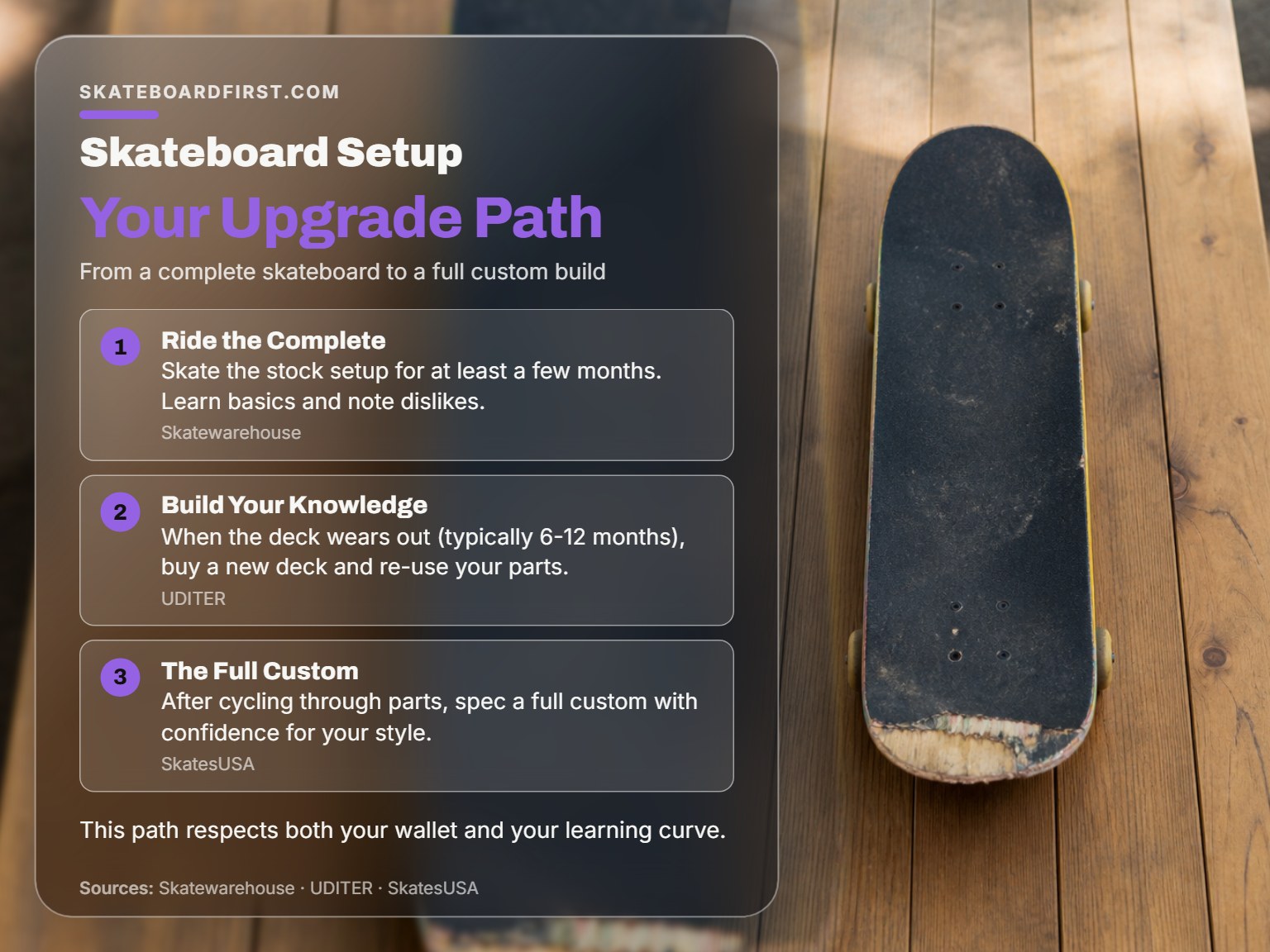
You don’t have to choose one path forever. The most practical approach is to start with a complete and evolve it.
Phase 1: Ride the Complete. Skate the stock setup for at least a few months. Learn to push, turn, stop, and maybe ollie. Pay attention to what you dislike. Do the wheels feel too slow on your rough driveway? Does the board feel too narrow for your stance?
Phase 2: Replace the Worn or Wrong Part. Wheels and bearings are the first to show wear or dissatisfaction. Swapping the stock 95A wheels for 78A cruisers or 101A street wheels is a $30 upgrade that completely changes the board’s personality. This is where you start to learn about parts combination.
Phase 3: Build Your Knowledge Base. When the deck finally loses its pop or chips beyond repair (around the 6-12 month mark), don’t buy another complete. Buy a new deck you like, and re-use your now-familiar trucks, wheels, and bearings. You’ve just performed your first partial custom build.
Phase 4: The Full Custom. Once you’ve cycled through a deck and a set of wheels, you know what you want. Now you can spec a full custom with confidence. You’ll know that an 8.25″ Powell-Peralta Flight deck feels right, that Independent Stage 11 trucks give you the turn you like, and that 53mm Bones STF wheels work on your local park’s concrete. This informed custom build is where the extra cost finally pays off.
This path respects both your wallet and your learning curve. It turns the question of “complete skateboard vs custom build” from a one-time dilemma into a phased journey.
Where to buy a complete or custom skateboard

For a first complete board, major online skate shops are the most straightforward option. They offer a wide selection of pre-built completes from reputable brands, and the parts are already matched to work well together. This is the easiest and most convenient path for a beginner. If you decide to build a custom board, these same online retailers have build-your-own tools, but you’ll need to understand part compatibility yourself. Your local skate shop is the best resource for a custom build. They can assemble the board for you, ensuring your truck axle width matches your deck and offering hands-on advice, but expect a higher total cost for this personalized service.
Frequently Asked Questions
Is it cheaper to build or buy a skateboard?
It is almost always cheaper to buy a complete skateboard. A beginner complete costs $60-$120. A custom build with comparable parts starts around $140, and using premium components can push it over $240. The complete is the budget-friendly entry point.
Are complete skateboards good for beginners?
Yes, they are the recommended choice for beginners. Experts from Skatewarehouse, Dankies Skateboards, and UDITER all advise beginners to start with a complete. They are pre-assembled with matched parts, removing technical guesswork so you can focus on learning to ride.
What does “complete skateboard” mean?
Complete skateboard is a fully assembled, ready-to-ride skateboard. It includes the deck (board), grip tape, trucks (metal axles), wheels, bearings, and all necessary hardware. You take it out of the box and can start skating immediately.
Can you do tricks on a complete skateboard?
Absolutely. Completes from reputable brands like Element, Santa Cruz, and Powell-Peralta are designed for real skating. They can handle basic to intermediate tricks like ollies, kickflips, and grinds. The parts are functional and durable enough for progression.
How long does a complete skateboard last?
With regular use, the deck may last 6-12 months before losing its pop or chipping significantly. Wheels can last 1-2 years, and bearings last longer if cleaned periodically. It’s a starting platform; expect to replace components as you improve and wear them out.
The Bottom Line
Start with a complete. Seriously, just start with a complete.
The data from retailers, the price breakdowns, and the lived experience of countless new skaters all point to the same conclusion: a $90 complete from a real brand is the fastest, cheapest, and least frustrating way to get rolling. It answers the most important question, “Do I even like skateboarding?”, before you buy a custom skateboard setup.
When you’ve worn through that first deck and have opinions on wheel hardness and truck tightness, then spend the afternoon at the shop counter picking out each part. The custom build will mean something because you’ll know what you’re customizing for.
Your first board isn’t your last board. It’s your first lesson. Make it an easy one.
