
How to Choose Your First Skateboard: Step-by-Step
This post contains affiliate links. As an Amazon Associate, we earn from qualifying purchases.
Choosing your first skateboard means matching three things: your intended riding style, your physical build, and a realistic budget. Start with a pre-assembled complete board from a real skate shop, pick a popsicle-shaped deck around 8 inches wide, and consider wheels in a medium durometer range for a balanced, forgiving ride.
That setup covers the large majority of new skaters who want to cruise and learn basic tricks. The rest is fine-tuning those three parts, deck, trucks, wheels, to fit your specific situation, which is where most guides overwhelm people with endless options before they’ve even pushed once. A key part of this fine-tuning is learning how to choose your first skateboard.
What follows: a breakdown of each component with the specs that actually matter, a direct comparison of where to buy, and the five-minute setup check you should do before your first session.
Key Takeaways
- Start with a pre-assembled complete skateboard from a shop like Roller Snakes; building a custom setup adds cost and confusion when you don’t yet know your preferences.
- Pick a popsicle-shaped deck in a width suitable for your size; this versatile shape works for cruising and learning tricks.
- Sources disagree on ideal beginner wheel hardness: Hammer Skateboard suggests a softer or medium hardness wheel for your first few weeks, while Roller Snakes recommends a standard hardness around 97a-101a.
- Never skate a wet board; water ruins wood decks and bearings, and a warped deck is unrideable.
- Your local skate shop is your best resource; their staff can set up your board correctly and answer questions big-box stores can’t.
The One Rule That Trumps All Others
Buy from a real skate shop, online or in person. The Portland Parks & Recreation department explicitly advises against toy boards from “one-stop shopping marts,” noting their weak components slow skill development and increase injury risk. A shop board uses industry-standard materials, seven plies of Canadian Maple for the deck, urethane for wheels and bushings, metal trucks, the stuff that actually responds when you lean or push.
Portland Parks skateboard guide states that a proper setup is crucial, as inferior toy boards “will not stand up to repetition or respond to stance, balance and movement the way a quality board will.”
The difference isn’t subtle. A cheap department-store complete has plastic-feeling wheels, gritty bearings that seize after a week, and trucks that either don’t turn or feel like they’re made of jelly. You’ll assume skating is just that hard. It isn’t. A complete from a shop brand like Element, Santa Cruz, or Powell-Peralta gets you rolling on day one with parts that work together. That’s the whole point of a first board.
How Do I Pick the Right Deck Size?
Deck width is your starting point. Length matters less for beginners. The common range is 7.5 inches to 8.5 inches.
Here’s the straightforward advice from retailers, which you can use as a baseline before overthinking it:
- For younger or smaller skaters (roughly under age 10 or shoe size below men’s 6): decks 7.5” to 7.75” wide.
- For teens and adults: decks 7.75” and up wide.
- Roller Snakes suggests decks 7.8” and up are better for older skaters or people with big feet, while Hammer Skateboard argues shoe size is not really relevant.
A medium concave will be fine for your first board. The slight side-to-side bend helps your feet stay planted without being so dramatic it locks your stance.
Now, the debate. Roller Snakes links deck width to shoe size for bigger feet. Hammer Skateboard argues your shoe size “is not really relevant,” stating that control comes from your toes and heels hanging over the edge anyway. Both are right in a way. A size 13 foot on a 7.5” deck feels cramped and tippy. A size 7 foot on an 8.5” deck feels like steering a boat. You want a width where you can stand comfortably with your feet just behind the bolts, not where the board disappears under your soles.
Start at 8.0 inches. It’s the middle ground, offering stability for cruising and enough pop for learning ollies. After a month, you’ll know if you want to go narrower for quicker flips or wider for more landing room. This is where a shop visit helps, you can stand on a few sizes and feel the difference.
Complete Skateboard vs. Custom Build: Which Wins for a Beginner?
Get the complete. Every time.
A pre-assembled complete is a skateboard that comes ready to ride. You pick the width and graphic, and the shop or manufacturer pairs matching trucks, wheels, and bearings. This is the best beginner skateboards path because it removes fifty decisions you aren’t ready to make. The complete vs custom debate isn’t about quality at this stage; it’s about simplicity.
| Factor | Complete Skateboard | Custom Build |
|---|---|---|
| Cost | Lower. Bundled pricing saves money versus buying parts separately. | Higher. You pay retail for each premium component. |
| Decision Load | Minimal. Choose deck size/graphic; the rest is matched for you. | High. Requires research on truck width, wheel durometer, bearing specs, hardware. |
| Setup Time | Zero. It’s assembled. | Requires assembly time and tools. |
| Best For | First-time buyers, anyone unsure of preferences, budget-conscious starters. | Experienced skaters replacing worn parts or tailoring a setup for a specific discipline (e.g., vert). |
| Risk If You Get It Wrong | Low. Components are designed to work together. | High. Mismatched trucks/wheels can cause wheel-bite or a dead board feel. |
Building a custom skateboard setup is fantastic, later, after you’ve mastered the basics of how to choose your first skateboard. Once you know you prefer Independent trucks over Thunders, or that 54mm Spitfires work better for you than 52mm Bones, then you can swap parts. Your first board’s job is to be reliable, affordable, and rideable immediately. A complete does that.
Wheel Hardness and Size: Your Ride Quality Lever
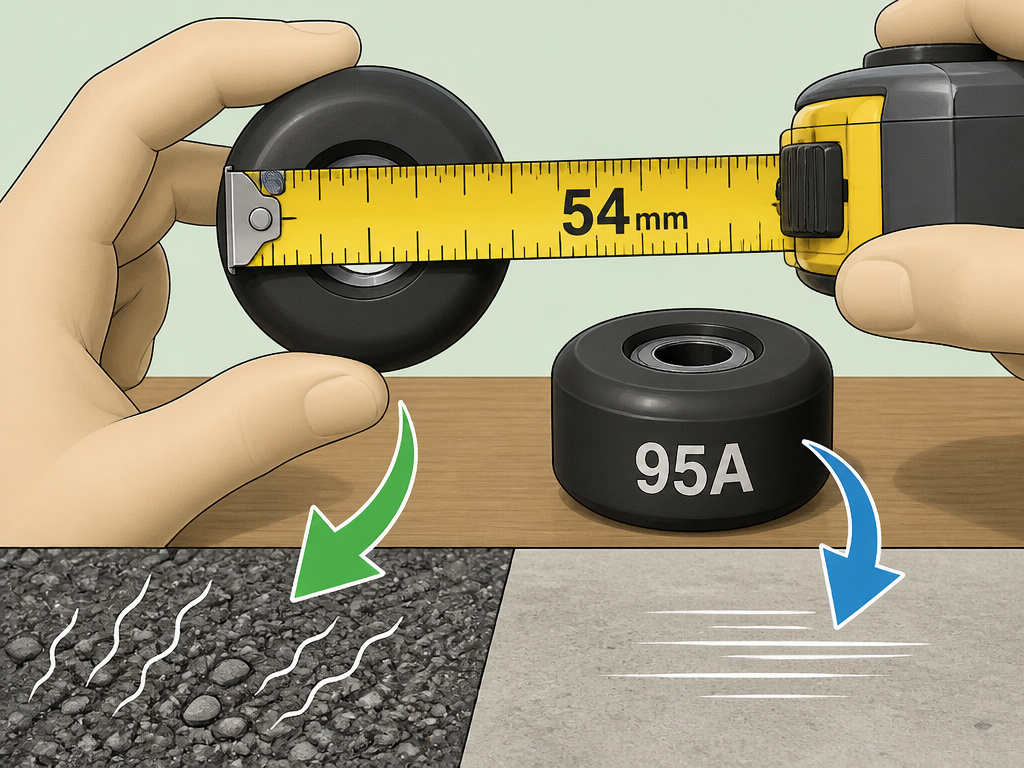
Wheels are where your board meets the ground, and the wrong choice makes learning a chore. They’re defined by two specs: diameter (size in mm) and durometer (hardness on the A scale).
For a first board, follow this priority:
- Hardness (Durometer): Aim for 90A to 95A. This is the “medium all round street” range per Hammer Skateboard. It’s the sweet spot, softer than the 99A–101A park wheels that come on many completes, but harder than true 78A cruiser wheels. They absorb cracks and rough asphalt vibration, giving you a quieter, smoother push, but they still slide predictably when you start learning powerslides or board stops.
- Size (Diameter): 52mm to 54mm. This is the standard beginner recommendation from Roller Snakes. Smaller wheels (sub-50mm) are for technical street skaters who want a lower center of gravity. Larger wheels (56mm+) are for cruisers and transition skaters who prioritize roll speed over quick acceleration. 52–54mm is a balanced, do-it-all size.
Where this goes sideways: Putting 101A super-hard wheels on your first board because they came with the complete. On rough pavement, hard wheels can transmit vibration. Some sources, like Hammer Skateboard, suggest swapping to a softer or medium hardness wheel for a better experience.
The CPSC notes that longer boards and proper truck tightness increase stability at speed, but your wheels determine comfort at all speeds. Hard wheels are fast on smooth concrete. Soft wheels smooth out bad asphalt. Medium wheels split the difference, which is why they belong on a first board.
Trucks, Bearings, and the Myth of ABEC
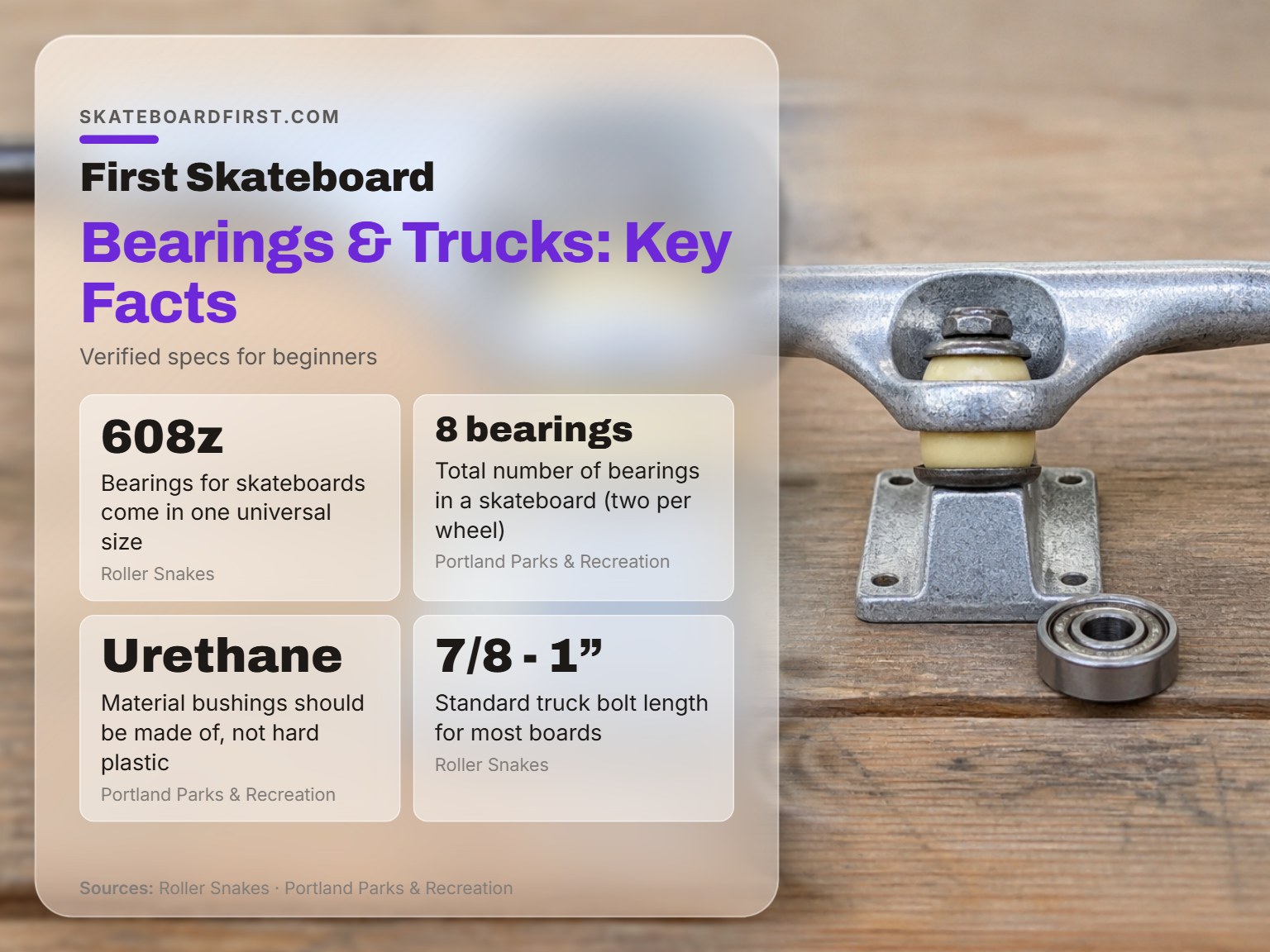
Trucks are the T-shaped metal axles. For a complete, they’ll be matched to your deck width. The only adjustment you need to make as a beginner is tightness.
Tight trucks turn less, feel more stable, and are better for beginners learning to push in a straight line. Loose trucks turn more, feel twitchy, and are for experienced skaters who carve bowls or navigate tight lines. Start with them snug, not cranked down, but with no visible side-to-side play in the hanger. You can always loosen them a quarter-turn at a time later.
Inside each truck are urethane bushings. The Portland guide specifies they “should be made of urethane, not hard plastic.” Softer bushings are often recommended for lighter riders. If your board feels impossible to turn even with loose kingpins, you might need softer bushings. That’s a $10 upgrade for another day.
Bearings are the least important place to spend money early on. Roller Snakes states bearings come in one universal size, 608z. The ABEC rating (1, 3, 5, 7) measures precision tolerance, not necessarily skate performance. A higher ABEC bearing might spin faster in a lab, but on a board, seal quality and lubrication matter more. Stand Tall Shop calls chasing the highest ABEC “the most common mistake.”
Get a bearing in the universal 608z size. Keep them clean and dry. The CPSC skateboarding safety fact sheet and every other source agree: water destroys bearings. One puddle can turn a smooth roll into a gritty, slow crawl.
Your First Setup and Safety Check
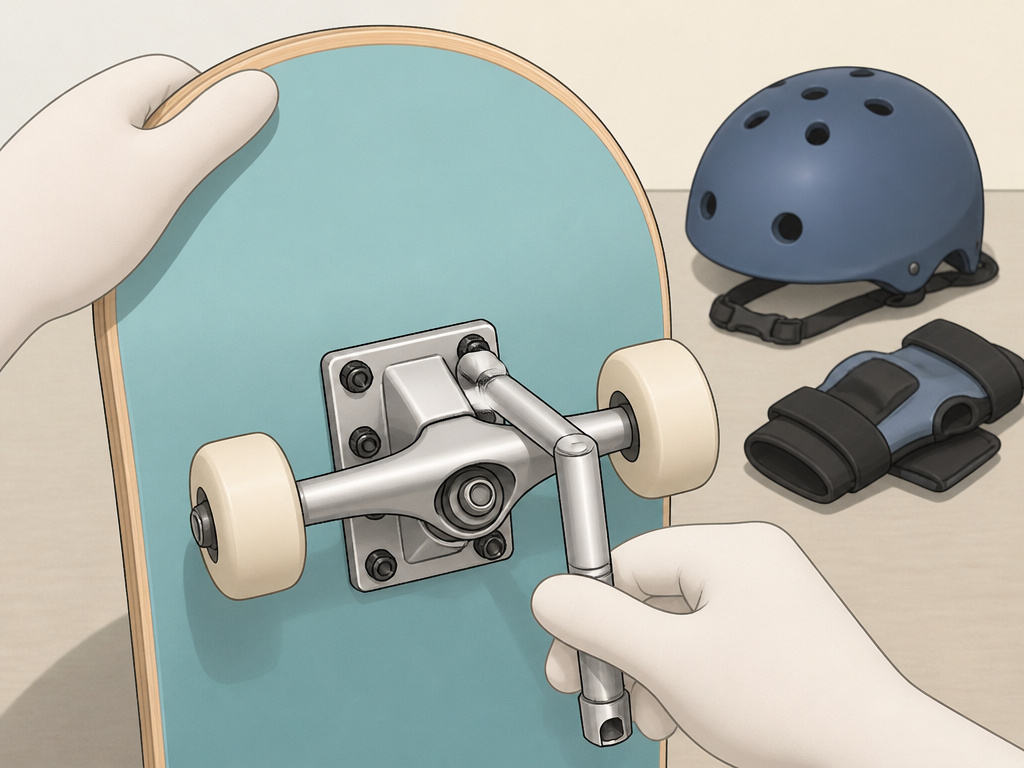
You have the board. Before you ride, do these five things. They take five minutes and prevent most common early failures.
- Check all hardware. Are the eight truck bolts tight? Are the axle nuts on the wheels snug, but not so tight the wheel can’t spin? A skate tool is an essential.
- Test the trucks. Stand on the board (on carpet or grass) and rock side-to-side. They should offer resistance, not flop over. Adjust tightness with the skate tool’s socket.
- Spin the wheels. Give each wheel a flick. They should spin freely for several seconds. A wheel that stops immediately has a bearing that’s too tight or is seized.
- Apply your safety gear. This isn’t optional. The Consumer Product Safety Commission states a helmet “can mean the difference between life and death.” Wear a skateboard helmet designed for multiple impacts (hard shell with foam), and fasten it. Wrist guards are also critical for beginners who instinctively put their hands out when they fall.
- Find a smooth, flat, quiet place. A empty parking lot, a tennis court, a freshly paved path. Avoid hills, traffic, and gravel until pushing and foot-braking are automatic.
This pre-ride ritual is your how to ride foundation. It builds the habit of checking your equipment, which the CPSC emphasizes for safety. A loose truck bolt or a seized wheel isn’t just annoying; it’s a crash waiting to happen.
Where Should You Buy Your First Skateboard?
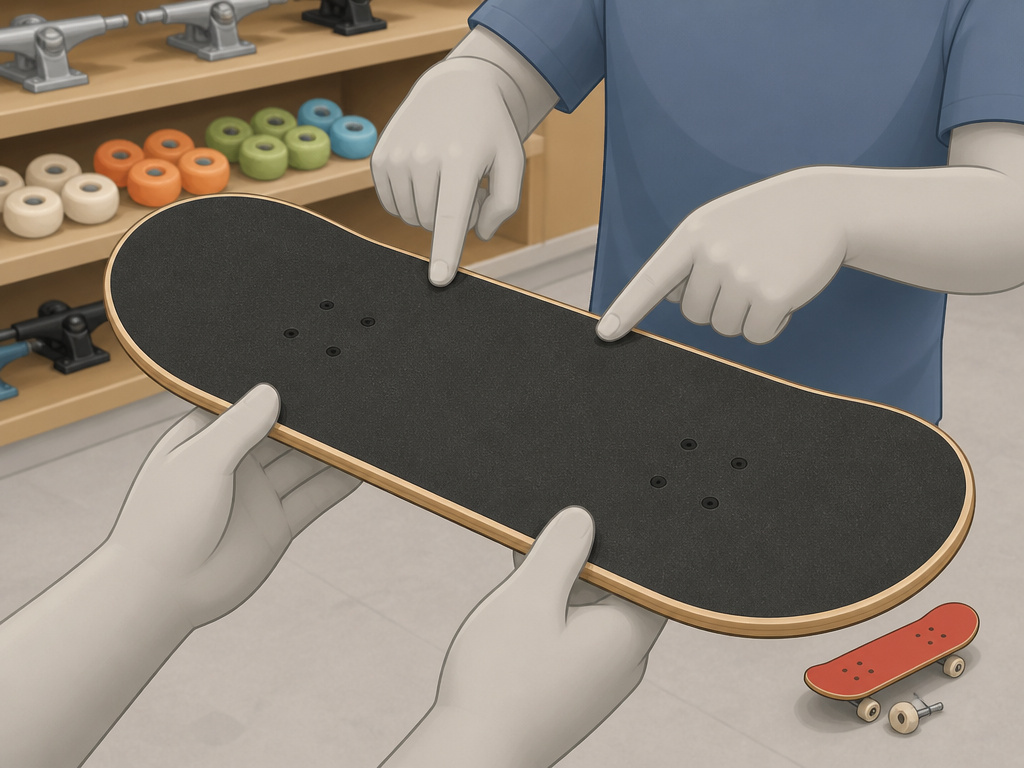
You have three options for how to choose your first skateboard, but one is vastly better.
Local Skate Shop (Best Choice)
Walk in. Tell them it’s your first board.
- Let you stand on different deck widths.
- Explain truck tightness and adjust it for you.
- Recommend a complete within your budget.
- Assemble it perfectly, often for free.
- Be a resource for future questions and part upgrades.
You pay a slight premium for this service. It’s worth every dollar.
Online Skate Shop (Good Alternative)
Reputable online skate shops offer reliable completes. Use their filtering tools to select deck width and read product descriptions carefully to see what wheel hardness is included. You miss the hands-on advice, but you get authentic gear.
Big-Box Retail or Toy Store (Do Not Do This)
The boards here are the “toy skateboards” the Portland guide warns about. They have plastic cores in the wheels, brittle plastic trucks, and graphics glued onto weak plywood. They deaden the learning process. What you save in cash you pay for in frustration and a higher risk of the board breaking under you.
What type of skateboard should I get?
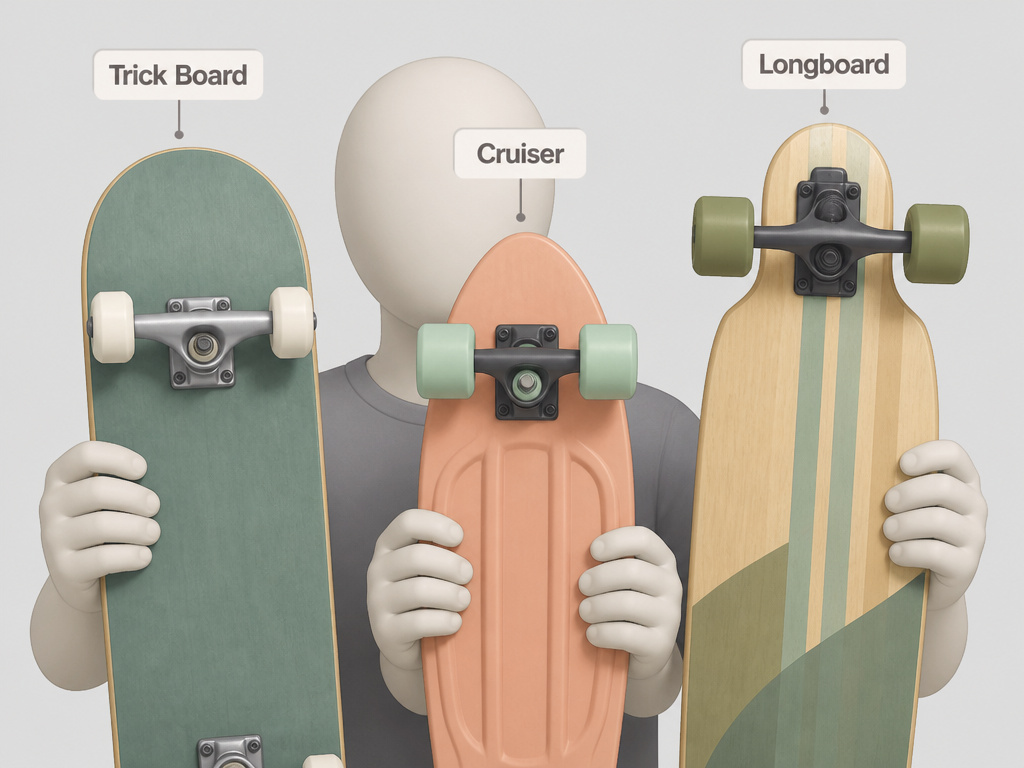
Your first choice is between a trick board, a cruiser, or a longboard. For learning tricks, the most versatile and recommended first board is a symmetrical popsicle shape. This is the standard for street and park skating. If you plan to use your board primarily for transportation on rough streets, a cruiser or longboard is a better fit. Roller Snakes notes softer wheels are great if you wish to use your skateboard as a mode of transport. Wider, longer boards are more stable, while narrower, shorter ones turn sharper. A pre-assembled complete is a good way to get a skateboard with no hassles.
What skateboard size is right for my age?
For younger children, choose a deck 7.5” to 7.75” wide. As skaters grow older, they generally move to wider decks for better stability and foot space. Very young skaters should avoid toy boards from general stores; these use weak materials and hinder progress. Instead, choose a skateboard made with a wood deck, urethane wheels, and metal trucks. For all ages, a pre-assembled complete from a skate shop is the simplest way to start. Remember to always wear protective gear, especially a helmet that fits snugly and is designed for skateboarding.
Frequently Asked Questions
Is an 8.25 skateboard good for beginners?
Yes, an 8.25-inch wide deck is an excellent beginner size for most teens and adults. It offers a stable, confidence-inspiring platform for learning to push, turn, and ollie. It’s a modern standard width that balances stability for cruising with enough pop for tricks.
Which skateboard should I buy as a beginner?
Buy a pre-assembled complete skateboard from a brand like Element, Santa Cruz, or Powell-Peralta. Look for a deck width between 7.75” and 8.25”, wheels in the 52–54mm size and 90A–95A durometer range, and ensure it’s from a real skate shop (online or local).
What size skateboard should I get if I’m 5’7″?
Deck width between 8.0” and 8.25” is a common starting point for many beginners. Your height suggests a medium build, and this width range provides a stable yet manageable platform. The final choice depends more on your shoe size and personal comfort, if you have larger feet, lean toward 8.25”.
How much should I spend on my first skateboard?
Expect to spend a reasonable amount for a complete skateboard from a skate shop. This price range gets you industry-standard materials that will last and perform correctly. Spending less often means compromising on parts that will hinder your progress.
Can I learn to skateboard on a cruiser board?
You can, but a traditional popsicle-shaped skateboard is more versatile for a beginner. Cruisers are great for transportation but their shape, larger softer wheels, and often lack of a functional kicktail make learning fundamental tricks like ollies much harder later on.
Before You Go
Skip the endless research. The goal isn’t a perfect board; it’s a board you can start using today. Go to a shop, pick a pre-assembled board in the 8.0” range, ask them to set it up snug, and walk out with a skateboard helmet on your head. Your first month should be about finding your balance and building the muscle memory to push and turn without thinking. The gear just needs to get out of the way and let that happen. Everything else, truck preferences, wheel brands, bearing myths, you’ll figure out naturally once you’re rolling.
