
Electric Skateboard Waterproofing Guide: Step-by-Step
This post contains affiliate links. As an Amazon Associate, we earn from qualifying purchases.
No electric skateboard is fully waterproof. Water resistance is a spectrum defined by IP ratings like IP65 or IP55, which measure protection against dust and water jets. Manufacturers like Evolve, Exway, and Backfire explicitly state water damage voids warranty, and riding in the rain is not recommended by many brands for safety and component longevity, though stances vary; for example, Evolve and Exway do not recommend it, while ONSRA states you can generally ride in the rain.
That IP rating on your board’s spec sheet is a promise with fine print. It tells you what the board survived in a lab test, not what it will survive on your commute. The real guide isn’t about finding a mythical waterproof board; it’s about understanding the limits of your specific model and learning how to push those limits a little further, or more importantly, when not to. For practical advice, consult a detailed electric skateboard waterproofing guide.
What follows is a breakdown of what those numbers mean, what each major brand actually says you can do, and the real-world steps you can take to protect your investment from drizzle, puddles, and outright downpours. The article explains the manufacturer warnings, the DIY fixes owners actually use, and the one component that fails first.
Key Takeaways
- IP ratings are not permissions. An IP65 rating means dust-tight and protected against low-pressure water jets in a test, not that you should ride through a car wash.
- Water damage voids nearly every warranty. A survey of 20 brands by electricskateboard.com found 14 explicitly exclude or limit coverage for water-related failures.
- Dry your board immediately after any wet ride. For hub motors, run them for 2 minutes to spin water out, then wipe everything down.
- The power button is a critical weak point. TyneeBoard specifically calls it out as the most vulnerable part on their IP54-rated boards.
- A wet lithium-ion battery is a fire hazard. Backfire’s protocol for a suspected water-damaged battery is extreme: disconnect it immediately and store it outdoors in a sealed, fire-resistant container.
What Does IP65 or IP55 Really Mean?
You see IP65 on an ONSRA page, IP55 on an Exway FAQ, and IPX3 on an Evo-Spirit blog. They’re not interchangeable, and the difference is the gap between a board that handles a damp road and one that dies in a light shower.
The IP (Ingress Protection) code comes from the IEC 60529 standard. The first digit rates protection against solids like dust; the second digit rates protection against liquids. An ‘X’ means that aspect wasn’t tested.
For water, the second digit is key: 3 means spraying water, 4 means splashes from any direction, 5 means water jets, and 6 means powerful water jets. No mainstream electric skateboard claims a rating of 7 (temporary immersion) or higher.
Here’s how the common ratings translate to real-world conditions:
| IP Rating | Dust Protection | Water Protection (Test) | Real-World Translation |
|---|---|---|---|
| IP54 (TyneeBoard) | Protected from limited dust ingress. | Protected from splashing water from any direction. | Can handle wet roads. Puddles or heavy rain risk internal damage. |
| IP55 (Exway, Backfire) | Protected from limited dust ingress. | Protected from low-pressure water jets from any direction. | Okay for damp roads and very light, brief rain. Not for riding in a downpour. |
| IP65 (ONSRA, Maxfind) | Dust-tight. | Protected from low-pressure water jets from any direction. | Best common rating. Can handle light rain confidently, but prolonged exposure is still risky. |
| IPX3 (Evo-Spirit) | Not rated. | Protected against spraying water up to 60° from vertical. | Very basic splash resistance. Avoid any standing water or direct rain. |
The takeaway from an electric skateboard waterproofing guide is mechanical, not just cautionary. A higher second digit doesn’t just mean “more waterproof.” It means the seals and gaskets are rated for a specific pressure and duration. An IP55 board might survive a commute in a misty drizzle because the water never reaches jet pressure. The same board on a rainy day, with tires kicking up a constant stream from the road, is seeing conditions beyond its rated protection.
Manufacturer Stances: From “Don’t Do It” to “Maybe, But…”
Every brand has a legal and practical position on water. They have to balance marketing a rugged product with avoiding warranty claims. Reading their official advice is a masterclass in cautious language.
Evolve USA is among the most direct: “Evolve boards are not waterproof, and we don’t recommend riding in wet conditions.” They note newer models like the Hadean, GTR, and Stoke have dust seals and conformal coating, while the Diablo, Renegade, and Stoke X add extra lip seals. The final line is unambiguous: water damage is not covered under warranty.
Exway Canada states their boards are water-resistant to IP55. Their FAQ says riding in the rain is not recommended, but riding on wet roads post-rain is “generally ok for the electronic components but not for the bearings.” They provide a specific tip: if the hub or RIOT motors get wet, run them for 2 minutes to remove water, then wipe the board dry.
Backfire Boards also claims IP55. Their FAQ includes a critical safety warning that most others skip: if water damage to the battery is suspected, disconnect it immediately, stop using it, and store it outdoors in a dry, fire-resistant place like a sealed bucket. Do not ship a water-damaged battery.
TyneeBoard offers a unique exception. While their boards are rated IP54 and riding in heavy rain is not recommended, they explicitly state: “the power button is the most vulnerable part.” If water damages it, they offer a free replacement power button under warranty (customer pays shipping).
ONSRA claims an IP65 rating for models like the BLACK Carve 3 PRO and states, “You can generally ride your ONSRA board in the rain – but no electric skateboard is 100% waterproof.” They too confirm water damage is not covered under warranty.
The pattern, as detailed in any electric skateboard waterproofing guide, is nearly universal: resistance, not proof. A warranty exclusion for water damage is the standard for most brands, though TyneeBoard is an exception offering a free replacement power button if water-damaged under warranty.
The Immediate After-Ride Protocol
First, turn the board off. Procedures vary by brand; for example, Evo-Spirit advises laying a wet board on its side on two wheels to drain water, while Evolve recommends drying it immediately and cleaning bearings.
Where this goes sideways: Letting a wet board sit powered on or in a bag. Corrosion starts on contact points within hours, and a short circuit can happen the next time you power it up.
For the motors, use Exway’s method. If you have an Exway board and its hub or RIOT motors get wet, run the motors for 2 minutes at a low to medium speed (with the board elevated, wheels spinning freely). This uses centrifugal force to throw water out of the motor casings. A Reddit user’s anecdote aligns: “let the wheels run half throttle for like 5 minutes after riding in the rain, since it’s a hub motor.”
Then, the dry-down. Wipe the entire board, deck, trucks, and wheels with a dry towel. Pay special attention to the power button area, charging port cover, and any seams in the enclosure. Evo-Spirit suggests using a hairdryer from a safe distance to dry components.
Finally, inspect. Check around the enclosure lid for visible water beads. If anything seems off, leave it in a dry, warm room before trying to turn it on again. This isn’t paranoia. It’s the difference between a working board and a paperweight.
DIY Waterproofing for Existing Boards
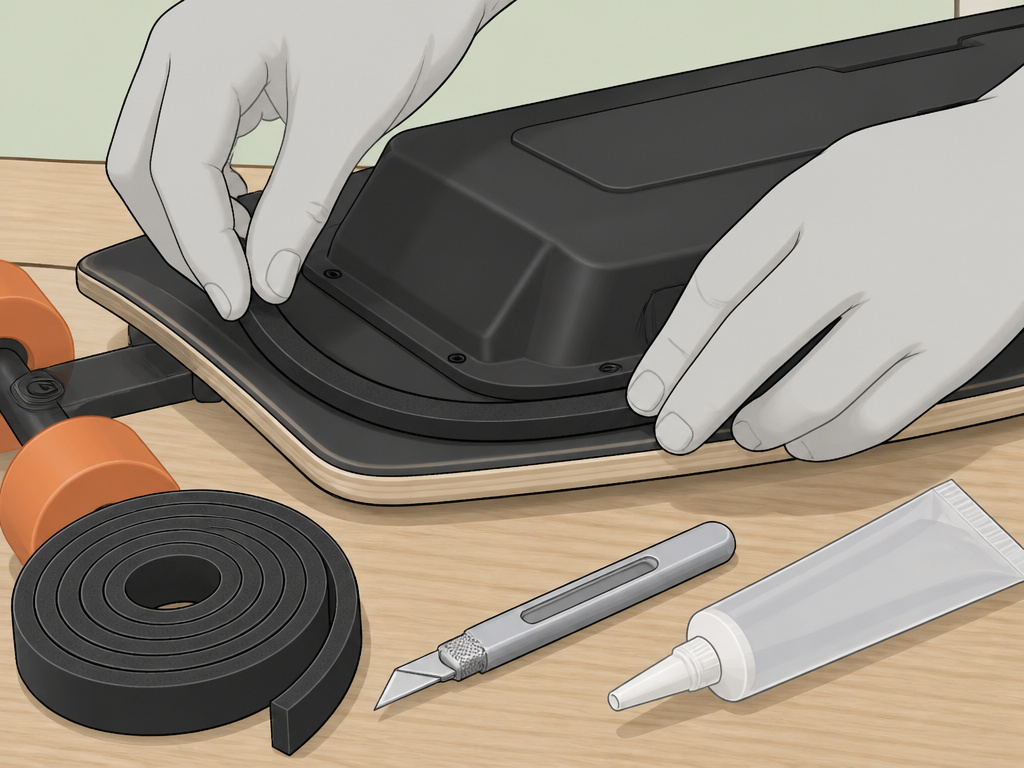
What if you live in a damp climate and your board isn’t an IP65-rated tank? The community has developed a toolkit of mods to improve your odds. This is advanced tinkering and will almost certainly void your warranty, but for some, it’s a necessary risk.
The goal is to supplement the factory seals. The most common target is the enclosure lid, where a single neoprene foam gasket is the only barrier.
Upgrading the Main Gasket: The stock foam gasket can compress over time. Owners on Reddit report cutting replacement gaskets from thicker neoprene rubber or closed-cell foam. The trick is to trace the enclosure, cut the new gasket about a half-inch larger, and then compress it thoroughly when screwing the lid down.
Sealing the Seams: For an extra layer, people use flexible sealants on the outside of the sealed joint. Butyl rubber tape (like used in car windshields) is a popular choice, it’s moldable, waterproof, and removable without making a huge mess. A thin bead of clear silicone caulk along the seam is another option, but it’s messier to remove later. The key is to seal the exterior so any water hitting the lid is diverted before it reaches the gasket.
Protecting Vulnerable Components: The power button and charge port are weak spots. Some owners carefully apply a conformal coating spray (a non-conductive acrylic coating) to the internal circuitry of these components after opening the enclosure. For hub motors, a common hack is to add a thin layer of marine grease around the outer seal where the motor casing meets the hub. This helps repel water kicked up from the road.
A Critical Warning: Sealing components like the ESC in rubber or epoxy, as some have tried, is dangerous. Your board’s electronics need to dissipate heat. Adding a thermal blanket guarantees a failure.
Component-Specific Risks and Protection
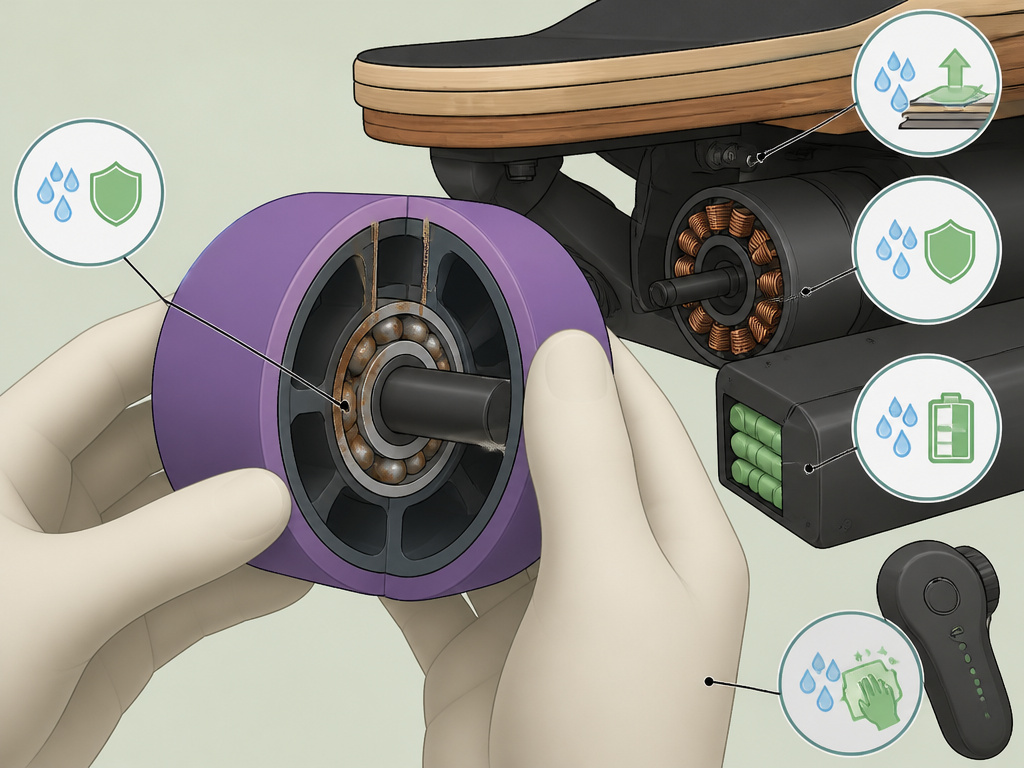
Water doesn’t attack your board equally. Different parts fail in different ways, and knowing which part is your current weakest link changes your strategy.
Bearings: These are the first mechanical casualty. Water rusts steel bearings fast. Even if your electronics are sealed, ruined bearings mean grinding, noisy wheels and lost speed. The fix is preventive: after any wet ride, dry the wheels and trucks thoroughly. For frequent damp riding, consider cleaning and re-lubricating your bearings more often with a water-resistant lubricant.
Motors: Hub motors are particularly vulnerable because the stator and windings are inside the wheel hub, right in the splash zone. Belt-drive motors are slightly more protected but can still suffer. The post-ride motor run-up is your best defense here. If you hear any grinding or unusual noise after a wet ride, stop using the board and inspect the motors.
The Remote: It’s easy to forget the remote in your hand is also electronic. A wet remote can cause erratic throttle or brake response, a terrifying scenario. A simple silicone remote cover is a cheap and effective shield against rain and sweat.
Battery: This is the highest-stakes component. A compromised lithium-ion battery is a fire risk, which is why Backfire’s instructions are so severe. Never charge a battery that has gotten wet. The internal damage might not be visible, and charging can trigger a thermal runaway.
Deck and Grip Tape: Water can weaken the wood layers in a deck over time and cause delamination. It also makes grip tape slick. While not an immediate failure, it contributes to the overall degradation from wet weather use.
Long-Term Maintenance for Wet-Weather Riders

If you regularly commute in a place where the weather is unpredictable, you need a schedule beyond the emergency dry-down. This is the regimen that keeps a board alive through a damp season.
Battery Storage: If you’re storing the board for more than a month, both Backfire and E-Glide recommend a similar principle. Backfire advises charging to 50%-60%, while E-Glide recommends 40-60%. Store the board in a cool, dry place. For long-term storage over 2 months, Backfire recommends giving it a charge once a month to keep the battery healthy.
Bearing Maintenance: Every few months of wet-weather riding, plan to clean and re-lube your bearings. The small amount of time this takes prevents the much larger headache of seized wheels or a damaged motor shaft.
Traction and Safety: It’s Not Just About the Board
Protecting the board is one thing. Protecting yourself while riding on wet surfaces is another, equally critical skill. Water changes everything about how a skateboard behaves.
Your wheels have dramatically less grip on wet pavement, especially painted road lines, metal plates, or wet leaves. Braking distances increase significantly. Acceleration can cause wheel spin. You need to adjust your riding style completely: slower speeds, gentler turns, and earlier, more gradual braking.
Common mistake: Assuming your board’s water resistance rating makes it safe to ride at normal speeds in the rain. The limiting factor isn’t your board’s IP rating, it’s your tires’ grip on the wet ground.
Consider your wheel type. Softer, grippier wheels will provide marginally better wet traction than hard, slick wheels. Some riders dedicated to wet conditions even look for wheels with a more defined tread pattern, though true “rain tires” for skateboards are rare.
Most importantly, wear your gear. A fall on wet asphalt is often harder and more sudden than on dry ground. A helmet, wrist guards, and knee pads are essential if you’re venturing out when the roads are damp.
Which electric skateboard brands are most water resistant?

Manufacturers publish different IP ratings, which directly compare their claimed water resistance. ONSRA’s BLACK Carve 3 PRO and similar models carry an IP65 rating, the highest among major brands, meaning they can handle water jets. Exway and Backfire both claim an IP55 rating, protecting against water jets. Tynee and enSkate boards are rated IP54, protecting against splashes from any direction. Evo-Spirit lists an IPX3 rating, where the ‘X’ means dust protection wasn’t rated and the ‘3’ protects against spraying water. Despite these ratings, almost every brand explicitly states that water damage is not covered under warranty, and riding in the rain is generally not recommended. The power button is often cited as a vulnerable point.
Frequently Asked Questions
Are electric skateboards waterproof?
No mainstream electric skateboard is fully waterproof. They are water-resistant to varying degrees, indicated by IP ratings like IP54 or IP65. These ratings protect against splashes and jets in controlled tests, but manufacturers do not design them for submersion or prolonged heavy rain.
Does the warranty cover water damage?
Almost never. Warranty exclusions for water damage are the industry standard. A survey of 20 brands found 14 explicitly exclude or limit such coverage. TyneeBoard is a rare exception, offering a free replacement power button if water-damaged, but this is specific to that one component.
What should I do immediately after my board gets wet?
Turn it off. Drain water by laying it on its side. If the motors are wet, procedures vary; Exway recommends running them for 2 minutes, while a Reddit anecdote suggests 5 minutes. Wipe the entire board dry with a towel. Leave it in a warm, dry area before using or charging it again.
Can I make my electric skateboard more waterproof?
Yes, with caution and by voiding your warranty. Common DIY methods include upgrading the enclosure gasket with thicker neoprene, sealing external seams with butyl tape, and applying conformal coating to vulnerable spots like the power button. Never seal components like the ESC in a way that traps heat.
The Bottom Line
The highest IP rating you can buy is a false summit. IP65 is the best common rating, and it still comes with a warranty exclusion for water damage. The real skill isn’t in buying a “waterproof” board; it’s in managing moisture at every level, from the factory seals to your post-ride ritual.
If you must ride in damp conditions, pick a board with a clear, high IP rating like an ONSRA IP65 model. Then, religiously follow the dry-down protocol: motor spin-out, thorough wipe, and extended air-drying. For everyone else, the rule is simpler: wet roads are for emergencies only. The cost of a rideshare on a rainy day is always cheaper than a new battery, ESC, or motor.
One final, critical point: store a wet or potentially damaged battery exactly as Backfire dictates, outside, in a fire-resistant container. Everything else is a repair. That is a hazard.
