
Freestyle Skateboard vs Street Skateboard: Key Differences
This post contains affiliate links. As an Amazon Associate, we earn from qualifying purchases.
A freestyle skateboard is engineered for technical flat-ground routines with a symmetrical shape, a maximum length of 33 inches, and a mellow concave, while a street skateboard is built for impact and tricks on urban obstacles with a standard 31-32.5 inch length, a pronounced concave, and a directional popsicle shape. For most beginners, a street setup is the more versatile and accessible choice.
That distinction isn’t just about labels. It decides whether your board feels like a dance partner on smooth concrete or a precision tool for launching off a curb. The difference lives in three specific places: the deck’s geometry, the truck’s height and width, and the wheel’s hardness. Understanding the choice between a freestyle skateboard vs street skateboard is key.
What follows is a breakdown of each component, the numbers straight from manufacturer rulebooks and pro interviews, and where even the experts disagree. By the end, you’ll know exactly which board type matches the skating you actually want to do.
Key Takeaways
- Modern freestyle decks for competition max out at 33 inches with a mellow concave, while street decks typically run 31-32.5 inches with a pronounced concave.
- Freestyle trucks are lower (45-48mm) and narrower (125-129mm) to facilitate spins and rail stands, where street trucks prioritize stability for high-impact landings.
- Both disciplines use hard wheels (99A-101A), but freestyle wheels are often smaller (50-54mm) for weight, while street wheels in the same range prioritize slide control.
- Manufacturers often market modern freestyle decks as all-around boards, but community feedback argues their narrow widths are suboptimal for modern street skating.
- If you’re starting out and want to learn ollies, kickflips, and skate park basics, a street setup is the default recommendation. Choose freestyle only if you’re specifically drawn to flat-ground technical routines.
The Deck: Shape, Size, and Purpose
The deck is where the split in a freestyle skateboard vs street skateboard is most visible. They don’t just look different; they’re built for entirely different conversations with the ground.
According to the International Skateboarding Federation’s (ISF) 2023 Freestyle Rulebook, a competition-ready freestyle deck has a maximum length of 33 inches, a width between 7.5 and 8.5 inches, and a kicktail angle of 15-25 degrees. This standardized shape prioritizes footwork and balance on a flat, smooth surface.
That’s the technical target. Now, compare it to a street deck. The resource Skateboard Science lists the industry standard for street decks as 31 to 32.5 inches in length, with the same 7.5 to 8.5 inch width range but almost universally built with a steeper, more pronounced concave. The shorter length and sharper curves make the board pop quicker and lock your feet in for flip tricks and grinds. A freestyle deck’s longer, flatter profile gives you a bigger, more stable platform for caspers, manuals, and 360 shuvits where your feet are constantly moving.
The historical context matters here. The iconic 1980s freestyle deck, like the Powell Peralta Mike McGill pro model, measured 28.5 inches long and a whopping 9 inches wide. Modern freestyle has evolved, stretching out for stability. This leads to the first big disagreement in the scene.
Concrete Wave Magazine cites modern freestyle pros using shorter decks, around 30-31 inches, for quicker rotations. Conversely, in a Nine Club interview, Rodney Mullen advocated for slightly longer decks (32-33 inches) for greater stability during complex manual combinations. There’s no single right answer, it’s a preference between snappy spins and stable footwork.
Trucks: Stability vs. Spin
If the deck is the body, the trucks are the joints. Their geometry dictates how the board pivots, grinds, and feels underfoot. Get this wrong, and the board fights you on every trick.
Freestyle-specific trucks have two defining specs. First, they’re lower, with a height of 45-48mm. Second, they have a narrower hanger width, typically 125-129mm. This low-and-narrow profile brings the deck closer to the ground for rail stands and makes the board spin on its axis with less effort. It’s the difference between forcing a 360 and letting it happen.
Street-oriented trucks have a higher profile and come in specific axle widths (129mm, 139mm, 149mm) to match deck width. The extra height provides clearance for bigger wheels and prevents “wheel bite”, when the wheel touches the deck during a turn and stops you dead. The wider hanger offers a more stable base for landing from jumps.
Where this goes sideways: Setting your trucks too tight on a freestyle board. You’ll burn through bushings trying to initiate a smooth truck stand, and the board won’t pivot freely for the spins that link tricks together.
Here lies another documented split. Skateboard GB tutorial videos advise moderately tight trucks for general freestyle stability. However, a Boardpusher technical article argues for very loose kingpins to facilitate effortless 360-degree board spins. For street, there is disagreement: Independent Truck Company’s setup guide recommends tighter kingpins for landing stability, while Thunder Trucks’ pro team advice column suggests slightly looser trucks can provide better turning and board control for complex ledge and manual tricks.
The lesson? Truck tightness isn’t a set-it-and-forget-it spec. It’s a tuning knob. Start with the manufacturer’s recommendation, then adjust a quarter-turn at a time based on whether you need more spin or more stick.
Wheels and Bearings: The Contact Point
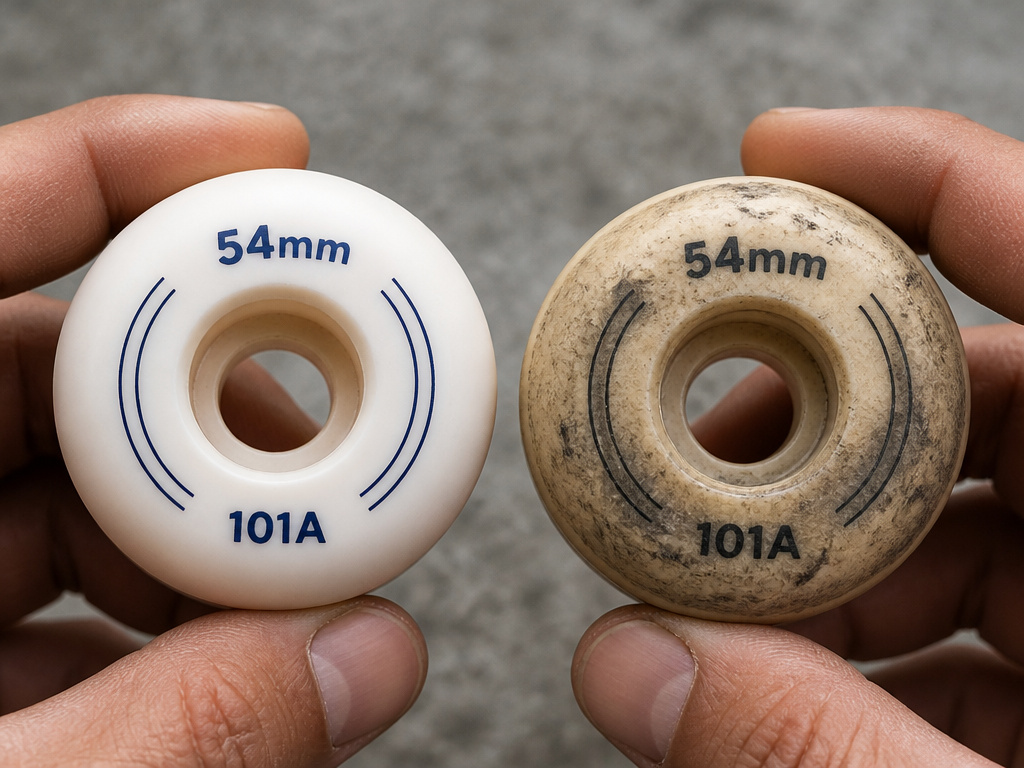
You might think wheels are wheels, but the specs here are about nuance. Both freestyle and street skating demand hard wheels, but the priorities shift.
The Bones Brigade Video Archives, in discussion with Rodney Mullen, cite the classic freestyle wheel as 50-54mm in diameter with a durometer of 99A-101A. The small size keeps weight down for flick tricks, and the extreme hardness ensures the board slides predictably during flat-ground pivots and rail stands.
Street wheels, per Spitfire Wheels product tech specs, share that same durometer range (99A-101A) and diameter spread (50-54mm). The difference is in the formula and profile. Street wheels are often designed with a focus on slide control and durability against abrasive concrete. While a freestyle skater might prioritize a perfectly round lip for rail tricks, a street skater might choose a slightly conical shape for better grip when carving into a ramp.
I learned this the hard way putting 101A freestyle wheels on a street setup. They slid like a dream on smooth skatepark concrete, but on the rough asphalt behind my local school, every pebble felt like a speed bump. The ride was so harsh I thought my trucks were broken.
There’s community pushback here too. While Spitfire Wheels product tech specs promote wheels with a durometer rating of 99A-101A for street skating, SkateboardCity forum threads show many skaters prefer slightly softer wheels (e.g., 99A) for better grip and a less harsh ride on rough pavement. It’s a classic case of marketed ideal versus real-world comfort.
Bearings are the one universal component. The International Organization for Skateboarding (IOS) standards confirm that modern skateboards, both street and freestyle, use the standard 608 bearing (8mm core, 22mm outer diameter, 7mm width). Don’t overthink this. A decent mid-priced set you clean every few months will outperform fancy sealed bearings full of old grease.
The Modern Freestyle vs. Street Showdown
So you have the specs. Which board should you actually ride? Let’s put them head-to-head across the scenarios you’ll encounter.
| Scenario | Freestyle Skateboard | Street Skateboard | Which Wins? |
|---|---|---|---|
| Flat-Ground Technical Routines | Built for it. Symmetrical shape, mellow concave, low trucks. | Can do it, but directional shape and deep concave are less ideal. | Freestyle |
| Learning Ollies & Kickflips | Possible, but the longer deck and low trucks make pop control harder. | The default. Short length and steep concave generate pop efficiently. | Street |
| Skatepark Obstacles (Ledges, Rails) | Narrow trucks and small wheels can be unstable on high-impact landings. | Designed for it. Stable truck geometry and impact-absorbing decks. | Street |
| Casual Cruising & Carving | Stiff, hard wheels offer a rough ride. Not intended for distance. | Also rough, but better for quick, technical carves in a park setting. | Neither (get a cruiser) |
| Board Control & Footwork Drills | Excellent. Large, flat platform is ideal for manuals, caspers, and shuvits. | Good, but the pronounced concave can limit foot placement options. | Freestyle |
This table exposes a key tension in the freestyle skateboard vs street skateboard debate. Manufacturers like Powell Peralta and Santa Cruz often market modern “freestyle” re-issue decks as suitable for “all-around” or “street” skating. But dig into community discussions on Skate[Slate], and experienced skaters consistently argue these decks’ narrow widths and mellow concaves are suboptimal for the demands of modern street skating. They’re best used strictly for traditional freestyle or old-school flat-ground tricks. This is a classic case of marketing stretching a product’s purpose beyond its engineered design.
Setting Up for Your Style
You’re not locked into one category forever. Your first board should match the skating you’re most excited to try right now. Let’s break down the decision.
If you’re drawn to the rhythmic, technical dance of flat-ground tricks, think Rodney Mullen’s flowing combos, then a freestyle setup is your calling. Look for a complete from a company specializing in freestyle or a freestyle skateboard from a reputable brand. Ensure the trucks are the low-profile type (45-48mm). Start with the trucks moderately loose and tighten them incrementally if the board feels twitchy. Your progression will be measured in new footwork links, not how high you can ollie.
If you want to ollie down stairs, grind ledges, and skate parks, a street setup is the only sane choice. Your first mission is choosing a street deck. Visit a local shop if you can; stand on different widths to see how an 8.0″ feels versus an 8.25″. For a true street skating setup, pair it with standard trucks matched to your deck width and street skateboard wheels in the 99A-101A range, around 52-54mm. This is the toolbox that built modern street skating.
What about a hybrid? Can you do freestyle tricks on a street board? Absolutely. Rodney Mullen did it for years. But you’re choosing the harder path. The deep concave will fight you on rail stands, and the higher trucks make the board top-heavy for spins. Conversely, trying serious street skating on a dedicated freestyle board is like using a scalpel to chop wood, possible, but inefficient and hard on the tool.
Common mistake: Buying a board for its graphic or because it’s labeled “pro.” Match the tool to the job you’ll actually do.
Frequently Asked Questions
Can I use a freestyle skateboard for street skating?
You can, but it’s not ideal. The narrower trucks (125-129mm) can feel less stable on high-impact landings off stairs or gaps. The mellow concave provides less foot lock for flip tricks, and the longer deck length (up to 33 inches) can make the board feel sluggish for quick ollies. It’s better suited for its intended purpose: technical flat-ground routines.
What size wheels are best for street skating?
For street skating, wheel diameters from 50mm to 54mm are standard, with a durometer (hardness) of 99A to 101A. A 52mm or 53mm wheel in the 99A-101A range offers a good balance of speed, control, and slide ability for most street and park terrain.
Are old-school skateboards good for freestyle?
The original 1980s freestyle boards, like the Powell Peralta Mike McGill model (28.5″ long, 9″ wide), are the direct ancestors of modern freestyle. Their ultra-wide, short platform is perfect for the era’s footwork tricks. Modern freestyle decks have evolved to be longer (up to 33″) and narrower (7.5-8.5″) for different styles of combos, but the old-school shape is still a legitimate and fun choice for pure, traditional freestyle.
Do I need special trucks for freestyle?
Yes, it’s highly recommended. Freestyle-specific trucks are lower (45-48mm tall) and have a narrower hanger width (125-129mm) than standard street trucks. This design lowers the board’s center of gravity for rail stands and makes it easier to spin the board on its axis for 360 shuvits and truck stands.
How tight should my trucks be for street skating?
There’s disagreement. The Independent Truck Company guide recommends tighter kingpins for stability on high-impact landings. Many street skaters start with their trucks tight enough that the board doesn’t turn sharply when leaned, then loosen them a quarter-turn at a time until they have the right balance of stability for landings and responsiveness for turns. It’s a personal preference you dial in over sessions.
The Bottom Line
The freestyle versus street question isn’t about which is better. It’s about which is built for the job in front of you. A freestyle board is a specialist, a precision instrument for flat-ground artistry. A street board is a versatile workhorse, ready for the chaos of curbs, stairs, and skatepark features.
For a beginner, the choice is straightforward. If you watch flat-ground freestyle videos and feel a pull toward that specific, flowing style, seek out a proper freestyle setup. For everyone else, the vast majority of new skaters, a street skateboard is the correct, versatile starting point. It’s the platform that will let you explore ollies, kickflips, grinds, and park skating without the board itself holding you back.
One rule I stick by: your first board should come from a skate shop, not a toy aisle. The extra investment buys you trucks that actually turn, bearings that roll, and a deck that doesn’t feel like a soggy noodle. That investment doesn’t guarantee you’ll stick with skating, but it absolutely removes the board as an excuse for why you quit. Start there, then build.
