
Street vs Park Skateboard Wheels: Which Should You Buy?
This post contains affiliate links. As an Amazon Associate, we earn from qualifying purchases.
Street skateboard wheels are small, hard, and shaped for slides on rough pavement, while park skateboard wheels are slightly larger and shaped for speed and grip on smooth concrete. The best hybrid wheels for both sit around 54–56mm and 99A, offering a compromise for mixed terrain.
That split, hard for street, slightly larger for park, is the starting point, but the real choice is messier. It hinges on the actual ground you skate and the tricks you prioritize. The difference between street vs park skateboard wheels is key. A wheel that’s perfect for a buttery-smooth indoor park will punish you on cracked sidewalks, and a wheel built to survive crusty ledges might feel sluggish on a vert ramp.
What follows: the specific specs that matter (durometer, size, shape), how top formulas from Bones, Spitfire, and Powell actually perform, and a clear path to picking your set, or knowing when you need two.
Key Takeaways
- Street wheels prioritize slide and control on rough surfaces, typically using harder durometers (97A–101A) and smaller diameters (50–56mm).
- Park wheels prioritize speed and grip on smooth concrete, often using hard durometers (99A–101A) and slightly larger diameters (52–58mm) for momentum.
- For a true do-it-all wheel, start with a 54–56mm diameter and a 99A durometer, this middle ground handles most surfaces beginners and intermediates encounter.
- Modern mid-soft formulas (93A–97A) like Powell Dragon and Bones X-Formula defy the old rules, offering smooth rolls on rough ground while still sliding for tricks.
- Wheel shape (conical vs. Radial) affects grip and slide as much as hardness; conical slides easier, radial grips tighter in bowls and ramps.
The Durometer Debate: Hardness for Street vs. Park
Durometer measures wheel hardness on the Shore A scale. A higher number means a harder wheel. The old rule was simple: hard wheels (99A+) for tricks and parks, soft wheels (under 90A) for cruising. The reality on the ground is more nuanced.
Technical Snippet: Durometer is measured on the Shore A scale, where a higher number indicates a harder wheel. Street and park wheels typically range from 95a to 101a. Harder wheels (99a+) slide more predictably and maintain speed on smooth surfaces, while softer wheels (95a and below) absorb vibration and provide more grip on rough terrain.
For street skating on actual asphalt and crusty spots, the hardest possible wheel isn’t always the answer. While sources like Redbull recommend “at least a 99a durometer rating” for street, a Tactics comparative test found wheels in the 93a-97a range provided a significantly smoother ride over rough pavement. The vibration from a 101A wheel on a rough sidewalk can make board control feel impossible for a beginner.
Conversely, for park skating on pristine concrete, you want that hardness for speed. Bont explicitly designs its 99a Park Flow wheel for “smooth concrete bowls, ramps, and park surfaces.” The harder surface allows the wheel to rebound quickly, carrying speed through transitions and allowing for faster pumps.
Where Sources Disagree on Hardness
The research doesn’t present a single truth. It shows a clear debate.
| Skating Style | Traditional Recommendation | Counterpoint / Modern Take | Best For |
|---|---|---|---|
| Street | 99A–101A (hard for slides) | 95A–97A (more grip/comfort on rough streets) | Technical tricks on smooth ledges vs. Commuting over rough concrete |
| Park/Vert | 95A–100A (balance of grip/speed) | 99A+ (for speed/stability at high speeds) | Flow and control in bowls vs. Maximum velocity in deep vert |
This table highlights the core tension in the street vs park skateboard wheels debate. A wheel like the Powell Peralta Dragon Formula (93a) or Bones X-Formula (97a) lives in the middle, designed for the skater who encounters both worlds. The Tactics test concluded these wheels are “great for transportation and you’ll still be able to do some technical skating.”
Common mistake: Choosing 101A wheels because a pro skater uses them. If your local “street” is a patchy parking lot, that hardness will transfer every bump to your feet and make learning miserable. Start with the terrain, then match the durometer.
Wheel Size: The 52mm vs. 56mm Trade-Off
Diameter isn’t just about speed; it changes how the board flips and how high you sit off the ground. The Bont Flow Park wheel, for instance, is 58mm. It also lowers your center of gravity, which can feel more stable for ledge tricks.
Park and vert skaters often go slightly larger, commonly 56mm and up. For example, a Bont Flow Park wheel is 58mm. The larger diameter holds speed better. You don’t have to pump as aggressively to maintain momentum around a bowl or up a ramp. That extra roll is the difference between making it to the coping and stalling out mid-transition.
This is the most common range for a reason. It’s large enough to roll over sidewalk cracks without hanging up, yet small enough that your board won’t feel like a boat when trying to ollie. When you’re looking at a wheel size chart, these middle measurements offer the most flexibility.
The Flip Trick Penalty
Shape and Contact Patch: Conical vs. Radial
Hardness and size get the headlines, but shape dictates how the wheel interacts with the ground. The contact patch is the width of the urethane that touches the surface.
A narrow, conical-shaped wheel has a small contact patch. This is the classic street shape. It concentrates your weight on a smaller area, which makes initiating slides easier. It’s predictable for bluntslides and board slides. The downside is that same concentration amplifies vibrations on rough terrain.
A wider, radial-shaped wheel has a larger contact patch. This is common on many park and cruiser wheels. The larger surface area provides more grip, which is confidence-inspiring in a bowl or when carving hard. It smooths out rough concrete. The trade-off is that it can feel “sticky” when you want to slide.
Your skateboard wheel shapes should follow your priority. Learning slides on curbs? Lean conical. Learning to carve and pump in a bowl? Lean radial. Many all-around wheels use a “classic” or “full” shape that splits the difference, offering a medium contact patch that does neither exceptionally but both adequately.
Top Wheel Formulas Compared

Once you know your target durometer and size, the next layer is the urethane formula. Brands invest heavily here, and the differences are real.
| Formula (Brand) | Durometer | Key Claim | Best Use Case |
|---|---|---|---|
| Bones Street Tech (STF) | 99A, 103A | Available in the original 103A and the new 99A. | High-performance street and smooth park. |
| Spitfire Formula Four (F4) | 99a, 101a | Durable formula, classic “slippery” street performance. | Street skating and technical park where slide predictability is key. |
| Powell Dragon Formula | 93a | Rolls smooth over rough terrain, slides well, “all-terrain” feel. | Rough streets, slippery indoor parks, mixed transportation and trick sessions. |
| Bones X-Formula (XF) | 95a, 97a, 99a | Rolls over rough terrain like a soft wheel, slides like a hard wheel. | The hybrid skater: street spots with bad ground, park sessions, no wheel swaps. |
| OJ Elite Nomads | 95a | Classic mid-soft performance. | A smoother alternative to traditional hard wheels for street and mellow park. |
| Bones Skatepark (SPF) | Hard | Resists flatspotting on slick surfaces, higher rebound. | Dedicated park and vert skating on smooth concrete. |
This comparison shows the specialization. The Powell Dragon & Bones X-Formula wheels are the new-school answer to the street vs park skateboard wheels question. They acknowledge that most skaters don’t have perfect ground. The Tactics test found these formulas could “out-slid” harder wheels in a controlled downhill powerslide, breaking the old correlation that harder always means better slide.
But for one board that does it all, the Powell Dragon (93a) or Bones XF 97a are compelling defaults.
Do You Need Two Sets of Wheels?
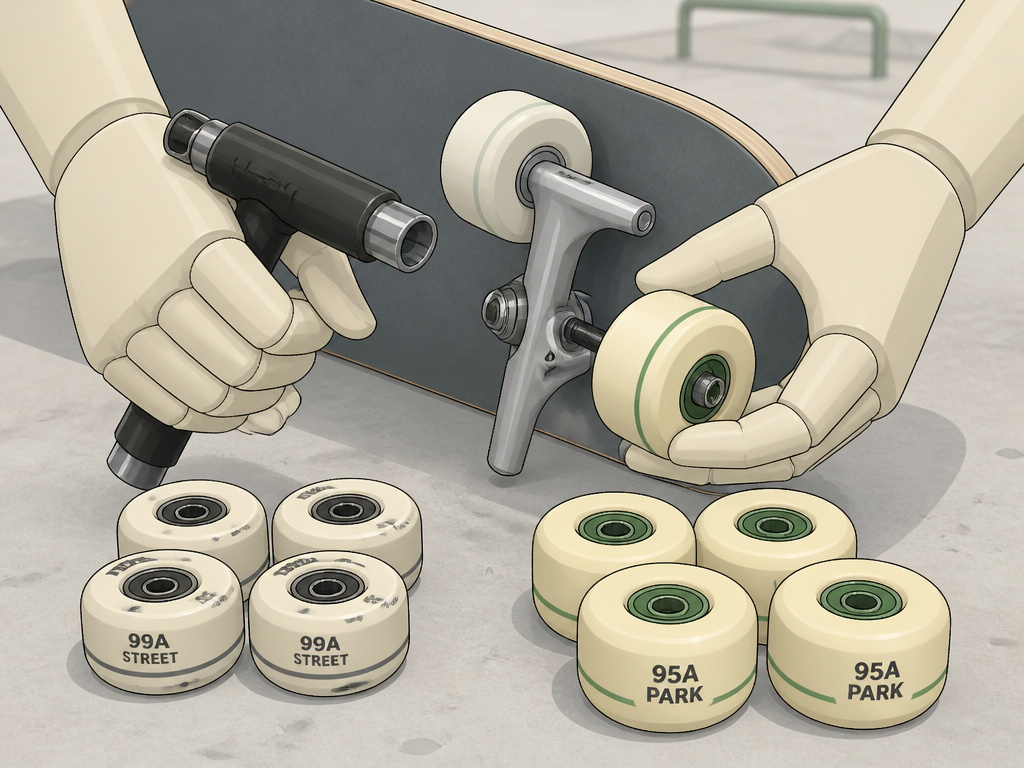
This is the practical question most guides skip. Having separate wheels for street and park is ideal but not always practical. It means carrying tools and spending ten minutes at the park swapping wheels before your session.
For a beginner or someone skating 80% one style and 20% the other, a compromise wheel is smarter. A 54mm 99A wheel is that compromise. It will perform well enough in both worlds that you won’t feel handicapped. You only need two sets when the gap between your primary terrains is massive, like cruising on soft wheels one day and hitting a tech street spot with hard wheels the next.
For everyone else, invest in one great set that matches your most common surface. A proper wheel hardness guide will show that a 95A-99A wheel covers a huge amount of real-world skating.
How to Choose: A Step-by-Step Filter

Stop thinking about “street” or “park” as abstract ideas. Think about your specific situation.
- Audit your most-skated ground. Is it glassy-smooth skatepark concrete, or asphalt with cracks and pebbles? Be honest.
- Pick your durometer based on that ground. Smooth park: 99A–101A. Rough street: 95A–97A. Mixed: 97A–99A. Use a durometer chart to visualize it.
- Pick your size based on your trick goals. Priority on flip tricks: 52–54mm. Priority on speed and flow: 54–56mm (or 56–58mm for pure park).
- Pick your shape based on your need for slide vs. Grip. Learning slides: conical. Want maximum grip for carving: radial. Unsure: classic/full shape.
- Select a formula from the table above that matches your chosen durometer and described use case.
This filter leads to a clear answer. If you land on “rough asphalt” and “learning ollies,” a wheel like the Bones X-Formula 97a in 54mm is a targeted, high-performance choice. It’s not a generic “best wheel,” but it’s the best wheel for that specific scenario.
Frequently Asked Questions
What wheels are best for both street and park skating?
For a true hybrid, start with wheels in the 54–56mm diameter and 99A durometer range. Modern formulas like the Powell Peralta Dragon (93a) and Bones X-Formula (97a) are specifically engineered for this mixed use, offering a smoother ride on rough street terrain while retaining enough slide for park tricks.
Is 99A too hard for street?
It depends on the street. For perfectly smooth skate plazas or new concrete, 99A is excellent. For typical cracked sidewalks and rough asphalt, a 99A wheel can feel very harsh. In those cases, a 95A–97A wheel will provide more grip and vibration absorption, making the session less punishing and improving board control.
What’s the difference between park and street skateboarding?
Park skating focuses on flowing lines, airs, and tricks on transitions (ramps, bowls, quarter pipes) in a controlled environment. Street skating happens on urban architecture, stairs, handrails, ledges, and benches, for technical tricks. The equipment differs slightly: park setups often use slightly larger, grippier wheels for speed, while street setups use smaller, harder wheels for slides and quick flips.
Are 56mm wheels too big for street?
They can be. 56mm wheels are at the upper limit for dedicated street skating. They might cause wheel bite without riser pads and can make flip tricks feel slower and heavier. However, for street skating that involves more cruising and less technical flip tricks, or for skating rough ground, 56mm can be a great choice for maintaining speed over cracks.
The Bottom Line
Stop choosing between “street” and “park” wheels. Choose between the ground you have and the ground you wish you had.
If you only skate pristine parks, get hard, fast park wheels like Bones SPF or Spitfire F4 101d. If you only skate crusty street spots, get a modern mid-soft wheel like the Powell Dragon 93a. But most of us live in the middle, skating a mix of okay pavement and decent parks. For that reality, a 54–56mm wheel at 97A–99A isn’t a compromise, it’s the correct tool.
One final, essential tip: feel the wheels before you buy. A 99A from one brand can feel different from a 99A from another. The numbers guide you, but the ride decides. Find a setup that makes you want to skate longer, not one that looks perfect on a spec sheet. That’s the only difference that matters.
