
How to Use a Skateboard T Tool: Step-by-Step
This post contains affiliate links. As an Amazon Associate, we earn from qualifying purchases.
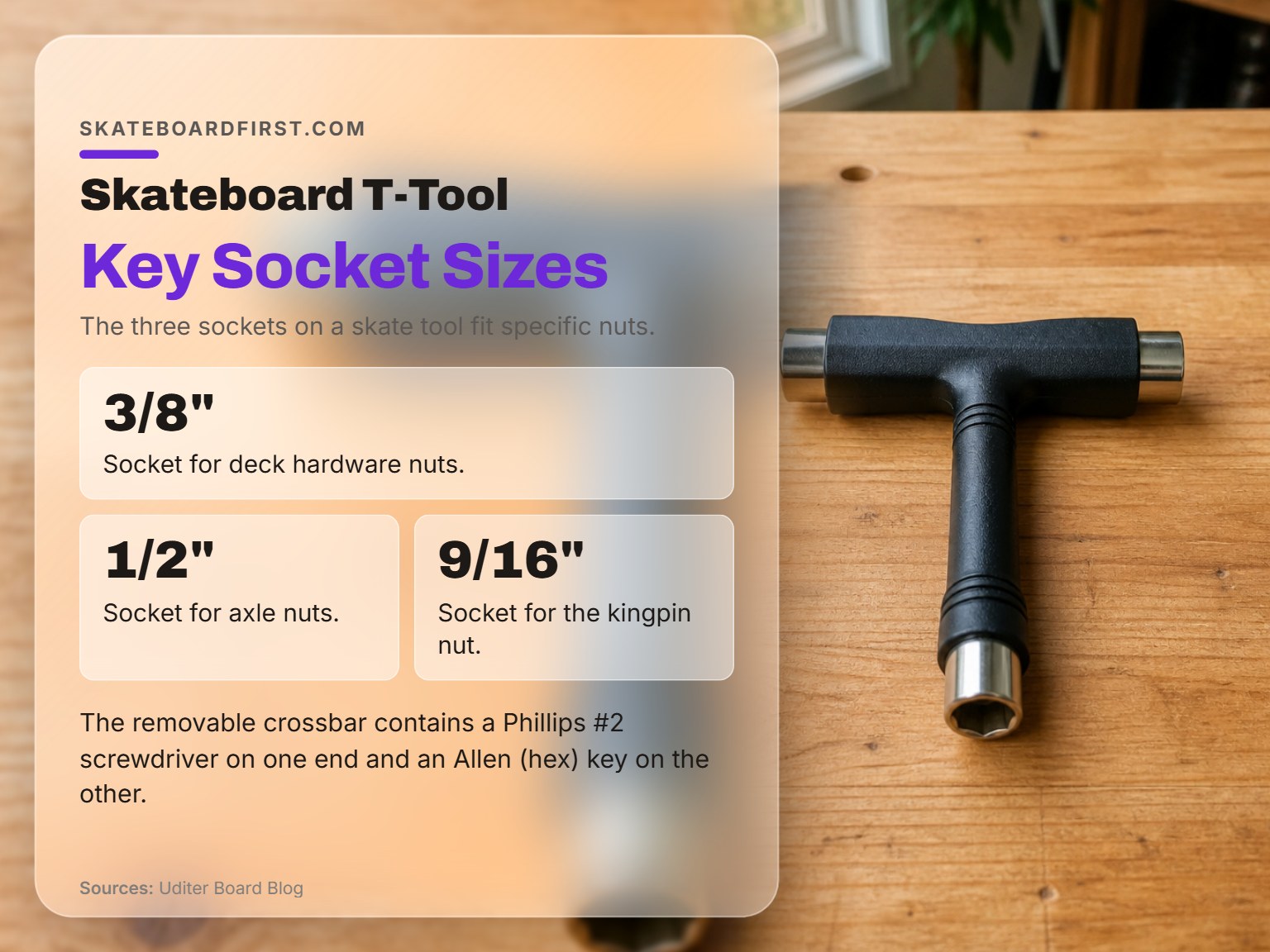
To use a skateboard T-tool, match its three sockets to your board’s three standard nut sizes: the 9/16″ socket fits the kingpin nut, the 1/2″ fits axle nuts, and the 3/8″ fits deck hardware nuts. The removable crossbar has a Phillips #2 screwdriver on one end and an Allen key on the other for securing the bolts.
The three-socket design isn’t arbitrary. It’s a direct match to the hardware that’s been standardized across skateboards for decades, which is why a garage wrench set often fails, a loose fit strips the nut. For a proper fit, you need to know how to use a skateboard t tool’s three sockets sized 3/8″, 1/2″, and 9/16″.
What follows is a visual map of every part, the exact steps for truck adjustment and wheel changes, and the common mistakes that turn a five-minute fix into a stripped-thread headache when you don’t know how to use a skateboard t tool. By the end, you’ll know how to use the tool and when to ignore the manual.
Key Takeaways
- The three sockets are fixed sizes: 3/8″ for deck hardware, 1/2″ for axle nuts, and 9/16″ for the kingpin.
- Adjust trucks a quarter turn at a time and test-ride; cranking them tight destroys bushings and kills your turn.
- Use the Phillips or Allen end of the crossbar to hold the bolt from the top while you turn the nut underneath with the 3/8″ socket.
- Street skaters tend to run looser trucks; your preference decides the limit.
- A T-tool is more compact and pocket-friendly than a Y-tool, which usually includes a 5/16″ rethreader for fixing damaged axle threads.
What Is a Skateboard T-Tool?
A skateboard T-tool is a pocket-sized, all-in-one wrench made specifically for skateboard hardware. It consolidates the three socket sizes you need, plus a screwdriver, into one piece of metal or plastic. Think of it as the universal key for your board.
Before you start: The tool applies leverage directly to soft aluminum and steel hardware. Over-tightening can strip threads, crack nuts, or crush plastic bushings. Hand-tight is enough; you don’t need to win a strength contest.
I used to tighten bolts by feel. Over a few months, that led to a loose kingpin nut here and a rounded-off axle nut there. A proper skate tool and a quick check every session replaced that guesswork habit. The difference wasn’t just secure hardware, it was confidence that my board wouldn’t fall apart mid-session.
The T-Tool Layout: A Visual Map
Hold a T-tool in your hand. It has three fixed sockets on a T-shaped body and a removable crossbar. Every part has one job.
Here’s what each part does, drawn from manufacturer specs from Penny, SkateXS, and the Uditer Board Blog:
| Part | Size / Type | Its Job | What Happens If You Use the Wrong Size |
|---|---|---|---|
| Large Socket | 9/16″ | Fits the kingpin nut at the center of the truck. | A smaller socket won’t grip; a larger one will round the nut’s corners. |
| Medium Socket | 1/2″ | Fits the axle nuts that hold wheels on. | A loose fit strips the axle threads, locking the wheel or ruining the axle. |
| Small Socket | 3/8″ | Fits the deck hardware nuts underneath the board. | Stripping these makes removing trucks later a drill-and-extract nightmare. |
| Removable Crossbar | Phillips #2 / Allen Key | Holds the bolt from the top (through the grip tape) while you turn the nut below. | The bolt spins freely, you can’t tighten anything, and you strip the bolt head. |
The crossbar pulls straight out. One end is a Phillips #2 screwdriver (the cross-head), and the other is an Allen key (hex head). Most skateboard hardware uses Phillips screws, but some brands use Allen bolts, your tool handles both.
How to Tighten or Loosen Your Trucks
Truck tightness controls your turn radius and board stability. Looser trucks turn sharper but feel less stable; tighter trucks are stable but turn like a shopping cart.
Where sources disagree: A generic skateboard manual advises against loosening the kingpin nut “more than a few turns for a loose setting.” The Uditer Board Blog and common practice say adjust “a quarter turn at a time” and test, with no upper limit, noting that street skaters tend to run looser trucks. The manual is a safety guideline; the blog reflects real rider customization.
- Locate the kingpin nut. It’s the large nut in the center of the truck, facing downward.
- Fit the 9/16″ socket over the kingpin nut.
- Turn counter-clockwise to loosen, clockwise to tighten. Start with a quarter-turn adjustment.
- Test immediately. Stand on your board and rock side-to-side. Feel how the truck responds.
- Repeat until the turn feel matches your style.
I won’t recommend a specific technique for first-time calibration. The visual feedback is honest, but new users overcorrect on every shot and chase ghosts. Found that out training my first apprentice.
A quarter-turn changes everything. Cranking it too many turns can deform the bushing, giving you a dead spot in the turn. Overtightening can crack the bushing and damage your turn.
Front vs. Rear: Should They Match?
Some riders intentionally set their front truck looser than the rear for a specific steering response. This isn’t a mistake; it’s a tuning choice. Try it after you’re comfortable with symmetrical trucks.
How to Change Skateboard Wheels
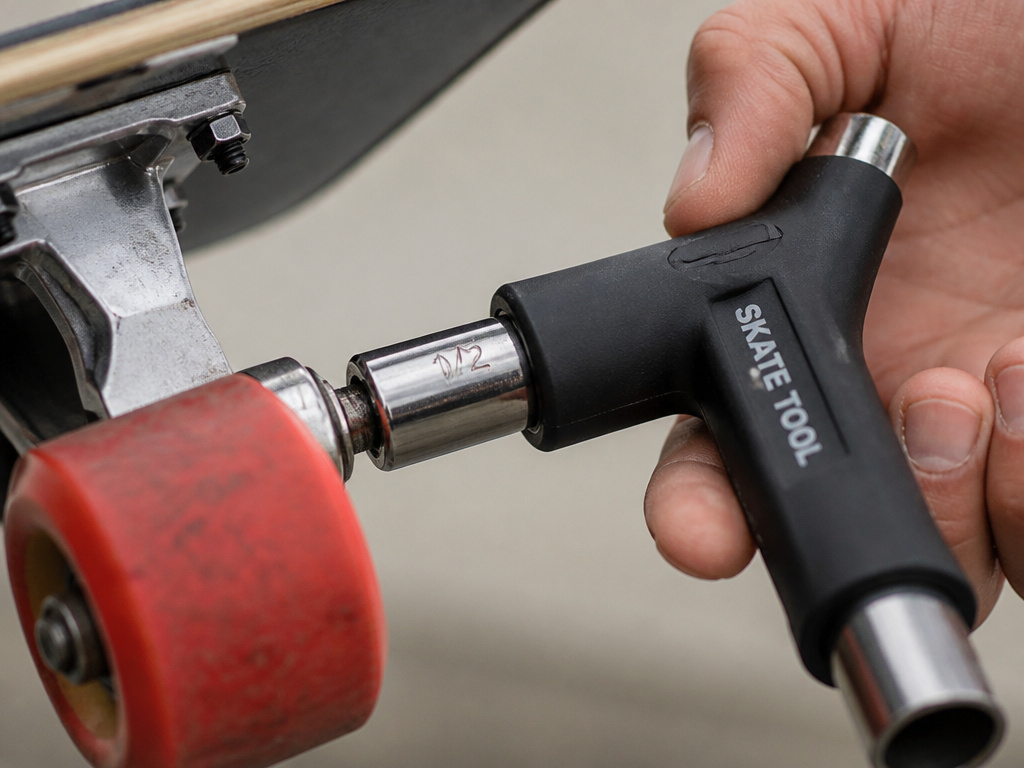
Swapping wheels allows you to match hardness to your terrain or replace worn-down ones. The process takes two minutes with a T-tool.
You’ll need: Your T-tool and, optionally, a rag. If your wheels use spacers, keep them for reassembly.
- Fit the 1/2″ socket over one axle nut.
- Turn counter-clockwise to remove the nut. Place it somewhere it won’t roll away.
- Pull the wheel off the axle. If it’s stubborn, wiggle it side-to-side.
- Slide the new wheel onto the axle. Ensure any spacers go on first, if used.
- Thread the axle nut back on by hand, then tighten with the 1/2″ socket. Stop when the nut is snug against the wheel, overtightening pinches the bearings and makes them slow.
Common mistake: Overtightening the axle nut squeezes the bearings’ inner races against the axle, creating drag and premature wear.
A properly seated wheel has a tiny bit of side-to-side play. If you grip the wheel and it doesn’t wobble at all, the nut is too tight.
How to Secure Deck Hardware (Mounting Trucks)
Deck hardware is the set of bolts and nuts that attach your trucks to the deck. They can work loose from hard landings.
This job requires both hands: one on the crossbar, one on the T-tool body.
- Insert the bolt from the top of the deck, through the grip tape and the truck baseplate hole.
- Thread the nut onto the bolt from underneath. Get it finger-tight.
- Select your driver. Use the Phillips #2 or Allen key end of the crossbar to fit the bolt head.
- Hold the bolt steady with the crossbar pressed firmly into the bolt head.
- Fit the 3/8″ socket over the nut underneath the deck.
- Turn the socket clockwise to tighten while maintaining pressure on the crossbar above. Snug is sufficient.
The crossbar prevents the bolt from spinning, which is a core concept in how to use a skateboard t tool. Without it, you’re just twisting the bolt in place and stripping its head. This two-handed technique is the core skill for any skateboard hardware work.
T-Tool vs. Y-Tool and Other Skate Tools
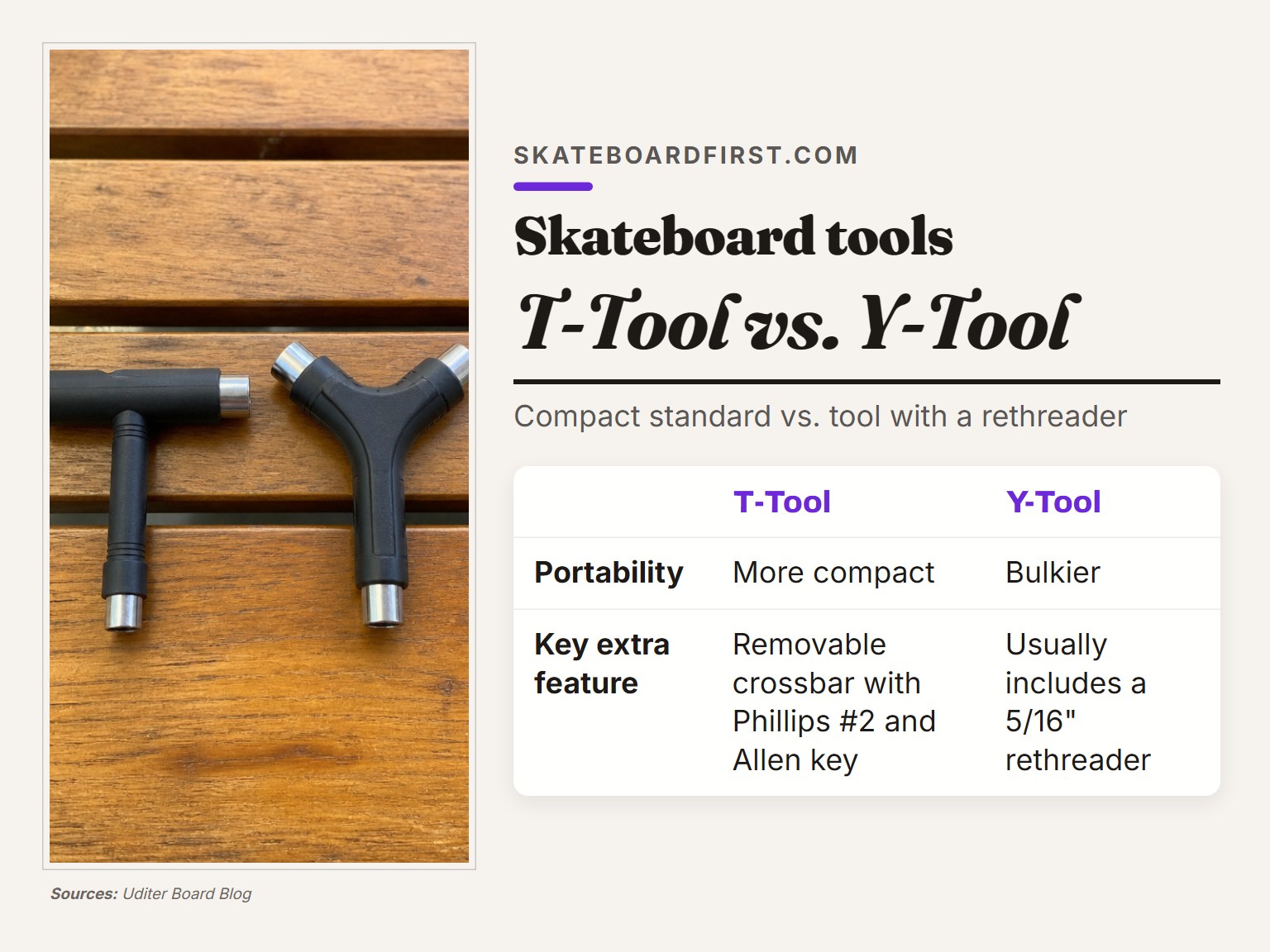
The T-tool is the standard, but it’s not the only shape. Knowing the difference helps you buy the right one.
| Feature | T-Tool | Y-Tool |
|---|---|---|
| Shape | T-shape, sockets on three ends | Y-shape, two arms plus a crossbar |
| Portability | More compact, pocket-friendly | Bulkier, takes up more bag space |
| Extra Features | Some include a ratchet | Almost always includes a 5/16″ rethreader |
| Best For | Most riders, casual skaters, commuters | Heavy users, people who build boards often, grind-heavy skaters |
The built-in rethreader on a Y-tool is for fixing damaged axle threads. For most skaters, the compact T-tool is the default pick.
Price reflects this. According to the Uditer Board Blog, T-tools range from $5 to $15, while Y-tools run $8 to $20. The extra few dollars buy the rethreader.
Troubleshooting Common Problems
Even with the right tool, things can go sideways. Here’s how to handle the usual snags.
Stripped Nut: The socket spins but the nut doesn’t turn. This happens when you use a mismatched wrench or over-torque a cheap nut. Grip the nut’s sides with a pair of locking pliers and turn. Replace the nut immediately after.
Stuck Bearing: The wheel is off, but the bearing is seized on the axle. Don’t hammer it. Slide the wheel at a sharp angle against the axle end to pop the inner race loose. Pry gently with a screwdriver if needed.
Spinning Bolt: You’re trying to tighten the deck hardware, but the bolt spins with the nut. You forgot the crossbar. Use the correct driver end to hold the bolt head firmly from above.
Missing Spacers: You took the wheels off and small plastic rings fell out. Those are spacers that keep the bearings aligned. Put them back on the axle before the wheel, or the bearings will sit crooked and wear unevenly.
Electric Skateboard Riders: Extra Tool Needs
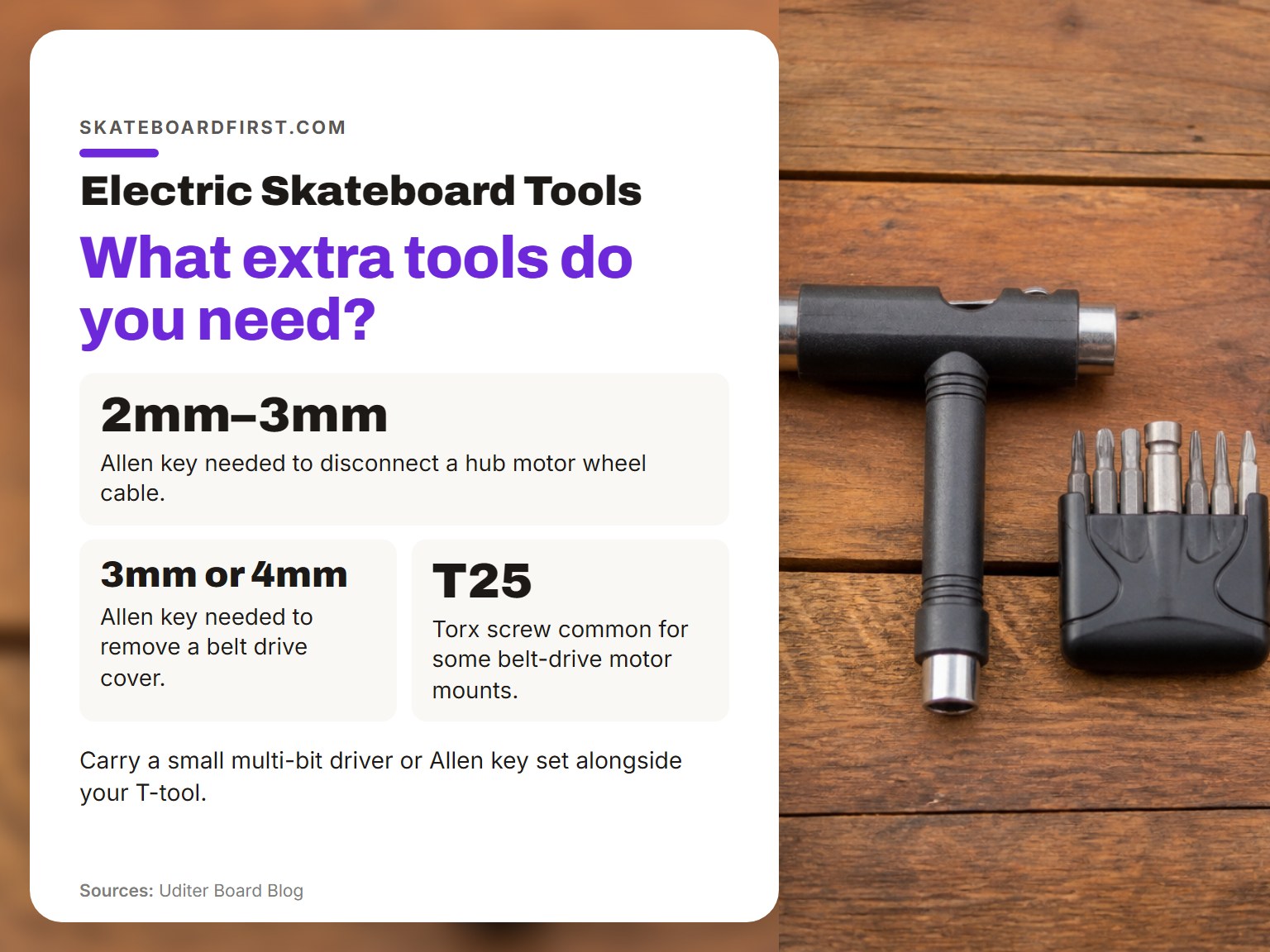
The basic T-tool covers standard board adjustments, but electric skateboards add a few extras.
- For hub motor wheels, check axle nuts more often.
- To disconnect a hub motor wheel cable, you need a small Allen key (usually 2mm–3mm). The T-tool’s Allen key is too large.
- For belt-drive boards, you’ll need an Allen key (usually 3mm or 4mm) to remove the belt cover. Some brands use Torx screws (T25 is common) for the motor mount, a standard skate tool won’t fit those.
Keep a small multi-bit driver or a set of Allen keys in your bag alongside your T-tool. The T-tool handles most standard adjustments; the small keys handle the electric-specific tasks.
How to choose a skate tool
Look for a tool that feels solid in your hand and is easy to hold. A skate tool is a portable, all-in-one piece that consolidates the sockets and drivers you need. Consider the grip; a tool that’s easy to hold makes adjustments simpler. For portability, a T-tool is more compact than a Y-tool, making it easier to carry in a pocket.
When to check your skateboard setup
Make checking your board a regular habit. Give it a quick look before each session. Tighten any loose deck hardware and check that your axle nuts are secure so your wheels don’t wobble. If your wheels use spacers, make sure they’re in place when reassembling. After riding in wet conditions, maintain your bearings. For truck tightness, adjust a quarter turn at a time and test how it feels. Street skaters often run looser trucks, sometimes with the front looser than the rear for a specific steering response.
Frequently Asked Questions
What is a skate T-tool?
Skate T-tool is a compact, all-in-one wrench designed specifically for skateboard hardware. It features three fixed sockets (3/8″, 1/2″, and 9/16″) for the standard nut sizes on a board and a removable crossbar that acts as both a Phillips #2 screwdriver and an Allen key. It’s the most common type of skate tool.
What’s the hardest trick to learn on a skateboard?
While this guide focuses on tools, the hardest trick is subjective and depends on the skater. Many point to the “360 flip” or “laser flip” for their complex footwork and board control. However, mastering the foundational ollie is often the first major hurdle that makes everything else possible.
Is 27 too late to start skateboarding?
No, 27 is not too late. Progress might look different than for a teenager, focusing more on cruising, carving, and basic tricks rather than massive stair sets. The key is managing expectations, wearing protective gear, and celebrating small victories. Start small and stay consistent.
Do you really need a skate tool?
Technically, no. You can use a collection of standard wrenches and screwdrivers if you have the exact sizes (3/8″, 1/2″, 9/16″ sockets, Phillips #2). Practically, yes. A skate tool is inexpensive, ensures a perfect fit to prevent stripping, and is always with you. It turns a hardware puzzle into a simple, reliable fix.
The Bottom Line
Carry the tool. Use it every session to check axle nuts and kingpin tightness.
Sources disagree on truck tightness: a generic manual advises against loosening the kingpin nut ‘more than a few turns,’ while the Uditer Board Blog recommends adjusting ‘a quarter turn at a time’ with no stated upper limit. The manual defines a safe starting zone; your riding defines the final setting. If your trucks are so loose the nut is about to fall off, you’ve gone too far. Otherwise, tune by feel, not by fear.
For most riders, a simple T-tool from a brand like Penny or SkateXS is the answer. It fits in your pocket, it fits your board, and it keeps you rolling.
Go push down the block once today.
