
How to Waterproof a Skateboard: A Realistic Guide
This post contains affiliate links. As an Amazon Associate, we earn from qualifying purchases.
To waterproof a skateboard, you apply a protective sealant like polyurethane to the wooden deck and swap metal components like bearings and hardware for rust-resistant alternatives. No skateboard becomes fully waterproof, but these steps significantly reduce water damage from splashes and wet ground.
That’s the physical work. The real decision is choosing between a quick-clear-coat job for occasional drizzle and a full component overhaul for daily damp commutes. One adds a layer; the other changes what the board is made of. Understanding this choice is the core of how to waterproof a skateboard.
What follows: the exact sealants that work (and one that doesn’t), the manufacturer specs that prove why “waterproof” is a marketing myth, and the repair steps to follow when your board gets soaked despite your best efforts.
Key Takeaways
- Apply multiple coats of polyurethane to seal a wooden deck against moisture; paint alone is not enough.
- Swap standard steel bearings for ceramic bearings to prevent rust, but accept they’ll run slower without lubrication.
- Manufacturer IP ratings like IP65 do not mean waterproof; ONSRA states an IP65 rating, and Evolve, ONSRA, Rideparsec, and Evo-Spirit all state water damage voids their warranties.
- Sources disagree on drying method: iFixit warns against applying direct heat to a wet wooden deck to avoid warping, while Evo-Spirit advises placing a soaked board near a radiator or in the sun.
- For electric boards, focus on model-specific seals like Evolve’s lip seals or Rideparsec’s potted PCBs, not generic claims.
The Two Real Paths to Water Resistance
You have two proven options, not one. The first is a surface treatment. The second is a material swap. Most guides talk about the first and ignore the second, which is why commuters get frustrated when their “waterproofed” board dies in a month, missing the full scope of how to waterproof a skateboard.
A surface treatment means adding a barrier between the water and the board’s core materials. For the wooden deck, that’s a sealant. The go-to product is a clear polyurethane finish, brushed or sprayed on in multiple coats. It soaks into the top ply of maple and cures into a plastic-like shield. This isn’t about making the board shiny. It’s about filling the wood’s pores so water can’t seep in and start the delamination process that turns a crisp deck into a soggy, dead plank.
Applying 2-3 coats of polyurethane to a sanded, clean deck is the most effective method for slowing water absorption. It does not make the board waterproof, but it can turn a catastrophic soak from a single puddle into a salvageable mishap.
The material swap path targets everything but the wood. It starts with the bearings. Standard steel bearings rust. It’s not a maybe. Leave them wet once, and you’ll hear the gritty grind on your next push. The alternative is ceramic bearings. They’re water-resistant and won’t rust, but they come with a trade-off. They often don’t hold speed lubricant as well as steel, so you sacrifice a bit of roll for longevity. You also swap out the standard steel hardware, the bolts and nuts, for stainless steel or titanium. It’s a more expensive, more involved process, but it’s the only way to build a board that can truly handle repeated wet conditions without constant maintenance.
| Method | Best For | What It Protects | Limitation |
|---|---|---|---|
| Polyurethane Sealant | Occasional riders, light drizzle | Wooden deck from moisture absorption | Does not protect metal parts; needs reapplication |
| Ceramic Bearings & Stainless Hardware | Daily commuters, rainy climates | Bearings and hardware from rust | Higher upfront cost; may reduce bearing speed |
| Combination (Both) | All-weather riders | Entire board structure | Most expensive and time-consuming to install |
Electric Skateboards: Seals vs. Splashes
Electric skateboards add motors, batteries, and circuit boards to the water equation. A wet deck is one problem; a short-circuited battery is a brick. Manufacturers use specific terms here, and they matter. Dust seals, conformal coating, lip seals, potted PCBs, these are the features you look for, not the word “waterproof.”
Check the spec sheets. Evolve details the differences between its models: the Hadean, GTR, and Stoke have dust seals and conformal coating on electronics. The Diablo, Renegade, and Stoke X add “additional lip seals” and thicker sealing. Rideparsec lists “water-resistant griptape, 704-sealed cable ports, and potted PCBs” for its Aero model. ONSRA states an IP65 rating for its BLACK Carve 3 PRO, Challenger, and VELAR models.
Where this goes sideways: Believing an IP rating guarantees a dry ride. ONSRA specifies IP65 but simultaneously states “riding in wet conditions is not recommended” and that water damage voids the warranty. Evolve and Rideparsec state the same. The rating tests controlled laboratory spray; it doesn’t cover a real-world commute through puddles or a sudden downpour.
The warranty line is your reality check when learning how to waterproof a skateboard. Every manufacturer cited. Evolve, ONSRA, Rideparsec, Evo-Spirit, explicitly states that water damage is not covered. An IP rating is a description of build quality, not a license to ride in the rain. It tells you which board might survive an accidental splash, not which one you should take through a storm.
The Components You Can Actually Protect
We’ll look at each part separately. You can’t make a wooden deck waterproof, but you can make it highly water-resistant. You can’t stop metal from oxidizing, but you can choose metals that don’t rust.
The Deck: Sand the existing grip tape off completely. Clean the bare wood with a damp cloth and let it dry fully. Apply a first coat of oil-based polyurethane with a foam brush, following the wood grain. Let it dry for the time specified on the can. Lightly sand with fine-grit sandpaper to knock down any raised wood fibers, wipe clean, and apply a second coat. Multiple coats increase durability. This creates a plastic-like shell. The board will still get wet if submerged, but it will dry out faster and is less likely to warp.
Bearings: This is the crux. Steel bearings rust. Ceramic bearings don’t. The trade-off is performance. A well-lubricated steel bearing is faster. A ceramic bearing is more resilient. For a wet-weather board, choose ceramics and accept you might need to push slightly more. Ceramic bearings are the benchmark, but even budget ceramic options will outlast steel in damp conditions.
Hardware & Trucks: The bolts that hold your trucks to the deck are steel. They rust. Swap them for stainless steel hardware. It’s a few dollars for a full set. Your trucks are aluminum, which doesn’t rust, but the kingpin (the main bolt inside the truck) is steel. Consider upgrading to a titanium kingpin kit if you’re building a dedicated rain board. It’s overkill for most, but it’s the final step in eliminating rust points.
Wheels: Urethane itself isn’t harmed by water. The issue is the bearing inside the wheel. Ensure your ceramic bearings are properly shielded and seated.
What To Do The Moment Your Board Gets Wet
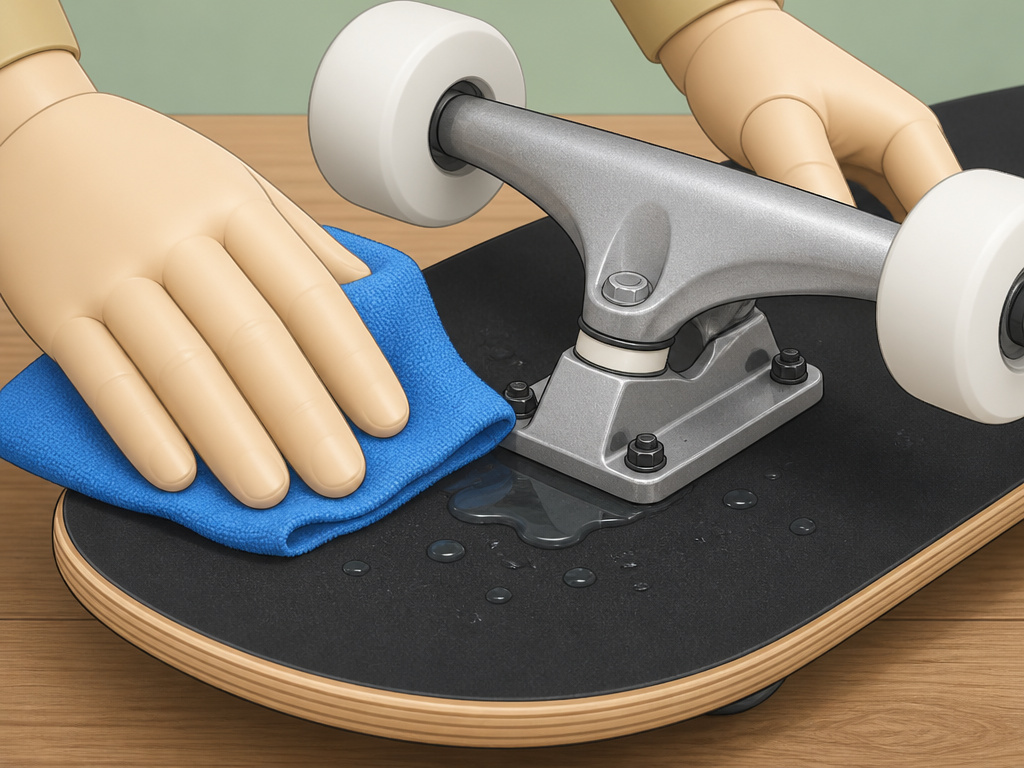
The clock starts when water hits the deck. Your first move depends on how wet it got.
For a light drizzle or splash: Wipe the entire board down with a dry towel immediately. Focus on the areas where the deck meets the trucks and around the bearing shields. Set the board on its side (resting on two wheels) in a dry, room-temperature spot for a few hours. Don’t stand it upright; water pools around the truck mounts.
I follow the wood rule, not the radiator rule. Warping is permanent; slower drying is just inconvenient. Dry it at room temperature, with fans if you have them, but no direct heat.
For electric boards, if the board is unresponsive, you may need to disassemble it to manually disconnect the battery, as Evo-Spirit suggests. Separate the electronics and place them in a sealed bag with silica gel packets or uncooked rice. Do not use a hairdryer directly on circuit boards.
Diagnosing a waterlogged deck: The iFixit guide offers a simple test. Once the deck is dry to the touch, step on it lightly or flex it with your hands. A healthy deck will have a crisp, springy feel and often a faint “pop” sound. If it feels dull, dead, and makes no sound, the wood’s internal structure is compromised. The board has lost its pop and may be unsafe for high-impact tricks.
The Gear That Makes a Difference
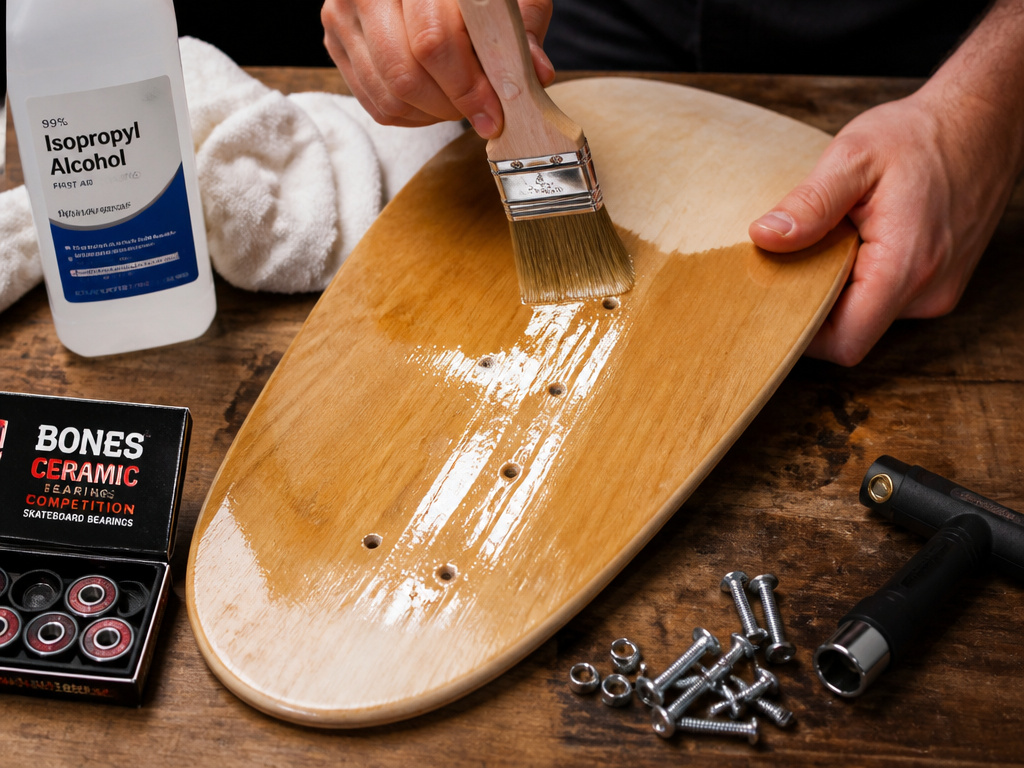
You don’t need a lot of specialized gear, but using the right stuff matters.
- Oil-Based Polyurethane: This is the sealant. Water-based polyurethane is easier to clean up but doesn’t penetrate as deeply or create as hard a shell. Use oil-based for durability.
- Ceramic Bearings: Don’t just buy the cheapest set. Look for bearings with rubber-sealed shields, which offer better protection against water ingress than metal shields. Ceramic bearings with rubber-sealed shields are a reliable starting point.
- Stainless Steel Hardware: Any skate shop sells packs of 8 bolts and 8 nuts. Ensure they’re the correct length for your deck and riser pads.
- Skate Tool: You’ll need this to remove trucks and wheels to apply sealant and swap bearings and hardware.
- Clean Rags & Isopropyl Alcohol: For cleaning the bare wood before sealing and for drying bearings later.
Common mistake: Only sealing the top of the deck. Water wicks up from the ground through the trucks. You must seal the entire deck, top, bottom, and all sides, during the coating process. Leaving the bottom unprotected is like wearing a raincoat but going barefoot.
Frequently Asked Questions
Can you make a skateboard 100% waterproof?
No. You can make it highly water-resistant. Wood absorbs moisture, and complex assemblies like trucks have too many crevices to seal completely. The goal is to significantly slow down damage, not eliminate it.
Are penny boards waterproof?
Penny boards are made from waterproof plastic, as noted by Skateboards.com. This makes them inherently more resistant to water damage than wooden decks. However, their metal bearings and hardware are still susceptible to rust, so the same component-swap advice applies.
How often should I reapply waterproofing sealant?
Inspect it every few months. If you ride in wet conditions frequently, check for worn spots or cloudiness in the clear coat. A full reapplication of polyurethane might be needed once a year for a commuter board.
Is it worth waterproofing an old, worn board?
Only if the deck itself is still in good shape, it has pop, no major cracks or chips. Waterproofing a deck that’s already lost its structural integrity is a waste of sealant. Focus on protecting your next new deck instead.
Do I need special wheels to skate in the rain?
No. Standard urethane wheels are fine. The issue is traction. Wet pavement is slippery. Softer wheels may offer marginally better grip than hard park wheels, but the difference is small. Ride slower and avoid leaning hard into turns.
The Bottom Line
Waterproofing a skateboard is a game of damage reduction, not damage elimination. Start by sealing the wood with polyurethane and swapping the bearings to ceramic. That combo will get you 80% of the way there.
The remaining 20% is accepting that no amount of sealing will convince a manufacturer to honor a warranty for water damage, and no IP rating turns an electric skateboard into a submarine. Your best waterproofing tool is still checking the forecast and knowing when to leave the board at home. When it does get wet, dry it slowly at room temperature, patience saves the deck.
If you’re committed to all-weather riding, build a dedicated rain board with sealed components and maintain it like you would any other tool exposed to the elements. The goal isn’t a perfect board; it’s a board that lasts through the season.
