
Leg Exercises for Skateboarders: A Research-Backed Guide
This post contains affiliate links. As an Amazon Associate, we earn from qualifying purchases.
Strong legs build better skating. A 2025 study in The Scientific Temper found that a 6-week program of targeted leg exercises significantly improved skateboarders’ vertical jump, balance, and Ollie performance. Research-informed leg exercises for skateboarders often focus on building single-leg strength for control, developing explosive power for pop, and training balance and ankle stability.
That 6-week timeline is the key.
The guide explains the three core exercise types you need, how to schedule them around your skate sessions, and the exact rehab protocols from clinical trials for the two most common skateboarding ankle injuries.
Key Takeaways
- A 2025 peer-reviewed study found that a 6-week program of targeted exercises led to measurable gains in pop and balance.
- Train legs on non-skate days or after a chilled session; tired legs land badly and increase injury risk, a principle backed by training guides like the one from A Human Web.
- Single-leg stability is crucial; a 2021 study found professional skaters had significantly better balance and joint control than amateurs.
- For Achilles tendinitis, both eccentric and isometric heel drop protocols showed significant improvement in pain and function within 4 weeks, with no clear winner between the two methods.
- Balance training cuts repeat ankle sprains; one trial cited by A Human Web showed a reduction from 33% to 22% in athletes who did specific balance work after a sprain.
The Core 3: Strength, Power, and Balance
The Technical Snippet: Autoregulatory Progressive Resistance Exercise (APRE) is a training method that adjusts intensity based on daily performance. A 2025 study had skateboarders follow an autoregulatory progressive resistance exercise (APRE) program for 6 weeks. Post-testing showed significant improvements in Vertical Jump Test (power), Star Excursion Balance Test (balance), and Ollie maneuver evaluation.
Single-Leg Strength: Your Standing Leg’s Foundation
Your back foot pops, but your front foot guides and absorbs. Every trick starts and ends on one leg. A 2024 study found a strong, significant, and inverse relationship between leg muscle strength and dynamic balance scores in skateboard players.
Your single-leg strength program needs two moves:
- Bulgarian Split Squats: These force your front leg to control the entire descent and ascent, mimicking the load of landing from a trick. Keep your torso upright and descend until your back knee gently taps the floor.
- Single-Leg Romanian Deadlifts: This exercise builds stability in the hip and hamstring of your standing leg, the exact muscles that keep you from buckling on a sketchy landing. Hold a dumbbell in the hand opposite your working leg for balance.
The unstable surface challenges the stabilizer muscles important for the ankle control observed in professional skaters.
Explosive Power: Translating Strength to Pop
Landing an ollie loads your feet at nearly five times body weight, according to the workout guide from A Human Web. Your muscles must absorb that force and then immediately re-apply it to snap the tail, a key reason for leg exercises for skateboarders.
- Box Jumps:
- Depth Jumps: Step off a low box, land softly, and immediately jump vertically. This shortens the transition time between absorbing force and producing it, which is the essence of a powerful pop.
- Pogo Hops: Simple, continuous two-footed jumps in place. They build ankle stiffness and calf power.
Balance & Ankle Stability: The Professional’s Edge
Here’s where the lab data gets unequivocal. That 2021 study comparing pros and amateurs found professional skateboarders had a significantly smaller inversion angle at the ankle and better overall balance. Their joints didn’t wobble as much. You can’t buy that control; you have to train it with dedicated leg exercises for skateboarders.
This is where dedicated balance exercises pay off.
- Single-Leg Stands: Start on the floor. Close your eyes. The moment you start to sway, your ankle muscles are working. Do this for time, aiming for 30-45 seconds per leg.
- Star Reaches: Stand on one leg and slowly reach your other foot out to tap points in a star pattern around you. This challenges stability in multiple directions.
- Board Drills: Use your actual skateboard. Stand on the deck (over the trucks) on one leg, letting it tilt. Catch it with your ankle, not your whole body. This is specific, unscripted stability work.
Integrating this kind of targeted off-board training creates a foundation that makes every trick attempt more stable.
Scheduling: When to Train vs. When to Skate
This is the practical hurdle. You’re motivated, you find a routine, you crush a leg day… And then you can’t skate for two days because you’re sore. It defeats the purpose.
The guidance from the 45-minute “Strength and landing workout for skateboarders” is blunt: do it twice a week, on days you don’t skate or after skating, not before. Tired legs land badly. The program from The Daily Push agrees, recommending its leg workout 2-3x per week on non-skate days or chilled session days.
Here’s a sample week for someone skating 3-4 days:
- Monday: Skate session (focus)
- Tuesday: Leg workout (strength/power focus)
- Wednesday: Active recovery (light stretching, skateboarding flexibility exercises)
- Thursday: Skate session
- Friday: Leg workout (balance/stability focus)
- Saturday: Skate session (or rest)
- Sunday: Rest
The goal is to separate high-intensity skating from high-intensity training by at least 24 hours. Your body adapts and gets stronger on rest days, not workout days.
Injury Prevention & Rehab: The Two Most Common Ankle Issues
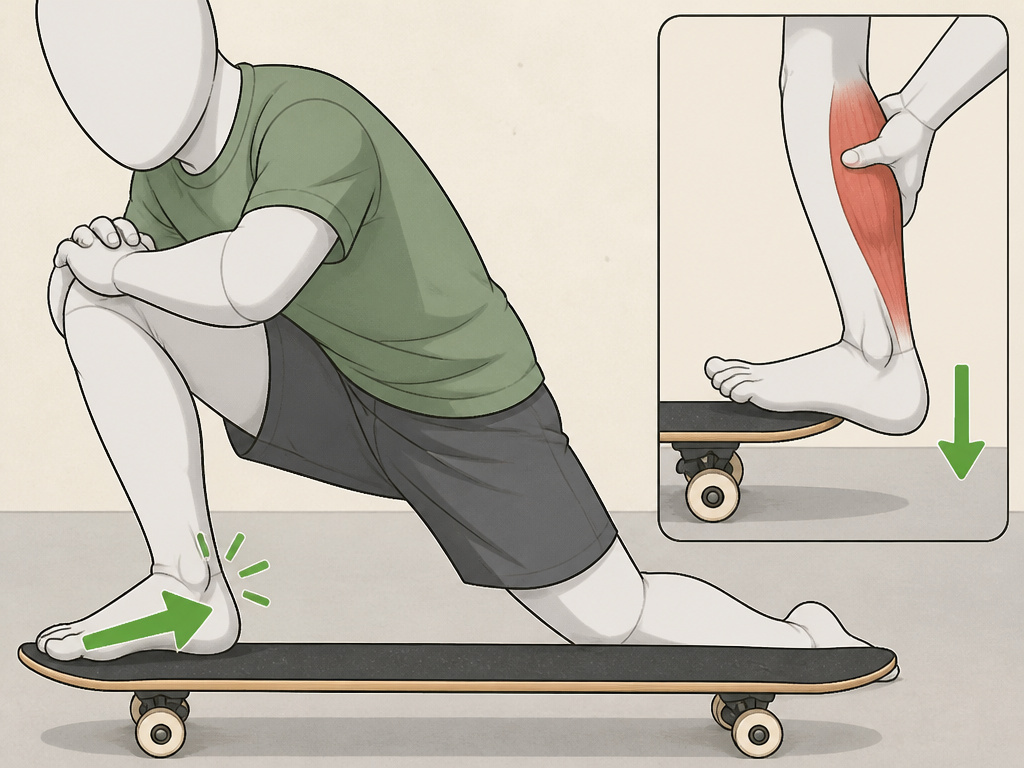
Skating is brutal on ankles. The two most common overuse injuries, per the Skateboard Strength guide, are anterior ankle impingement (“hot pockets”) and Achilles tendonitis. Both stem from repetitive stress in awkward positions. The good news is clinical research provides clear rehab paths.
Anterior Ankle Impingement (“Hot Pockets”)
That pinching pain at the front of your ankle when you crouch for a trick is often a mobility and control issue. The joint is getting crunched because the surrounding muscles aren’t doing their job.
The rehab focus is mobility and strength:
- Foam Roll Calves: 2-3 minutes. Tight calves pull on the ankle joint, limiting its range.
- Ankle Mobility Holds: Pull your foot into dorsiflexion (toes toward shin) and hold for 1 minute. This gently stretches the anterior joint capsule.
- “Runner’s Pose” Hold: A deep lunge stretch, held for 20-40 seconds per side for 3 sets. It opens up the front of the ankle.
This approach treats the foot and ankle as a interconnected system, which is why detailed guides like the Ultimate Foot, Ankle & Calf Guide for Skateboarders are so effective.
Achilles Tendinitis: The Two-Week Fix
For persistent pain at the back of your heel, a 2020 clinical trial published in the NIH’s PubMed Central gives us a direct comparison. Researchers split skaters with Achilles tendinitis into two groups for 4 weeks.
| Exercise Protocol | Sets & Reps | Frequency | Key Finding |
|---|---|---|---|
| Eccentric Heel Drops (Alfredson protocol) | 3 sets of 15 reps | Twice daily | Significant improvement in VISA-A (function) and VAS (pain) scores. |
| Isometric Holds (max plantar flexion) | 3 sets of 5 reps (45-sec hold) | Twice daily | Significant improvement in VISA-A and VAS scores. No statistically significant difference vs. Eccentric group. |
Where this goes sideways: Choosing one protocol and ignoring the other because of “pain.” The eccentric drops are meant to be painful (but not disabling), while the isometric holds should be pain-free. The study concluded both are valid, and clinicians often recommend the eccentric protocol followed by 4-6 weeks of rest from aggravating activity.
The takeaway? If you have Achilles pain, you have two proven, research-backed options. The eccentric heel drop is the classic, but if the pain is too sharp, the isometric hold is a valid, pain-free starting point that still reduces symptoms and increases strength. For more detail on the NIH eccentric exercise study, the full paper is available.
How to Plant Your Feet During Leg Exercises
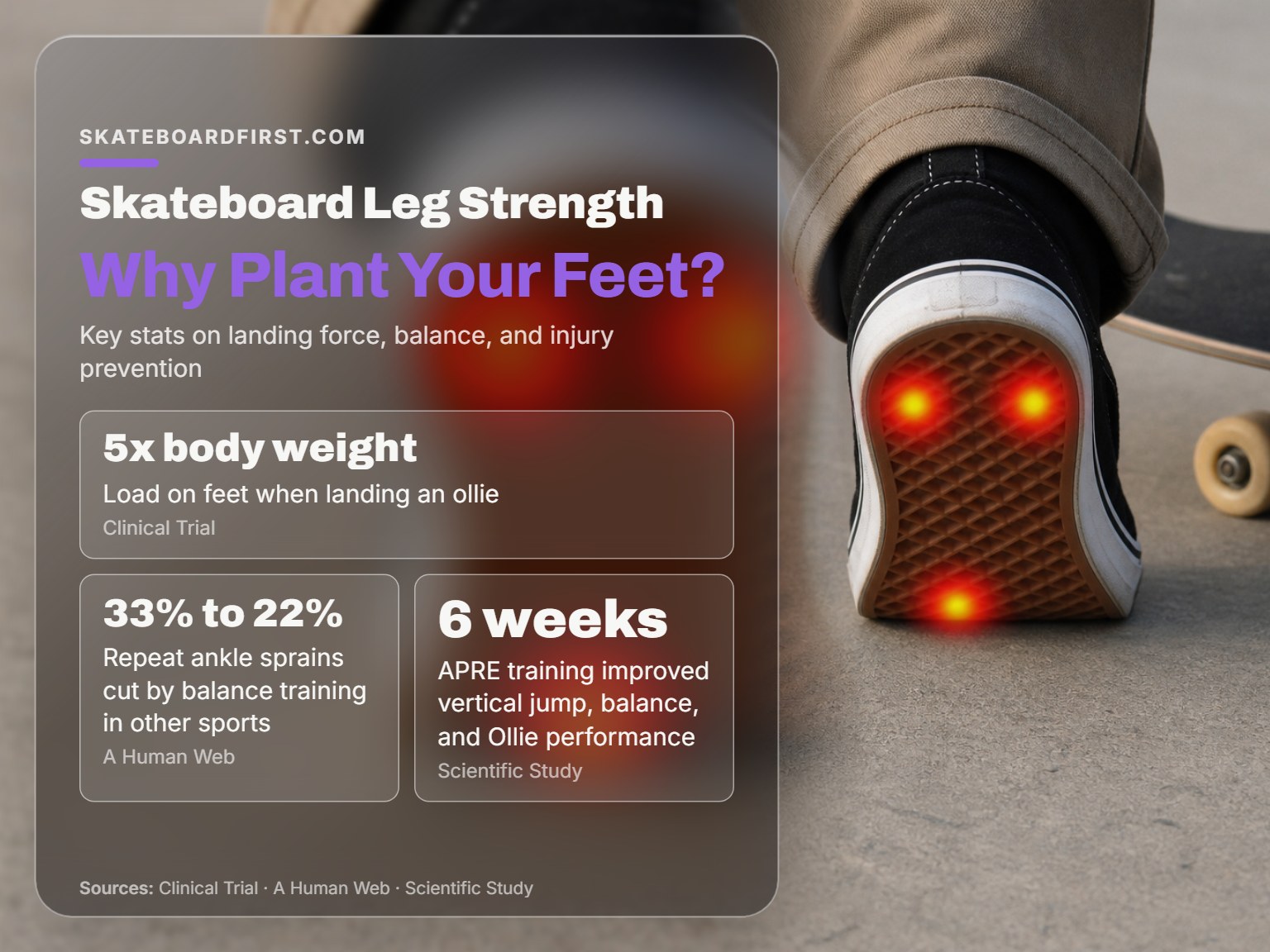
Maintaining a stable ‘tripod foot’ is a key recommendation for off-board training. This means consciously pressing down through three points: the ball of your big toe, the ball of your little toe, and your heel. Creating this solid base of support mimics the need for stability on your skateboard, especially during landings that place immense load on your feet. Focusing on this foot placement during exercises like squats and lunges builds the proprioception and lower-leg strength that contributes to better balance, a trait observed in professional skaters.
Frequently Asked Questions
How often should I do leg workouts if I skate 4 days a week?
Aim for 2 dedicated leg workouts per week, placed on your non-skate days or after a very light skate session. This aligns with the recommendations from both The Daily Push and A Human Web programs. The goal is to avoid stacking high-intensity leg training and high-intensity skating on the same day, which leads to fatigue, poor form, and higher injury risk.
Will lifting weights make me too bulky for skateboarding?
No. The type of training recommended here, focused on relative strength, power, and stability, builds functional muscle, not bulk. Professional skateboarders in the 2021 NCBI study had better ankle control and balance, traits developed through targeted strength training. Bulky muscles come from a specific diet and hypertrophy-focused lifting, which is not what these routines are designed for.
What’s the best exercise for a higher ollie?
No single exercise is a magic bullet, but the combination is clear. The Scientific Temper resistance exercise study linked improved hip extensor and knee flexor strength to better Ollie scores. In practice, this means exercises like Bulgarian Split Squats (for single-leg drive) and Box Jumps (for explosive translation of that strength) will have the most direct carryover.
I have weak ankles. Should I wear braces instead of training?
Braces are a temporary support, not a solution. The long-term fix is building the muscles that act as your body’s natural braces. The NCBI postural control study showed pros had superior innate ankle stability. Start with balance exercises like single-leg stands, progress to board taps, and consistently work on ankle strength exercises. A brace might help you skate through a minor sprain, but only stronger muscles will prevent the next one.
Can VR skateboarding games count as training?
Potentially, yes. A 2023 Frontiers in Bioengineering study found that VR-skateboarding increased trunk flexion, hip flexion, ankle dorsiflexion, and weight distribution on the supporting leg compared to normal walking. This suggests it provides a novel, targeted balance challenge. It’s not a replacement for strength training, but as a supplementary balance training tool, it has measurable biomechanical benefits.
The Bottom Line
Forget doing random exercises until your legs burn. The research hands us a specific blueprint: train single-leg strength, explosive power, and dynamic balance for a minimum of 6 weeks to see real changes in your pop and control.
Schedule it so your hardest workouts and hardest skate sessions never touch. If your ankles complain, you now have two clinically proven paths, the eccentric heel drop or the isometric hold, to follow for four weeks.
Start with one thing. Maybe it’s adding 3 sets of single-leg stands at the end of your next skate session. Or maybe it’s committing to two weekly Bulgarian split squat sessions for the next month and a half. The muscles used in skateboarding are complex, but training them doesn’t have to be. Pick a target, follow the protocol, and measure your progress by what happens on the board, not just in the gym.
