
Exercises to Improve Skateboarding Balance: Step-by-Step
This post contains affiliate links. As an Amazon Associate, we earn from qualifying purchases.
To improve skateboarding balance, you need a plan that targets proprioception (your body’s sense of position), leg and core strength, and ankle stability. A peer-reviewed study on young skaters showed a 12-week program of specific drills, done 3 times a week for 30 minutes, significantly improved balance. Another systematic review found wobble board exercises and hip strengthening offered the biggest gains for ankle stability, with average improvements of 14.3% and 12.8% respectively.
That gap between a generic “practice balancing” tip and a structured, research-backed progression is where most guides stop. They tell you to stand on one leg, but not how to progress from a shaky 10 seconds to a solid 60, or how to translate that stability onto a moving board. The science gives us a clear map: balance isn’t one skill, but a stack of them, proprioception, strength, and specific on-board adaptation, built through targeted exercises to improve skateboarding balance.
What follows: the exact 8-level proprioception program from a clinical study, the strength exercises that directly support landing and control, the common causes of “wobbliness” and how to fix them, and a set of no-equipment drills you can do in a hallway tonight. By the end, you’ll have a weekly schedule, not just a list of moves.
Key Takeaways
- A 12-week, 3x/week proprioception program from a 2020 study built balance in young skaters through 8 progressive levels, starting with eyes-open double-leg stances and advancing to single-leg tests on skates.
- For chronic ankle instability, a common balance killer, a 2021 systematic review found wobble board training (14.3% avg. Improvement) and hip strengthening (12.8% avg. Improvement) were most effective, recommending sessions 3 times weekly for 4–6 weeks.
- Single-leg exercises are essential. A 2024 balance study used 30-second repetitions with 60-second rests, finding skateboarders significantly outperformed non-skaters on challenging tasks like bipedal stance on a board with eyes closed.
- Equipment matters for stability. The U.S. Consumer Product Safety Commission (CPSC) recommends longer boards, wider trucks, and properly tightened components to reduce speed wobble risk, sometimes the balance problem is in the setup, not the skater.
- Beginner wobbliness often comes from a high center of gravity and stiff knees. The fix isn’t just “bend your knees,” but learning to absorb movement through your legs, a skill you can practice off the board with simple drills.
The 8-Level Proprioception Progression (From Study)
Featured Snippet Target: A 2020 peer-reviewed study detailed a proprioceptive physical exercise program for young skaters that ran 12 weeks, 3 times per week, for 30 minutes per session. The program progressed through 8 distinct levels of difficulty: Level 1: eyes open, double-leg stance on firm surface, wide base. Level 2: eyes closed, double-leg stance, reduced base. Level 3: eyes open, single-leg stance on unstable horizontal board. Level 4: eyes open, single-leg stance on unstable vertical board. Level 5: eyes closed, single-leg stance on unstable horizontal board. Level 6: eyes closed, single-leg stance on unstable vertical board. Levels 7 & 8: tests conducted on skates, eyes open then closed.
The word “proprioception” sounds clinical, but it’s just your body’s internal GPS. It’s what tells your ankle how far it’s rolled without you looking down. For skateboarding, where your feet are glued to a moving, tilting platform, that GPS needs to be high-resolution. The study above gives us a blueprint.
Start small, then build. You don’t need the unstable boards from the study’s later levels right away. Level 1 is simply standing with your feet wide, eyes open, on a firm floor. Hold it for 30 seconds. The real test comes at Level 2: close your eyes on that same floor, but bring your feet closer together. You’ll feel your ankles firing tiny corrections you never noticed before. That’s the system waking up.
Most people skip the eye-closed step. They go straight to a balance board, which is like trying to run before you can walk with your eyes shut. The study’s progression works because it systematically removes sensory inputs. First you take away vision, then you add an unstable surface, then you take away vision on the unstable surface. Your body learns to rely on the feedback from your joints and muscles alone.
Where this goes sideways: Rushing to Level 3 (single-leg on a wobble board) before mastering Level 2. Your body will compensate by gripping with your toes or locking your knee, which builds bad habits and doesn’t translate to skating. Stick to the 30-second repetition format used in the research, with 60-second rests between tries.
Here’s how to adapt the study’s 8-level plan into a home routine, even without specialty boards.
| Level | Stance | Surface | Eyes | Home-Friendly Substitute |
|---|---|---|---|---|
| 1 | Double-leg, wide base | Firm floor | Open | Stand on a yoga mat. |
| 2 | Double-leg, reduced base | Firm floor | Closed | Stand on a thin carpet. |
| 3 | Single-leg | Unstable horizontal board | Open | Use a folded towel or a couch cushion. |
| 4 | Single-leg | Unstable vertical board | Open | Stand on a pillow. |
| 5 | Single-leg | Unstable horizontal board | Closed | Cushion, eyes closed (have a wall nearby). |
| 6 | Single-leg | Unstable vertical board | Closed | Pillow, eyes closed (use extreme caution). |
| 7 | Tests on skates | Skateboard (stationary) | Open | Stand on your board on carpet. |
| 8 | Tests on skates | Skateboard (stationary) | Closed | Stand on your board on carpet, eyes closed. |
Progress only when you can hold a level steadily. The original study used a structured progression based on ability. If you’re wobbling wildly at 15 seconds, you’re not ready. This isn’t about endurance; it’s about teaching your nervous system a new default setting for stability. For more on the fundamentals, see our guide on basic skateboard balance.
Strength and Stability: The Muscle Layer
Proprioception tells your body where it is. Strength decides what it can do about it. When you land from an ollie off-kilter, your ankle muscles need to fire instantly to correct it. If they’re weak, the joint rolls, and you’re hopping off the board clutching your leg.
A 2021 systematic review in the Journal of Sport Rehabilitation looked at the best fixes for chronic ankle instability, a major balance saboteur. The winners were clear: wobble board training (14.3% average improvement) and hip strengthening (12.8% average improvement). The review recommended doing both, three times a week for 4–6 weeks.
The hip connection is crucial. Your glutes, especially the gluteus medius on the side of your hip, are primary stabilizers. When they’re weak, your knee caves inward during a squat or landing, putting massive strain on your ankle. Strengthening them gives your entire leg a stable platform to work from. This is why a complete off-board training plan always includes hip work.
Common mistake: Doing only double-leg squats. Skateboarding is a one-legged sport most of the time, pushing, landing tricks, manuals. Your training must reflect that.
The most effective strength exercises for skateboard balance are unilateral (one-legged). Build them into two short sessions per week, separate from your skating.
- Bulgarian Split Squats. This is the king. It builds single-leg strength, hip stability, and ankle control under load. Keep your torso upright and descend until your back knee gently touches the floor. Weak glutes here will make your knee wobble inward, a sure sign you need this exercise. Start with just your bodyweight.
- Single-Leg Romanian Deadlifts. Hold a water bottle or kettlebell in one hand. Hinge at your hips, keeping your back flat, and extend the opposite leg back. This hammers your hamstrings and glutes while challenging your standing ankle’s stability.
- Calf Raises (Single-Leg). Do them off a step for a greater range of motion. Control the lowering phase, that’s where the ankle stabilizing muscles work hardest. The burning in your calf after 15 reps is the feeling of future board control.
- Side-Lying Leg Lifts. Target the gluteus medius directly. Lie on your side, keep your toes pointed slightly down, and lift your top leg. You might be shocked how quickly this small muscle fatigues.
Aim for multiple sets of repetitions per exercise, focusing on control. The goal isn’t to lift the heaviest weight, but to move with perfect control and no wobbling. If your knee is shaking, the weight is too heavy. This focused work complements broader leg exercises for balance.
Fixing “The Wobbles”: On-Board Drills and Setup Checks
You’ve done the off-board work, including exercises to improve skateboarding balance. You step on your board and… Still feel like a newborn deer. This is where specific on-board drills and a hardware check come in. Often, “the wobbles” are a mix of skill deficit and a board that’s working against you.
First, the skill part. A 2024 study published in Kinesiologia Slovenica tested skateboarders versus non-skaters on four balance tasks. The third task, bipedal stance on a skateboard with eyes closed, showed a significant difference between the groups. Skateboarders were better, but it was still hard. A 2024 balance testing study used three 30-second repetitions with 60-second rests for its tasks, which can serve as a useful template for structuring your own exercises to improve skateboarding balance.
Practical on-board drills:
- The Static Hold: On grass or carpet, place your board and stand over the bolts. Hold for 30 seconds. Then close your eyes. The goal is stillness. You’ll feel the board making tiny tilts, your job is to correct with your ankles, not your whole body.
- The Manual Finder: While rolling slowly on smooth pavement, gently lean back to lift the nose. Don’t try to hold a long manual; just find the “balance point” where the nose comes up an inch, then set it down. Repeat. This teaches you to make micro-adjustments with your hips while moving.
- The Carving Circle: Find a empty parking lot. Push once, then practice carving tight figure-eights using only your body weight and ankle tilts, no more pushes. This builds dynamic balance and the coordination to link turns smoothly.
Now, the hardware. The U.S. Consumer Product Safety Commission (CPSC) has a Skateboarding Safety PDF that lists equipment factors for stability. Their advice directly counters speed wobble: longer boards, wider trucks (hangers), and properly tightened trucks/wheels/nuts/mounting screws.
Easy to miss: Loose hardware feels like a balance problem. A nut that’s not fully tightened on a truck kingpin allows the hanger to shift unpredictably. Before you blame your feet, check your gear. A longer wheelbase (the distance between trucks) inherently increases stability at speed.
If you’re an adult beginner on a tiny 7.75″ board from your teen years, you’re fighting physics. A wider, longer cruiser or longboard deck (even if just for practice) can build confidence faster. This kind of gear tweak is a form of injury prevention, letting you practice longer without frustration.
Yoga and Mobility: The Flexibility Factor

Balance isn’t just strength and proprioception; it’s also range of motion. If your ankles are stiff and your hips are tight, your body can’t achieve the positions it needs to stay centered. This is where yoga poses and simple mobility drills enter the picture, they’re the missing link in many skate training plans.
A stiff ankle is a weak ankle. When you can’t dorsiflex (bring your toes toward your shin) adequately, your body compensates by collapsing your arch or rotating your knee during a squat or landing. Yoga poses like Downward-Facing Dog and Low Lunge stretch the calves and Achilles, creating more space for the ankle to move. Meanwhile, poses like Warrior III and Tree Pose are balance challenges in themselves, forcing stability through a full range of motion.
A sample no-equipment mobility sequence (do this before skating or as a standalone routine):
- Ankle Circles: 10 circles in each direction, per foot. Wake up the joint.
- Deep Squat Hold (30 seconds): Heels down, chest up. This opens hips and ankles.
- Pigeon Pose (30 seconds per side): Targets external hip rotation and glute stretch.
- Standing Quad Stretch (20 seconds per side): Don’t just pull your foot; focus on keeping your knees together to feel the hip flexor stretch.
For adult beginners, this is essential. A body that sits at a desk all day arrives at the skatepark with the mobility of a rusty hinge. Ten minutes of this work can prevent the tight calves and sore knees that cut sessions short. It directly supports the flexibility needed for complex tricks down the line.
The part nobody mentions: Holding a deep squat for 30 seconds is harder than most leg workouts for a new skater. Your hips and ankles will protest. That’s the point, you’re expanding their usable range, which makes every stance on the board more comfortable and controlled.
Putting It All Together: A Sample Weekly Plan

Research gives us the pieces: the 12-week proprioception plan, the 4-6 week strength protocol, the on-board drills, and the mobility work. The final step is assembling them into a schedule you can actually follow without living at the skatepark.
Here’s a balanced, research-informed weekly template for a skater aiming to build foundational balance. It assumes you skate 2-3 times per week already.
| Day | Focus | Activity | Duration | Key Principle |
|---|---|---|---|---|
| Monday | Proprioception & Mobility | Proprioception Level Drills (e.g., Levels 1-3) + Full Mobility Sequence | 30 min | Start the week by waking up the nervous system and joints. |
| Tuesday | Skate Session | On-board drills (Static Hold, Carving Circles) + free skating | 60 min | Apply stability work in a skate context. |
| Wednesday | Strength Training | Bulgarian Split Squats, Single-Leg RDLs, Calf Raises, Side-Lying Leg Lifts | 25 min | Build the muscular foundation for control. |
| Thursday | Active Recovery | Light walking, foam rolling, gentle stretching | 20 min | Let the body adapt and repair. |
| Friday | Proprioception & Skate | Advance Proprioception Level (if ready) + Skate Session focusing on manuals | 45 min | Integrate higher-level balance into trick practice. |
| Saturday | Optional Skate / Rest | Social skate or complete rest | Variable | Listen to your body. |
| Sunday | Planning & Light Mobility | Review week, plan next week’s progression, light ankle circles/hip stretches | 15 min | Prepare mentally and physically for the cycle to repeat. |
The short version: Spread the work across the week. Don’t try to do your proprioception drills, heavy strength work, and a long skate session all on the same day, you’ll be too fatigued to perform any of them well. This approach mirrors the coordination needed to link complex movements.
Trust the process, one session at a time. The goal isn’t to master Level 8 in a month. It’s to show up consistently. You might feel clumsier before you feel better, as your brain rewires its movement patterns. That’s normal.
Exercises to improve pop/power
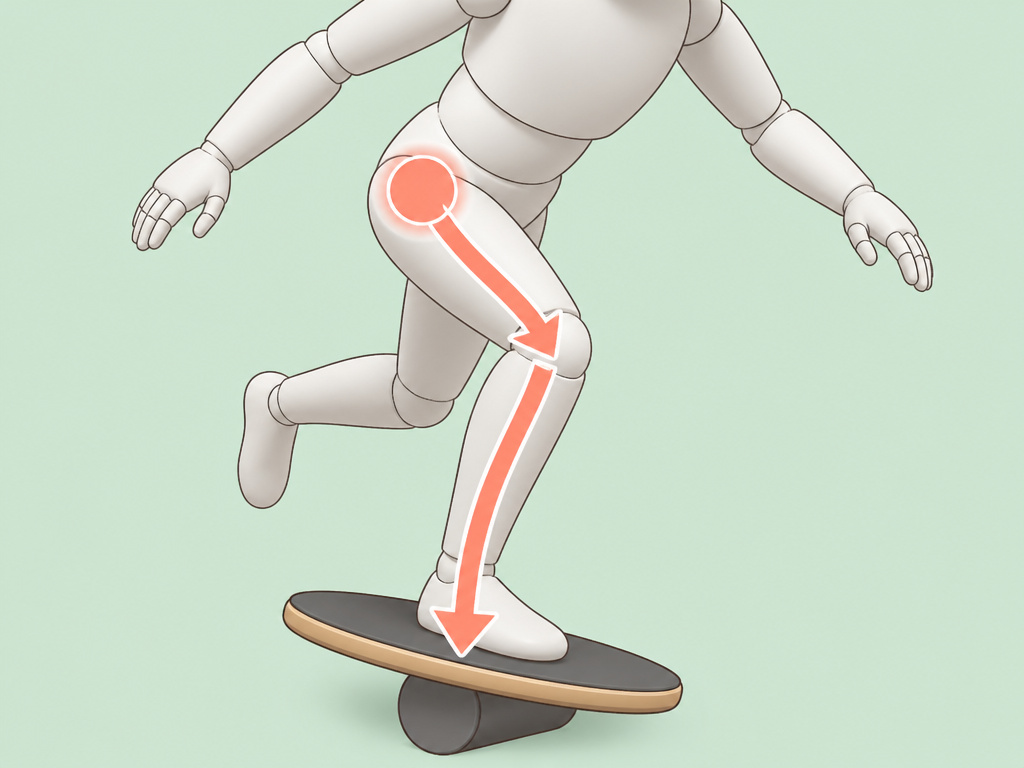
Building pop and power for skateboarding relies on a stable foundation. A key element is strengthening the muscles that control your hips and trunk. A systematic review identified hip strengthening as one of the most effective methods for improving lower limb stability, which directly translates to a more powerful and controlled pop. This is because a strong, stable core and hip allow you to drive force efficiently through your legs and into the board without energy leaks from wobbling. Focus on exercises that challenge single-leg stability and control, mimicking the unilateral stance of a skater preparing to ollie. Integrating these strength exercises with balance training creates a platform for generating more explosive pop from a solid base.
Frequently Asked Questions
How long does it take to see improvement in skateboarding balance?
You can feel small improvements in comfort within a couple of weeks of consistent, focused training. Significant, measurable gains, like holding a single-leg stance for 30 seconds longer or noticing less wobble at speed, can be seen in timelines used by research, such as the 4–6 weeks for ankle instability rehabilitation or the 12 weeks for the proprioception program. The key is progressive overload: consistently challenging your balance a little more each week.
Why am I so wobbly on my skateboard?
“Wobbliness” usually comes from three places: a lack of ankle and hip stability (solved with strength and proprioception work), a high/rigid body position (solved by bending your knees and learning to absorb movement), or an unstable board setup (solved by checking truck tightness and considering a longer/wider deck as recommended by the CPSC). Often, it’s a combination of all three.
Is yoga good for skateboarding balance?
Yes, yoga is excellent for skateboarding balance. It improves the ankle mobility and hip flexibility that underpin good stance, and poses like Tree Pose or Warrior III are direct balance challenges. Poses that stretch the calves and hips can also reduce the muscle tightness that leads to a stiff, wobbly skating style. It’s a powerful form of off-board training.
What is the best balance board for skateboarding?
The best tool is the one you’ll use consistently. For replicating the study’s proprioception levels, a simple wobble board (a disk on a hemisphere) is ideal. For a more skate-specific feel, a balance board that uses a roller or a cylinder under the deck better simulates the side-to-side motion of a skateboard. Start with basic drills on a cushion or folded towel to see if you’ll stick with it before investing.
Can I improve my balance if I’m an adult beginner?
Absolutely. A 2024 balance study had skateboarders with an average of 15 years experience, demonstrating that experienced skaters have developed balance, but the proprioception and strength protocols are effective at any age. The main adjustment for adult beginners is to prioritize mobility and warm-up to compensate for less flexible joints from sedentary lifestyles. Progress may be slower than for a teenager, but the neurological and strength gains are absolutely achievable.
The Bottom Line
Improving your skateboarding balance is a project, not a quick fix. The research hands us the tools: a 12-week proprioception ladder, 4-6 weeks of targeted strength work, specific on-board drills, and mandatory mobility. The mistake is thinking you need to do it all tomorrow.
Pick one thing from this article and start there tonight. Maybe it’s testing your single-leg stance on the floor for 30 seconds. Maybe it’s checking your truck nuts are tight. Maybe it’s adding three sets of Bulgarian split squats to your week. One concrete action beats a perfect plan you never start.
The wobbliness you feel isn’t a permanent label. It’s just a signal that your body’s stability systems, proprioception, strength, flexibility, are under-developed for the task. Train them systematically, and the board starts to feel less like a bucking horse and more like an extension of your feet. Keep rolling.
