
Longboard Trucks vs Skateboard Trucks: Core Specs and Ride
This post contains affiliate links. As an Amazon Associate, we earn from qualifying purchases.
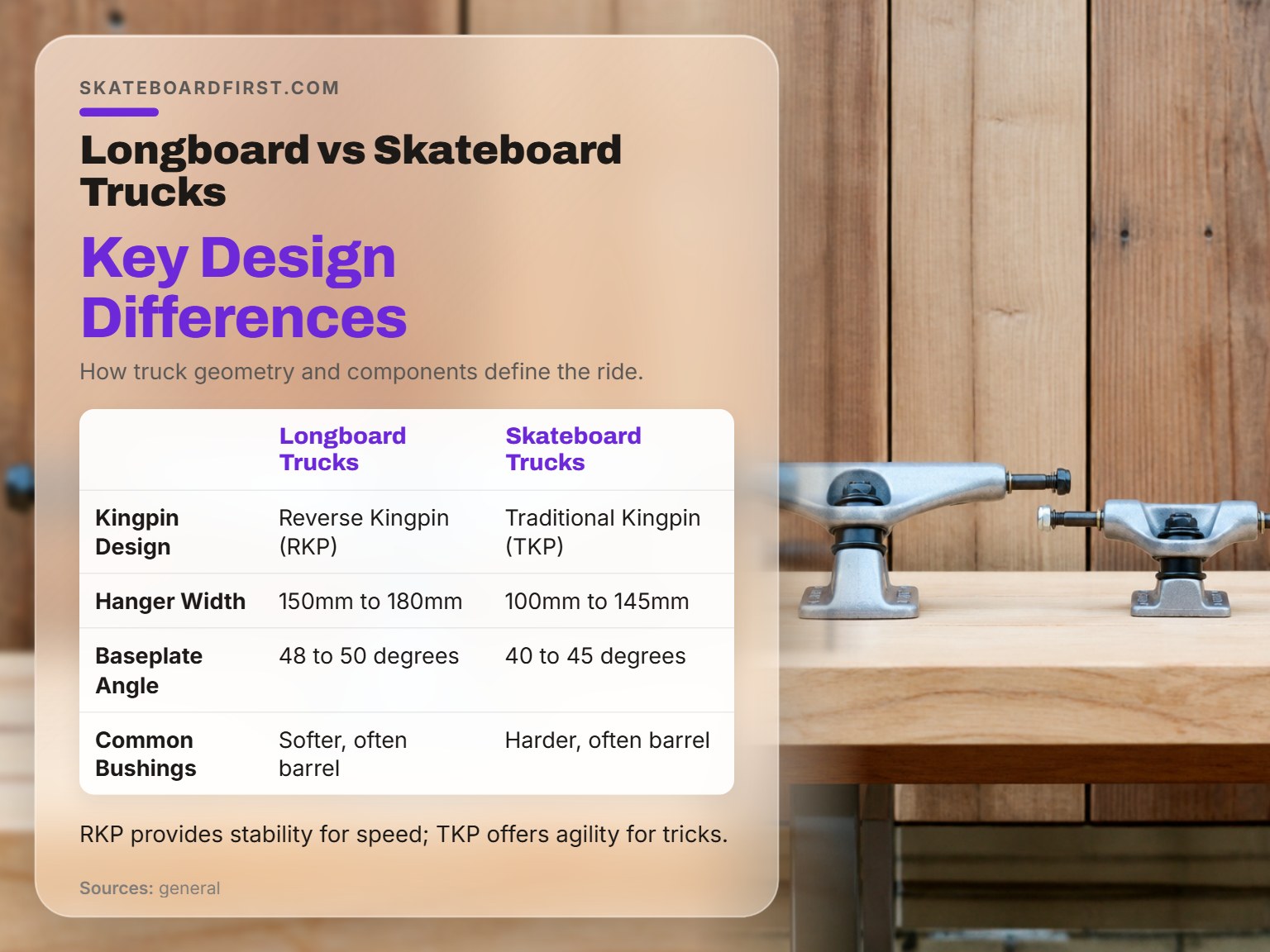
Longboard trucks are wider (150-180mm hangers) with Reverse Kingpin (RKP) design and higher baseplate angles (48-50°) for stability and smooth carving at speed. Skateboard trucks are narrower (100-145mm hangers) with Traditional Kingpin (TKP) design and lower angles (40-45°) for agile, snappy turns suited for tricks and street skating. The kingpin faces outward on RKP trucks and inward on TKP trucks, which changes the ride height and turning feel.
That axle width, kingpin angle, and orientation difference is mechanical, not just marketing. It decides whether your board feels planted through a downhill carve or flickable off a curb, which is the core of longboard trucks vs skateboard trucks.
What follows is a breakdown of the specs, the why behind the ride feel, and what happens when you cross the streams in the longboard trucks vs skateboard trucks debate. By the end, you’ll know exactly which truck type fits your deck and your plans for it.
Key Takeaways
- Match truck width to deck width for stability; a mismatch makes the board feel unstable or unresponsive.
- Reverse Kingpin (RKP) trucks face outward, sit higher, and are built for cruising and carving stability.
- Traditional Kingpin (TKP) trucks face inward, sit lower, and are the default for street skating and technical tricks.
- Bushing hardness is not universal; skateboard truck bushings vary by brand and model despite common claims.
- Putting longboard trucks on a skateboard deck converts it into a dedicated cruiser, ending its trick capability.
The Core Specs: Size, Angle, and Kingpin
The numbers tell you what the truck is built for before you ever step on it, clarifying the longboard trucks vs skateboard trucks distinction. A longboard truck’s 180mm width isn’t just bigger; it’s a lever for carving. A skateboard truck’s 128mm width on a 7.5″ deck isn’t an accident; it’s the pivot point for flip tricks.
Longboard truck hangers range from 150mm to 180mm wide, with baseplate angles from 48 to 50 degrees, using a Reverse Kingpin (RKP) design where the kingpin faces outward. Skateboard truck hangers range from 100mm to 145mm, with baseplate angles from 40 to 45 degrees, using a Traditional Kingpin (TKP) design where the kingpin faces inward.
Start with hanger width, the most visible difference. For longboards, the sweet spot is 150mm to 180mm. A model like the Ghost Boards Silver 180mm/50° truck lands at the top of that range, built to apply maximum force on a wide deck. For skateboards, the range is 100mm to 145mm. The rule of thumb is to match your axle width to your deck width for a stable ride, though skateboard setups often use a slightly narrower axle for quicker turn initiation.
Baseplate angle is the steering geometry. Higher angles turn your lean into more wheel turn. Longboard trucks use those 48° to 50° angles to give you deep, predictable carves without needing to throw your weight around. Skateboard trucks use 40° to 45° angles. The lower angle keeps the board more stable under your feet during the violent shifts of a kickflip or heel-flip landing. It’s a trade-off: carving power versus landing stability.
Then there’s the kingpin, the bolt that holds the whole truck together. This is the RKP vs TKP split. In an RKP truck, the kingpin faces outward, away from the deck’s center. This gives the truck a higher ride height and a more gradual, stable turn. In a TKP truck, the kingpin faces inward. This design sits much lower and delivers a quicker, more dive-y turn feel. You can see the difference at a glance. The kingpin orientation changes how the truck leans, which is why you can’t just swap one for the other and expect the same performance.
The short version: wider + higher angle + outward kingpin = cruising stability. Narrower + lower angle + inward kingpin = trick agility.
How the Design Dictates the Ride
A longboard truck doesn’t just turn. It carves. A skateboard truck doesn’t just lean. It flicks. The difference is in the geometry and the parts that connect you to the pavement.
The turning radius is the first clue. Longboard trucks have a larger turning radius. Your carves are wide, smooth, and predictable, which is exactly what you want at higher speeds or when you’re dancing on a deck. Skateboard trucks have a small turning radius. The response is immediate and sharp, letting you snap the board around for a quick ollie pivot or a tight corner on a street run.
Where this goes sideways: Cranking down the kingpin nut because loose trucks feel scary. Overtightened bushings can’t compress properly, making the truck feel dead and unresponsive. The board stops turning with your lean and starts fighting you. You’ll feel it in your calves after ten minutes.
Bushings are the rubber cushions that control how much the truck leans. Their durometer (hardness) is tuned for the job. Longboard trucks often come with softer bushings for a relaxed, forgiving carve. For downhill, you’d swap in stiffer ones to limit lean and increase stability at speed. Skateboard trucks typically use harder bushings from the factory. They provide a stable platform for landing and the snap-back you need for quick, successive turns.
The common claim that all skateboard truck bushings are the same size and universally interchangeable is wrong. The bushing seat geometry and kingpin diameter can vary between brands like Independent and Thunder. A bushing that fits one perfectly might pinch or rattle in another. You match the bushing to the truck model, not just the sport.
Ride height is a physical consequence of the kingpin design. RKP trucks sit higher off the deck. This extra space accommodates larger longboard wheels and prevents wheel bite—when the wheel rubs the deck during a hard turn. TKP trucks sit much lower. This gives you a lower center of gravity, which directly translates to better board control for flip tricks and a more stable feel when you’re landing back on the grip tape. That lower height is why putting RKP trucks on a standard skateboard deck feels noticeably top-heavy and “squirrelly,” as riders on forums describe it.
Can You Mix and Match?
Technically, yes. The mounting holes are often compatible, especially if your deck has both old-school (2.5″ length spacing) and new-school (2.125″ length spacing) patterns, like those on the Gullwing Charger II. Practically, you are building a different kind of board.
Putting longboard trucks on a skateboard deck converts it into a cruiser. The RKP design raises the ride height, and the wider hanger changes the point where force is applied. The board will want to carve and roll over cracks smoothly, but it will lose its “pop” for ollies and become unwieldy for flip tricks. It’s a fun hybrid for getting around, but it’s no longer a street skateboard.
The reverse—skateboard trucks on a longboard deck—is less common and generally not advised. The narrow TKP trucks on a wide deck reduce stability dramatically, making the board feel twitchy and insecure at any speed. The wheelbase might also feel off, as TKP trucks can extend the wheelbase slightly compared to RKPs.
I got this wrong once, putting a set of 150mm RKPs on an old 8″ street deck thinking it would be a fun cruiser. It was, sort of. But the high, tippy feel made every push feel like I was balancing on a rail, and any attempt at an old-school kickturn was a gamble. I took them off after a week.
If you want a hybrid, aim for a dedicated cruiser deck or a mini-longboard designed for a lower, TKP-like truck. Otherwise, you’re forcing a part to do a job it wasn’t designed for, and the board will tell you every time you ride.
Choosing the Right Trucks for Your Style

Your riding style picks the truck. The specs just confirm it.
| Riding Style | Recommended Truck Type | Key Specs to Look For | Sample Use Case |
|---|---|---|---|
| Street Skating & Tricks | Traditional Kingpin (TKP) | Hanger width: 129-149mm, Baseplate: 50-52°, Lower ride height | Independent Stage 11 for park and street |
| Cruising & Carving | Reverse Kingpin (RKP) | Hanger width: 150-180mm, Baseplate: 48-50°, Softer bushings | Ghost Boards Silver 180mm/50° for smooth paths |
| Downhill & Speed | Reverse Kingpin (RKP) | Hanger width: 150-180mm, Baseplate: 44-50°, Stiff bushings | Precision trucks for stability at high speed |
| Freestyle & Dancing | Reverse Kingpin (RKP) | Hanger width: 150-180mm, Baseplate: 48-50°, Medium bushings | Trucks with good rebound for board walks |
For street skating, TKP is the standard choice. Brands like Independent, Thunder, and Venture are known for TKP trucks. You want the lower center of gravity and the snappy, dive-y turn that makes trick execution consistent.
For cruising and commuting, RKP trucks are the default. The stability and smooth, wider turns make pushing longer distances less fatiguing. A model like the Gullwing Charger II with its barrel bushings is one option for cruising.
For downhill, you still use RKP trucks, but you look for specific geometry like a lower degree baseplate and you’ll definitely swap in the hardest bushings you can find to limit lean and increase stability at high speed. And you’ll definitely swap in the hardest bushings you can find to limit lean and increase stability at high speed.
Weight matters, especially for bushings. A rider at 75kg will find most stock bushings too soft, leading to excessive lean and instability. The fix is a harder barrel/barrel bushing setup. Some companies provide charts recommending bushing durometers based on rider weight. Ignoring this is why two riders with the same truck can have completely different experiences.
Bushings, Materials, and Fine-Tuning
The truck’s job is to translate your movement. The bushings and materials decide how accurately that translation happens.
Bushings are the final tuning point. They are not all the same. A longboard bushing is often taller and conical, while many skateboard bushings are shorter and cylindrical. The material matters too. Urethane formulas differ between brands, affecting rebound and compression feel.
Common mistake: Assuming bushings are a “set and forget” part. Bushings break in over the first few weeks of riding. The factory feel changes. A quick quarter-turn adjustment on the kingpin nut after this break-in period often brings the perfect balance back.
Truck materials are about strength and weight. Longboard trucks often use a mix of steel, brass, and aluminum for strength, with hollow kingpins and axles to shave off weight. Skateboard trucks typically use aluminum for the hanger and baseplate with a steel axle, while longboard trucks also use metals like steel and aluminum, sometimes with hollow components to reduce weight. This combo provides the right blend of lightweight for flicking and strength for impacts. Hollow kingpins and axles are used in some trucks to reduce weight.
Fine-tuning is where you make the truck yours. Start with the factory setup. Ride it for a few hours. If the board feels too loose and unstable, tighten the kingpin nut a quarter-turn. If it feels unresponsive and hard to turn, loosen it a quarter-turn. Change one variable at a time. Swapping bushings and changing kingpin tightness in the same session only tells you that you’ve changed something, not what each change did.
My own rule came from eating pavement: a board that turns too easily feels scary, but a board that won’t turn is a mechanical failure. The sweet spot is where the truck leans smoothly with your weight and returns to center without a fight. You’ll know it when you feel it.
What are the size differences between longboard and skateboard trucks?
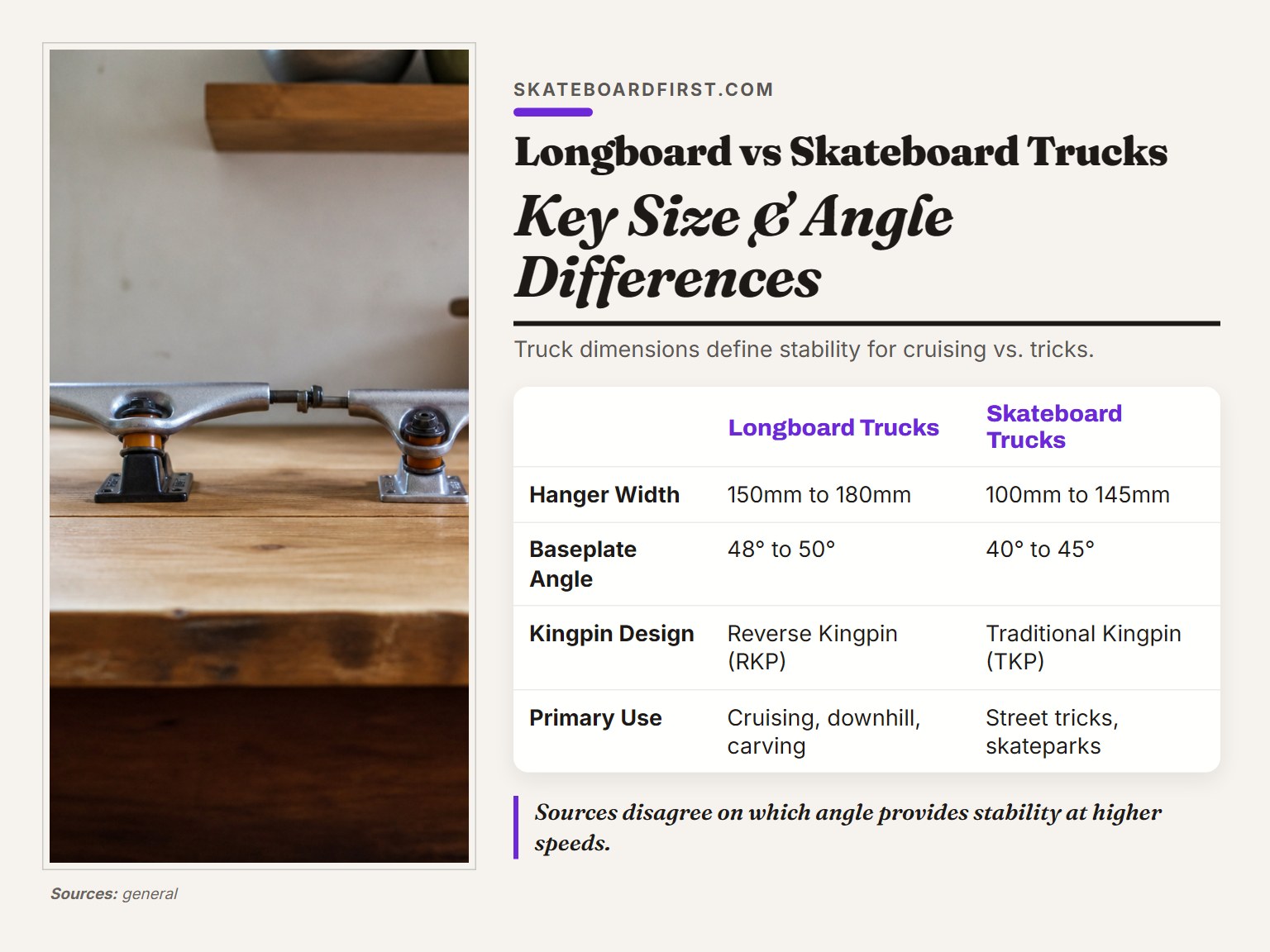
The most obvious difference is in hanger width. Longboard trucks are generally wider, with hangers typically ranging from 150mm to 180mm. This width provides a stable platform for carving and cruising. The baseplate angle also differs. Sources disagree on which baseplate angle provides stability at higher speeds: some state longboard trucks’ higher angles (48-50°) enhance turning and maneuverability, while others state skateboard trucks’ lower angles (40-45°) provide stability for tricks. For the best performance, choose a truck width that matches the width of your deck.
How do bushing choices differ between longboard and skateboard trucks?
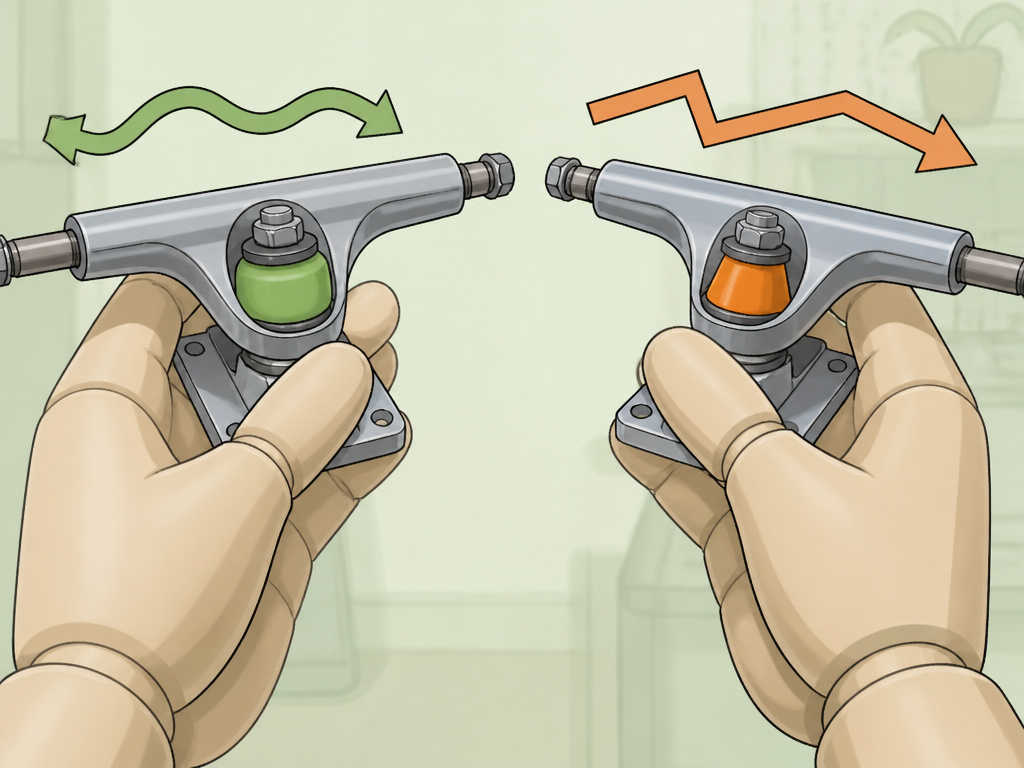
Bushings are the urethane parts that control how your trucks turn. Their hardness and shape are chosen for different riding styles. Longboard trucks often come with softer bushings for a relaxed, fluid ride that’s forgiving and responsive for carving. For high-speed downhill riding, stiffer bushings are used to provide stability. Skateboard trucks typically feature harder bushings from the start, which offer increased stability during landings and precise control for flip tricks and grinds. The tightness of skateboard truck bushings can be easily adjusted to suit a rider’s preference, allowing for fine-tuning of the board’s feel.
Frequently Asked Questions
What is the main difference between RKP and TKP trucks?
The main difference is kingpin orientation and ride height. Reverse Kingpin (RKP) trucks have the kingpin facing outward, which results in a higher ride height, more stability at speed, and a gradual, predictable turn. Traditional Kingpin (TKP) trucks have the kingpin facing inward, resulting in a lower ride height, a quicker, “dive-y” turn feel, and better agility for technical street skating.
Can I use longboard trucks for street skating?
You can, but you shouldn’t expect to perform standard street skating tricks. Longboard trucks are taller and designed for carving stability, not flicking the board for flip tricks. Using them for street skating will make the board feel top-heavy, slow to respond, and ill-suited for ollies, kickflips, or grinds.
How do I choose the right truck width?
Match the axle width to your deck width as a starting point. For a precise fit, the hanger (the part the axle runs through) should be roughly the same width as your deck. For a standard 8.0″ skateboard deck, look for trucks with a hanger width that matches your deck width, typically within the 100mm to 145mm range. For a 9″ longboard deck, look for hangers in the 150-180mm range. A slight underhang on a skateboard can be acceptable for certain styles.
Are skateboard and longboard bushings interchangeable?
Generally, no. While some sizes may appear similar, skateboard and longboard bushings often differ in shape (conical vs. Cylindrical), height, and durometer (hardness). Bushing seat geometry also varies between truck brands and models. Always choose bushings designed for your specific truck model for proper performance and safety.
Do I need different trucks for downhill longboarding?
Yes. While they still use the RKP design, downhill-specific trucks often feature lower baseplate angles (sometimes as low as 44°) and are built with precision tolerances to minimize speed wobbles. They are also paired with very hard, stable bushings to limit turn lean at high speeds, which is a different feel from the softer bushings used for casual carving.
Before You Go
The truck choice isn’t a minor detail. It’s the foundation. A great deck with the wrong trucks feels permanently off. A mediocre deck with well-matched, properly tuned trucks can surprise you.
For most riders, the answer is straightforward. If your board lives at the skate park or on street corners, Traditional Kingpin trucks are your only real option. If your board is for transportation, carving hills, or dancing, Reverse Kingpin trucks with the correct width will serve you best.
One final, grounded tip from the shop floor: before you buy a complete board based on the graphic, check the truck specs. That “cool” complete often has generic, low-performance trucks that will hold you back faster than any other component. Spend your money on a set of trucks first. Everything else—wheels, bearings, deck—is easier to upgrade later. The truck is the soul of the setup. Get that right, and the rest is just fine-tuning.
