
How to Choose Skateboard Truck Width: Step-by-Step
This post contains affiliate links. As an Amazon Associate, we earn from qualifying purchases.
To choose skateboard truck width, match the axle width to your deck width, staying within a 1/4-inch tolerance. The axle nuts should sit no more than a quarter-inch inside or outside the edge of your deck. For an 8.0-inch deck, look for trucks with an 8.0-inch axle width, like Thunder 147s or Independent 139s.
That quarter-inch rule is the manufacturer line. The real conversation starts when you step outside it. A wider truck locks grinds and feels planted in a bowl. A narrower one flips faster and feels snappier on flatground. Understanding how to choose skateboard truck width is key to this decision.
This guide walks through the three things that decide your truck width: the printed spec on your deck, the style you skate, and the brand you pick, which together form the core of how to choose skateboard truck width. You will also get a method for measuring any truck in your hand, a cross-reference table to decode brand model numbers, and the one mistake that burns out bushings before their time.
Key Takeaways
- Match your truck axle width to your deck width, with a tolerance of no more than 1/4 inch in either direction.
- For street skating and flip tricks, a truck slightly narrower than your deck (by 1/8 inch) can improve flick speed.
- For transition skating and stability, a truck slightly wider than your deck provides a more locked-in feel on grinds.
- Always reference axle width, not the brand’s model number, when comparing trucks across different manufacturers.
- A wobbly or squeaky truck is often a bushing or pivot cup issue, not a sign you need a whole new set of trucks.
The 1/4″ Rule: Why Axle Width Matters More Than Model Numbers
The rule from the Arbor Collective’s guidebook is clear: axle widths should be similar to the deck width, varying by no more than 1/4 inch wider or narrower. Your axle nuts should sit within that quarter-inch band from the edge of your deck.
Axle widths should be similar to the deck width for best fit, varying by no more than 1/4″ wider or narrower than the width of the deck.. Arbor Collective Skateboard Trucks Guidebook.
Go outside that band, and the board tells you. Trucks too narrow make the board feel tippy, like you’re balancing on a tightrope. Your heels or toes hang way over the wheels, and pushing feels unstable. Trucks too wide put the wheels out past the deck. You will kick your own wheels while pushing.
The confusing part isn’t the rule of how to choose skateboard truck width. It’s the labels. Brands like Independent, Thunder, and Venture use their own numbering systems. An Independent 149 has an axle width of 8.5 inches. A Thunder 149 also has an axle width of 8.5 inches, but this matching of numbers across brands is not a reliable rule. But a Venture 55 is 9 inches. The model number is a brand-specific code, not a universal width.
That’s why the Arbor Collective guide says it’s generally better to reference axle width. Ignore the model number at first. Find the axle width spec on the retailer’s page or the brand’s size chart. That number is what you match to your deck.
How to Measure Your Trucks (Axle Nut to Axle Nut)
You have a set of trucks with no box. The model number rubbed off. Here is how you measure them.
Remove the wheels. You need a clear view of the axle ends. Take a tape measure and place it at the very outer edge of one axle nut. Stretch it straight across to the outer edge of the opposite axle nut. That distance is your axle width. Do not measure the hanger, the thick central part you grind on. That’s the hanger width, and it’s a different, smaller number.
If your trucks are already mounted, you can estimate. The Rollersnakes guide states your axle nuts should be within a quarter of an inch from the edge of the deck. If the nuts are visibly sunken in more than that, your trucks are likely too narrow. If they poke out, they’re too wide.
This measurement is your ground truth. It cuts through the brand-number confusion. An Independent 139, an Ace AF1 33, and a Venture 33 all share an axle width of 8.0 inches. They will all fit an 8.0-inch deck within that quarter-inch tolerance. The model numbers are just different roads to the same destination.
Decoding Brand Size Charts: Independent, Thunder, Venture, Ace
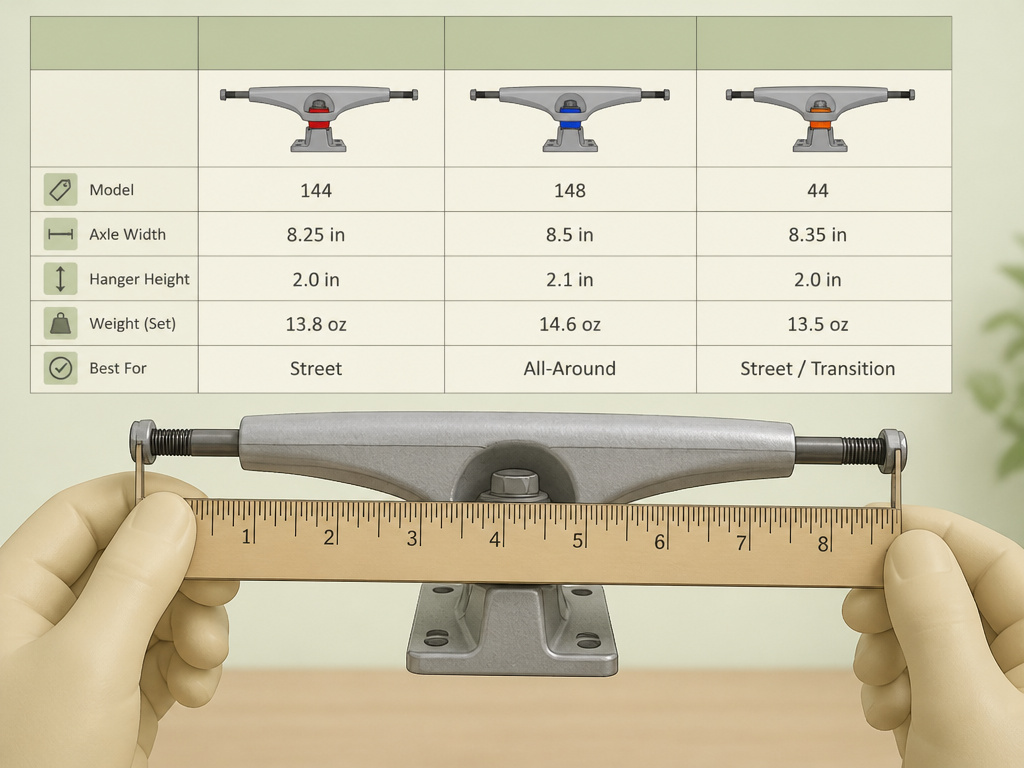
You know your deck is 8.25 inches wide. Which truck model do you buy? This table translates the major brand model numbers into axle widths and recommended deck ranges. All data is sourced from the Rollersnakes size guide.
| Brand & Model | Axle Width | Recommended Deck Width Range |
|---|---|---|
| Independent 144 | 8.25″ | 8.2″ – 8.375″ |
| Thunder 148 | 8.25″ | 8.12″ – 8.38″ |
| Ace 44 | 8.25″ | 8.25″ – 8.5″ |
| Venture 44 | 8.35″ | 8.25″ – 8.75″ |
| Independent 149 | 8.5″ | 8.375″ – 8.6″ |
| Thunder 149 | 8.5″ | 8.38″ – 8.62″ |
| Ace 55 | 8.5″ | 8.5″ – 8.75″ |
Notice the overlap. An 8.25-inch deck fits the Independent 144, Thunder 148, and Ace 44. Your choice within that window depends on brand preference and the subtle feel of their geometry. A wider truck in the range, like the Venture 44 at 8.35 inches, will feel more stable. A narrower one, like the Thunder 148 at 8.25 inches on the dot, will feel a touch quicker.
Where this goes sideways: Picking a truck based on the model number alone, without checking its actual axle width. An Independent 151 (8.625″) is very different from a Thunder 151 (8.75″), even though they share a number.
For a clean, default match, follow the brand’s own recommendation. If you have an 8.25-inch deck, the Independent 144 is the intended pair. It’s a safe, performance-tested starting point.
Street vs. Transition: How Riding Style Changes the Math

The quarter-inch rule is for a neutral, balanced setup. But your style pushes the boundaries.
For street skating, flat ground, ledges, stairs, many skaters prefer trucks that match their deck exactly or even sit slightly narrower. The narrower track width makes the board flip faster for kickflips and heelflips. It feels snappier. This is a common tweak you will not find in a manufacturer’s guide.
For transition skating, ramps, bowls, pools, the preference often flips. A truck slightly wider than the deck is common. The extra width gives more hangar surface to lock into grinds on coping. It also provides a more stable, planted feel when carving at speed. Some skaters run trucks like Independent 149s (8.5″ axle) on decks around 8.38 inches for bowl skating. The board felt more secure, and grinds locked in with less precision required.
This is the non-commodity part. The forums and pro setup videos are full of these intentional mismatches. The rule of thumb bends based on what you are trying to do.
| Skating Style | Typical Truck Width | Why It Works |
|---|---|---|
| Street / Tech | Matched or 1/8″ narrower | Faster flip, lighter feel, less wheelbase for quicker spin. |
| All-Around / Park | Matched within 1/4″ | Balanced for both flip tricks and transition. The manufacturer’s default. |
| Transition / Bowl | Matched or 1/8″ wider | More stability at speed, larger grind surface, better lock-in on coping. |
Your first setup should follow the standard rule. Once you know how a balanced board feels, then experiment. Move one variable at a time. Try a slightly wider truck before you change your bushings or wheel size.
The Hanger-Axle Conversion: What “5.0” or “5.5” Really Means
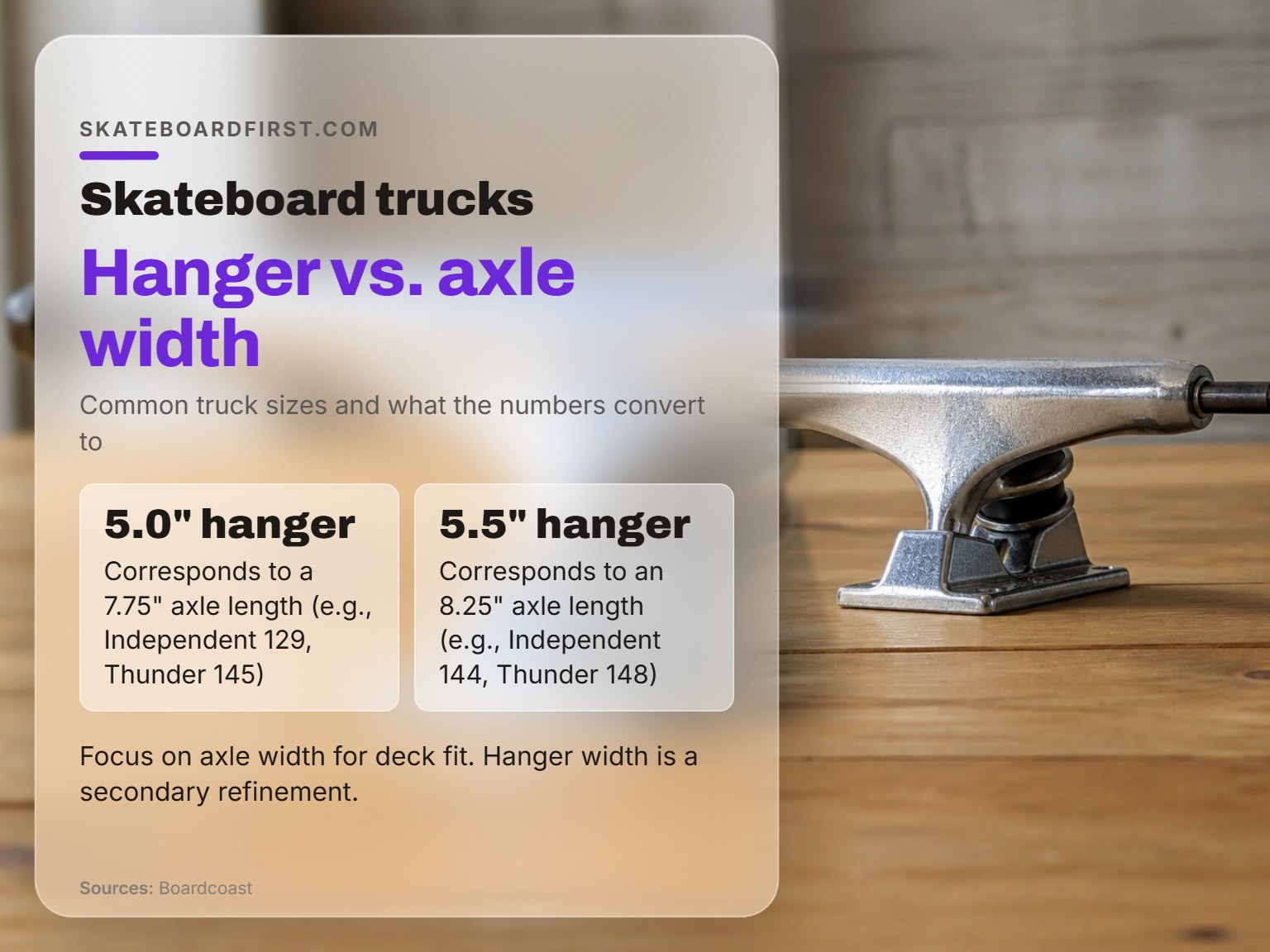
You might hear skaters talk about “5.0 trucks” or “5.5 hangers.” This refers to the hanger width, measured across the central grinding surface. It’s another layer of jargon.
Boardcoast provides a handy conversion: a 5.0-inch hanger generally corresponds to a 7.75-inch axle length (like the Independent 129 or Thunder 145). A 5.5-inch hanger corresponds to an 8.25-inch axle length (like the Independent 144 or Thunder 148).
Most of the time, you can ignore hanger width. Axle width is the decisive measurement for deck compatibility. Hanger width affects the wheelbase slightly and the feeling of the grind, but not whether the truck physically fits your deck. Focus on axle width first. Consider hanger width a secondary refinement for very dialed-in preferences.
Common Mistakes and How to Avoid Them

The most common error is overthinking the brand model number. You need the axle width. Find that number first.
Another is misdiagnosing truck problems. A loose, wobbly feel is not always a sign of cheap or ill-fitting trucks.
I nearly bought a new set once because my board felt vague and shaky at speed. I tightened the kingpin nut, but the slop remained. The problem was the bushings. They had flattened out and gone mushy. A replacement set of aftermarket bushings fixed the wobble. The trucks themselves were fine.
Now I troubleshoot one variable at a time: tighten the kingpin a quarter turn, test, then inspect the bushings. Changing one thing at a time saves money and stops you from blaming the hardware for a simple wear issue.
Squeaks follow the same logic. A loud squeak often comes from a dry pivot cup, not a bad bearing. A tiny dab of wax or light grease in the pivot cup cavity can often quiet it down. Before you start swapping bearings, check the simple, cheap parts first.
Easy to miss: The axle nuts can work loose over time. Before every session, give your trucks a quick visual check and a wiggle. A loose nut is a fast track to a wheel flying off mid-push.
Frequently Asked Questions
What size trucks go on an 8.25 skate deck?
For an 8.25-inch deck, look for trucks with an axle width between 8.125 and 8.375 inches. The most direct matches are the Independent 144 (8.25″ axle), Thunder 148 (8.25″ axle), and Ace 44 (8.25″ axle). All three keep the axle nuts within a quarter-inch of the deck edge.
Will 8.25 trucks fit an 8.5 deck?
Yes, but they will be narrow. An 8.25-inch axle on an 8.5-inch deck puts the axle nuts roughly 1/8 inch inside the deck edge on each side. This is at the outer limit of the recommended 1/4-inch tolerance. The board will feel more nimble but potentially less stable. For a beginner, it’s better to match more closely.
Will 5.5 trucks fit an 8.25 deck?
Usually, yes. A “5.5” truck refers to a 5.5-inch hanger width, which typically corresponds to an 8.25-inch axle length (like Independent 144s). Always verify the actual axle width, as the hanger-to-axle conversion can vary slightly by brand.
Is it okay if my trucks are a little smaller than my deck?
Yes, within the 1/4-inch tolerance. Many street skaters intentionally choose trucks 1/8 inch narrower than their deck for a quicker, more flickable feel. Just ensure the axle nuts are not so far inside that your shoes constantly rub the wheel.
The Bottom Line
Start with the quarter-inch rule. Match your truck’s axle width to your deck width, keeping the nuts within that band. Use the brand charts to translate model numbers into real inches.
Then, let your style guide you. Street skaters often drift narrower. Transition skaters often drift wider. Both are correct.
Your first set of real trucks, like Independent 139s or Thunder 147s for an 8-inch deck, will outlast several decks. Get the width right, and then tune the feel with bushings and tightness. The truck is the foundation. Everything else builds on it.
