
Skateboard Lock Pros and Cons: Which One Is Right for You?
This post contains affiliate links. As an Amazon Associate, we earn from qualifying purchases.
Using a skateboard lock is a trade-off between security and convenience. A cable lock is a lightweight deterrent that stops opportunistic theft but can be cut, while a U-lock offers serious theft resistance at the cost of heavy, bulky carry. The right choice depends on your board’s value, where you leave it, and how long you’ll be away.
The key is matching the lock’s rated strength to the actual risk. A cheap cable might be fine for a five-minute coffee run, but leaving a premium electric board unattended for hours demands something that meets a security standard. Understanding skateboard lock pros and cons is essential for this choice.
What follows is a breakdown of every major lock type, grounded in patent specs and user reports. We will show where they fail in practice, how they can damage your board, and the one question that decides if you even need a lock.
Key Takeaways
- Cable locks are deterrents, not fortresses. They stop a thief who can simply pick up a board that isn’t locked but won’t withstand bolt cutters.
- Cold weather jams combination mechanisms. User reports show locks like the DaKine Cool Lock freezing solid at 20–30°F, which conflicts with its marketing for snow sports.
- Locking through the truck mounting bolts is the most secure point, but patents show integrated designs may not fit all board geometries.
- A heavy electric skateboard changes the safety calculus. Bindings or foot straps add control but make crashing with a heavy board dangerously immobile.
- The UL 1034 standard provides benchmarks for lock strength (static, dynamic, endurance). Most skateboard locks don’t advertise a rating, which tells you everything.
The Real Trade-Off: Security vs. Everything Else
You don’t buy a lock. You buy time. The goal is to make stealing your board more annoying, more visible, or more time-consuming than the board next to it.
Patents like US Patent 5901588 envision robust security, using Y-shaped shackles and security bolts that prevent truck removal. Commercial reality often differs. Reviews of products like the DaKine Cool Lock reveal a user base that accepts deterrent-only cable locks, acknowledging they ‘won’t stop a determined thief’ but prevent ‘targets of opportunity.’ This gap between patent ideals and practical carry is where the skateboard lock pros and cons question lives.
This section maps that gap. We’ll start with the most common choice.
Cable Locks: The Portable Deterrent
The DaKine Cool Lock is one example. It’s a 37-inch retractable cable with a 4-digit combination. On paper, it seems convenient: compact, keyless, and with a 37-inch cable.
In practice, user reports from 2018 to 2021 tell a different story. The mechanism jams in cold weather around 20–30°F. Riders have needed hand warmers or had to cut the cable to free their gear. That’s a critical failure for a product sold for winter sports.
Common mistake: Relying on a cable lock in freezing conditions. The internal lubricant gums up, the dials stick, and you’re left trying to remember a combination you can’t feel with numb fingers.
Cables work as a visual “do not touch” sign. However, a reviewer noted the DaKine Cool Lock felt “like having another cell phone” in their pocket. For quick stops where your board is in sight, that’s often enough. The security comes from the social contract, not the steel.
Where the cable fails:
- Cutting: A pair of handheld cable cutters can slice through many cable locks quickly.
- Weather: Cold kills the combo mechanism. Heat and rain rust the internal coil over time.
- Fit: The 37-inch length struggles with some ski racks and can’t always loop through multiple boards securely.
If you go this route, treat it as a temporary leash, not an anchor. It’s the lock you use when you’re inside for ten minutes, not three hours.
U-Locks & Heavy-Duty Chains
This is where security gets serious. A hardened steel U-lock or a thick chain forces a thief to bring a loud, bulky angle grinder. The goal is no longer to look inconvenient; it’s to be physically untenable to remove quickly.
The UL Standard 1034 gives us a framework to think about this. It rates burglary-resistant locks for static strength (500-1500 lbf), dynamic strength (33-70 ft-lbf), and endurance (100k-250k cycles). No skateboard-specific lock advertises these ratings, but looking for a bike lock that does tells you what “heavy-duty” actually means.
The downside is all in the carry. A solid U-lock can be heavy and bulky. You need a dedicated mount on your backpack or belt loop. Forgetting it means riding home without your board, which defeats the whole point.
| Lock Type | Best For | The Real Carry Cost |
|---|---|---|
| Mini U-Lock | Quick stops, high-theft areas | Fits in a deep jacket pocket; rattles in a backpack |
| Standard U-Lock | Long-term parking, expensive boards | Needs a frame mount; heavy enough to feel on a long push |
| Chain Lock | Locking to odd-shaped objects | Heavy and bulky; often needs a separate bag |
The mounting point matters. A U-lock fits through a wheel and around a post, but that leaves the rest of the board vulnerable to quick-release trucks. Patents like US20130305790A1 address this by designing a housing that sandwiches between the deck and truck, locking the board as a unit. The catch is compatibility, it might not fit your specific truck geometry.
For some electric board owners, the added lock weight may be less of a concern than for a rider pushing a traditional board.
Smart Locks & Integrated Designs
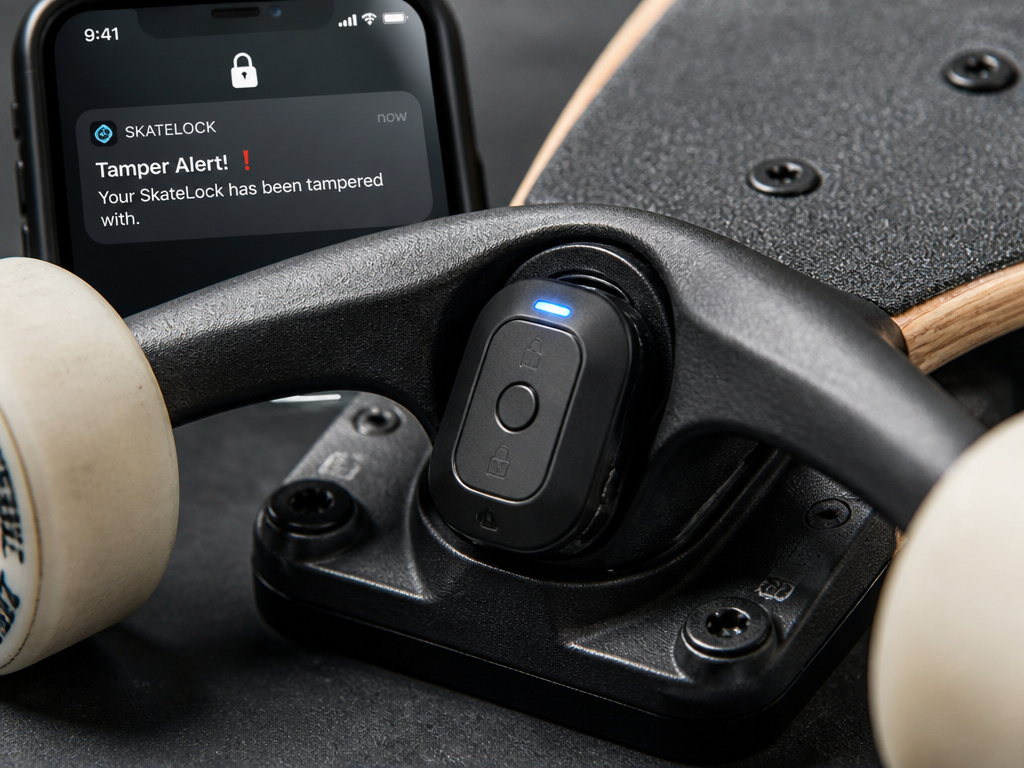
This category is full of clever ideas that often stumble on practicality. Smart locks use Bluetooth or Wi-Fi to open with your phone, send tamper alerts, or track location. Integrated designs for other sports, like the one in US Patent 5,773,245 for roller skates, aim to “positively lock the wheels” as part of the equipment itself.
The pros are obvious. No keys to lose. A theft attempt sends a notification to your phone. The lock becomes a feature, not an add-on.
The cons are less obvious until you need it.
- Battery life: A dead smart lock is a brick. Cold weather drains batteries faster.
- App dependency: If the company’s servers go down or the app glitches, you’re locked out, from your own board.
- Complexity: More moving parts mean more ways to break. A traditional mechanical lock either works or it doesn’t.
Integrated designs face a different hurdle. Skaters are notoriously particular about their setup weight and feel. Adding a permanent lock mechanism changes the deck’s flex, the truck’s turning radius, or the ground clearance. For riders sensitive to their board’s setup, that can be a hard sell.
Where this goes sideways: Choosing a smart lock for its tech over its core security. The flashiest app can’t compensate for a weak shackle. Always check the physical lock’s specs first.
If you’re tech-savvy and your board is a high-value electric model, a robust smart lock can be a great fit. For a traditional street setup, the added complexity rarely justifies itself. A solid multi-tool in your pocket solves more problems.
The Weight and Portability Equation
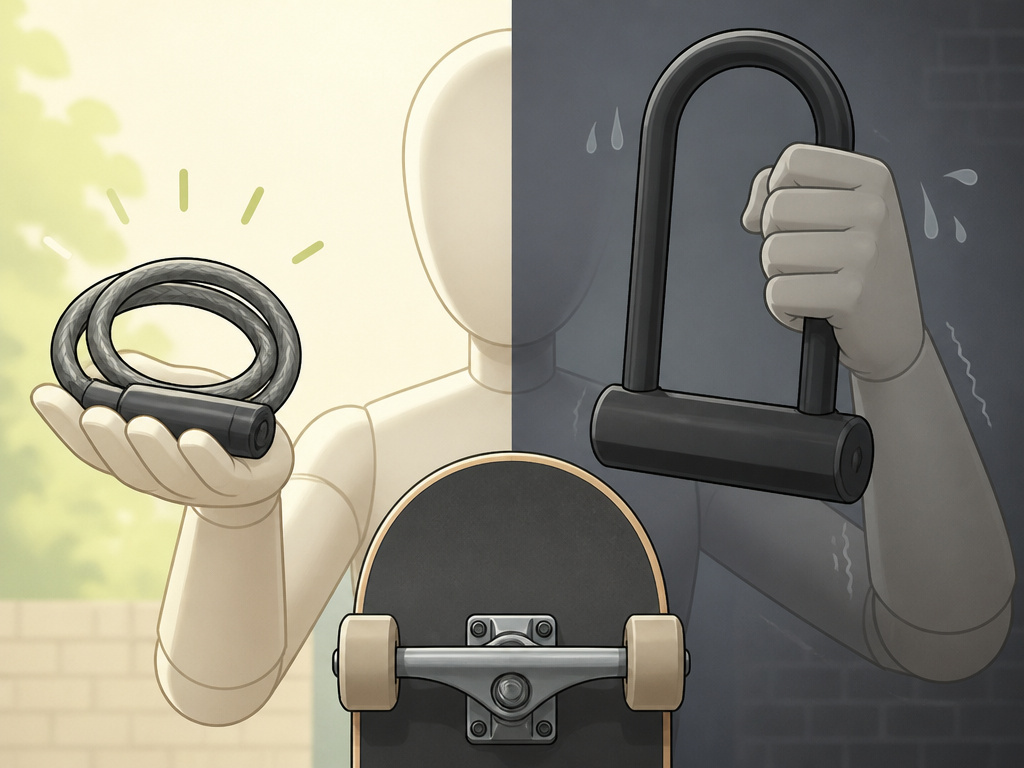
Lock weight is a decision you make every time you leave the house. “Do I want to carry this today?” If the answer is often “no,” the lock stays home and the board is unprotected.
This is the cable lock’s biggest win. A retractable cable like the DaKine Cool Lock coils into a compact pack. You can forget it’s there. A full-size U-lock announces itself with every step. This is why many riders settle for the cable, it’s the lock they’ll actually use.
For the electric skateboard crowd, the equation flips. Your board may already be very heavy, with some models like the Ecomobl M24 reported at 50+ lbs. Adding a two-pound lock to your backpack is negligible. Your priority shifts from minimal carry to maximum security. A heavy chain or U-lock is a logical upgrade.
Think of it as a simple rule: if you dread carrying the lock, you’ll stop carrying it. Buy the most secure lock you won’t leave behind.
Security Level: What Are You Actually Buying?
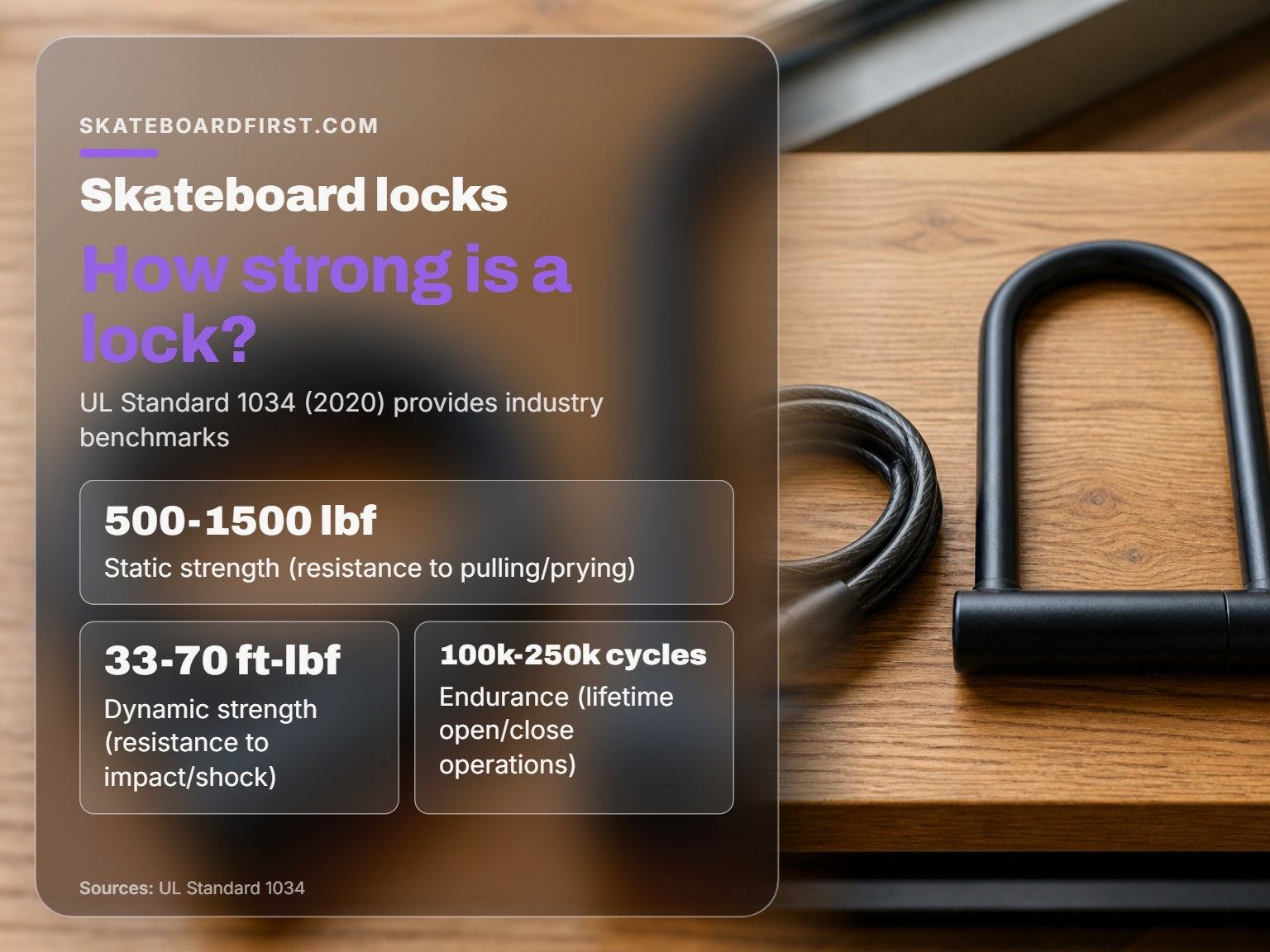
Security isn’t a binary “safe” or “unsafe.” It’s a timeline. How long can your lock delay a thief with basic, then moderate, then professional tools?
A cable fails at the “basic theft” level. A U-lock that meets UL Standard 1034 pushes the thief into “professional” territory, requiring a loud, spark-throwing grinder in a public place. That’s a huge deterrent.
The patents we’ve cited focus on defeating quick, silent theft. US Patent 5179847 describes a device that encompasses the entire truck, making it impossible to remove without first defeating the lock. That’s the engineering ideal. The commercial reality, as seen in forums, is that most theft is opportunistic, which is central to the skateboard lock pros and cons debate. A simple cable raises the bar just enough.
Electric Skateboard-Specific Concerns
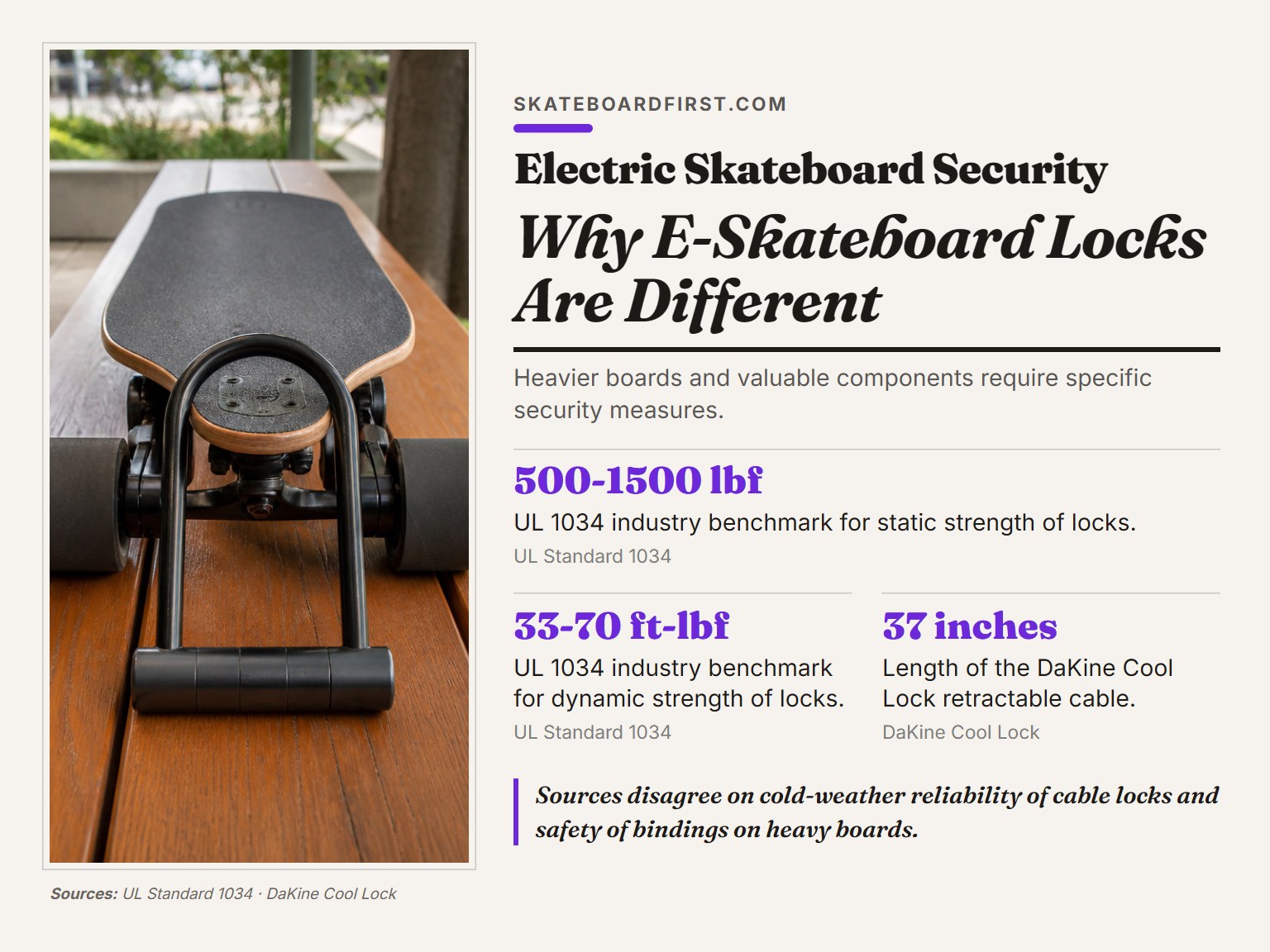
An electric skateboard is a $1,500+ piece of electronics with a battery, motor, and remote. The stakes are higher, and the security needs change.
First, the weight. An Ecomobl M24, as mentioned by Reddit users, has been reported to weigh 50+ lbs, 55 lbs, and 60 lbs. That makes it harder to steal quickly, but also means any crash while locked in with bindings is far more dangerous. Your ankles and knees take the full torque of that weight.
Second, the components. A thief can’t easily resell a distinctive electric board frame, but they can strip it for the battery, motors, and ESC. A lock that only secures the deck doesn’t protect those high-value parts. You need to lock the board in a way that makes accessing the underside difficult.
Third, warranty and insurance. Modifying your board to install a lock could void the warranty, and insurance may have requirements for lock quality.
For electric boards, the best practice is layered security: a heavy-duty U-lock through the deck and a motion alarm on the board itself. It’s about adding sequential hurdles.
Durability and Weather Resistance
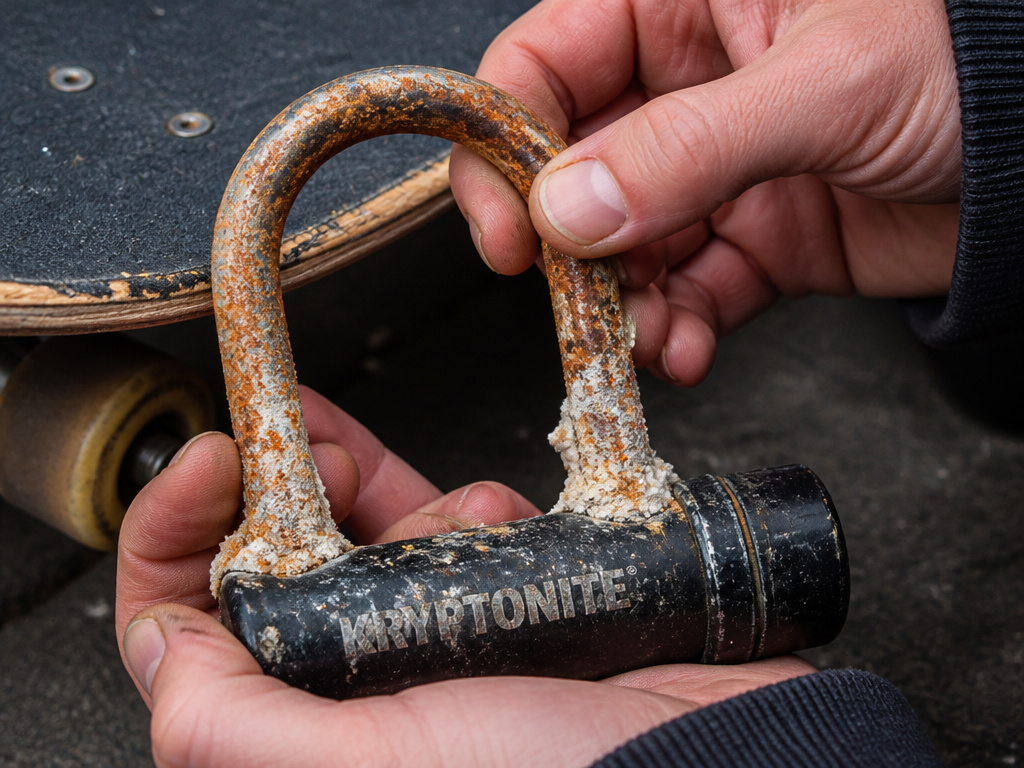
A lock lives a hard life. It bangs around in your bag, gets dropped on pavement, and faces rain, snow, and road salt. How it holds up decides when it fails you.
The UL 1034 endurance rating (100,000 to 250,000 cycles) is a clue. It tests the locking mechanism being engaged and disengaged over and over. A cheap lock might feel fine for a few months, then the combo dial gets sloppy or the key cylinder grinds.
Weather is the silent killer. We’ve covered cold jamming combos. Salt corrosion is slower but just as fatal. It seizes the internal spring of a retractable cable or fuses a U-lock shackle to its body. A lock with a physical key has a different vulnerability, as the keyhole itself can ice over.
Listen to your lock. A gritty feel when turning the key, a hesitant combo dial, a rust spot on the shackle, these are warnings. A lock that fails open is an annoyance. A lock that fails closed is a crisis.
Long-Term Wear on Your Board
This is the hidden con most guides miss. Locking your board isn’t free. It scratches, dents, and stresses the parts you use.
Truck Damage: Looping a cable or chain around the hanger grinds against the axle nut and kingpin. Over time, this wears down the finish and can even bend a thin axle. Metal-on-metal grinding leaves a permanent polished groove.
Deck Damage: A U-lock clamped against the deck’s edge will compress the laminate layers, causing a visible dent. If it’s tight against the grip tape, it can peel the edge up. This is mostly cosmetic, but it hurts resale value.
Mounting Damage: Integrated locks that mount between the truck and deck, like in US Patent 4773239, stress the mounting bolts. Over-tightening to prevent theft can crack the deck’s plywood around the bolt holes.
You can minimize this. Use a soft sleeve around the cable where it contacts the truck. Pad the U-lock jaws with an old piece of grip tape. The goal is security without vandalizing your own gear. A dedicated skateboard backpack with a built-in carry strap can often eliminate the need for a lock altogether on short trips.
Is a skateboard lock worth the money?
The value of a lock depends entirely on your board’s weight and your local theft risk. Patents describe integrated designs that physically secure the trucks, suggesting a higher level of security. User reports on specific cable locks like the DaKine Cool Lock highlight a trade-off: they are portable, but some users note they are heavy or fail in cold weather. The choice depends on the board’s value and the theft risk.
Frequently Asked Questions
Can you actually lock a skateboard?
Yes, but the method matters. You can’t lock a standard board through the wheels like a bike. You must lock through the trucks, either around the hanger or, more securely, through the gap between the truck baseplate and the deck. Specialized shackles from patents are designed to do this.
What is safer, a combination lock or a key lock?
For pure reliability, a key lock is often safer. It has fewer moving parts to freeze or jam. The trade-off is key management, lose the key, and you’re cutting the lock. Combination locks are convenient and key-free but suffer in cold, wet conditions and can be vulnerable to code guessing or physical manipulation. Each type has trade-offs: key locks avoid combo freeze-up but require key management.
What are the downsides of using a smart lock?
The primary downsides are battery dependence, app reliability, and potential over-reliance on tech. If the battery dies, the lock may fail closed. If the app servers are down, you might not be able to open your board. The security of the lock is only as good as its physical shackle; a weak smart lock is no better than a weak traditional lock, just more expensive.
Does using a lock affect my skateboard’s warranty?
Generally, no. Using a lock does not void a manufacturer’s warranty. However, modifying your board to install a permanent, integrated lock (like drilling new holes) likely would. Damage caused by a lock, like a crushed deck or stripped truck, is also typically not covered. Always check your specific warranty terms.
Is it better to just carry my board with me?
Often, yes. This is the ultimate security. No lock is faster to defeat than a board that isn’t there. For quick errands, carrying your board inside eliminates the risk entirely and is the best skateboard storage solution for short stops. A lock becomes necessary only when carrying the board isn’t an option.
Before You Go
The calculus is simple but personal. For a standard board on a brief, in-sight stop, a cable lock is probably enough. For an expensive electric board left unattended, step up to a rated U-lock.
One threshold decides it: if losing your board would ruin your week, don’t rely on a deterrent. Buy a real barrier.
Start with the minimal option, a cheap cable, and see if the anxiety disappears. If it doesn’t, upgrade. The right lock is the one you use every time without a second thought. Everything else is just weight in your bag.
