
How to Store a Skateboard Properly: The 4-Step Checklist
This post contains affiliate links. As an Amazon Associate, we earn from qualifying purchases.
To store a skateboard properly, you need a dry, temperate indoor spot, a pre-storage clean, and the board laid flat, not on its side. For electric boards, the battery must be kept between 40% and 50% charge if stored for over a month, and the storage area must stay within 12°C (10°F) of room temperature.
That 40–50% charge rule is the difference between a board that’s ready in spring and one with a dead, swollen battery. It’s not just about space; it’s about chemistry. The wood, the bearings, and especially the lithium-ion pack in an e-board each have a specific enemy, moisture, grit, and extreme temperatures, and your storage routine is the truce you negotiate with all three. Knowing how to store a skateboard properly is key.
What follows is a four-point checklist for how to store a skateboard properly that works for any board, from a classic deck to a high-tech electric model. We’ll cover the essential location specs, settle the debate on taking your board apart, and outline the one cleaning mistake that damages grip tape.
Key Takeaways
- Store your board horizontally in a dry, indoor space with stable temperature; vertical storage warps the deck over time.
- For storage over one month, an electric skateboard’s battery must be kept between 40% and 50% charge to prevent permanent capacity loss or damage.
- Clean the board with only a damp cloth before storing; Evolve Skateboards warns that most cleaning products contain solvents that can damage the deck and components, while Skateboards.com says gentle soaps can be used for grease or residue.
- Avoid storage in car trunks, garages, or sheds where temperature swings and moisture are highest.
- In humid climates, add a dehumidifier or moisture-absorbing product to your storage area to protect against warping and rust.
The 4-Step Pre-Storage Checklist
Do these four things in order, and your board will thank you. Skip one, and you’ll see the consequence in the spring, a warped deck, seized bearings, or a battery that won’t take a charge.
Step 1: Decide on Disassembly
This is where sources disagree. The manual for the Evolve Hadean electric board doesn’t mention taking it apart, focusing instead on climate and battery charge. Meanwhile, Skateboards.com’s guide insists you should remove the wheels and trucks (“hanger shafts”) before long-term storage to save space and let the deck lie perfectly flat.
Here’s my take: if you’re stacking boards in a closet or a tote, take them apart. It prevents pressure points and saves a surprising amount of room. If you’re using a dedicated wall mount or rack, leave it assembled. The act of disassembly also forces you to inspect each part, a loose kingpin nut or a cracked bearing gets noticed now, not mid-session.
Step 2: Clean It Right (The Solvent Warning)
Wipe the deck, trucks, and wheels with a damp cloth. That’s it. The Evolve Hadean manual is explicit: “Cleaning products may contain solvents that can damage your board. Only use a damp & dry cloth to clean.” I’ve seen grip tape turn gummy and delaminate from a well-meaning wipe with a multi-surface spray. For grease on the trucks or residue on the grip, Skateboards.com allows for “gentle soaps” like Dawn dish soap. A thorough pre-storage clean of your board stops dirt from hardening into an abrasive paste that grinds at your bearings and deck graphic all winter.
Common mistake: Using all-purpose cleaners or wet wipes. The solvents seep into the plywood, weakening the glue bonds, and leave a residue that attracts more grime.
Step 3: Dry It Completely
This isn’t a quick towel-off. Let the board sit at room temperature for a few hours, especially if you used any water near the bearings or truck axles. Any lingering moisture is an invitation for rust in the bearings and slow warping in the maple plies. If your board got caught in the rain, our guide on how to dry it after rain has the specific steps to prevent water damage.
Step 4: Charge State Check (Electric Boards Only)
If you have an electric skateboard like the Evolve Hadean, plug it in and get the battery to between 40% and 50%. The manual states this is critical for any storage period over one month. A full charge left for months causes permanent capacity loss. A near-dead battery can drop to an “unrecoverable voltage.” Set a reminder on your phone, check the remote’s display, and hit that sweet spot. It’s the single most important thing you can do to extend its life.
Where (and Where Not) to Put Your Board
The manuals from Evolve, Decathlon, and Skate Labs agree on the what but differ slightly on the why.
The Ideal Spot
A closet interior wall, under your bed, or a dedicated shelf in a climate-controlled room. The Evolve manual specifies the area must be within 12°C (10°F) of room temperature. Decathlon’s advice is simpler: “somewhere dry that’s neither too hot nor too cold.” The common thread is stability. Wood and metal expand and contract with temperature swings; that repeated stress fatigues the materials. A consistent room-temperature environment is perfect.
The Banned Zones
All sources blacklist the same places:
- Car Trunks & Garages: Called out by Decathlon and Skateboards.com. Summer turns them into ovens; winter makes them freezers. The temperature can swing dramatically.
- Sheds & Basements: Often damp and poorly insulated. Humidity warps wood and rusts steel bearings faster than cold alone.
- Direct Sunlight: Fades your deck graphic and, over many hours, can heat the wood unevenly, creating subtle warps.
For apartment dwellers, this list can feel limiting. That’s where creative skateboard storage solutions come in, wall mounts, under-bed racks, and vertical stands that keep the board in the living space but out of harm’s way.
| Storage Location | Risk | Timeline for Damage |
|---|---|---|
| Car Trunk | Extreme heat/cold, humidity | Warping over time |
| Garage (uninsulated) | Moisture, temperature swings | Bearing rust over time |
| Damp Basement | High humidity, mold risk | Deck warp & mold on grip tape over time |
| Direct Sunlight (window) | UV fade, uneven heating | Graphic fade and potential warp over time |
Electric Skateboards: The Battery Exception

Storing an electric skateboard isn’t just a storage question; it’s a battery maintenance protocol central to how to store a skateboard properly. The rules for a standard board apply, but they’re superseded by the battery’s needs.
The Critical Charge Window
The Evolve Hadean manual is unambiguous: for prolonged storage of “1 MONTH OR MORE,” keep the battery “BETWEEN 40 AND 50% charge.” This isn’t a suggestion, it’s the voltage range where lithium-ion cells are most stable. Storing at 100% charge stresses the chemistry, leading to permanent capacity loss. Storing near 0% risks the voltage dropping so low the battery’s protection circuit permanently disables it. A battery maintained at 40–50% will lose less capacity over time; one stored full can suffer permanent capacity loss.
Climate Control is Non-Negotiable
The manual also warns to “only charge the battery indoors in dry spaces that are not excessively hot or cold (within 12°Celsius / 10°F of room temperature).” A hot garage accelerates the battery’s slow self-discharge and degrades the cells. A freezing shed can permanently damage the electrolyte inside. Your living area is the battery’s best friend. For a complete guide on proper storage for electric boards, we’ve covered the specifics of climate control and long-term care.
Where this goes sideways: Leaving the charger plugged in after the battery is full. The Evolve manual warns against this. The charger may stop feeding current, but the board’s electronics stay active, generating a tiny amount of heat against the battery pack for weeks on end.
Horizontal vs. Vertical: The Warp Factor

Store it flat. Every source that mentions orientation says the same thing. Skateboards.com puts it bluntly: “Don’t store your skateboards vertically, as this can cause them to warp over time.”
The Physics of a Warped Deck
A skateboard deck is a laminated spring. Storing it on its tail, leaning against a wall, puts uneven pressure on the concave. Over months, gravity pulls the nose or tail downward, creating a permanent twist or a “banana” bend. That warp kills pop and makes the board feel unpredictable underfoot. Laying it flat distributes its weight evenly, letting the deck keep its intended shape.
The Rack Exception
If you’re using a commercial skateboard rack or a wall mount that cradles the board securely at two points, like under the trucks, vertical is fine. The rack supports the deck at its strongest points, preventing flex. This is the method recommended for display and quick access. The key is secure support; a board jammed haphazardly into a corner is asking for trouble.
Protecting Your Board’s Graphic During Storage
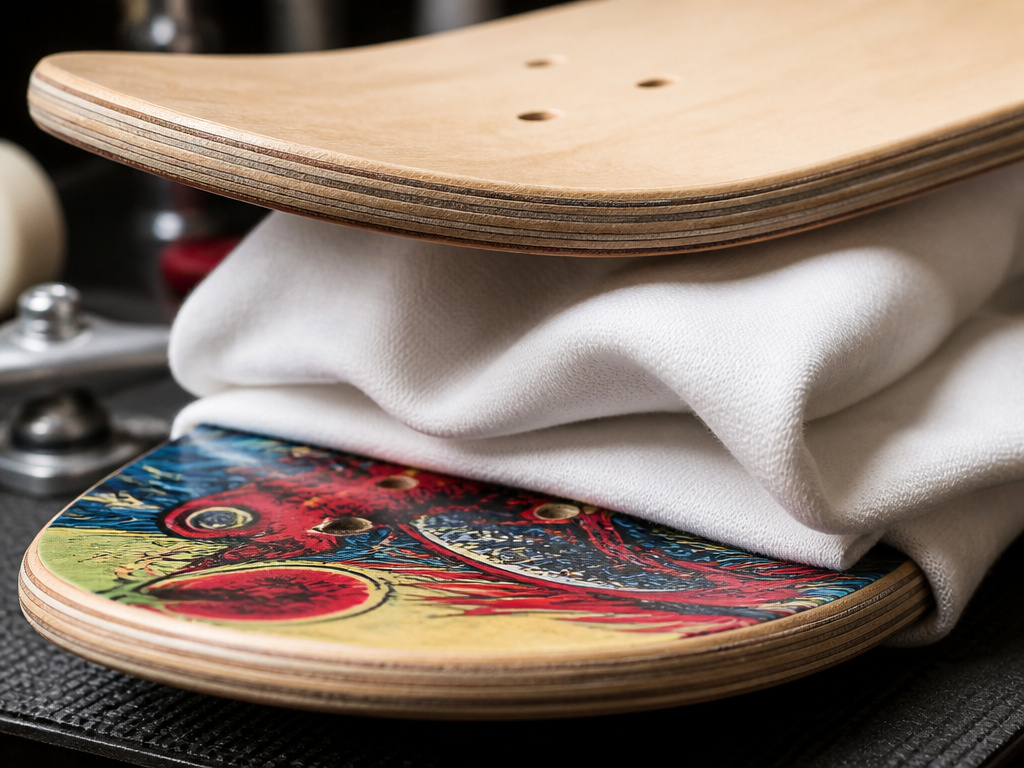
The artwork on your deck is just a layer of ink and laminate. It’s durable, but it’s not armor.
The Two-Contact-Point Rule
When stacking decks or laying a board flat, make sure only the bare wood, or the high-quality, clear laminate, touches the surface. If you’re stacking multiple disassembled decks, place a soft, clean cloth or a sheet of butcher paper between them. This prevents the gritty underside of one deck from microscratching the graphic of the deck below. For wall mounts, choose hooks or racks with padded, non-abrasive contact points.
Sunlight is Your Graphic’s Worst Enemy
UV rays break down ink molecules. A deck left in a sunny window will have a faded, ghostly graphic in a matter of months. This is another reason the “dry, indoor space away from direct sunlight” rule is so important. It preserves both the function and the form.
Seasonal Storage & Reactivation
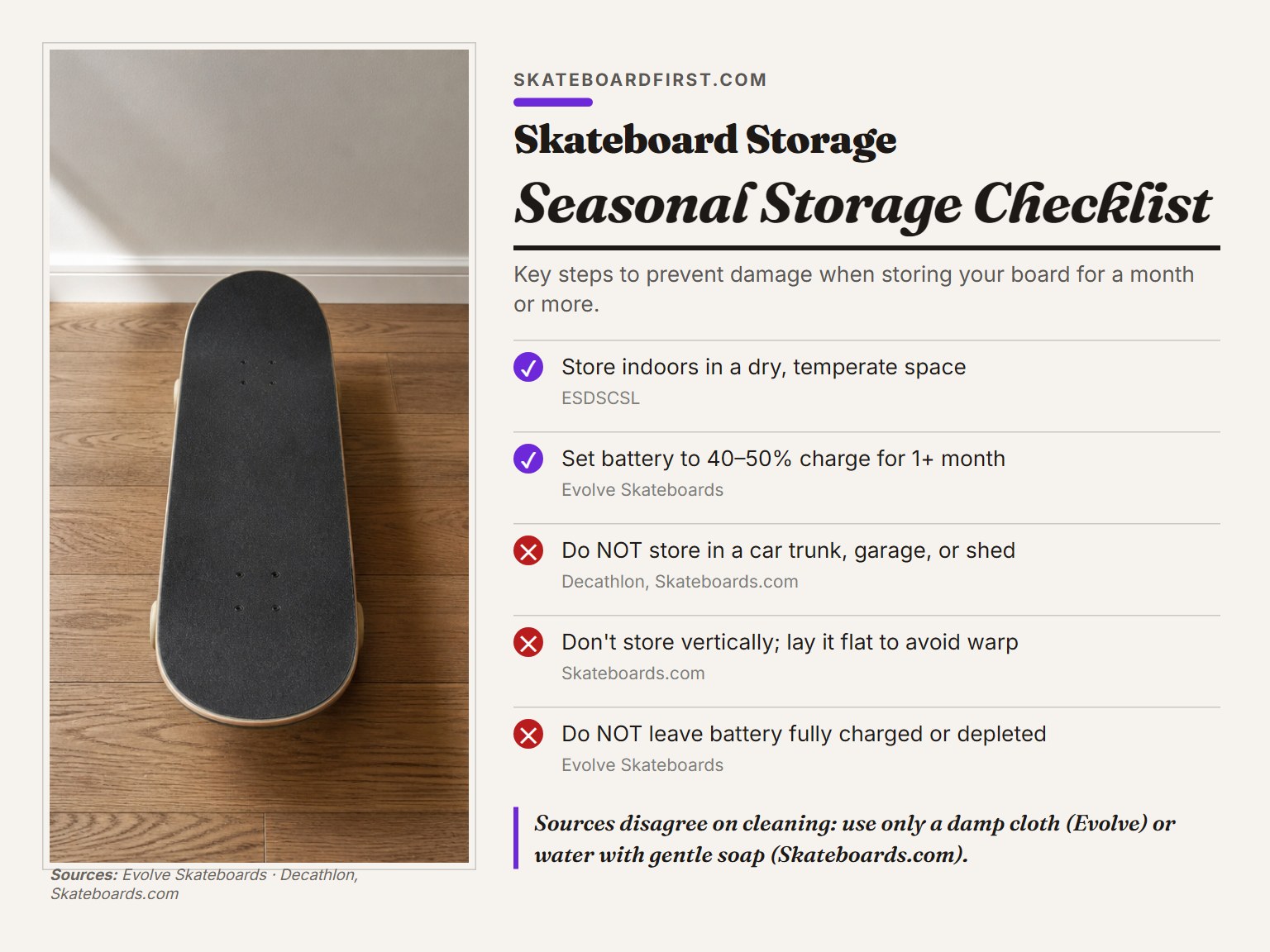
Putting the board away for winter? A few extra steps ensure it’s session-ready when the sun returns.
Before You Store:
- Perform a full routine skateboard cleaning.
- Loosen your trucks a quarter-turn. This relieves constant pressure on the bushings, preventing them from taking a “set” and becoming less responsive.
- For electric boards, confirm the battery is at 40–50% charge.
When You Take It Out:
- Re-tighten Trucks: Tighten the kingpin nut back to your preferred setting. Bushings may have relaxed, so ride for ten minutes to let them warm up and reshape before fine-tuning.
- Spin Test Bearings: Give each wheel a flick. A gritty, slow spin means moisture got in. You might need to clean and lubricate the bearings before riding.
- Check for Warp: Lay the board on a flat floor. Rocking or a visible gap under the middle means it warped. A slight warp might still be rideable, but it will feel off.
- Electric Board Power-Up: Turn on the remote and board. Check the battery percentage. If it’s dropped significantly from your 40–50% set point over storage, the battery may have a higher self-discharge rate, note it for future reference. Take it for a gentle test ride to wake the electronics up.
How to stack skateboard decks

For flat storage, you can stack decks on top of each other. Remove the wheels and trucks first. Place each deck with its bottom side facing down. This method keeps the decks lying flat, which helps prevent warping. Always store stacks in a dry, indoor area where the temperature stays consistent. Avoid places like a hot car trunk, a garage, or a damp shed, as heat, cold, and moisture will weaken the wood over time.
Using skateboard racks and wall hooks
Commercial racks or wall hooks offer a space-saving way to store your board. When using a rack, you typically do not need to remove the wheels before placing the skateboard on it. However, you should still avoid hanging your board in problematic spots. Keep it away from direct sunlight, heaters, or any area prone to temperature swings. A dry, indoor wall in a living space is a much better choice than a garage or car trunk.
DIY skateboard storage ideas
If you’re building your own storage, the key principles are a dry location and stable temperature. Your creation should keep the board horizontal, not vertical, to prevent warping. You could build a simple shelf or a padded cradle. Wherever you place it, ensure the spot is indoors, away from windows, and not near heat sources like radiators. For electric boards, also ensure the storage area is suitable for charging if needed, meaning it’s dry and within a normal room temperature range.
Frequently Asked Questions
Should I take my skateboard apart for storage?
It depends on your space. For long-term storage in a closet or tote, removing the wheels and trucks keeps the deck lying flat and saves space, reducing the risk of warping. If you’re using a wall rack or mount, you can leave it assembled. The act of disassembly also gives you a chance to inspect for loose hardware or worn parts.
Can I store my skateboard in the garage?
You should not. Garages are typically subject to large temperature swings and higher humidity, both of which can warp the wooden deck and rust the bearings. Sources from Decathlon, Skateboards.com, and Evolve Skateboards all specifically warn against garage storage.
How do I store an electric skateboard for the winter?
Follow all the standard storage rules, plus one critical battery step: ensure the battery charge is between 40% and 50%. Store the board in a dry, temperature-stable indoor room (within 12°C/10°F of room temperature). Do not leave it plugged in. This protocol prevents permanent battery capacity loss.
How can I protect my skateboard’s graphic?
Keep it away from direct sunlight to prevent UV fade. When stacking decks, place a soft barrier like a cloth between them to avoid scratches. Use storage racks with padded contact points. The main enemy is abrasion during handling, so be mindful when moving it in and out of storage.
The Bottom Line
Storing a skateboard properly isn’t just about tidiness; it’s preventative maintenance. Get four things right: a dry, temperate spot indoors; a solvent-free clean; a flat orientation; and for electric boards, that 40–50% battery charge. That’s the entire game.
Everything else, fancy racks, disassembly, graphic protection, is optimization. Start with the four-point checklist. If your storage spot passes the garage/trunk/shed test, you’re already ahead of most. The goal is to pull your board out in a month or six and have it feel exactly like it did when you put it away: ready to roll.
