
Skateboard Tool Alternatives: What Actually Works
This post contains affiliate links. As an Amazon Associate, we earn from qualifying purchases.
You don’t need a dedicated skateboard tool to assemble or maintain your board. A basic household wrench set, a screwdriver, and an Allen key in the right sizes can handle every job. The standard skateboard sockets are 9/16″, 1/2″, and 3/8″.
That’s the mechanical truth. A skate tool is just a convenient bundle of those three sockets plus a screwdriver. But using the wrong tool or the wrong size rounds off nuts, strips bolts, and can leave you stuck mid-session, which is why it’s useful to know about skateboard tool alternatives.
This guide walks through the exact sizes you need from your toolbox, the step-by-step for using them safely, and the creative hacks that work when you have nothing else, all central to the skateboard tool alternatives question. We’ll also cover when the hassle of alternatives makes a $15 skate tool the smarter long-term play.
Key Takeaways
- The three critical socket sizes are 9/16″, 1/2″, and 3/8″. Mismatch these, and you risk rounding the nuts.
- An adjustable wrench and a #2 Phillips screwdriver can handle most skateboard assembly and adjustments if you’re careful with fit.
- Using pliers or the wrong size wrench will damage hardware within a few uses, turning a simple wheel swap into a bolt-extraction project.
- For inline skates like those from Rollerblade, a 4mm hex key is used for axle and frame bolts, not a 1/2″ socket.
- A dedicated skate tool becomes worth it after several DIY sessions, when the time and frustration saved pay for the tool itself.
The 3 Socket Sizes Every Alternative Must Match
Every nut and bolt on a standard skateboard is built to one of three measurements. Get these wrong, and your wrench will slip, leaving a rounded, useless nut.
The 9/16″ socket fits the kingpin nut, the large bolt in the center of your truck that controls turning tightness. The 1/2″ socket fits the axle nuts that hold your wheels on. The 3/8″ socket fits the nuts for the mounting hardware that attaches the trucks to the deck. These sizes are confirmed across manufacturer listings from CCS, SkatePro, and others.
Using a 12mm wrench on a 1/2″ axle nut feels like it fits, but that 0.3mm difference is enough for the wrench to chew the corners off the nut. By the third time you tighten it, the nut is round and you can’t get the wheel off without cutting it.
They’re not perfect, but they’ll work in a pinch if you apply pressure straight down. A slanted pull guarantees a slip.
Here’s the mismatch that breaks things:
| Skateboard Part | Correct Socket | Common Wrong Tool | What Happens |
|---|---|---|---|
| Truck Kingpin Nut | 9/16″ | 14mm or 15mm Wrench | Wrench slips, rounds nut, truck becomes unusably loose or seized. |
| Wheel Axle Nut | 1/2″ | 13mm Wrench or Pliers | Nut strips. Wheel wobbles or won’t come off. Bearing seat gets damaged. |
| Mounting Hardware | 3/8″ | 10mm or 11mm Wrench | Bolt head strips. Truck rattles loose, risking deck damage. |
The takeaway is simple: measure first. Don’t guess.
What You Already Own: The Household Tool Checklist
Open your toolbox. You likely have what you need.
A 3/8″ drive socket set is the gold standard. The 9/16″, 1/2″, and 3/8″ sockets are common in any mechanic’s set. You’ll need a ratchet or driver handle to go with them. This is the closest you’ll get to a professional skate tool without buying one.
An adjustable wrench (Crescent wrench) can cover all three socket sizes by dialing in the jaw width. The risk is that it doesn’t grip as firmly as a fixed socket, increasing the chance of slippage if you don’t keep the jaws tight. Always pull straight.
A combination wrench set with open-end and box-end wrenches is ideal if you have the exact sizes. The box-end provides full contact, preventing rounding.
For screws, a #2 Phillips head screwdriver handles all mounting hardware. Many trucks use an Allen key (hex key) for the bolt head instead; the size varies. The hardware pack that came with your trucks often includes the correct key.
Common mistake: Using a screwdriver as a pry bar to pop bearings out. The blade snaps or slips, stabbing your palm. The bearing stays put.
If you have these tools, you’re set. The process is just slower than with a dedicated skate tool, requiring you to swap tools for each step.
Step-by-Step: Using a Wrench and Screwdriver
We’ll build a board from scratch with common tools. The goal is no damaged parts.
1. Attach the Trucks.
Place the truck baseplate against the deck, lining up the holes. Insert the mounting bolts from the top of the deck. Underneath, thread on the nuts by hand until they’re finger-tight. Now, hold the bolt head steady with your Phillips screwdriver or Allen key. Use your 3/8″ socket or wrench to tighten the nut. Go firm, but don’t crank. Overtightening pulls the bolt head through the deck’s plywood.
2. Mount the Wheels.
Slide a bearing onto the truck axle. Push the wheel onto the bearings. Add the second bearing. Thread the axle nut on by hand. Use your 1/2″ socket or wrench to tighten. The wheel should spin freely but not wiggle. If it’s too tight, the bearing seizes. Too loose, and the wheel develops a dangerous wobble.
3. Adjust the Trucks.
The kingpin nut is under the baseplate. Use your 9/16″ socket or wrench to turn it. Tighten for stability, loosen for easier turning. Adjust a quarter-turn at a time, then test.
The whole job takes longer with separate tools due to swapping. A skate tool is significantly faster by keeping everything in one hand.
Creative Hacks When You Have Nothing
No toolbox? These get you out of a jam. They’re last resorts.
The Coin Trick. A thick quarter or similar coin can fit over a 1/2″ axle nut. Use the edge of the coin in the wrench’s jaw as a makeshift socket. It’s sloppy and can damage the coin and nut, but it works once or twice to tighten a wheel that’s about to fall off.
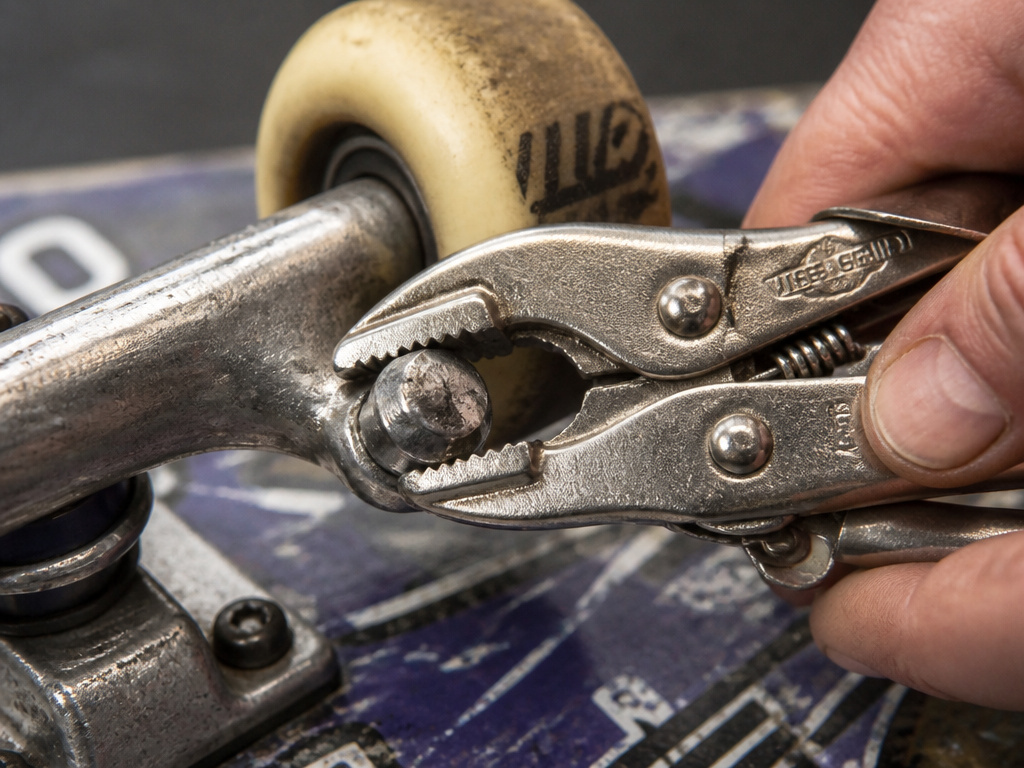
Pliers. Locking pliers (Vise-Grips) can clamp onto a rounded or standard nut. They will mar the metal, so consider the hardware sacrificial. Never use regular slip-joint pliers; they guarantee a round nut.
A Leather Belt. In a true emergency, a belt looped around the truck hanger can give you the force needed to loosen a stuck kingpin nut if you have no wrench at all. It’s a grip aid, not a tool.
I’ve used pliers for years when I was a kid and didn’t know better. It works, but you replace your hardware twice as often. Every rounded nut is a lesson.
Where Alternatives Fail (And It Costs You)
Household tools are a bridge, not a permanent solution.
The first failure is time. Swapping a wrench for a screwdriver for an Allen key back to a wrench for a simple truck adjustment eats up your session. A skate tool keeps you rolling.
The second is damage. Even the right size open-end wrench can slip if you’re tired or working at a weird angle. That slip strips the nut. Now you need to learn how to remove stripped skateboard bolts, which is a whole new, frustrating project.
The third is portability. You’re not carrying a wrench set to the skatepark. A loose truck mid-session means you’re done for the day unless you have a pocket tool.
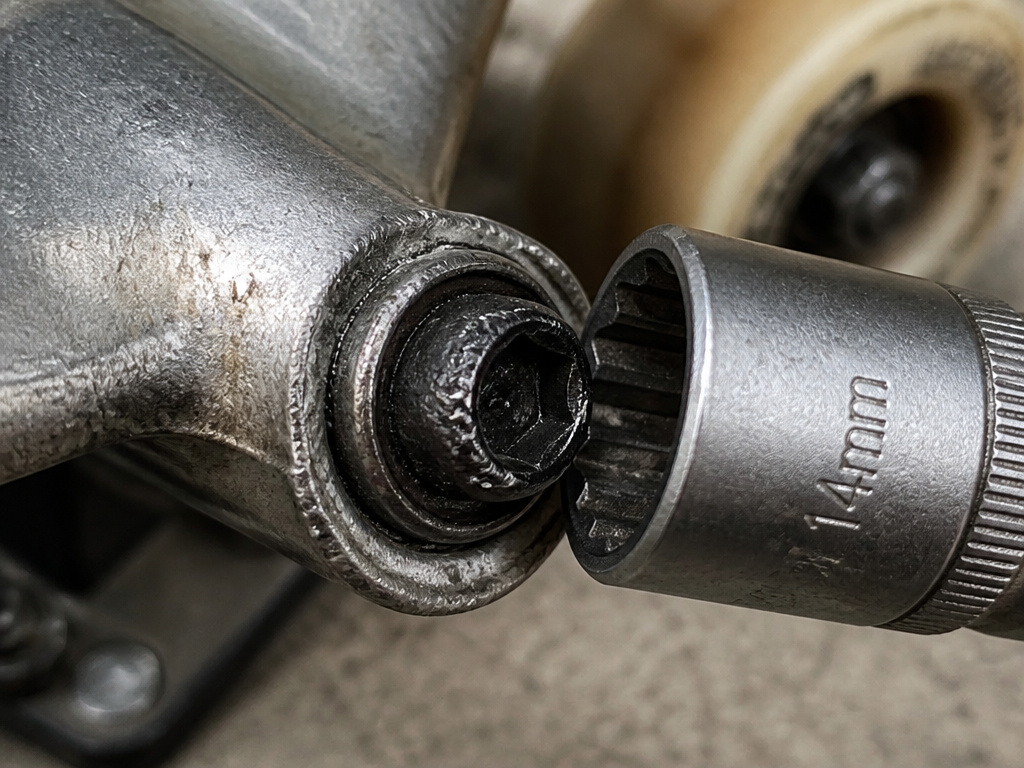
Where this goes sideways: Using a metric socket on an imperial nut because it’s “close enough.” The soft steel of the skateboard nut deforms to the socket, not the other way around. After two uses, the socket no longer grips anything properly, ruining both the nut and your tool.
A dedicated skate tool like the CCS Skateboard Tool or the SkatePro All In One is designed for this exact force and angle. The sockets are hardened steel and fit perfectly. That precision is what you’re buying.
Skate Tool vs. Household Tools: The Real Trade-Off
Is buying a skate tool worth it? We’ll examine the details.
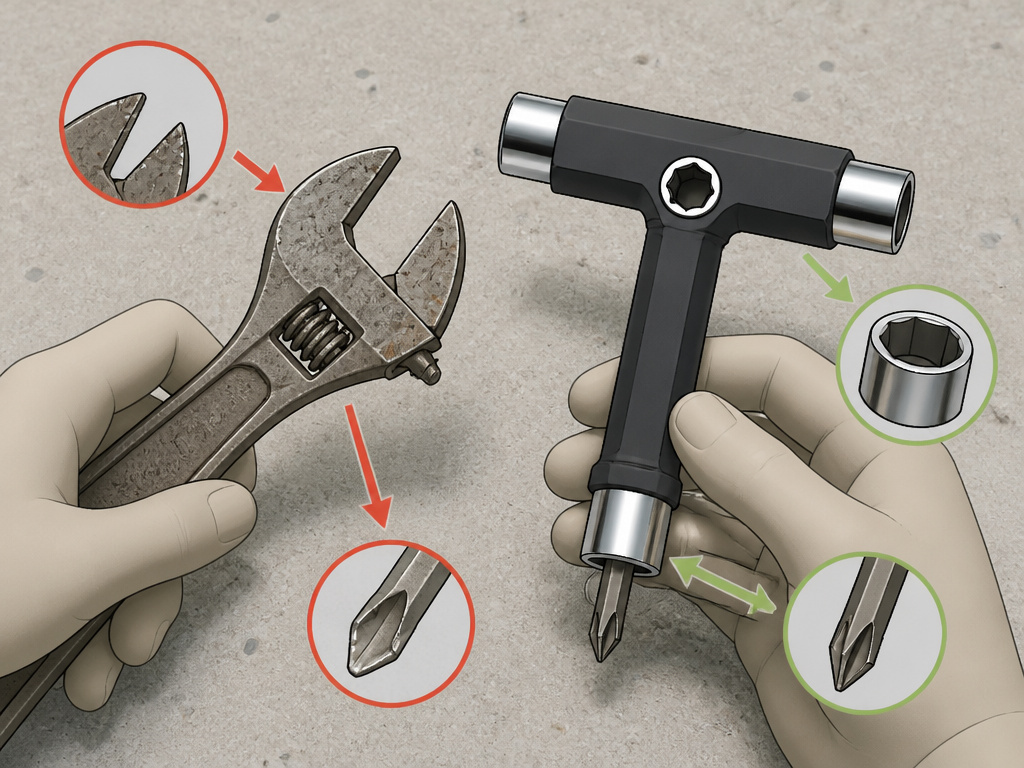
A basic T-tool costs between $10 and $20. For that, you get the three sockets, a Phillips screwdriver, and often an Allen key, all in a package the size of a phone.
Your household tools are “free” if you own them. But using them on your skateboard wears them down. Wrench jaws spread, screwdriver tips deform. You’re diverting the life of general-purpose tools for a specific job.
The decision point comes after several full assemblies or adjustments. By then, the time you’ve spent juggling tools, the frustration of a slipped wrench, and the risk of stripped hardware outweigh the tool’s cost. For a skater who adjusts their setup weekly, a skate tool pays for itself in the first month.
Consider specialized needs. Some, like SkatePro and CCS (via the US20170021487A1 patent), advocate for tools with axle re-threaders and bearing press removers as essential for certain repairs. Others, like the US6279434B1 patent and standard tools, consider a simple T-tool with sockets and a screwdriver sufficient as a universal solution.
| Scenario | Household Tools | Dedicated Skate Tool | Verdict |
|---|---|---|---|
| One-time board assembly | Works fine. Slow but doable. | Faster, zero risk of damage. | Tools are fine. |
| Weekly truck/wheel adjustments | Inconvenient, high risk of wear/stripping. | Quick, precise, preserves hardware. | Skate tool wins. |
| On-the-go park repair | Impractical to carry a wrench set. | Fits in pocket, ready instantly. | Skate tool essential. |
| Fixing stripped axle threads | Impossible without a 5/16″ die. | Possible with a tool like the CCS Rethreader Y-Tool. | Skate tool only. |
For most people, the path is clear: use household tools for your first build or emergency fix, then move beyond skateboard tool alternatives. Then order a skate tool. It’s a small investment that pays off in saved time and saved hardware.
The Special Cases: Inline Skates and Electric Boards
Not everything on wheels uses the same standards.
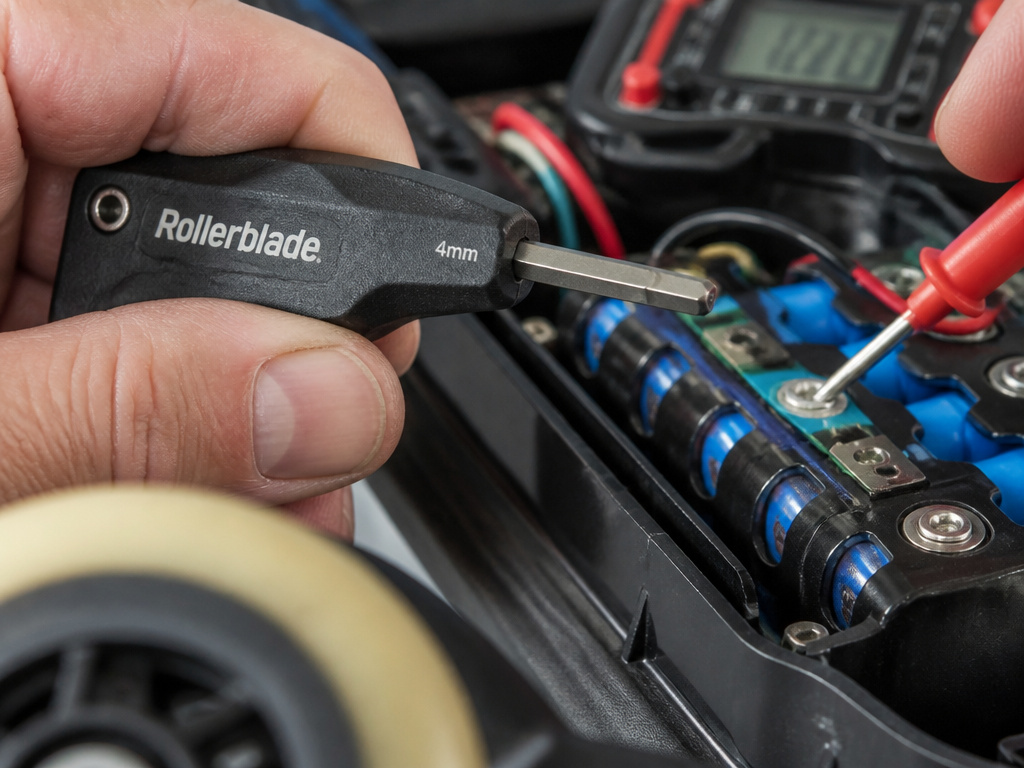
Inline skates, like those from Rollerblade, often use a 4mm hex key for axle bolts, not a 1/2″ socket. The Rollerblade Bladetool includes a 4mm hex key for this purpose. Using a skateboard tool on inline skates simply won’t work.
Electric skateboards add another layer: battery maintenance. If you’re working on an e-board, following the manufacturer’s storage guidelines is part of tool safety. For example, Evolve manuals state you should store lithium-ion batteries at 40-50% charge and avoid temperatures below -10°C (14°F) or above 60°C (140°F). A regular skate tool doesn’t help with that, but knowing it prevents you from storing a board with a full charge in a hot garage, which is a maintenance task of its own.
Also, some truck brands break the mold. Grind King trucks are noted by CCS as not working with their standard tool, meaning you might need a different size. Always check your specific hardware.
Frequently Asked Questions
What can I use instead of a skate tool?
You can use a combination of an adjustable wrench (for 9/16″, 1/2″, and 3/8″ nuts), a #2 Phillips screwdriver, and the Allen key that came with your trucks. A 3/8″ drive socket set with those three sizes is the best household alternative.
Do you really need a skate tool?
No, you don’t need one. You need the correct size tools. A skate tool is just those specific tools combined into one convenient, portable package. For casual use, separate tools work. For regular skating, a skate tool is a worthwhile upgrade.
What size wrench is used for skateboards?
The three essential wrench/socket sizes are 9/16″ for the truck kingpin nut, 1/2″ for the wheel axle nut, and 3/8″ for the mounting hardware nuts. An adjustable wrench can be set to each of these sizes.
Why is a skate tool better than regular wrenches?
Skate tool is better because it’s faster (no tool swapping), perfectly fits the hardware (prevents rounding), and is portable (fits in your pocket for park repairs). Regular wrenches can work but are less convenient and more likely to cause damage over time.
Before You Go
You can absolutely put a board together with a wrench from the garage. Millions have.
But here’s the threshold: if you find yourself adjusting your setup more than twice a month, stop borrowing from the household toolbox. The minor hassle and constant risk add up. A single stripped kingpin nut can end your session and cost more in replacement trucks than a basic skate tool.
Invest in a T-tool like the CCS standard. Start with a simple T-tool like the CCS standard. It works with all trucks except Grind Kings and covers the fundamentals. Keep it in your skate bag. That one habit—checking your hardware before you roll out—saves more headaches than any hack ever will.
Your first upgrade shouldn’t be fancier bearings or softer wheels. It should be the tool that allows you to install and adjust all of them properly.
