
Skateboard Wheel Hardness Chart: How Durometer Works
This post contains affiliate links. As an Amazon Associate, we earn from qualifying purchases.
Skateboard wheel hardness is measured on the Shore durometer scale, most often the A scale, where numbers like 78A (soft) to 101A (hard) indicate a wheel’s grip and speed. The right choice is about matching the durometer to the surface you skate, not finding a single best number. For smooth park concrete, wheels between 97A and 101A offer speed and slide control. For rough pavement or cruising, softer wheels between 78A and 90A absorb vibration and provide a smoother, grippier ride.
That range, 78A to 101A, covers almost every wheel you’ll see. The numbers printed on the side predict how the board will feel under your feet on day one and how it will wear down by month three. A mismatch here is why beginners on rough roads with pro-level 101A wheels quit after thirty minutes of numb feet, and why park skaters on soft cruiser wheels can’t slide out of a basic trick.
What follows is a breakdown of how durometer actually works, a skateboard wheel hardness chart that translates numbers into real-world performance, and the one rule for choosing hardness that most guides skip.
Key Takeaways
- Sources disagree on the maximum reading for the Shore A durometer scale: the Exploratorium states it runs from 0 to 100, while instrument manufacturer Checkline makes a tester that measures up to 120A for modern ultra-hard wheels.
- Street and park skating typically uses wheels in a hard range; the CCS Buyers Guide states they are harder than 98A, while SkatePro recommends 97A to 101A.
- Cruising and longboarding uses softer wheels; the CCS Buyers Guide states cruising wheels are usually around 78A but can be anywhere between 78A and 90A, while BASF notes comfortable longboard wheels usually come between 78 and 90 A.
- Wheel hardness directly trades grip for speed, softer wheels deform more on impact, creating more friction and a smoother, slower ride.
- Always check the printed durometer before buying; a cool graphic often hides a 101A rating that will buzz your feet numb on rough ground.
The Durometer Scale: A, B, and the 101A Debate
You’ll see two letters after the number on a wheel: A or B. The Shore A scale is the standard. It measures a material’s resistance to indentation, basically, how much a weighted needle sinks into the urethane. The scale runs from 0 to 100. A higher number means a harder wheel.
Wheel durometer is most commonly measured using the “A” scale, the same one used to determine bushing hardness. The A scale is a ranking system of numbers followed by the letter “A.” The larger the number, the higher the durometer, and the harder the wheel.
This seems straightforward until you see a wheel labeled 101A. If the A scale tops out at 100, what does 101A mean? Sources disagree. The Exploratorium’s educational resource states the Shore “A” durometer reads from 0 to 100. Omni Skateboards argues that “the wheels that advertise a 101A durometer is incorrect,” explaining the D scale begins where the A scale stops.
Meanwhile, instrument manufacturer Checkline sells a durometer tester, the RX-1600-A120, with a dial that reads from 20 to 120 on the ‘A’ scale, created because “wheels with hardness ratings over 100 A became available.” The practical reality matters more than the theory. Manufacturers make wheels harder than what a standard Type A durometer can measure, and they label them 101A or 102A. Whether it’s technically correct per ASTM D2240 matters less than the fact you can buy them and they perform as advertised, extremely hard.
Then there’s the B scale, used almost exclusively by Bones Wheels. Their conversion is simple: the B scale reads 20 values below the A scale. So Bones 81B wheels are equivalent to 101A on the standard scale. Don’t let it confuse you; it’s just their way of marking the same hardness range.
| Scale | Typical Range | Used By | Key Note |
|---|---|---|---|
| Shore A | 78A – 101A+ | Most brands (Spitfire, Ricta, OJ) | The industry standard. Values above 100A measured with extended-scale testers. |
| Shore B | e.g., 81B | Bones Wheels | Converts to A scale by adding 20 (81B = 101A). |
| Shore D | 50D – 75D | Used for very hard wheel cores | Sometimes used for ultra-hard skate wheels; follows the A scale. |
How Hardness Changes Your Ride: Grip vs. Speed
Hardness isn’t an abstract rating. It dictates a direct, physical trade-off between grip and speed. When your weight presses down on a moving wheel, the urethane where it meets the ground flattens slightly, this is called deformation. A softer wheel deforms more. That larger contact patch grips the pavement better, smoothing out bumps and cracks. But all that squishing and rebounding steals energy, which slows you down.
A harder wheel barely flattens. It maintains a smaller contact patch, which creates less friction with the ground. Less friction means more speed. It also means less grip, which is why hard wheels slide predictably for powerslides and board slides. The downside is a harsh, buzzy ride where you feel every pebble.
I learned this the hard way with a set of 101A wheels I bought for the graphic. On the smooth concrete of my local park, they felt fast and responsive. On the cracked asphalt street outside my house, my feet buzzed like they’d fallen asleep after ten minutes. I spent an evening loosening and tightening my trucks, convinced the problem was there. The real culprit was the durometer number I’d ignored.
Where this goes sideways: Choosing wheels for the graphic and ignoring durometer. A harsh, vibrating ride on rough ground has nothing to do with your truck tightness and everything to do with a too-hard wheel.
The effect is immediate. You don’t need to break wheels in to feel the difference between 78A and 101A. The first push tells you everything.
Skateboard Wheel Hardness Chart
This skateboard wheel hardness chart translates durometer numbers into the skating styles they’re built for. Remember, these are general ranges, a 99A wheel from Spitfire might feel different than a 99A wheel from another brand due to urethane formula secrets.
| Durometer (A Scale) | Category | Best For | Feel & Performance |
|---|---|---|---|
| 78A – 87A | Very Soft | Cruising, longboarding, rough pavement | Maximum grip and shock absorption. Smooth, quiet, slower. Ideal for beginners on uneven surfaces. |
| 88A – 95A | Soft/Medium | All-terrain cruising, smoother streets | Good grip with better speed retention than very soft wheels. A versatile middle ground. |
| 96A – 99A | Hard | Street skating, technical park skating | The modern standard for street/park. Offers a balance of speed, slide control, and enough grip for confidence. |
| 100A – 101A+ | Very Hard | Smooth skateparks, bowls, advanced street | Maximum speed and slide. Minimal grip and vibration dampening. Harsh on anything but perfect concrete. |
SkatePro states the most common size range for skateboard wheels is about 52-56 mm, and these sizes pair with the durometers above. A 54mm 99A wheel is the default for a reason, it’s a solid middle ground that works on many surfaces.
Matching Hardness to Your Skate Style
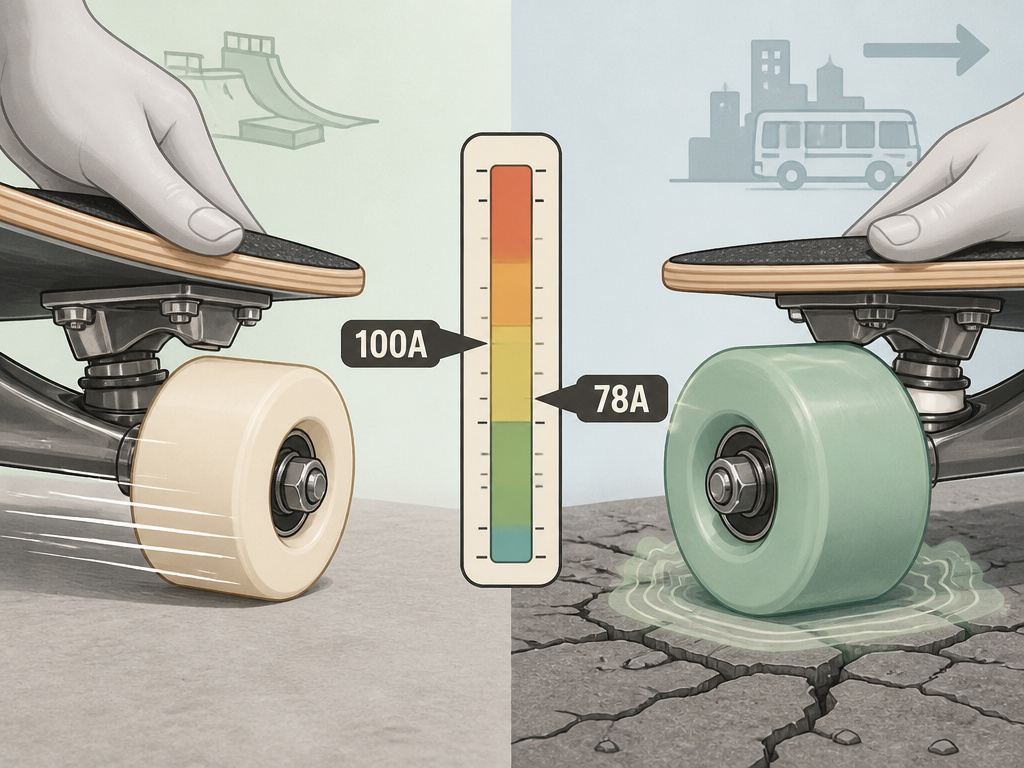
Your skating style dictates your ideal durometer range more than any other factor. We can examine the recommendations, which come directly from the manufacturer and retailer guides.
For Street and Park Skating (97A to 101A)
Retailer SkatePro specifies that “skateboard wheels for street should have a hardness rating of 97A to 101A.” The CCS Buyers Guide notes that “almost all street and transition wheels are harder than 98A.” This is the performance sweet spot. Wheels in this range are fast, they slide predictably for grinds and powerslides, and they offer enough feedback for precise control. Brands like Spitfire Formula Four (99A) and Bones STF (100A) dominate here for a reason. If you’re learning ollies and kickflips on decent pavement or skating at a smooth park, start here.
For Cruising, Commuting, and Longboarding (78A to 90A)
If your primary goal is rolling from point A to B over sidewalks and roads, softer is better. The CCS Buyers Guide states “cruising wheels are usually around 78A, but can be anywhere between 78A and 90A.” BASF’s science article agrees, noting “comfortable longboard wheels usually come between 78 and 90 A.” These wheels absorb vibrations, roll quietly over cracks, and provide a stable, grippy platform. Popular picks in this range include Ricta Clouds (78A, 86A, 92A) and OJ Hot Juice wheels.
What About Inline Skates and Longboard Specifics?
Inline skate wheels often live in the 82A to 90A range for a blend of comfort and speed, according to Powerslide. The principles are the same: softer for grip and comfort, harder for speed and slide.
Wheel Formulas: Why Two 99A Wheels Can Feel Different

Durometer tells you how hard the urethane is, but not how it behaves. Two wheels labeled 99A can perform wildly differently because of their urethane formula, the secret sauce each brand guards closely. The polyurethane mixture determines rebound (how snappily the wheel returns to shape), wear rate, and slide feel.
This is where brand reputation matters. Spitfire’s Formula Four 99A is famous for its consistent performance and slow wearing. Bones STF 100A is known for its icy slide and durability. Powell-Peralta’s Dragon Formula, even at a softer 93A, famously claims to “grip and slide like 99A and 101A wheels,” demonstrating that the formula can defy the standard durometer expectations.
Common mistake: Assuming all wheels of the same durometer are equal. The urethane formula from brands like Bones, Spitfire, and Powell-Peralta changes rebound, slide, and wear characteristics dramatically.
When choosing, look at the specific formula line (e.g., Spitfire Formula Four, Bones STF, Bones SPF, Powell Dragon) as much as the durometer number. A good guide to wheel durometer will examine these brand-specific traits in more detail.
Practical Considerations Beyond the Chart

A chart gives you ranges, but your real-world decision needs a few more filters.
Your Local Terrain is the Final Judge
The chart says 99A for street. But if your “street” is made of rough, chip-seal asphalt with expansion cracks every ten feet, 99A will beat you up. A Reddit user once pointed out that “even the ‘roughest spots’ in videos… Are silky smooth compared to the roads of my neighborhood.” In that case, stepping down to a 92A or even an 86A wheel is the only way to enjoy skating there. Match the wheel to the ground you actually ride, not the ground you wish you had.
Your Weight Affects Hardness Perception
A heavier rider will compress a soft wheel more than a lighter rider. That means a 78A wheel might feel overly mushy and slow for a heavier skater, while a lighter skater might find a 101A wheel unforgivably slippery. If you’re on the heavier side, consider the harder end of a recommended range. If you’re lighter, the softer end might give you better grip without sacrificing too much speed.
Mixing and Matching for a Hybrid Setup
You don’t have to commit to one hardness for everything. It’s perfectly reasonable to have a set of 101A park wheels and a set of 86A cruiser wheels, swapping them depending on the day’s mission. Some skaters even mix harder wheels in the front for slide control and slightly softer wheels in the back for grip, a minor tweak that can stabilize a setup. For more on how shape plays into this, our guide covering skateboard wheel shapes details the specifics.
How Wheel Hardness Works with Size and Diameter

Wheel size and hardness work together to define your ride. Larger diameter wheels, like those common for cruising or longboarding, often pair with softer urethane. This combination rolls over cracks and pebbles smoothly and maintains speed over longer distances. Smaller wheels, typical for street and technical skating, are almost always harder. This gives you the sharp, fast response needed for flip tricks and board control. While you can find exceptions, the general rule is that bigger wheels lean softer for comfort and smaller wheels lean harder for performance.
Frequently Asked Questions
What hardness skateboard wheels should I get?
Start with 99A if you’ll be skating at smooth skateparks or doing street tricks on decent pavement. Start with wheels between 86A and 92A if you’ll be cruising on rough roads or sidewalks. These are the two most common starting points that prevent immediate frustration.
Are 99A wheels hard?
Yes, 99A wheels are considered hard and are the modern standard for street and park skating.
Is 100A skate wheels hard?
Yes, 100A is very hard. Wheels at this durometer are designed for maximum speed and slide on ultra-smooth surfaces like skatepark concrete. They provide minimal shock absorption and can feel harsh and slippery on rough ground.
Are 85A wheels hard?
No, 85A wheels are considered soft to medium. They fall into the cruising and all-terrain category. They offer significant grip and vibration dampening, making them much more comfortable for riding on rough pavement than harder wheels.
Can I use park wheels for street?
You can, but the result depends on the street surface. On smooth, new asphalt, park wheels (99A-101A) will work fine. On typical cracked, rough city streets, they will vibrate intensely and feel slow because they can’t grip and roll over imperfections easily.
The Bottom Line
The hardness number on your wheel is a tool for the job, not a badge of skill level. A 101A wheel on busted asphalt is the wrong tool, just like a 78A wheel in a concrete bowl is.
So here’s your action step: look at the wheels on your board right now. Find the durometer rating printed on the side. Then, honestly assess the ground you skate most. If you’re fighting vibration and feeling slow, a switch to a softer wheel, even just stepping from 101A to 99A or 99A to 92A, can feel like getting a new board. The right combination of wheel size and hardness is the cheapest, most effective upgrade you can make.
Progress beats perfection. Begin with a wheel that lets you roll comfortably for more than twenty minutes, then adjust from there. Your feet will thank you by not going numb, and you’ll actually want to keep skating.
