
Skateboarding vs Longboarding for Beginners: How to Choose
This post contains affiliate links. As an Amazon Associate, we earn from qualifying purchases.
Skateboarding vs longboarding for beginners depends on your goal: learning technical tricks like ollies and kickflips, or cruising comfortably for transportation and distance. A standard skateboard is the necessary tool for tricks, while a longboard provides greater stability and is more effective for transportation over longer distances.
That difference in purpose, central to the skateboarding vs longboarding for beginners question, drives every other spec, deck shape, wheel size, and even the wood used. Choosing the wrong one doesn’t just slow you down; it can turn a fun hobby into a frustrating chore.
What follows is a breakdown of the physical differences, the real learning curves, and the concrete specs you should look for. By the end, you’ll know exactly which board fits your first goal, and how to set it up so your first push feels right.
Key Takeaways
- Your primary goal decides the board: choose a skateboard for tricks, a longboard for cruising and commuting.
- Deck width is your stability lever: Sources disagree on the ideal beginner skateboard deck width: MuirSkate recommends 8.0″ or above for stability, while Powell-Peralta suggests a mid-width like 7.75″ for easier flipping.
- Wheel hardness defines your ride: skateboards use hard wheels (like 99A Bones STF) for park and street slides, while longboards use soft wheels (like 80A Orangatang Fat Free) to smooth out cracks and vibrations.
- Avoid the cheapest completes: subpar bearings and plastic trucks on bargain boards create a dead, unresponsive feel that convinces new skaters they have no talent.
- Stability isn’t just about length: a longboard’s longer wheelbase and lower center of gravity (especially on drop-through decks) make balancing and pushing significantly easier on day one.
The Core Physical Differences
Forget “one is bigger.” The difference is in the job. A skateboard is a precise, flickable tool. A longboard is a stable, rolling platform. That intent is baked into every component.
According to Powell-Peralta, standard quality skateboard decks are 7-ply, vertically laminated North American maple. Sector 9 states its longboard decks use materials like Baltic birch plywood, typically 7-9 plies, and often incorporate composite materials like fiberglass or carbon fiber for flex and strength. This isn’t about strength, it’s about the board’s personality: maple is snappy and rigid for pops; birch and composites are damp and forgiving for long rides.
The numbers tell the story. A beginner skateboard deck width typically ranges from 7.75″ to 8.25″. Sector 9 notes that its longboard deck lengths commonly start around 36″. That’s not a slight variation; it’s a different species. The skateboard’s compact, twin-tip “popsicle” shape is designed to be identical nose and tail for tricks. The longboard’s elongated shape, whether a pintail or a drop-through, is for directional stability.
Then there are the wheels. You’ll feel this difference in your ankles and knees immediately. Bones STF wheels for skateboards have a durometer of 99A. Orangatang ‘Fat Free’ longboard wheels have a durometer of 80A and a diameter of 70mm. Putting 80A wheels on a skateboard turns it into a capable cruiser; putting 99A wheels on a longboard makes every pebble feel like a speed bump.
Common mistake: Buying a board based only on looks or a vague sense of what’s “cool.” The shape you’re drawn to usually signals the riding style you’ll naturally enjoy. Fighting that mismatch is how boards end up gathering dust in the garage.
Ease of Learning: Stability vs. Maneuverability
The skateboarding vs longboarding for beginners debate on which is easier to learn on depends entirely on your definition of “learning.”
If “learning” means standing on the board, pushing, and rolling comfortably for more than a block, a longboard wins on day one. The reasons are mechanical. The longer wheelbase (the distance between the trucks) prevents the speed wobbles that terrify new skateboarders. The larger, softer wheels roll over sidewalk seams and tiny debris that would stop a hard skateboard wheel dead. As one Reddit user put it, longboards are easier “because of larger wheels to go over the cracks.” A drop-through longboard, where the deck mounts through the base of the trucks, lowers your center of gravity further. That feeling of being “in” the board rather than “on” it builds confidence fast.
If “learning” means progressing to the foundational tricks of skateboarding, the ollie, the kickturn, the shove-it, then a skateboard is the only tool for the job from minute one. Its shorter wheelbase and kicktails make it highly maneuverable. The trade-off is a steeper initial balance curve. That first week can feel wobbly. But that wobbliness is the price of access to everything that defines the sport. A peer-reviewed NIH study notes that longboards “provide greater stability and are more effective for transportation over longer distances.”
I learned this the hard way trying to teach a friend. We started her on a longboard, and she was cruising happily in an afternoon. But when she wanted to ollie up a curb, the longboard was a boat anchor. We switched to a skateboard, and she had to re-learn her balance from scratch. The lesson was obvious: start on the board that matches your first real goal, even if the first few pushes are harder.
Matching Your Goal to the Right Board
This is the decision that matters more than any brand or graphic. We’ll keep it simple.
Choose a Skateboard If:
- Your end goal is to learn tricks like ollies, kickflips, or grinding rails.
- You envision yourself at a skatepark riding transition (ramps and bowls).
- You like the idea of a compact, portable board you can easily carry.
- You’re okay with a rougher ride on imperfect pavement as you learn control.
Choose a Longboard If:
- Your primary use is transportation, getting to class, the store, or work.
- You want a smooth, comfortable ride for cruising around your neighborhood or bike paths.
- You’re interested in long-distance pushing or casual carving.
- Initial stability and confidence are your top priorities.
The retailer Skates USA puts it bluntly: “If you want to learn tricks, start with a skateboard. For smooth cruising and commuting, a longboard is more forgiving.” This is a matter of mechanics. A skateboard’s design is an answer to the question “how do I ollie?” A longboard’s design answers “how do I roll for miles?”
What about the middle ground? Community forums often suggest a “cruiser” skateboard, a wider skate deck (9.0 inches or more) paired with soft wheels (80A or less). This is a fantastic hybrid. It looks and feels like a skateboard, giving you room to grow into tricks, but the soft wheels handle rough pavement. One Reddit user’s advice for a beginner who only planned to ride around was exactly this: “a regular deck with soft wheels, 80A or less.” It’s a smart, flexible starting point if you’re genuinely unsure.
The Best Beginner Setup for You

Here are the specifics. What should you actually look for when you walk into a shop or click “add to cart”?
| Component | Beginner Skateboard Spec | Beginner Longboard Spec | Why It Matters |
|---|---|---|---|
| Deck Width | 7.75″ – 8.25″ | 8.5″ – 9.5″ (width) | Skateboard: Balances flip-ability and foot stability. Longboard: Wider platform for comfortable pushing and carving. |
| Deck Length | ~31″ – 32″ | 36″ and longer | Length affects wheelbase. Longer = more stable at speed, harder to turn sharply. |
| Wheel Hardness | Hard (e.g., 99A Bones STF) | Soft (e.g., 80A Orangatang Fat Free) | Hard wheels slide on smooth surfaces. Soft wheels absorb vibration for cruising. |
| Wheel Diameter | Smaller (common for tricks) | Larger (e.g., 70mm Orangatang Fat Free) | Larger wheels roll over cracks easier but make the board taller. |
| Trucks | Mid or Low height | Reverse Kingpin (RKP) or traditional | Truck geometry changes turning feel. RKP trucks on longboards offer a smoother, more predictable carve. |
Where this goes sideways: Buying a complete board from a non-skate brand at a big-box store. Experienced owners frequently advise against these because their subpar bearings, plastic trucks, and low-quality wood create a dead, unresponsive feel. You’ll struggle more, blame yourself, and likely quit. The extra $40-$60 for a shop complete from a brand like Powell-Peralta or Santa Cruz buys a functional tool that responds to your input.
Now, about that deck width debate for skateboards. Sources disagree. MuirSkate recommends a wider deck (8.0″ or above) for stability. Powell-Peralta suggests a mid-width deck (7.75″) is preferable as it’s easier for younger or smaller beginners to flip. Who’s right? Both. If you have larger feet or value stability over flick speed, go wider. If you’re smaller or dream of quick tech tricks, go mid-width. There’s no universal rule, only what works for your body and goals.
Cost, Progression, and Next Steps

Now, consider cost and what comes next. A beginner complete from a skate shop will run you roughly the same for either type, you’re not saving cash by picking one over the other. The price difference is in the next stage.
Skateboarding progression has a relatively low recurring cost. You’ll wear down decks and wheels, but a single setup can last months of learning. Longboarding, if you get into downhill or long-distance pushing, can lead to more specialized (and pricier) gear like precision trucks and custom wheels. For a pure beginner, the entry ticket is the same.
What most people get wrong: Thinking they are locked into their first choice forever. You aren’t. Many skaters own both. The skills transfer. Balance, pushing, and weight distribution are universal. Starting on a longboard to build cruising confidence, then moving to a skateboard to learn ollies, is a completely valid path. The Reddit user who suggested practicing on a longboard first before moving to a skateboard had it right, the initial balance confidence pays dividends.
Your immediate next step is to visit a local skate shop instead of obsessing over specs online. Stand on boards. Feel the difference between a 7.75″ and an 8.25″ deck under your feet. Ask the staff, they’ve seen every beginner journey and can spot a mismatch between a buyer and a board from across the room. Tell them your goal: “I want to cruise to campus,” or “I want to learn to ollie.” They’ll point you to the right rack.
Which is faster, a skateboard or a longboard?
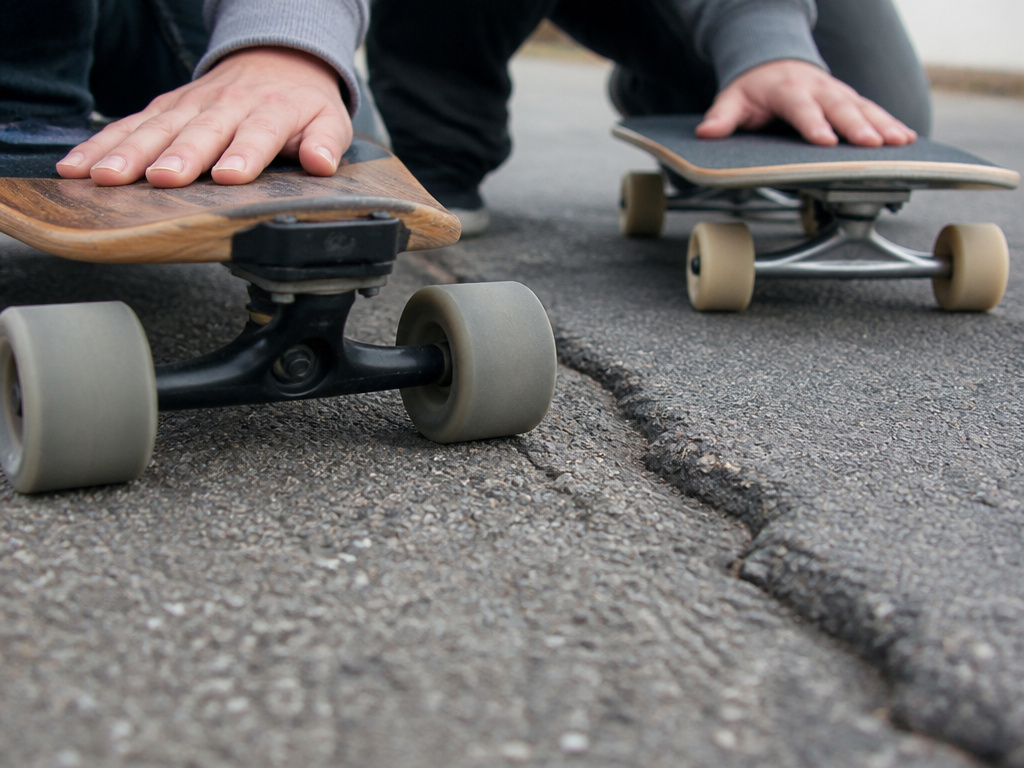
Longboards are built for speed and maintaining momentum over distance. Their longer wheelbase provides greater stability at higher speeds, and their larger, softer wheels are more effective for transportation over varied pavement. These wheels roll over cracks and debris that would stop a standard skateboard. A skateboard, with its smaller, harder wheels, is designed for technical control in a skatepark, not for straight-line speed. For a beginner, the stability of a longboard makes achieving and maintaining a comfortable cruising speed much easier and less intimidating than on a trick-oriented skateboard.
Frequently Asked Questions
Is it easier to learn to skateboard or longboard?
For pure, initial balance and pushing, a longboard is easier. Its longer wheelbase and softer wheels provide more stability and forgive rough pavement. For learning the foundational tricks of skateboarding, a skateboard is the only tool that works, even though the first few days feel less stable.
Is a longboard faster than a skateboard?
On a smooth downhill, a properly set-up longboard can reach higher speeds due to its stability and larger wheels. On flat ground, a skateboard with hard wheels can accelerate quicker with each push due to less friction and weight. For a beginner, the speed difference is negligible; the longboard just feels faster because you’re stable enough to enjoy it.
I’m an adult beginner. Is one better for me?
Adult beginners often prioritize stability and risk minimization, which points toward a longboard or a wider cruiser skateboard. Your weight and strength can handle a larger board, and the comfort of soft wheels is a bigger advantage. The “older beginner” fear is usually about falling, a longboard’s stability mitigates that from day one.
Can I do tricks on a longboard?
Yes, but a different set. Longboard dancing, freestyle slides, and downhill carving are their own disciplines. You cannot do street-style kickflips or ollies on a typical longboard, the shape, weight, and lack of a functional kicktail make it mechanically impractical. If your dream is a kickflip, start with a skateboard.
What’s the best all-around beginner board if I’m unsure?
Community forums often suggest a hybrid like a wider skateboard deck paired with soft wheels (e.g., 80A or less). This hybrid gives you a stable platform for riding around and the physical shape of a skateboard to grow into tricks later. It’s the Swiss Army knife of first boards.
The Bottom Line
The skateboard vs longboard choice for beginners is a filter. What do you want to do first? If the answer is “ollie,” the filter leaves only a skateboard. If the answer is “cruise,” it leaves a longboard.
Forget the pressure to pick the “real” skater’s option. The real skater’s option is the one you’ll actually ride. I’ve watched too many people buy a technical street deck because it looked cool, only to hate the rough, unstable feel and quit within a month. I’ve also seen people buy a longboard for transportation and discover a love for carving hills they never expected.
One rule most guides skip: if you go with a skateboard, give yourself a month of just riding, no tricks. Learn to push, turn, and stop comfortably. That board control is the hidden foundation every trick is built on, and rushing past it is the most common early stall.
Your first board is a first step, not a lifetime commitment. Make it a confident one.
