
Skateboard vs Longboard: Which Should You Buy?
This post contains affiliate links. As an Amazon Associate, we earn from qualifying purchases.
Skateboards are built for tricks, with a curved popsicle shape, smaller hard wheels, and rigid trucks for quick flips and grinds. Longboards are designed for smooth travel, with longer decks, larger soft wheels, and flexible Reverse Kingpin trucks for stability at speed. For most beginners who just want to cruise comfortably, a longboard is the easier start. If your goal is ollies and skateparks, get a skateboard.
That’s the basic answer to the skateboard vs longboard question. The real question is what you’ll actually do with the board. A longboard’s stability is tempting, but it locks you out of most street tricks from day one. A skateboard’s agility is thrilling, but it turns a half-mile commute into a full-body workout.
This guide walks you through the specs that matter in the skateboard vs longboard debate, wheelbase, truck design, deck shape, and ties them directly to your most likely use cases: cruising, commuting, or learning tricks. By the end, you’ll know which board type fits your first six months of riding, and which common beginner mistake to avoid before you spend a dime.
Key Takeaways
- A skateboard’s 12-14 inch wheelbase and curved kicktails are designed for ollies and flip tricks, while a longboard’s 20-25 inch wheelbase provides stability for cruising and downhill.
- Longboard wheels are larger and softer (60mm+, 78a-95a durometer) for smoothing out cracks; skateboard wheels are smaller and harder for sliding and park riding.
- For pure transportation and comfort, a longboard or cruiser is superior; for technical tricks and skatepark use, a skateboard is essential.
- The recommended minimum spend is $80 for a skateboard and $150 for a longboard; cheaper completes often sacrifice critical components like bearings and truck bushings.
- If you are unsure, choose based on your primary goal for the first six months; switching board types later is easier than struggling with the wrong tool from day one.
The Core Specs: Size, Weight, and Shape
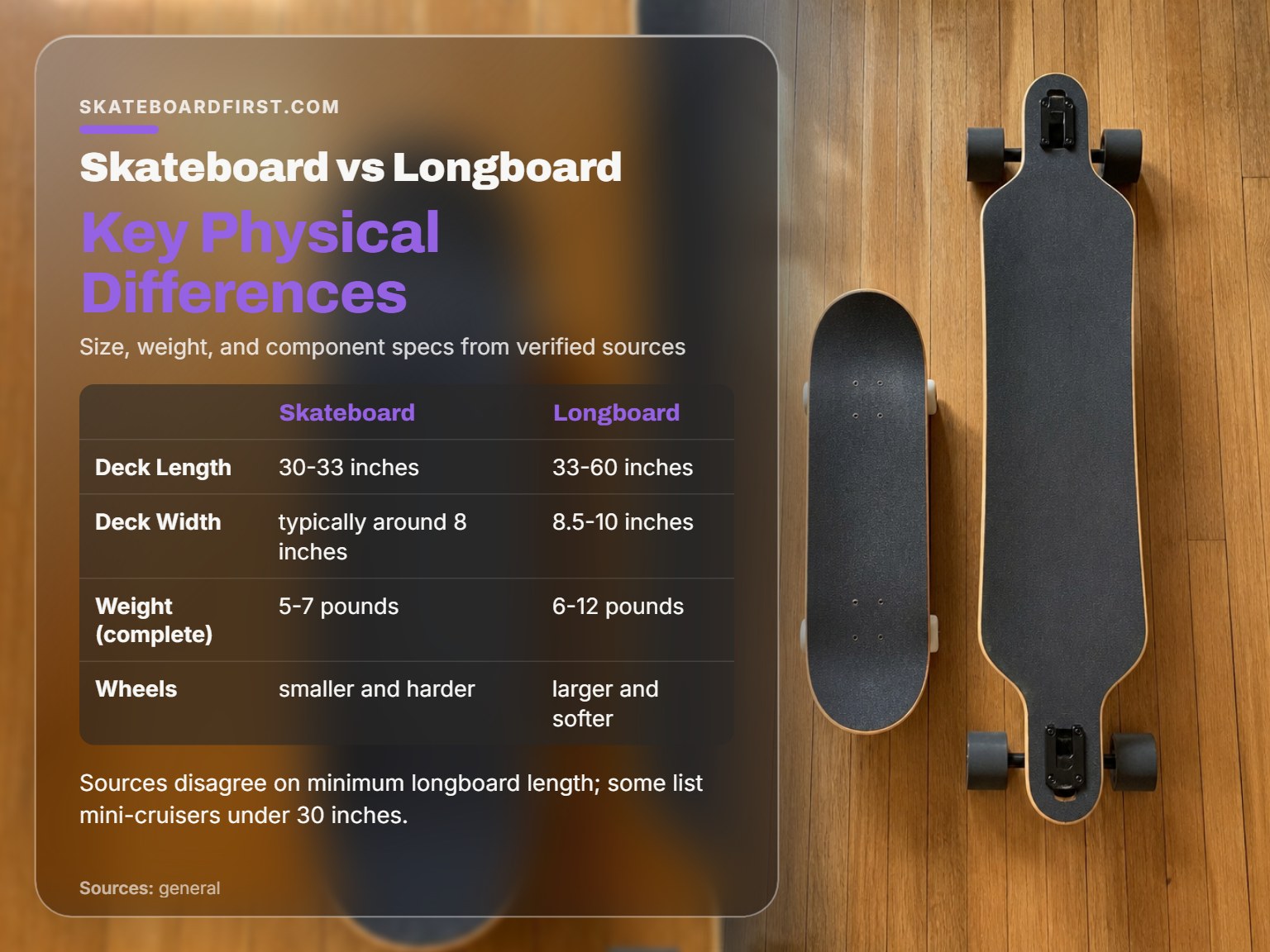
Look at the business ends. A skateboard deck is a 7-ply maple sandwich, typically 30 to 33 inches long and about 8 inches wide. It weighs 5 to 7 pounds complete. The shape is the classic “popsicle”, symmetrical with a pronounced, curved nose and tail. That curve is the kicktail, the lever you use to pop the board off the ground for an ollie.
A skateboard deck most commonly uses a 7-ply maple construction. This layered wood provides the snap needed for pop while retaining enough flex to absorb landings, a balance that cheaper, thinner boards completely miss.
A longboard deck is a different animal. Lengths range from 33 inches all the way to 60. Widths start around 8.5 inches and go past 10. A complete full-size longboard can weigh 8 to 10 pounds, though weights across the category range from 6 to 12 pounds (2.7 to 5.5 kg). The shape isn’t standardized. You’ll see pintails, drop-through decks, top mounts, and dancers. The common thread is a much flatter profile. Many have little to no kicktail, because the design priority is foot platform and stability, not popping into the air.
Here’s where it gets fuzzy. The longboard category includes mini-cruisers, like the 27.75-inch Loaded Ballona, which is shorter than many skateboards. This is why sources disagree on a length-based definition. Sources disagree on a length-based definition: a peer-reviewed study in Injury journal defines longboards as 36 to 60 inches, while the market includes mini-cruisers sold as “longboards” as small as 28 inches. The key visual differentiator is the flat deck versus the curved skateboard profile.
| Specification | Skateboard | Longboard |
|---|---|---|
| Typical Length | 30–33 inches | 33–60 inches |
| Typical Width | ~8 inches | 8.5–10 inches |
| Complete Weight | 5–7 lbs (2.3–3.2 kg) | 6–12 lbs (2.7–5.5 kg) |
| Deck Shape | Popsicle (symmetrical, curved kicks) | Pintail, Drop-Through, Top Mount, etc. |
| Primary Construction | 7-ply Maple | Varies (often thicker for low flex) |
The weight and length difference isn’t just academic. It directly translates to how the board carries momentum and responds to your input. A lighter, shorter skateboard flicks easily but gets bounced around by rough pavement. A heavier, longer longboard plows through cracks but feels like steering a canoe in a tight parking lot.
Wheel and Truck Design: Where the Ride Quality Splits
This is the mechanical heart of the difference. The components under the deck dictate what the board can and cannot do.
Skateboard trucks are rigid, narrower, and match the deck’s width. They use a Traditional Kingpin (TKP) design where the kingpin bolt is on the inside, facing the board’s center. This makes them responsive for quick, sharp turns and provides a solid lock for grinds on rails and ledges. The bushings are usually harder, limiting lean.
Longboard trucks are wider, typically measuring 150 to 180 millimeters. They are more flexible and often use a Reverse Kingpin (RKP) design, the kingpin faces outward. This geometry gives you a deeper, smoother lean per degree of tilt, perfect for carving and maintaining stability at higher speeds. It’s a surfy feel versus a skateboard’s twitchy feel.
The wheels complete the picture. Skateboard wheels are smaller and harder. They’re built for speed in skateparks (smooth concrete) and for sliding during tricks. On rough asphalt, they transmit every pebble and crack directly to your feet, a buzzing vibration that gets old fast.
Longboard wheels are larger and softer. Cruiser wheels start at 60mm diameter with a durometer (hardness rating) between 78a and 95a. That soft urethane absorbs vibrations and rolls over debris. The trade-off is grip; these wheels stick to the ground, making slide tricks much harder for beginners.
Common mistake: Putting longboard wheels on a standard skateboard without riser pads. The larger diameter causes “wheelbite”, the wheel contacts the deck during a turn, launching you forward. You need at least 1/4 inch riser pads to prevent this.
Why does this combo matter? The RKP truck and soft wheel work together. The truck allows a smooth, controlled lean, and the soft, large wheel maintains grip and roll speed throughout that lean. On a skateboard, the TKP truck and hard wheel are a pair: quick redirects and releases for technical footwork. Mixing these components, like putting RKP trucks on a short deck, creates a twitchy, unpredictable ride.
Skateboard vs Longboard for Commuting
Here’s a practical example. You need to get across campus or to the train station. Which board works?
A longboard wins, hands down. The reasons are physical. A longer deck offers a more comfortable, stable stance for pushing mile after mile. Those large, soft wheels (think 70mm, 80a) roll over sidewalk cracks, pebbles, and tar snakes that would stop a 52mm skateboard wheel dead. The lower rolling resistance means each push carries you further. Drop-through or drop-down longboard decks ride closer to the ground, making pushing even easier on your legs.
Urban cruisers in the 30 to 34-inch range are the sweet spot for city commuting. They’re maneuverable enough for sidewalk slaloming but still carry the comfort benefits of a longboard.
A skateboard can commute. People do it. But it’s inefficient and punishing. You’ll push twice as often. Your calves and ankles will fatigue quicker. And after a mile, that constant high-frequency vibration from the hard wheels turns your feet into numb, buzzing stumps.
The sensory reality is stark. Jumping onto a skateboard after riding a longboard, as one source notes, “feels like stepping into a shaker – every little crack in the terrain will send a vibration up your spine.” That’s not an exaggeration. It’s the direct result of the wheel and truck specs we just covered.
If transportation is your primary goal, get a longboard or a dedicated cruiser. A skateboard is a tool for a different job.
The Beginner’s Dilemma: Which is Easier to Learn?
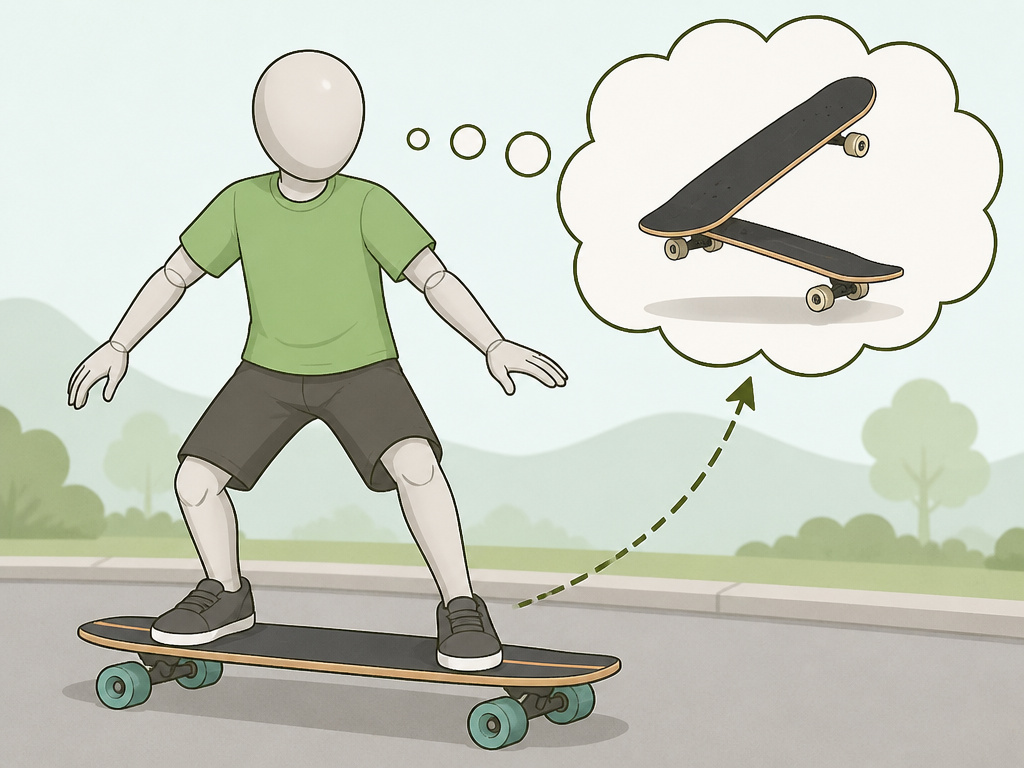
Most new riders ask this first. The standard advice is a longboard. Its larger platform and lower center of gravity (especially on drop-through decks) make balancing easier. The soft wheels forgive minor balance corrections without throwing you. You can likely ride in a straight line within an hour.
The Red Bull article explicitly advises: “If your goal is to learn and master new tricks but you’ve never stepped foot on a skateboard, try a longboard first. Since they’re larger and more stable, they’re easier to balance.”
But this is where a major beginner mistake happens. If your end goal is to do kickflips and skate street obstacles, starting on a longboard builds the wrong muscle memory. The wide, surfy stance and heavy, grippy board teach you to steer with your shoulders and lean heavily. Transitioning to a flickable, twitchy skateboard later means relearning your balance from scratch. It’s frustrating.
My stance? Match your first board to your primary goal. If you want to cruise and carve, start with a longboard. If you dream of ollies and grinds, start with a skateboard. Yes, the initial week will be harder. You’ll wobble more. But you’ll be building the specific board control and ankle strength that tricks demand from day one.
A hybrid option exists: the mini-cruiser. These are essentially oversized skateboards with kicktails that mount larger, softer wheels. They’re more comfortable than a skateboard for getting around and can still ollie. They’re a compromise, but for a beginner who genuinely wants to try a bit of everything, they’re a solid first purchase.
Cost, Culture, and Making Your Choice
Let’s talk money, because your budget is real. The fact sheet gives us clear numbers. Skateboards can cost anywhere from $25 to $200+, with a recommended minimum spend of $80 for a complete. Longboards range from $50 to $500+, with a $150 minimum recommended.
That $70 gap is the cost of more materials, more wood, more urethane, more metal in the wider trucks. A cheap $50 longboard will have dead plastic-feeling wheels, gritty bearings, and trucks that won’t hold adjustment. It’ll convince you that you hate longboarding. An $80 skateboard complete is a functional tool that won’t fight you as you learn.
Where this goes sideways: Buying a board based on looks alone. A beautiful pintail longboard is useless if you live near a skatepark and want to learn to drop in. A slick graphic on a skinny skateboard won’t help if your main route to work is on broken brick roads.
Culturally, the divide is overblown but real. Skateboard culture orbits around technical progression, video parts, and street spots. Longboard culture often focuses on distance, downhill speed, dance, and communal cruises. In practice, most riders are just happy to be on a board. The animosity is mostly an internet phenomenon.
So, how do you choose? Work through this quick list:
- Primary Use: Cruising/Commuting → Longboard. Tricks/Skateparks → Skateboard.
- Terrain: Smooth bike paths & hills → Longboard. Rough city streets → Longboard with soft wheels. Smooth skateparks & parking lots → Skateboard.
- Portability: Need to carry it into class or on a bus? A skateboard stashes in a backpack. A longboard is a hallway obstacle.
- Budget: Honestly assess what you can spend. It’s better to buy a good $80 skateboard than a terrible $80 longboard.
If you want one answer for the absolute beginner with no stated preference: get a quality mini-cruiser. It removes the worst vibrations from learning, remains somewhat trickable, and is a manageable size. It’s the “default pick” that keeps the most doors open.
Frequently Asked Questions
Is a longboard or skateboard easier for a beginner?
For simply riding and balancing, a longboard is easier due to its larger platform, lower center of gravity, and smoother-rolling wheels. However, if your goal is to learn skateboard tricks, starting on a skateboard, while initially harder, builds the correct foundation faster.
Can you do tricks on a longboard?
Yes, but a different set of tricks. Longboarding focuses on freestyle, dancing, and slides. Technical street tricks like kickflips and heelflips are extremely difficult on a longboard due to the lack of a functional kicktail, the board’s weight, and the grippy wheels.
Is a longboard good for commuting?
Absolutely. Longboards are specifically designed for comfortable, efficient commuting. The larger, softer wheels handle rough pavement, the longer deck provides a stable pushing platform, and designs like drop-through decks make pushing easier on longer distances.
What is the main difference between skateboard and longboard trucks?
Skateboard trucks are rigid, narrower, and use a Traditional Kingpin (TKP) design for quick, sharp turns and grinds. Longboard trucks are wider, more flexible, and often use a Reverse Kingpin (RKP) design for smooth, deep carves and stability at speed.
Can I use a skateboard for long distance?
You can, but it’s not ideal. The small, hard wheels and short wheelbase make for a rough, inefficient ride over long distances. You’ll expend more energy pushing and endure constant vibration. For distances over a mile, a longboard or cruiser is a significantly better tool.
Before You Go
One rule most comparison guides skip: your first board decides your first six months of experience. A longboard won’t teach you an ollie. A skateboard won’t make a three-mile commute pleasant. Choose based on the activity you’ll actually do most in the next season, not the one you think looks cooler.
If you’re still paralyzed by the choice, do this: visit a local skate shop. Stand on a few boards. Feel the difference in stance. Ask about their return policy on completes. The tactile experience of balancing on a wide, stable longboard versus a narrow, responsive skateboard is more telling than any spec sheet.
Then, once you’ve chosen, commit to it. Learn to push, turn, and stop confidently. That fundamental board control transfers to any other deck you step on later. The skills are portable, even if the perfect board for every job is not. Start with the right tool for your first, most important job.
