
How to Push on a Skateboard: Find Your Stance First
This post contains affiliate links. As an Amazon Associate, we earn from qualifying purchases.
To push on a manual skateboard, place your front foot over the front bolts at a 45-degree angle, keep your weight centered over that foot, and use your back foot to push against the ground. On a weight-sensing electric board like a ZBoard, acceleration is controlled by shifting into a specific stance. Place your back foot on the board after each push. The core skill is balancing on your front foot while the back foot is off the board.
That balance point is where most new skaters hesitate. They either lean too far forward and feel the board shoot out, or they lean back and struggle to get the push foot back on. It’s a physical shift, not just a mental one, and it’s the core of how to push on a skateboard.
What follows: how to find your natural stance, the exact foot angles from two different sources, the one balance drill that cuts the learning curve in half for learning how to push on a skateboard, and what to do when your board feels wobbly or your shoes won’t grip.
Key Takeaways
- Your front foot should be angled around 45 degrees over the front bolts, according to sources like pro skater Amelia Brodka’s tutorial and the ZBoard manual for its Acceleration stance, for optimal control.
- Balance on your front foot before you push; if you can’t stand on it alone, you’re not ready to push with speed.
- Avoid pushing mongo (using your front foot to push) as it disrupts your balance for turning and stopping, a common hurdle for self-taught beginners.
- Check your truck tightness if the board wobbles while pushing; loose trucks feel unstable, especially for new riders.
- Wear a helmet; the U.S. Consumer Product Safety Commission states it “can mean the difference between life and death” in a crash.
Find Your Stance: Regular or Goofy?
You don’t choose your stance. Your body already knows it. The classic test for learning how to push on a skateboard is to imagine someone is about to push you from behind. Which foot do you instinctively step forward with to catch your balance? That foot is likely your front foot on the skateboard. If it’s your left foot, you’re “regular.” If it’s your right foot, you’re “goofy.” It doesn’t matter which is more common. What matters is that you use the one that feels natural from the first step.
Common mistake: Forcing a “regular” stance because it’s the default. If you’re naturally goofy, learning regular will feel like writing with your wrong hand—possible, but needlessly difficult.
I see this a lot with adults who overthink it. They read that most people are regular, so they start there even if it feels awkward. A session spent on the wrong stance is a session you could have spent actually rolling. Do the push test, trust the result, and stick with it for at least a few weeks before you even consider switching.
The 5-Step Push: From Stance to Roll
This focuses on a smooth transfer of weight. Break it down into distinct parts, practice each one stationary, then chain them together.
Step 1: Set Your Front Foot. Place your front foot across the deck, just behind the front bolts. Amelia Brodka’s tutorial specifies angling it “at 45 degrees, with your toes pointing towards the nose.” This angle gives you a stable platform to balance on and sets your shoulders for steering. The ball of your foot should be near the centerline of the board.
Step 2: Find Your Balance. Before you even think about pushing, practice balancing on just your front foot with the board stationary. Shift all your weight onto it, pick your back foot up, and hold it for a few seconds. Can you do it without the board tipping? If not, you’re leaning too far to one side. Center your weight over the ball of your foot. This is the single most important feeling to master.
Step 3: Push and Return. Now, with your weight steady on the front foot, reach your back foot back and place the ball of your foot on the ground. Push straight back, not down. It’s a short, controlled motion. Immediately after the push, bring that foot back and place it on the tail, perpendicular to the board. Your feet should now be in a wide, stable stance ready for cruising.
Step 4: Roll and Repeat. As you start rolling, bend your knees. A stiff stance is a wobbly stance. To maintain speed, you’ll need to push again. Lift your back foot, reach back, push, and return it to the tail. The rhythm is push-return, push-return, not push-push-push while your foot dangles.
Step 5: Look Ahead. Your eyes want to stare at your feet. Fight that. Pick a point 10-20 feet in front of you and look at it. Your balance and steering will improve instantly because your body naturally adjusts to where you’re looking. Staring at the ground makes you drift and overcorrect.
| Step | Key Action | What Happens If You Skip It |
|---|---|---|
| 1. Set Front Foot | Angle front foot ~45° over front bolts. | Board won’t steer predictably; you’ll fight for control. |
| 2. Find Balance | Balance on front foot alone before pushing. | You’ll feel unstable the moment your back foot leaves the board. |
| 3. Push & Return | Push straight back, then return foot to tail promptly. | You’ll take “baby pushes” that don’t generate speed, or your foot will get left behind. |
| 4. Roll & Repeat | Bend knees, establish a push-return rhythm. | You’ll lose momentum quickly and tire yourself out. |
| 5. Look Ahead | Focus eyes on a point in the distance, not your feet. | You’ll weave unpredictably and not see obstacles or changes in terrain. |
How to Stay Balanced While Pushing
The wobble usually comes from stiff legs, uneven weight distribution, and trucks that are too loose or too tight for a beginner. Here’s how to troubleshoot.
First, check your foundation for balance. Are you putting 100% of your weight on your front foot before you push? If you’re splitting your weight, the board will tilt when you lift your back foot. Practice the one-foot balance drill on carpet or grass where the board can’t roll away. Hold it for a few seconds. Build up your balance over time. When that feels solid, the pushing motion gets much easier.
Second, listen to your trucks. When you’re pushing, do the wheels feel like they’re shimmying side-to-side? That’s speed wobble precursor. The CPSC notes that keeping “trucks, wheels, nuts, and mounting screws tightened properly” improves stability. For a beginner, ensure your trucks are tightened properly to improve stability.
The part nobody mentions: Your shoes matter more than your deck for balance. Worn-out sneakers or hard-soled shoes have no grip. Your front foot will slide during the push, breaking your stable platform. Wear shoes with good grip to prevent your foot from sliding.
Finally, relax your upper body. Tension in your shoulders travels straight to your hips and legs. Take a breath, drop your shoulders, and let your arms move naturally. They’re not just for show—they act as counterweights to keep you centered.
Common Beginner Mistakes (And How to Fix Them)
You will make these. Everyone does. Knowing what they look like helps you fix them quickly.
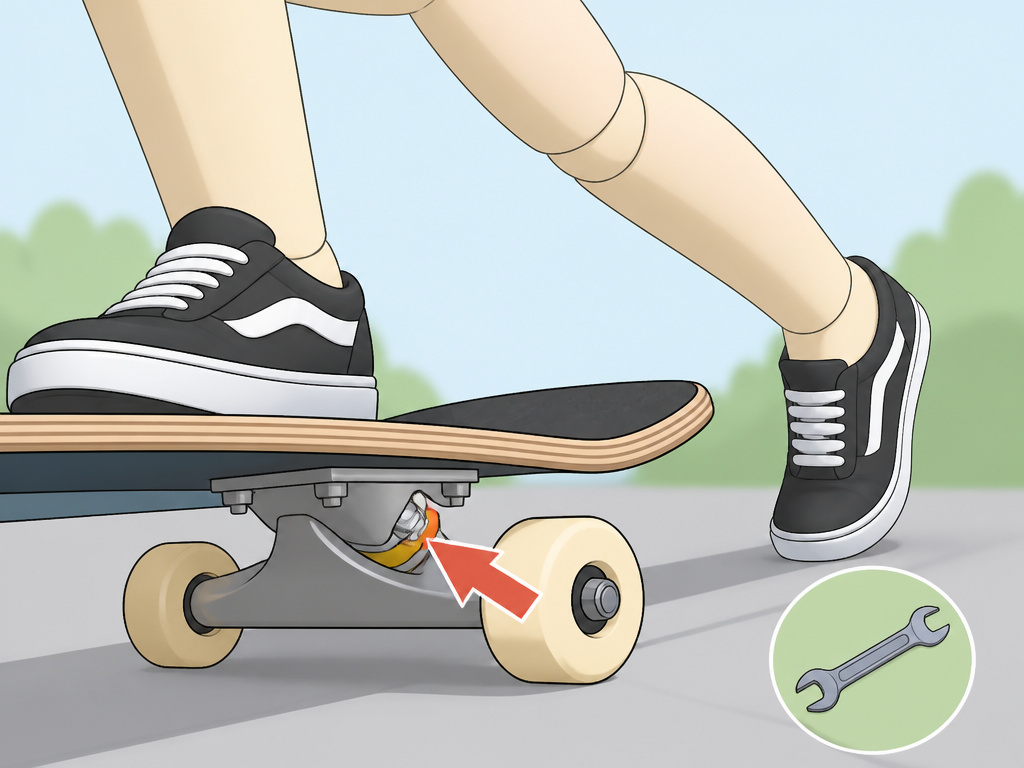
Mongo Pushing: This is pushing with your front foot while your back foot stays on the board. It feels intuitive because you’re always in contact with the board, but it puts you in a terrible position to steer or stop. Your pushing foot is also your steering foot, so every time you push, you twist your body. To fix it, commit to the regular sequence for foot placement. It will feel awkward for a day. Then it won’t.
The Baby Push: Taking tiny, rapid steps with your back foot because you’re scared to commit your weight to the front foot. You won’t go faster than a walking pace, and you’ll exhaust your pushing leg. The fix is the balance drill from earlier. Trust your front foot.
Stiff Legs: Locked knees are the enemy. They turn your body into a rigid pole on top of a moving pivot. The board transmits every tiny bump and grain of sand straight up, making you wobble. Bend your knees. Even a slight bend absorbs shock and lowers your center of gravity.
Looking Down: Your head is heavy. Where it goes, your shoulders and hips follow. If you stare at your front truck, you’ll unconsciously steer toward it. Pick a target down the path and skate toward it. Your peripheral vision will handle the immediate ground.
Pushing on Rough Roads and Uphill
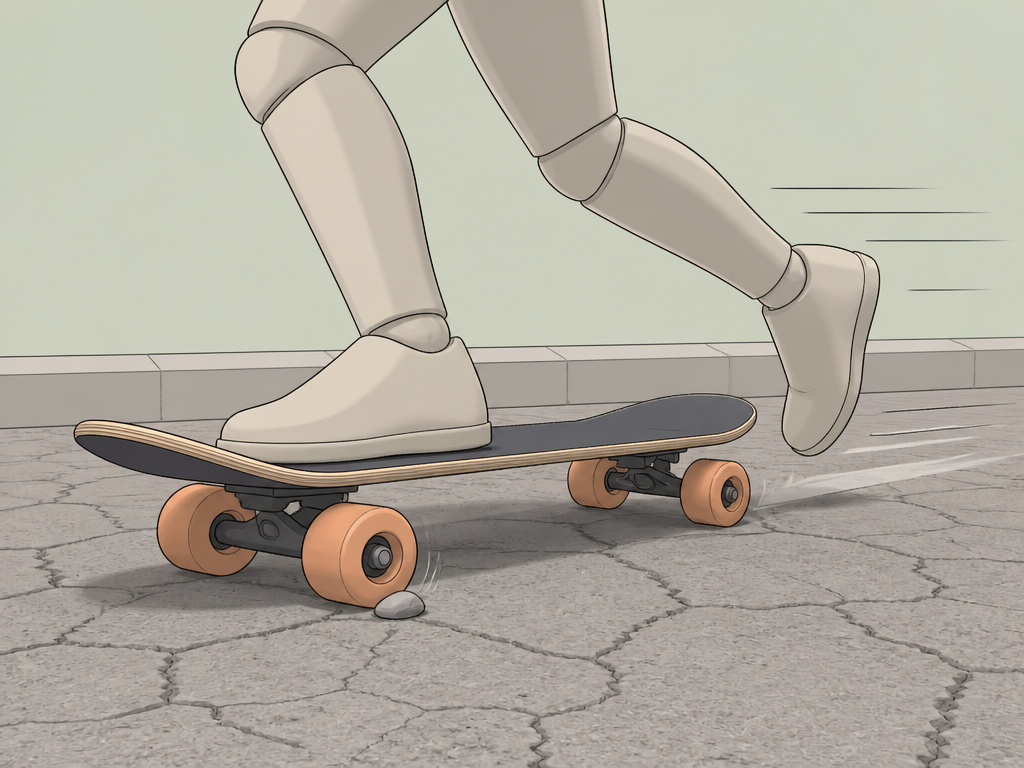
Smooth pavement is a luxury. Most beginners start in a driveway, a parking lot with cracks, or a sidewalk with seams. The technique adapts.
On rough ground, you need shorter, more frequent pushes to maintain momentum over the bumps. Don’t try for one big push to coast over rough patch—you’ll lose speed halfway through. Keep a rapid, light push rhythm and keep your knees extra soft to act as suspension.
Going uphill? It’s all about power and rhythm. You’ll need to push harder, but don’t sacrifice form. Leaning too far forward will make the board’s nose dip and slow you down. Keep your weight centered, push with a fuller leg motion, and be prepared to push almost constantly.
For longer distances on rough terrain, consider your setup for rough roads. Smaller, harder wheels can get caught on pebbles and cracks, while larger, softer wheels may roll over debris more easily. If you’re using a board with small, hard wheels, pushing on rough terrain will be a constant battle.
Safety First: Gear and Awareness
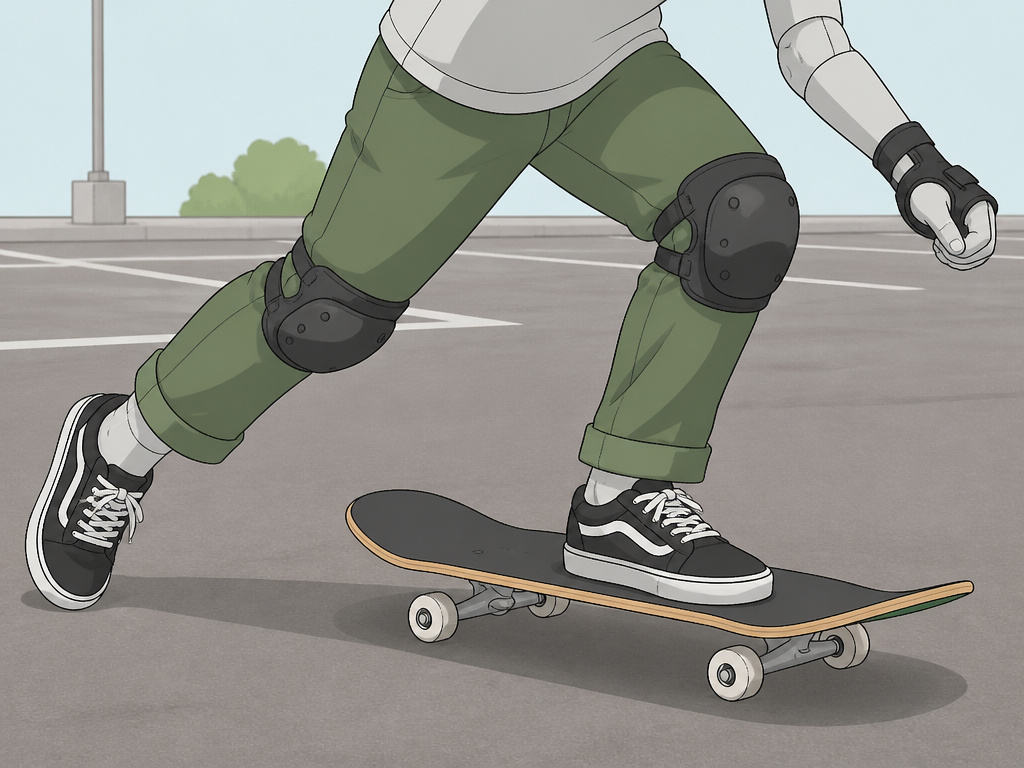
Skateboarding is a physical activity with concrete consequences. The U.S. Consumer Product Safety Commission is blunt: some of the “most common and severe skateboarding accidents involve collisions with moving vehicles.” This statement is supported by the data.
Before you start: Wear a helmet that fits snugly with the chin strap fastened. The CPSC states a helmet “can mean the difference between life and death.” Wrist guards are also highlighted as “especially important” for skateboarding, as falls onto outstretched hands are a default instinct.
Your gear is your last line of defense. Your first line is where and how you ride. The CPSC advises to never ride alone, to inspect your riding area for holes and debris, and to avoid riding at dusk or dawn. Other sources, like the ZBoard manual, offer general safety advice without explicitly prohibiting riding alone. Never “skitch” (hitch a ride on a vehicle). Don’t ride faster than you can control.
This official government skateboard injury data frames the risks in hard numbers. It’s worth a look to understand why the rules exist. Your local park or empty parking lot is a better classroom than a street with curb cuts and driveways.
Electric Skateboards: A Different Kind of Push
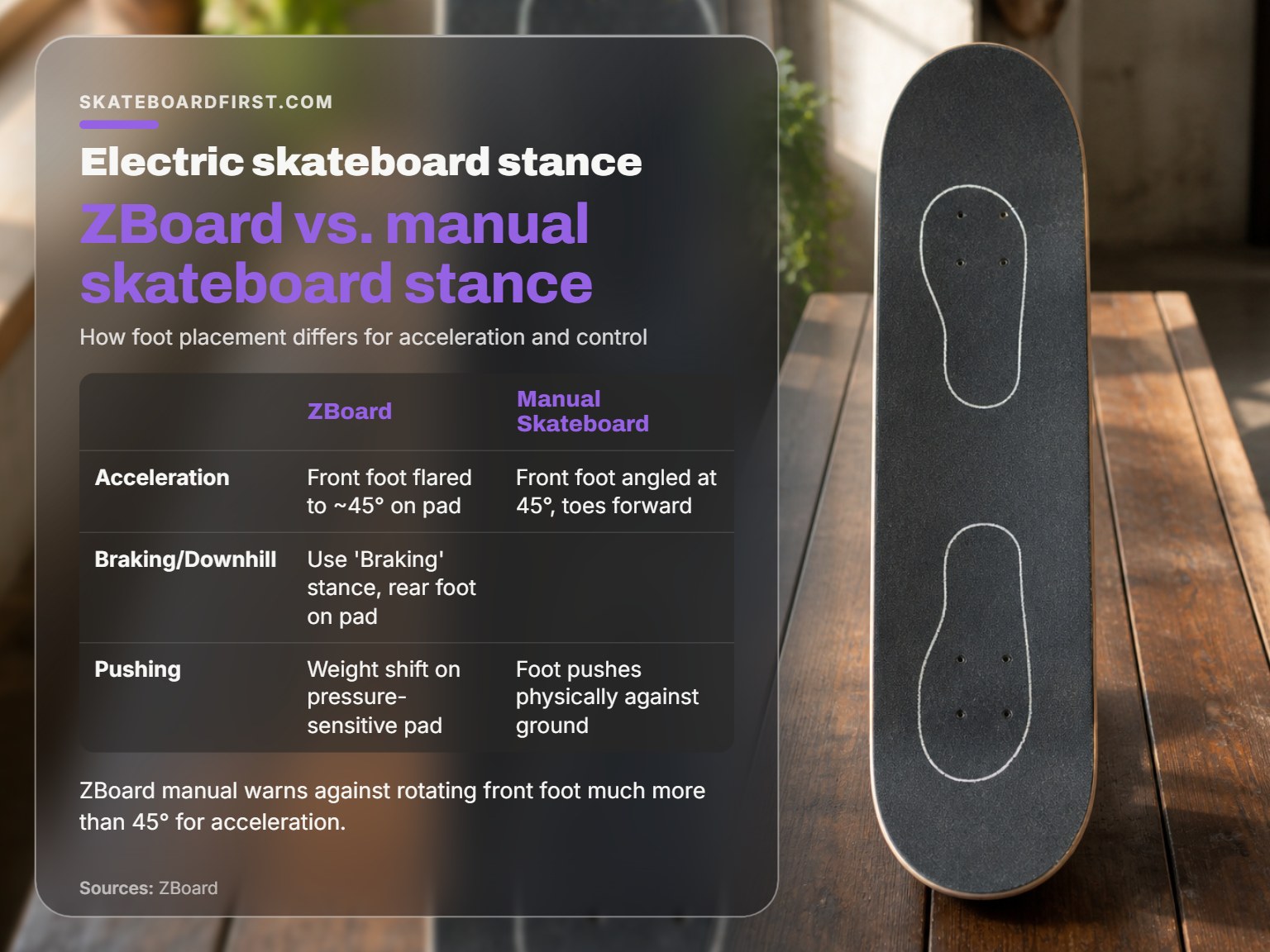
If you’re on a weight-sensing electric board like a ZBoard, the word “push” means something else entirely. There’s no kicking the ground. Instead, you shift into specific stances on pressure-sensitive footpads.
The ZBoard manual defines three stances. The ZBoard’s “Coast” stance has both feet perpendicular to the board. The ZBoard’s “Acceleration” stance requires flaring your front foot “to approximately a 45° angle” and its manual warns against rotating it much more than that. The ZBoard’s “Braking” stance involves placing your rear foot on the rear footpad. For downhill travel on a ZBoard, the manual specifically recommends the Braking stance over the Coast stance for control. For manual skateboards, common practice involves different techniques like foot braking.
The transition from manual to electric pushing is psychological. On a regular board, you control speed by how hard you push. On a ZBoard, as the manual notes, “sudden addition of weight on the front footpad will cause the board to accelerate more aggressively.” The push is a gentle, deliberate weight shift, not a leg swing. Start in a flat, open area and practice the stance transitions with the board off before you ever power it on.
Frequently Asked Questions
What is the correct way to push on a skateboard?
The correct way is to balance on your front foot, which is angled near the front bolts, and push straight back with your back foot before promptly returning it to the board. The critical detail is keeping your weight centered over the front foot throughout the motion.
Do you push with your front or back foot when skateboarding?
You push with your back foot. Your front foot stays on the board to steer and maintain balance. Pushing with your front foot (called “mongo” pushing) is less stable and makes it harder to set up for turns or stops.
Are more people goofy or regular?
More people are regular (left foot forward). However, your natural stance is what matters. Forcing yourself to ride regular if you’re goofy will significantly slow your progress. Use the “push from behind” test to find yours.
How do I stop speed wobbles when pushing?
Speed wobbles often start with loose trucks or uneven weight distribution. Tighten your trucks so the board doesn’t turn too easily, and focus on keeping your weight forward and your knees bent. The CPSC also recommends “riding forward and crouching on your board” to reduce wobble risk.
Can I learn to push on an electric skateboard?
Yes, but the technique is different. Electric boards like the ZBoard use weight-sensitive footpads. You “push” by shifting into an “Acceleration” stance (front foot flared ~45°) and control braking with a separate “Braking” stance. You never physically kick the ground. Always review the specific manual, as sudden weight shifts can cause aggressive acceleration.
The Bottom Line
Your first goal is to go steady. Master the balance-on-one-foot drill before you worry about pushing rhythm. If your board feels uncontrollably wobbly, tighten your trucks a quarter-turn and try again. And please, wear the helmet. Every skater you admire took their share of slams on the way up.
One thing to try next session: Find a smooth, flat line about 50 feet long. Push once to get rolling, then put your back foot on the board and just coast. See how far you can go while staying relaxed and looking ahead. That feeling of stable rolling is the foundation everything else is built on. Once you have that, the pushes will naturally get longer and more powerful.
