
How to Balance on a Skateboard: Step-by-Step
This post contains affiliate links. As an Amazon Associate, we earn from qualifying purchases.
To balance on a skateboard, match your foot placement to the truck bolts, keep your knees bent to lower your center of gravity, and practice stationary drills before rolling. The Skateboard GB guide calls this the “Bolts for Balance” principle, your feet should always be over the top of the bolts to have the right stance. Start by stepping on and off the board on grass or carpet, then progress to gentle pushes.
That bolt placement is the mechanical anchor point for the entire deck. When your weight is centered over the trucks, the board responds predictably to your shifts. Miss that spot, and every little movement feels amplified, which is why beginners often feel like they’re fighting the board. A key part of how to balance on a skateboard is finding this precise center.
What follows is a breakdown of that principle, the gear and setup that support it, and the progression from standing still to rolling with control. We’ll also cover what the official safety guides say about mitigating wobbles and why your mental approach matters as much as your footwork.
Key Takeaways
- Follow the “Bolts for Balance” rule from Skateboard GB: your front and back feet should be positioned directly over the truck bolts for maximum stability.
- Sources disagree on knee bend depth: SkateboardGB advises practicing a squatting position, while Skateboards.com warns not to sink too deep.
- Start your balance practice on grass or carpet so the board doesn’t roll, mastering stepping on, jumping on, and shifting your weight before moving to pavement.
- Tighten your trucks if you’re wobbly; looser trucks are for turning, but tighter ones provide a more stable platform for learning balance.
- Wear a snug-fitting helmet and wrist guards every session. The CPSC notes wrist guards are especially important, and a loose helmet can come off on impact.
The Bolts for Balance Principle
The Skateboard GB “Learn to Skate” guide establishes the “Bolts for Balance” principle as the foundational foot placement rule: “Your feet should always be over the top of the bolts to have the right stance for balancing.”
I learned this the hard way. When I started, I copied a pro’s wide stance from a video, with my back foot way back on the tail. For weeks, every push felt awkward and shaky. The board would dart out from under me on tiny cracks. It wasn’t until I re-read the basics and saw the “Bolts for Balance” phrase that I moved my back foot forward to hover over the rear bolts. The difference was immediate. The board stopped feeling like a separate entity and started feeling like an extension of my feet.
That’s because the trucks, the metal assemblies that hold the wheels, are the board’s pivot points. Placing your feet directly over them centers your weight on the deck’s most stable structural points. The Skateboard GB guide breaks this into a simple drill: place one foot over one set of bolts, then your second foot over the other set, and step off. Repeat until that motion feels automatic. Your front foot should be angled over the bolts, and your back foot should be perpendicular, covering the bolts near the tail.
This contradicts a common piece of generic advice: “feet shoulder-width apart.” While that’s often true, it’s not the whole story. Shoulder-width is a starting width, but the ‘over the bolts’ part is absolutely essential for control. If your shoulders are narrow and the bolts are wider, you still go to the bolts.
| Foot Position | Purpose | Risk If Wrong |
|---|---|---|
| Front foot over front bolts, angled ~45° | Provides steering control and stability for pushing. | Board turns unpredictably; front foot can slip off during pushes. |
| Back foot over rear bolts, perpendicular | Delivers power for pushing and maintains rear stability. | Loss of control over tail; board can kick out or spin during weight shifts. |
| Both feet centered over bolts (not on edges) | Maximizes deck contact and evenly distributes weight to both trucks. | Increased wobble; one truck may lift, leading to a sudden loss of balance. |
Finding Your Natural Stance
Don’t agonize over regular versus goofy. The right stance is the one that feels stable when you step on the board naturally. Here’s a simple test: stand with your feet together and have a friend gently push you from behind. The foot you step forward with to catch yourself is likely your front foot. That’s your natural stance.
Regular stance means your left foot is your front foot on the board, and you push with your right. Goofy stance is the opposite: right foot front, push with left. I forced myself to learn regular because it’s more common, but I’m naturally goofy. Everything felt backwards for months until I switched. Trust the push test more than any online quiz.
Once you’ve identified your front foot, the Skateboard GB guide recommends practicing the jump-on technique. Jump onto the skateboard with both feet at the same time and land with your feet covering the bolts. Keep your knees bent to absorb the impact and keep your body weight central. Do this on grass first so the board doesn’t shoot away. This drill builds the muscle memory for landing in your balanced stance every time, which is crucial for later tricks.
How to Build Your Balance Off the Board
Your balance on the board, specifically your ability in how to balance on a skateboard, is only as good as your balance off it. Core and ankle strength are the support system for everything you do on wheels. A balance board is the most direct piece of training gear for this. The Red Bull skateboarding guide suggests starting small: work to balance on a balance board for 30 seconds at a time. As you get confident, move side to side to simulate the weight shifts of carving.
You don’t need fancy equipment. Stand on one foot while brushing your teeth. Practice a shallow squat, holding the position for 30 seconds, focusing on keeping your weight centered over the ball of your foot. These are the same micro-adjustments you’ll use on the board. When I started doing these, I noticed I could recover from a small wobble on my skateboard without stepping off. My ankles stopped feeling like jelly after a 15-minute session.
Here’s a simple two-week drill schedule to build foundational stability:
- Days 1-3: Single-leg stands, 30 seconds per leg, 3 sets. Balance board static hold, 30 seconds, 5 attempts.
- Days 4-7: Single-leg stands with eyes closed (hold onto something). Balance board side-to-side rocking, 10 reps per side.
- Week 2: Incorporate the squat-hold from the Skateboard GB guide: practice going from a standing position to a squatting position on the deck (on carpet), holding for 10 seconds at the bottom. This builds the specific leg strength for the riding crouch.
Common mistake: Only practicing balance while stationary on the board. Your balance needs to adapt to motion. Once you’re comfortable on carpet, practice your step-on and jump-on drills while the board is rolling very slowly on smooth pavement.
The Right Gear and Setup for Stability

The board itself can be a friend or foe in your balance quest. The U.S. Consumer Product Safety Commission (CPSC) fact sheet states that longer boards increase stability and boards with wider hangers (wheels that are farther apart) give riders greater control. This is why many beginners find longboards or cruisers easier to learn on than a narrow, short street deck.
It’s not so long that it’s cumbersome, but it’s wide enough to give you a confident platform. The key is to ensure your trucks, wheels, nuts, and mounting screws are tightened properly, the CPSC notes this improves stability at higher speeds.
Truck tightness is your most powerful tuning knob. A quarter-turn clockwise on the kingpin nut can transform a wobbly board into a stable learning platform. For absolute beginners, tighter is better. You can loosen them later when you want to learn turns.
Your shoes matter. The Red Bull guide recommends sturdy skate shoes with flat and firm closed-toe construction. Thick-soled shoes are typically best at absorbing impact. You need to feel the board through your feet, and a flat, grippy sole gives you that connection.
Dealing with Speed Wobble and Fear
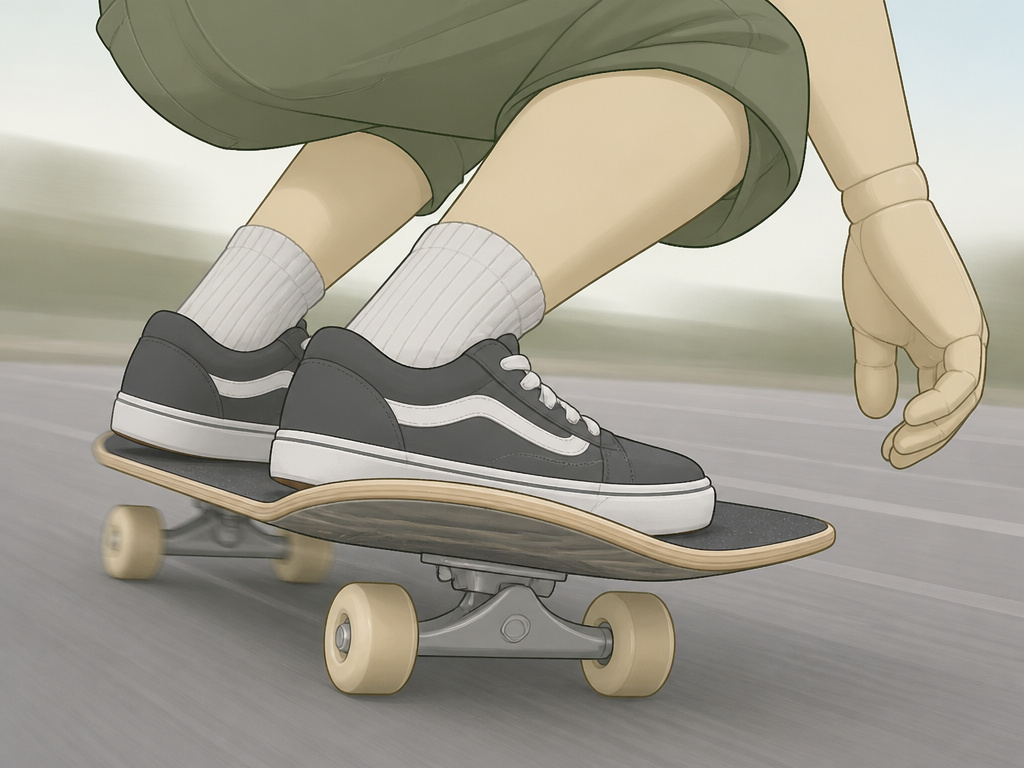
Speed wobble is the great humbler. The CPSC defines it: “Speed wobble happens when a skateboard begins to shimmy from side to side unexpectedly.” It feels like the board is vibrating itself out from under you. The instinct is to lean back and stiffen up. That’s exactly wrong.
The CPSC’s mitigation advice is direct: “Ride forward and crouch on your board.” Shift your weight slightly forward, bend your knees, and lower your center of gravity. Look ahead where you want to go, not down at your shaking wheels. This forward crouch adds damping to the system. Most speed wobble starts because the rider’s weight is too far back, making the front truck too light to steer effectively.
The fear of wobbling, and the fear of falling, is the biggest mental block. Your brain screams to bail. The fix is to practice falling. Find some grass, wear your pads, and practice stepping off the board at a slow roll. Learn to tuck and roll, landing on the fleshy parts of your body, not your wrists or tailbone. Knowing you can fall safely reduces the panic when wobble starts, so you can remember to crouch and ride it out.
Where this goes sideways: Stiffening your legs when you get scared. Locked knees transfer every bump directly to your torso, guaranteeing a fall. Bend your knees, and you give your body a suspension system.
Progressing from Stationary to Rolling Balance
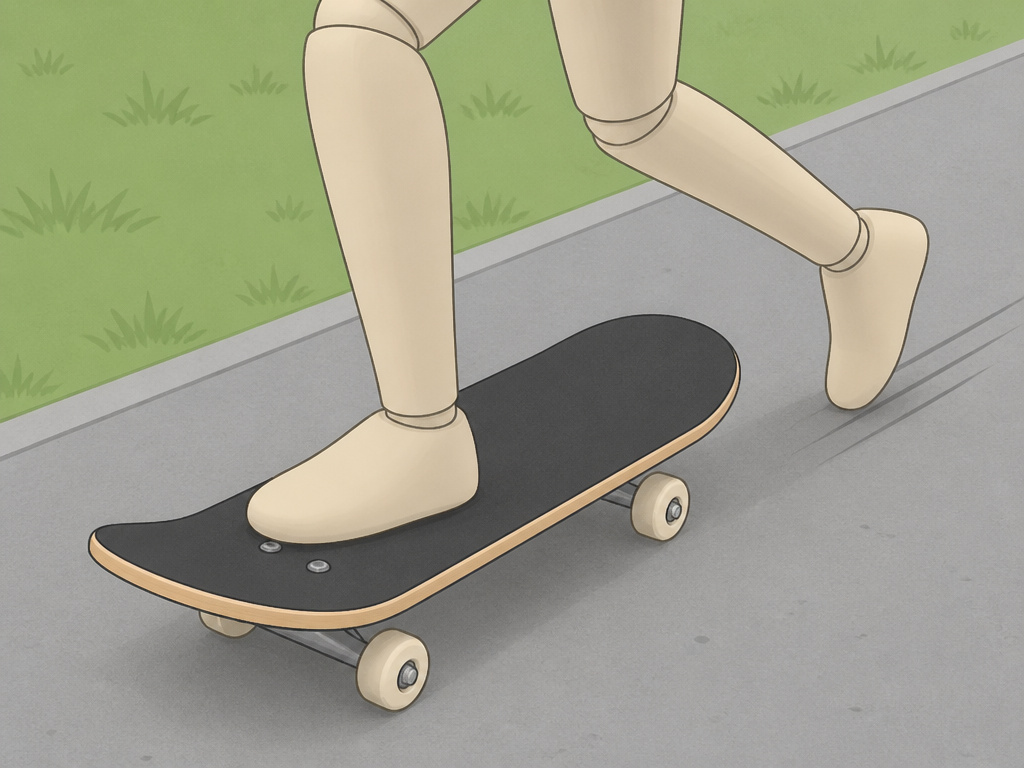
Balance isn’t a single skill you get; mastering how to balance on a skateboard is a series of milestones you hit. Start dead stationary on grass or carpet. Master stepping on and jumping on.
Your first rolling balance drill is the basic push and coast. According to the Skateboard GB guide for pushing: “Place one foot on the deck just overlapping the first two bolts.” Push off with your other foot, then “return your back foot to the board, placing it over the truck bolts towards the tail.” The goal is maintaining that balanced, bolts-over stance while coasting. Then stop, reset, and do it again.
A great next-step drill is the slow slalom. This forces you to make tiny balance adjustments without the drama of a full turn.
How to use a balance board for skateboard training

A balance board is a fantastic tool for building the core strength and ankle stability you need on a skateboard. Start by simply trying to stand on it. Your goal is to find that centered feeling where you can hold steady. Focus on keeping your knees slightly bent and your body weight central, just as you would on a real deck. Make small adjustments using the balls of your feet to maintain your position. When you’re starting out, aim for short, controlled sessions. This kind of off-board practice builds the muscle memory that makes stepping onto a moving skateboard feel much more natural.
Frequently Asked Questions
How can I practice balance on a skateboard at home?
Use a balance board or wobble board on carpet. Practice the Skateboard GB stationary drills: step on/off and jump on/off the skateboard (on carpet). You can also do single-leg stands and squat-holds to build core and ankle strength.
Why am I so wobbly on my skateboard?
The most common causes are incorrect foot placement (not over the bolts), locked knees, and trucks that are too loose for your current skill level. Fear also plays a huge role, tension in your body prevents the subtle adjustments needed for balance. Check your foot position, tighten your trucks a quarter-turn, and practice on a non-slip surface to build confidence.
Are more people goofy or regular?
There’s no definitive count, but regular stance (left foot forward) is generally considered more common. However, it doesn’t matter. Your natural stance is the correct one for you. Forcing the less common stance because you think it’s “wrong” will only slow your progress. Use the push test to find yours and stick with it.
How do I balance when skating?
Balance when skating is dynamic. It relies on the same principles as stationary balance, feet over bolts, knees bent, weight centered, but requires constant micro-adjustments. Use the balls of your feet to make these adjustments, keep your gaze on where you’re going (not your feet), and practice shifting your weight from heel to toe while rolling slowly to get a feel for how the board responds.
What protective gear is most important for learning balance?
A helmet is absolutely essential. The CPSC states a helmet should fit snugly with the chin strap fastened and be level on your head, not tilted back. The Red Bull guide agrees, calling it the most essential piece. Wrist guards are especially important, per the CPSC, as falls often involve putting hands out. Knee and elbow pads are also recommended, as they reduce injury fear, letting you commit to your stance.
Before You Go
Balance is a mechanical skill built on a few concrete rules: the Bolts for Balance principle, a moderate crouch, and progressive practice. The official guides from Skateboard GB and the CPSC give you the blueprint; your job is to repeat the drills until they’re automatic.
One threshold changes everything: when you stop thinking about your feet and start feeling the board. For most people, that happens after consistent, short practice. If you’re past that point and still fighting wobbles, your truck tightness is the first thing to check. Tightening your trucks can often improve stability.
The gear advice here isn’t optional. A helmet designed for skateboarding and wrist guards let you practice the falls that are part of learning. Start small, then build. Your balance won’t improve in one heroic session. It gets better one push, one coast, one corrected wobble at a time.
