
How to Pump on a Skateboard: Step-by-Step for Speed
This post contains affiliate links. As an Amazon Associate, we earn from qualifying purchases.
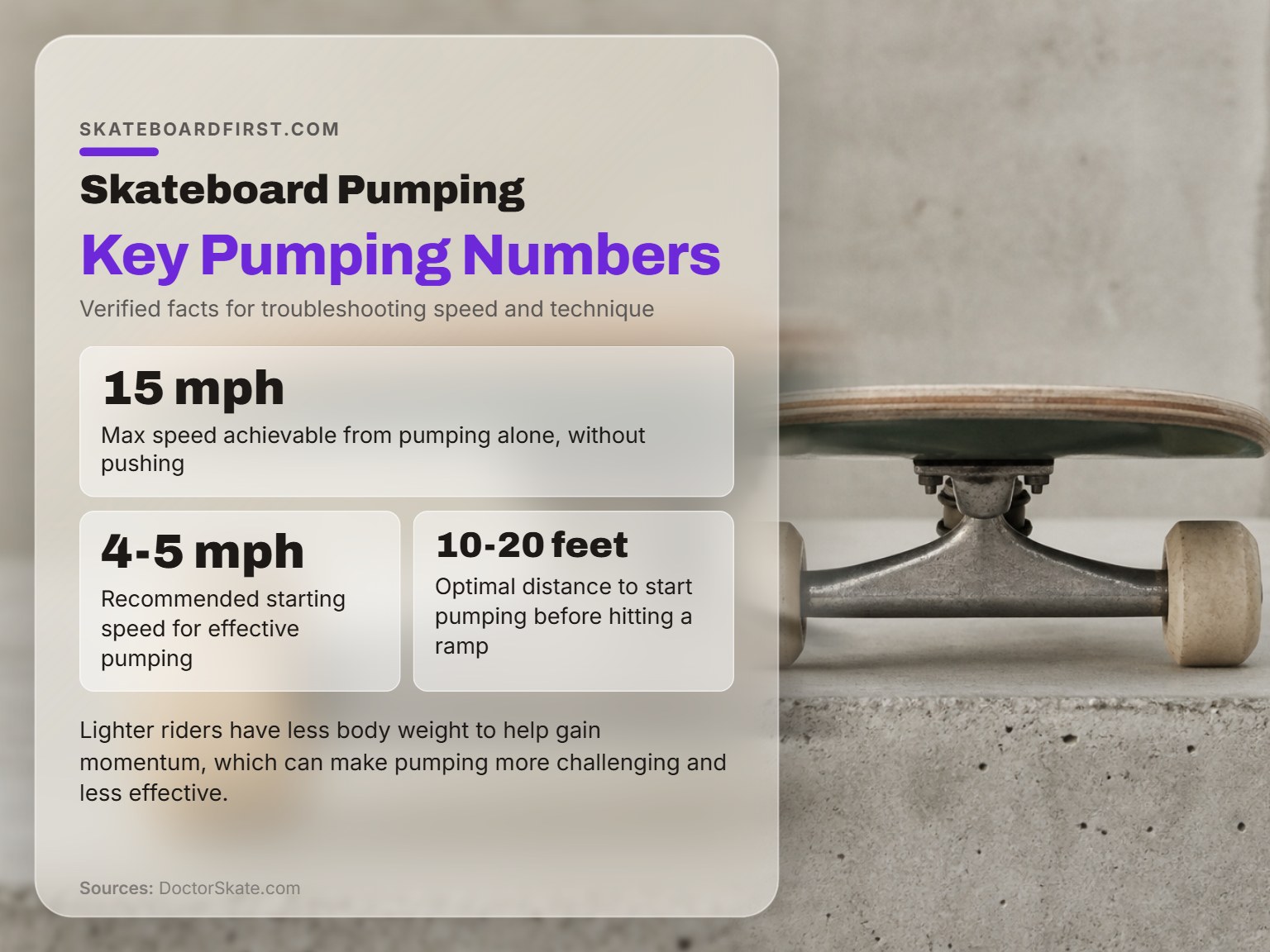
Pumping on a skateboard is a technique used to keep your speed and even generate more, without your feet leaving the board. It works by shifting your weight to use the curve of a ramp or the momentum of a turn to add energy. For most beginners, a starting speed of 4-5 mph is recommended, and with practice, you can reach speeds up to 15 mph without pushing.
That last number changes everything. When you realize you can fly across a park without touching the ground, skating stops being a series of pushes and starts being a flow. The trick is matching your body’s motion to the board’s path, a few inches of well-timed crouch and stand is worth a dozen frantic kicks. This is the core of how to pump on a skateboard.
Here is a breakdown of the pump, from the basic weight shift you can practice on flat ground to the precise timing that lets you climb higher in a halfpipe, all central to how to pump on a skateboard. The text explains where to put your feet, why lighter riders face a different challenge, and how to avoid the common mistakes that kill your speed.
Key Takeaways
- Start with a 4-5 mph push; pumping adds speed, it doesn’t create it from a standstill.
- The motion is a crouch going up, stand going down according to DoctorSkate.com, while the CPSC advises riding forward and crouching on your board.
- Foot placement matters, but sources disagree. Enuff Skateboards says back foot on the tail, front foot over the front set of bolts, while DoctorSkate.com recommends the front foot near the front truck bolts and the back foot near the tail’s end.
- Lighter riders have less body weight to convert into momentum, making the technique more challenging and requiring sharper timing.
- Always inspect your board and wear protective gear; speed wobble and falls are real risks, especially as you gain velocity.
The Core Pumping Motion: A Step-by-Step Breakdown
The pump is a transfer of energy, which is the essence of how to pump on a skateboard. You’re converting your body’s upward and downward movement into forward momentum by working with the ramp’s curve. Get the sequence wrong, and you scrub speed. Get it right, and you accelerate.
The optimal pumping strategy, as outlined in a peer-reviewed analysis, involves dynamically adjusting your center of mass in sync with the ramp’s curvature. A skilled skateboarder’s acceleration profile deviates less from this theoretical optimum than an unskilled rider’s, showing that good technique is a measurable, learnable skill.
Here is the basic sequence, best practiced on a gentle mini-ramp first.
Step 1: Approach with Speed. Don’t try to pump from zero. Give yourself two or three good pushes to reach a starting speed of 4-5 mph. DoctorSkate.com notes this is the sweet spot for the technique to work effectively.
Step 2: Crouch as You Go Up. As your front truck starts to climb the transition, bend your knees and sink down. This “unweights” the board, letting it roll up the curve with minimal friction. Your weight should be centered, not leaning back.
Step 3: Stand as You Go Down. The moment you feel the board start to descend, this is the apex, explode upwards by straightening your legs. This drives your weight down through the trucks and into the ramp, pushing the board forward. It’s this forceful extension that generates speed.
Step 4: Repeat and Refine. The motion is a rhythm: crouch up, stand down. Start small.
Where this goes sideways: Initiating the pump too late. If you don’t start your crouch until you’re already halfway up the ramp, you’ve missed the window to unweight the board. The result is a sluggish, speed-killing scrape. DoctorSkate.com recommends starting the motion at least 10 feet away from the ramp, but 20 feet is better.
| Phase | Body Position | Key Action | Result if Skipped |
|---|---|---|---|
| Approach | Knees slightly bent, weight centered | Build initial speed (4-5 mph) | Pumping has no energy to work with; you stall. |
| Ascent | Deep crouch, lowering center of mass | Unweight the board | Board drags against the ramp, killing momentum. |
| Apex/Transition | Begin standing, legs driving | Force board down into the curve | You ride passively down, gaining no speed. |
| Descent | Full stand, slight forward press | Convert body lift into forward thrust | You coast without acceleration. |
Your foot placement sets the foundation for this motion. The sources in our fact sheet show a clear disagreement here. Enuff Skateboards instructs riders to place the back foot on the tail and the front foot over the front set of bolts. DoctorSkate.com, however, advises placing the front foot near the front truck bolts and the back foot near the tail’s end. This isn’t a major conflict, both positions keep your feet over the trucks for control. Try both and see which gives you a more stable platform to crouch and stand from.
Pumping on Flat Ground and Pump Tracks
You don’t need a ramp to pump. On flat ground or specialized pump tracks, the technique shifts from vertical weight transfer to horizontal carving. This is where learning to turn on a skateboard becomes your best friend.
Instead of crouching against gravity, you’re using the centrifugal force of a turn. As you carve into a bend (say, a frontside turn to the right), you compress your body by bending your knees. Then, as you exit the carve and the board straightens, you stand up forcefully. This “snap” out of the turn pumps speed back into your line. It’s the core mechanic of long-distance pumping (LDP) and slalom skating.
On a dedicated pump track, a circuit of rolling mounds, the technique blends both. You crouch into the uphill face of each mound and stand explosively as you shoot down the other side, linking each pump to carry speed around the entire track without pushing. The motion is less about raw power and more about rhythmic, efficient weight shifts. If you want to feel the purest form of this, try how to ride a surfskate. Those boards are designed to amplify every little upper-body twist and knee bend into forward motion, teaching you how sensitive the pump can be.
Advanced Techniques: Bowls, Vert, and Maintaining Speed
Once you’re generating speed reliably in a mini-ramp, the whole skatepark opens up. The principles are the same, but the timing and commitment level change.
Pumping in a Bowl
In a bowl, you’re not just pumping back and forth on one plane. You’re using the entire curved surface, linking frontside and backside carves. The key is to start your pump before you hit the transition. As one Reddit user struggling with a skateboarding video game put it, “press forward on the left stick right before the transition.” In real life, that means initiating your crouch as you roll toward the wall, not as you hit it. This allows you to use the entire curve. Your goal is to pump at the bottom of the bowl to gain speed, then use that speed to air out of a skateboard bowl or to carve high up the opposite wall. For a deeper dive, our guide on how to pump a bowl breaks down the line choices.
Pumping on Vert Ramps
Vert ramps have a near-vertical section at the top. Pumping here is about extreme precision. The “crouch up, stand down” rhythm is compressed into a split-second decision at the very apex of the curve. A slight mistime means you won’t have the speed to reach the coping. This is where the mechanical optimization of skateboard pumping described in the physics literature becomes tangible, optimal control of your center of mass is the difference between floating and stalling. It’s the foundation of vert ramp skating.
Maintaining Momentum Through Corners
Linking pumps around a skatepark requires planning. You can’t pump in a straight line. Look ahead and set up each turn so you exit with speed, already coiled to compress into the next transition or mound. This “reading” of the park is what separates someone who pumps from someone who flows.
Equipment and Setup for Effective Pumping
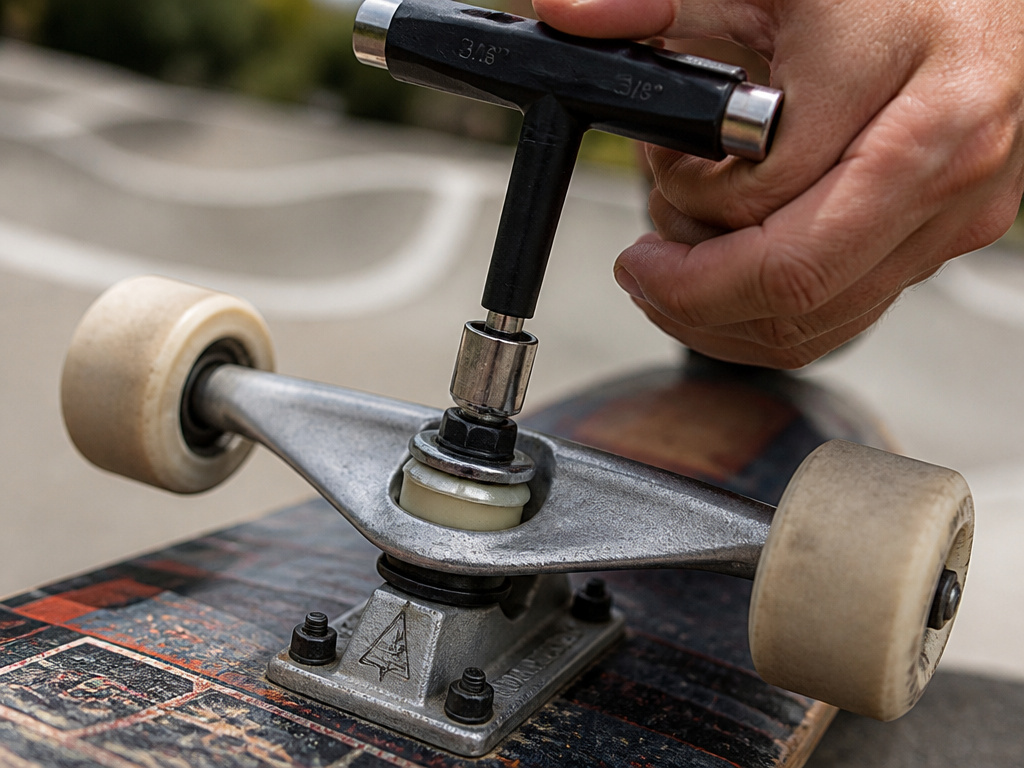
Your board’s setup isn’t just personal preference; it directly enables or hinders the pump. The U.S. Consumer Product Safety Commission (CPSC) notes that keeping trucks, wheels, nuts, and mounting screws tightened properly improves stability at higher speeds. This is crucial.
Trucks: Looser trucks allow for deeper, more fluid carves, which helps generate speed on flat ground and in bowls. However, too loose can lead to speed wobble. Tighter trucks offer stability for high-speed pumping on vert but require more forceful body English to turn. There’s no perfect setting, dial them in for the terrain you’re skating.
Wheels: Larger, softer wheels (e.g., 56mm+ and 78a-86a durometer) roll faster and maintain momentum better between pumps, ideal for pump tracks and long-distance skating. Smaller, harder wheels are snappier for technical ramp pumping where you need quick, sharp weight transfers.
Bearings: Don’t overspend here. Any decently cleaned and lubricated bearing will spin freely enough. The energy from your pump comes from your body, not from marginally freer-spinning bearings.
Board Length: The CPSC also observes that longer boards increase stability.
Common mistake: Riding a board set up for street skating on a pump track. Stiff, narrow trucks and tiny hard wheels will vibrate and slip, forcing you to work twice as hard for half the speed. If you’re getting serious about pumping, a dedicated setup is worth it.
Safety First: Managing Speed and Risk
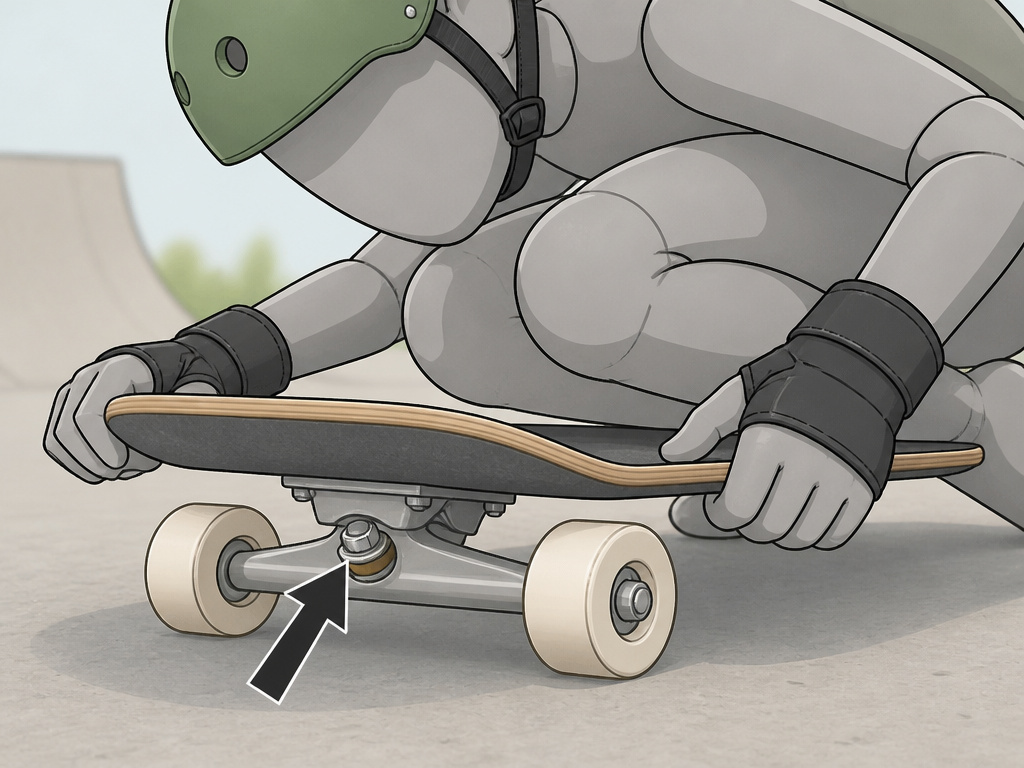
Pumping generates speed, and with speed comes new risks. The most notorious is speed wobble. The CPSC defines it clearly: “Speed wobble happens when a skateboard begins to shimmy from side to side unexpectedly.” It can throw you in seconds.
Before you start: The CPSC Skateboarding Safety Fact Sheet mandates a helmet designed for skateboarding (hard shell with foam interior) that fits snugly with the chin strap fastened. Wrist guards are also flagged as especially important. Inspect your board for loose trucks or cracked parts before each session, and never pump in or near traffic.
The physics are simple: as speed increases, the board’s natural damping decreases, and any imbalance, a loose truck, uneven weight distribution, a warped wheel, can trigger an oscillating feedback loop. To reduce risk:
- Crouch. Lowering your center of mass stabilizes the board.
- Tighten loose hardware. A quick pre-session check of kingpins and axle nuts is essential.
- Start slow. Don’t try to pump at 15 mph on day one. Build up to it as your control improves.
The thrill of pumping is the reward for managing the risk, not ignoring it.
Troubleshooting Your Pump
You’re going the motions but losing speed. Or you feel unstable. Here’s what’s probably happening.
Problem: You lose speed each time you hit the ramp.
Likely Cause: You’re pumping at the wrong point in the curve. You’re either crouching too late on the ascent (dragging the tail) or standing too late on the descent (missing the thrust). Fix: Focus on the apex. The stand must begin the instant you feel the board transition from up to down. It’s a quick, sharp motion. Practice on a very mellow bank where the timing is more forgiving.
Problem: You get speed wobble when you start going faster.
Likely Cause: Loose trucks or an uneven stance. If your weight is too far back, the front truck can become unstable. Fix: Distribute your weight evenly, bend your knees, and slightly tighten your trucks. As the CPSC safety recommendations for skateboarding advise, riding forward in a crouch improves stability.
Problem: The board doesn’t seem to respond to your weight shifts.
Likely Cause: Your setup might be too stiff for pumping. Rock-hard bushings and super-tight trucks won’t translate your body movement into board movement. Fix: Loosen your trucks a quarter-turn. Try a softer wheel. The board should lean easily when you carve on flat ground.
Problem: As a lighter rider, you struggle to generate momentum.
Likely Cause: This is a real physical constraint. Enuff Skateboards points out that lighter riders have less body weight to convert into kinetic energy. Fix: You need sharper, more precise timing. Focus on the explosive “snap” of the stand phase. Your margin for error is smaller, so your technique must be cleaner. The academic manuscript on pumping suggests optimal control strategy matters more than mass, good technique can compensate.
Weight Shift Timing at the Apex
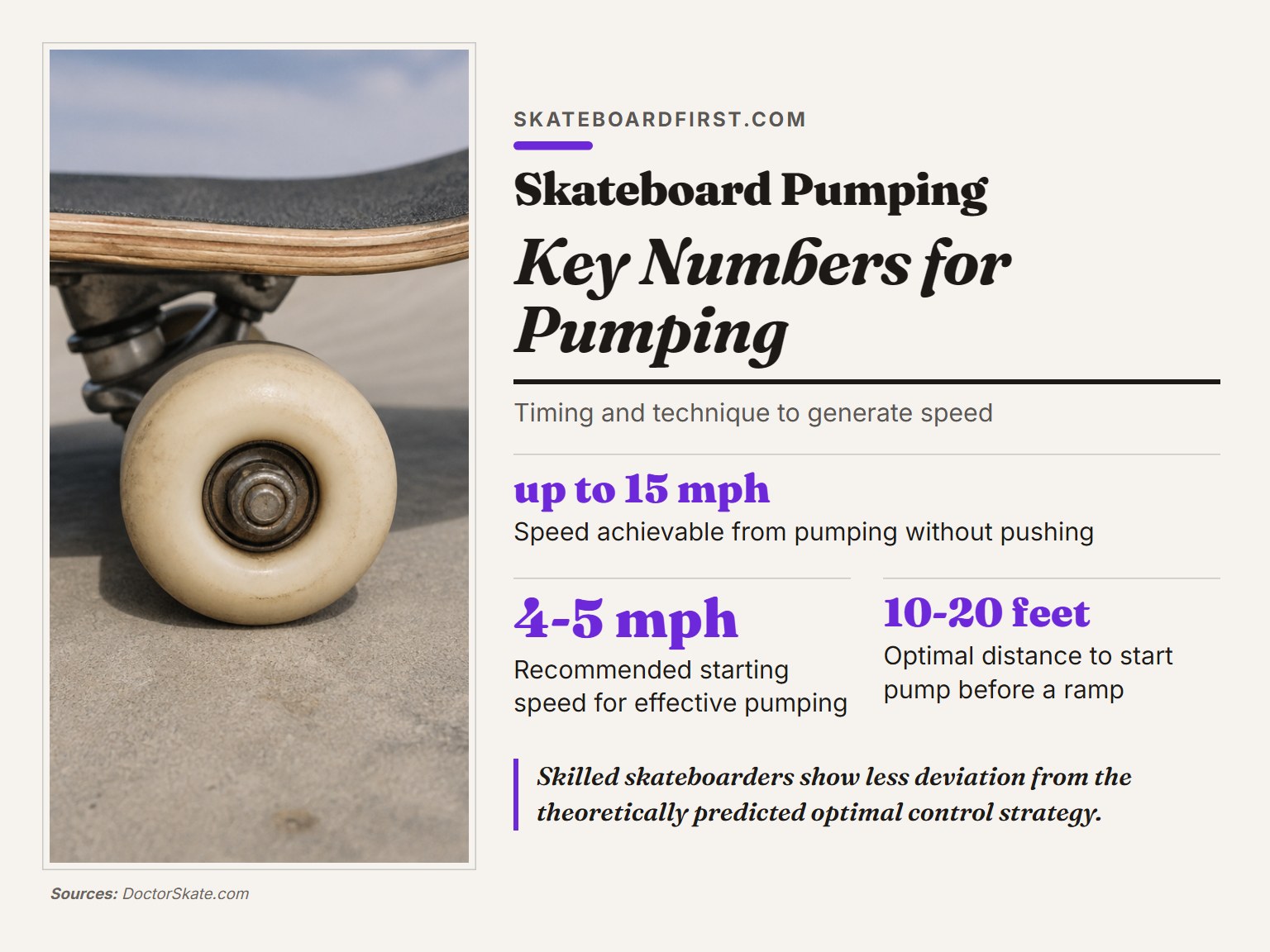
The key to a powerful pump is the precise moment you shift your weight. As you approach the top of a ramp’s curve, you need to transition from crouching to standing. This upward extension of your body should happen right at the apex. Pushing down through your legs at this highest point forces the board into the transition, converting your body’s motion into forward speed. Skilled riders show less deviation from this optimal timing. If you stand up too early or too late, you’ll lose the energy transfer and scrub speed instead of generating it.
Arm Movement for Extra Momentum
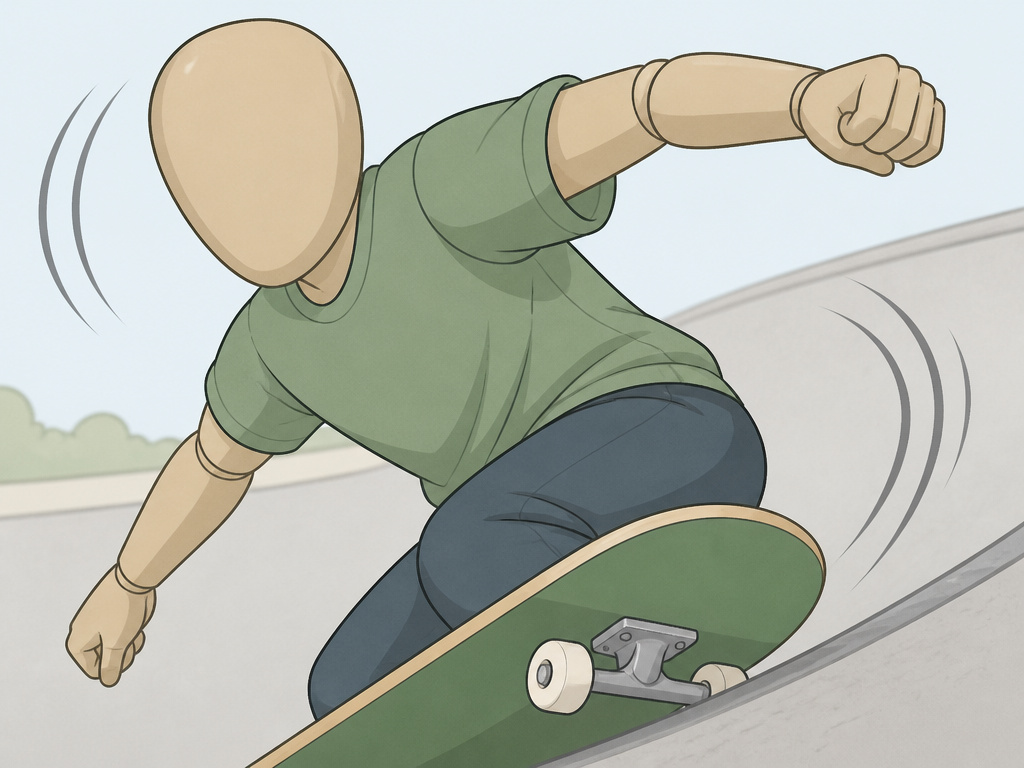
Keep the movement fluid and in sync with your legs. Practicing this coordinated motion on mellow banks can help you feel how arm swing contributes to acceleration.
Pumping Fakie Backwards
The timing of the crouch and stand is reversed relative to your direction of travel. As you roll backwards up a transition, you’ll crouch. Then, as you hit the apex moving fakie, you stand up forcefully to drive the board. The challenge is maintaining balance while shifting your weight against your momentum. Start on a small, mellow ramp and focus on the same powerful extension at the curve’s peak to generate speed.
Frequently Asked Questions
How do you properly pump on a skateboard?
You properly pump by shifting your weight in sync with the board’s path. On a ramp, crouch as you roll up the transition to unweight the board, then stand forcefully as you come down to drive it forward. On flat ground, compress your body during a carve and extend as you exit the turn. The key is timing the weight transfer to the board’s change in direction.
How do you pump in a half pipe?
In a halfpipe, you pump at the bottom of the “U.” As you approach one side from the flat bottom, crouch deeply. The moment you hit the transition and start going up, begin standing. This push off the curve propels you across the flat and up the opposite wall. The skilled skateboarder in a physics preprint showed less deviation from the theoretically predicted optimal control strategy, meaning consistent, timed motions beat raw power.
How do you use a pump track on a skateboard?
You use a pump track by linking your weight shifts over each successive mound. Crouch into the uphill face of each roller to unweight the board, then stand explosively as you shoot down the other side. The goal is to complete the entire circuit without pushing, using only the momentum generated from each pump. It’s a rhythmic, full-body exercise.
Where is the pump in skate?
The “pump” in skate refers to the technique itself, not a specific location. However, the term “pump track” refers to a specific circuit of dirt or asphalt rollers designed for practicing this technique. You can pump on any curved transition, a mini-ramp, a bowl corner, a quarter pipe, or even the gentle bank of a sidewalk.
The Bottom Line
Pumping turns skating from a leg-powered activity into a full-body dance with physics. It’s the skill that creates flow. Start on a small ramp with the basic crouch-stand rhythm. Pay attention to the click of your trucks hitting the transition, that’s your cue to move.
It’s almost always there. Everything above assumes you’re on a board that can turn and roll. If your setup is fighting you, no amount of technique will help.
The real win isn’t hitting 15 mph. It’s the moment you stop thinking about your feet and start feeling the curve of the ramp do the work for you. That’s when you’re not just riding a skateboard. You’re riding a wave.
