
How to Avoid Pebbles When Skateboarding: Cruising Tips
This post contains affiliate links. As an Amazon Associate, we earn from qualifying purchases.
To avoid pebbles when skateboarding, you need a three-part strategy: scan the ground ahead every few seconds, choose larger and softer wheels (over 60mm and under 97a hardness), and shift your weight to your back foot when rolling over debris. This combination helps you see hazards, roll over them, and stay balanced when you can’t avoid a hit.
The weight shift is the part that turns a sudden stop into a controlled roll. If your front truck hits a pebble with your weight forward, the board stops and you pitch over the nose. Shift your weight back, and the front wheels can bounce or roll over the obstacle, giving you a split second to recover. This is a key part of how to avoid pebbles when skateboarding.
What follows is the gear and technique breakdown that makes this work: why official safety sheets tell you to inspect everything, why that’s often impossible, and how experienced skaters actually navigate streets full of cracks and stones.
Key Takeaways
- Perform a regular ground scan while cruising—look ahead, not down, and check the pavement every few seconds to spot debris early.
- For cruising, choose wheels over 60mm with a hardness under 97a; this combination rolls over pebbles and cracks that stop smaller, harder park wheels.
- Shift your weight to your back foot the moment you see a pebble you can’t avoid; this keeps the board rolling and prevents you from pitching forward over the nose.
- If a surface has too many pebbles to clear, assume you will hit some and slow down; the CPSC skateboarding safety fact sheet advises inspection, but the skatepark organic debris guide notes skaters often manage debris reactively.
- Electric skateboards like the RazorX Cruiser have strict terrain rules; their motors can disengage under 3 mph, turning a simple pebble strike into a stranded ride.
The Two-Second Ground Scan
Don’t look directly at your feet. Your eyes should be up, watching for pedestrians, cars, and the general path. Every few seconds, flick your gaze down to the pavement ahead of you. That’s your hazard window.
This rhythm is a core part of how to avoid pebbles when skateboarding, letting you spot the grey pebble on grey asphalt. It’s the difference between seeing a crack and having your front wheels slam into it. The advice from Skatezoned.com is clear: looking straight down means you’ll crash into something else. Looking straight ahead means you’ll hit debris. The two-second scan splits the difference.
Common mistake: Staring at the ground right in front of your board. You lose all forward awareness, and a sudden curb or person can cause a worse crash than any pebble.
Wheel Choice: The 60mm / 97a Rule
Your wheels are your primary pebble defense. The specs that matter are diameter (mm) and durometer (the “a” rating). For cruising over rough ground, you want larger diameter and lower durometer.
| Wheel Type | Best For | Pebble Performance | Trade-Off |
|---|---|---|---|
| Hard Park Wheels (99a-101a, 50-54mm) | Skateparks, smooth concrete | Stops dead on pebbles | Maximum slide and trick control |
| Cruiser/Street Wheels (86a-97a, 56-60mm) | Rough roads, city cruising | Rolls over or deflects most pebbles | Less slide, can feel sluggish on smooth ground |
| Longboard/Cruiser Wheels (78a-83a, 60mm+) | Distance, very rough terrain | Absorbs and rolls over almost all debris | Very little slide, can cause wheel bite |
The Skatezoned.com guide gives a specific benchmark: “For a great skate wheel for pebbles… Make sure they are over 60 mm and have a softness of 97a or a little less.” A 60mm, 97a wheel provides a balance. It’s soft enough to absorb small impacts but hard enough to maintain speed on decent pavement.
Where this goes sideways: Putting large, soft wheels on a standard trick deck without riser pads. A 60mm wheel can cause “wheel bite” where it touches the deck during a sharp turn, throwing you off. If you go bigger, add riser pads.
The right wheels transform a skateboard on rough roads. They are the single most effective gear change for achieving a smoother ride.
Weight Shift: The Back-Foot Save
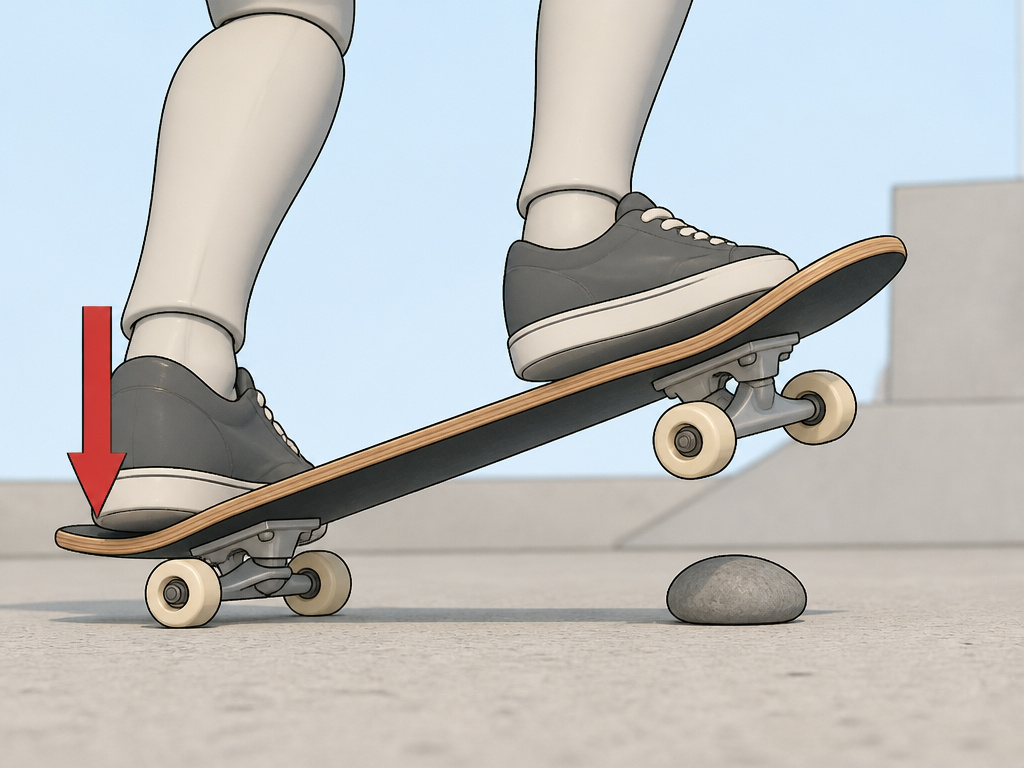
Seeing the pebble and having the right wheels sets the stage for the final move in how to avoid pebbles when skateboarding. The save happens in your feet. When a front wheel hits a pebble, the board decelerates instantly. Newton’s first law says your body keeps moving forward. The result is a classic over-the-front-truck fall.
The countermove is a swift, subtle weight shift to your back foot. You’re not doing a manual; you’re just transferring more of your weight onto the rear truck. This lightens the front wheels, allowing them to bounce or roll over the pebble instead of catching it. It gives you that half-second to regain balance.
Reddit users call this “getting light on your feet.” One described it as “the same motion you’ll need to use to go over cracks.” They’re right. This skill translates directly to the technique for riding over cracks on a skateboard.
The sequence when you spot a pebble you can’t avoid:
- Bend your knees slightly. This lowers your center of gravity.
- Press down with your back foot. Feel your weight settle over the rear truck.
- Keep your shoulders level. Don’t lean back; just shift the weight down.
- Roll through. As the front wheels clear, smoothly re-center your weight.
Practice this on a known patch of rough ground or even short grass. The board will slow dramatically, and you’ll feel the forward pitch. Resisting that pitch by driving your weight into the back foot is the fundamental skill.
Surface Management: What You Can and Can’t Control
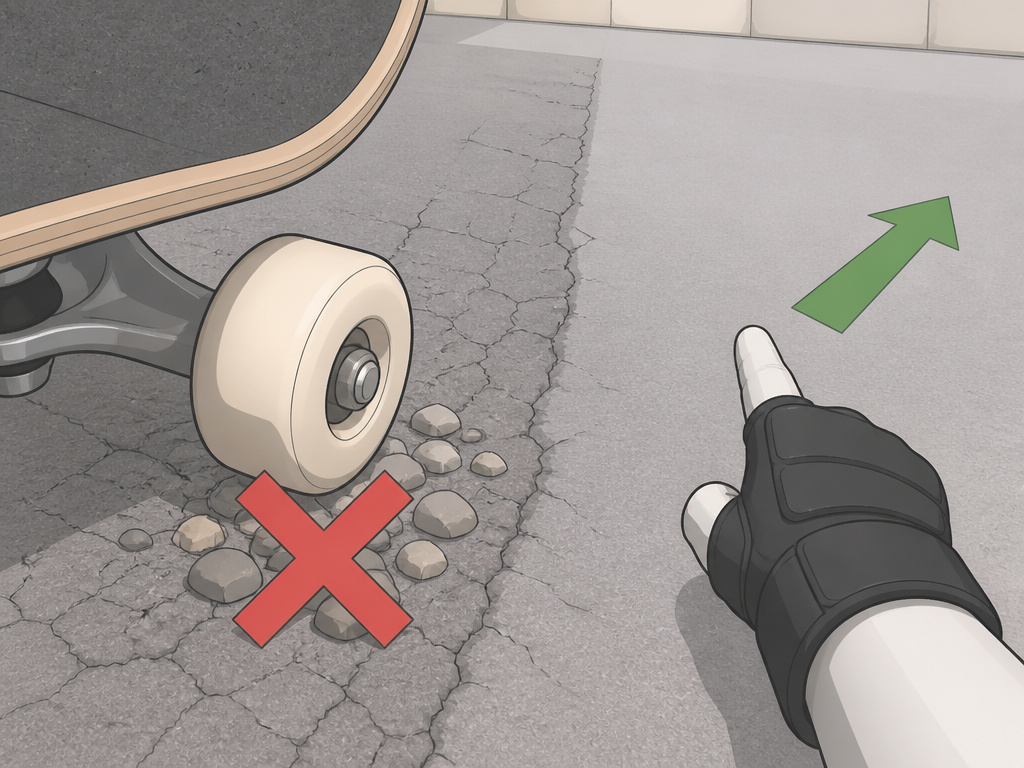
You can’t sweep a city street. You can choose where you skate. The RazorX Cruiser Electric Skateboard manual is brutally clear: the board is for “flat, dry surfaces… Without loose debris, such as sand, leaves, rocks or gravel.” It warns against “sharp bumps, drainage grates, and sudden surface changes.” For electric boards, a pebble isn’t just a fall risk—it can break a motor guard or disconnect a battery lead.
For regular skateboards, some surfaces you can skate on are inherently riskier. The Public Skatepark Guide calls out a specific design failure: “Pea gravel and crushed rock are absolutely inappropriate for ground cover edging a skatepark.” That gravel migrates onto the riding surface, creating a permanent pebble hazard.
Easy to miss: Park design can be your enemy. If your local park has gravel borders, the first few feet of concrete will always be littered. Start your session farther in.
Here’s what you control:
- Your starting point: Begin your push on clean pavement, not in debris zones.
- Your line: Steer around visibly rocky patches. A wide, smooth parking lot line is better than a direct, gritty path.
- Your speed: Sources disagree on the impact of speed: Skatezoned.com suggests you only fall at low speeds, while some Reddit anecdotes imply higher speed helps.
- Your exit: If a section looks like a gravel pit, step off and walk. It’s not a defeat; it’s terrain management.
When You Can’t Avoid the Fall
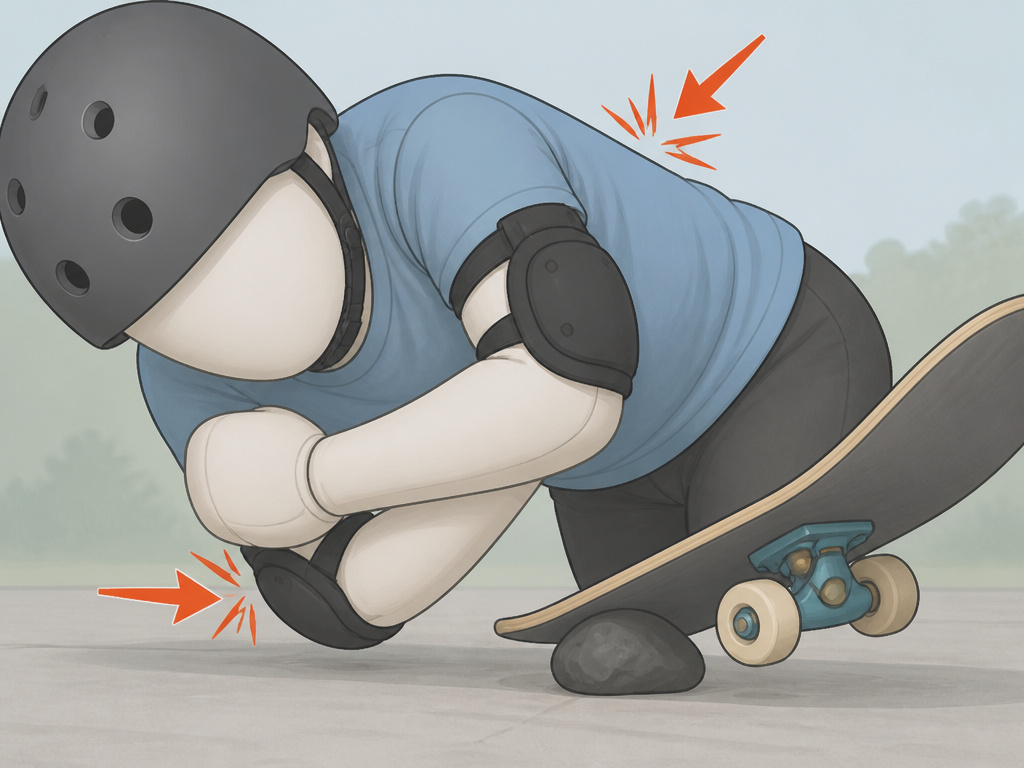
You will hit a hidden pebble. The board will stop. Knowing how to fall safely on a skateboard is your last-layer defense.
The mechanics of a pebble fall are usually forward and down. You’re not flying from a high trick; you’re tipping over the nose from standing height.
- Tuck and roll: If you feel yourself going over the front, try to turn your body into a shoulder roll. Don’t stick your arms out straight to catch yourself—that’s a wrist fracture waiting to happen.
- Spread the impact: Let your forearm, shoulder, and back take the scrape, not your wrist, elbow, or head.
- Relax: Tense muscles get injured more easily. It’s hard to do, but a loose, rolling fall hurts less than a rigid slam.
The AAOS skateboarding safety PDF emphasizes protective gear, and for good reason. A helmet is essential. Wrist guards are especially valuable for these sudden, low falls where your instinct is to put your hands down.
The Electric Skateboard Edge Case
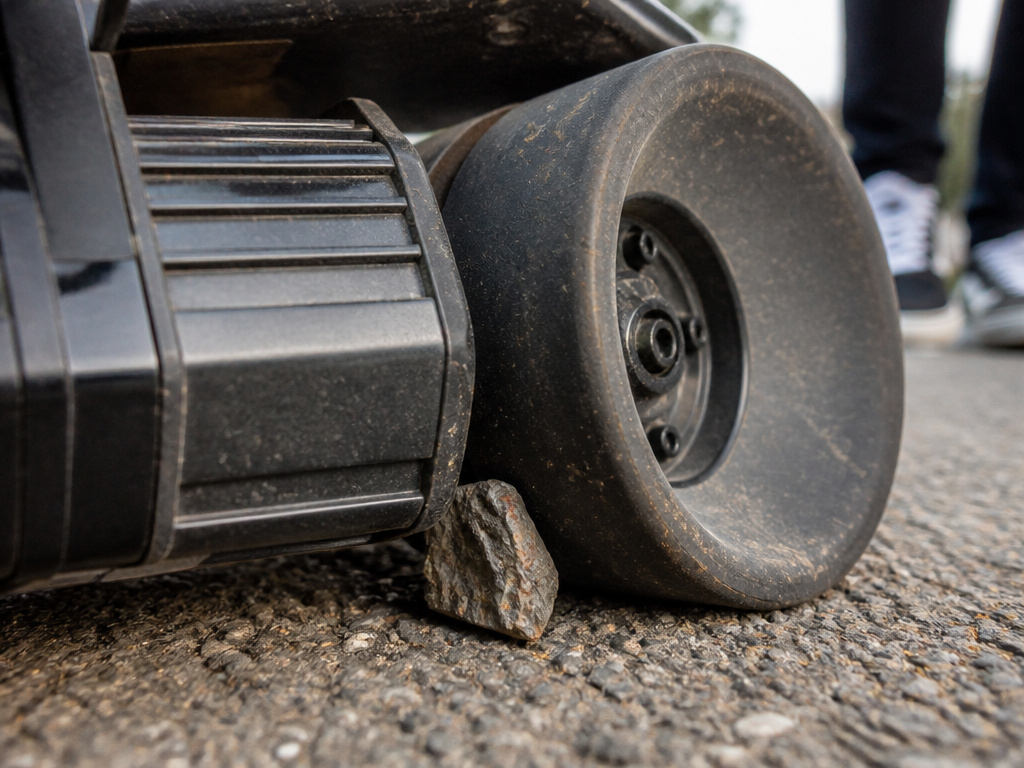
Electric skateboards like the RazorX Cruiser add another layer. Their manual states the motor only engages when the board is moving at least 3 mph. Imagine hitting a pebble at low speed. The board stops, the motor disengages, and you now have a 15-pound dead-weight board to carry. If you’re miles from home, that’s a real problem.
Their weight limit (220 lbs) and age recommendation (9+) also factor in. A heavier rider must stay within the board’s 220 lb weight limit, and the motor only engages above 3 mph. What a regular board might roll over, an electric board might stall on. The safety rules are stricter because the failure modes are more complex than just falling.
If you ride electric, the pre-ride inspection the CPSC talks about becomes critical. Your route needs to be as clean as the manual demands, because the consequences of a stop are higher.
Frequently Asked Questions
Can hard wheels roll over pebbles?
Yes, but it requires perfect technique. A very experienced rider can shift their weight so precisely that a 101a wheel deflects a small pebble. For beginners and most cruisers, the margin for error is tiny. Softer wheels (97a and below) provide forgiveness by absorbing the impact, making the skill easier to learn.
Do bigger wheels really help?
Absolutely. Larger wheels (60mm vs 52mm) have a greater contact patch and roll over obstacles rather than catching on them. Think of a bicycle wheel versus a skateboard wheel going over the same crack. The bigger wheel bridges the gap. For tackling rough pavement, larger diameter is one of the best wheels upgrades you can make.
Should I practice on pebbly ground?
Deliberately skating over a field of pebbles is a bad idea. Practicing your weight-shift technique on a known, slightly rough surface is excellent. Find a patch of bumpy asphalt or a sidewalk with manageable cracks. Work on feeling the board slow down and using your back foot to control the pitch. This builds the reflex you need for accidental pebble hits.
Why do I sometimes see pros skating on terrible ground?
Video parts are curated. As one Reddit user noted, “there was at least 30 minutes worth of sweeping and cleanup before anybody started skating or filming.” Pros also have years of ingrained weight-shift reflexes and often use harder wheels that they can control perfectly. Don’t compare your street cruise to a filmed pro section.
Before You Go
One threshold changes everything: if you can’t see the pebbles coming, you’re going too fast for the surface. Slow down until your two-second scan works. That speed is different for a bumpy backstreet than for a smooth park path.
Your first concrete step this week is to check your wheels. Are they under 56mm and harder than 99a? If you cruise more than you trick, a swap to a 58mm 86a wheel will feel like a new board. It’s the single most direct fix.
All this assumes a standard skateboard. If you’re on an electric model, the calculus is different—your manual’s terrain rules aren’t suggestions, they are the engineering limits of your battery and motor. Respect them, or you’ll be carrying a very expensive plank.
