
What Age Should a Kid Start Skateboarding? Where to Begin
This post contains affiliate links. As an Amazon Associate, we earn from qualifying purchases.
Most major health and safety organizations agree: children younger than 5 years should not ride skateboards. For kids aged 5 to 10, close adult supervision is mandatory, with the exact age range depending on which authority you follow. The right start involves a properly sized board, a helmet certified to the ASTM F1492 skateboard standard, and a safe, flat practice area.
That split between a hard prohibition (under 5) and a supervision window (5-10) is where parents get stuck, often wondering what age should a kid start skateboarding. Pediatric sources like the American Academy of Pediatrics draw a line at age 6 for the start of the supervision range, while the Canadian group Parachute starts at age 5, and consumer safety agencies like the CPSC use a simpler cutoff at age 8. Neither side is wrong, they’re measuring different things. Your job is to pick the rule that matches your child’s coordination and your ability to watch them without a single distraction.
What follows: a breakdown of the official age rules and their sources, the physical signs of readiness that matter more than a birthday, how to spot and skip the toy-store gear trap, and the one safety statistic that changes the entire conversation.
Key Takeaways
- Major pediatric groups say no skateboarding under age 5, and kids aged 6–10 need close supervision, but the Consumer Product Safety Commission uses a simpler under-8 rule.
- One-third of all skateboarding injuries happen in the first week, according to the American Academy of Pediatrics, which is why supervised, patient beginnings are essential.
- A proper skateboarding helmet (ASTM F1492 standard) cuts the risk of traumatic brain injury by 45%; wrist guards reduce injuries by almost 90%.
- The best starter board is a real skateboard, not a toy; choose a pre-assembled complete with a shorter, wider deck and softer, wider wheels for stability.
- Signs of readiness, like confidently riding a bike with training wheels or showing sustained interest for over a week, are better indicators than age alone.
The Official Age Guidelines (and Where They Differ)
You’ll find two types of rules in the official pamphlets: hard prohibitions and supervision requirements. The prohibition is universal. The supervision age is where the fine print lives.
The American Academy of Pediatrics states children younger than 5 years should not ride skateboards. For children aged 6 to 10 years, they mandate close adult supervision. Seattle Children’s Hospital echoes this, advising supervision for your 6- to 10-year-old. The Canadian injury prevention group Parachute also starts its supervision range at age 5.
The Consumer Product Safety Commission (CPSC) fact sheet uses a single, easier-to-remember cutoff: “Children under 8 years old should be supervised closely.” This creates a practical overlap. A cautious parent might follow the AAP’s 6-10 range, while a busy one might adopt the CPSC’s under-8 rule. Both aim for the same outcome: a watchful eye on a beginner.
The logic behind the age-5 floor is about physical development. Before age 5, most children lack the advanced balance, coordination, and judgment needed to manage a moving board and its sudden stops. Their heads are also proportionally heavier, making falls more dangerous.
| Organization | Minimum Age | Supervision Age Range | Core Reasoning |
|---|---|---|---|
| American Academy of Pediatrics (AAP) | Not under 5 | 6–10 years | Advanced balance and judgment develop around 5–6; close watch prevents early mishaps. |
| Consumer Product Safety Commission (CPSC) | Not specified | Under 8 years | Simplified, enforceable rule for a broad age group where risk is highest. |
| Parachute Canada | 5 and up | 5–10 years | Aligns with AAP, emphasizing that skateboarding demands physical skills toddlers don’t have. |
Where does that leave a mature 4-year-old who’s been on a balance bike since age 2? The rules are boundaries, not guarantees. My stance is simple: if you’re even asking if your 4-year-old is ready, the answer is probably no. Wait the year. The risk isn’t worth the bragging rights, and a child who starts at 5 with better control will progress faster than one who started shaky at 4.
Signs of Readiness: More Than Just a Number
Age is a convenient line, but it’s a blunt instrument. I’ve watched an 8-year-old freeze on a board they begged for, and I’ve seen a focused 5-year-old learn to push in an afternoon. The difference wasn’t age, it was readiness.
Look for these physical and behavioral cues before you even buy the board:
- Sustained interest. Does the child ask about skateboarding for more than a week, or is it a passing fascination? The Reddit parent who sparked this article noted their 2.5-year-old asked for a board daily for a week, an unusual focus for a toddler, but still not enough to override the age rule.
- Basic coordination. Can the child run, jump, and stop with control? Can they ride a bike with training wheels or a scooter? Seattle Children’s Hospital notes that by age 4, kids often have the balance for four-wheeled skates; by 6, most can stand on inline skates. That’s the kind of balance you’re looking for.
- Ability to follow instructions. Can they listen to a simple safety rule (“always step off this way”) and remember it when excited?
- A willingness to wear safety gear. If they fight the helmet before the board even arrives, you’re already in a tough spot.
The reality is this. If your child is 7 but has never been on anything with wheels, they might need more supervision than a 5-year-old who lives on a balance bike. The official age bands are your starting filter for the what age should a kid start skateboarding decision, not your final answer. Assess the kid in front of you.
Choosing a First Skateboard: Skip the Toy Store
Walk down the toy aisle and you’ll see them: brightly colored plastic mini-boards with cartoon graphics, often marketed to preschoolers. My strong opinion? Avoid them. They’re usually too light, have dead, hard wheels that don’t roll well, and their trucks are impossible to adjust. They teach kids that skateboarding is frustrating and wobbly.
Instead, get a real skateboard designed for small beginners. Brands like Element and Powell Peralta make high-quality completes in smaller sizes.
For a first real board, look for a pre-assembled complete setup with a shorter, wider deck and softer, wider wheels for stability. The CDC notes pre-assembled boards are best for beginners, and Parachute advises that shorter decks are easier to balance.
A real skateboard designed for small beginners is a typical starting point. The softer, wider wheels provide stability and smooth over sidewalk cracks, which builds confidence. The board will actually roll when pushed, which is the whole point.
This is where my gear preference clashes with a common parent instinct. You want to buy cheap in case they lose interest. I get it. But a bad board guarantees they’ll lose interest. A skateboard that isn’t bad gives them a fighting chance. If they do quit, a complete holds resale value far better than a broken toy.
The Non-Negotiable Safety Package
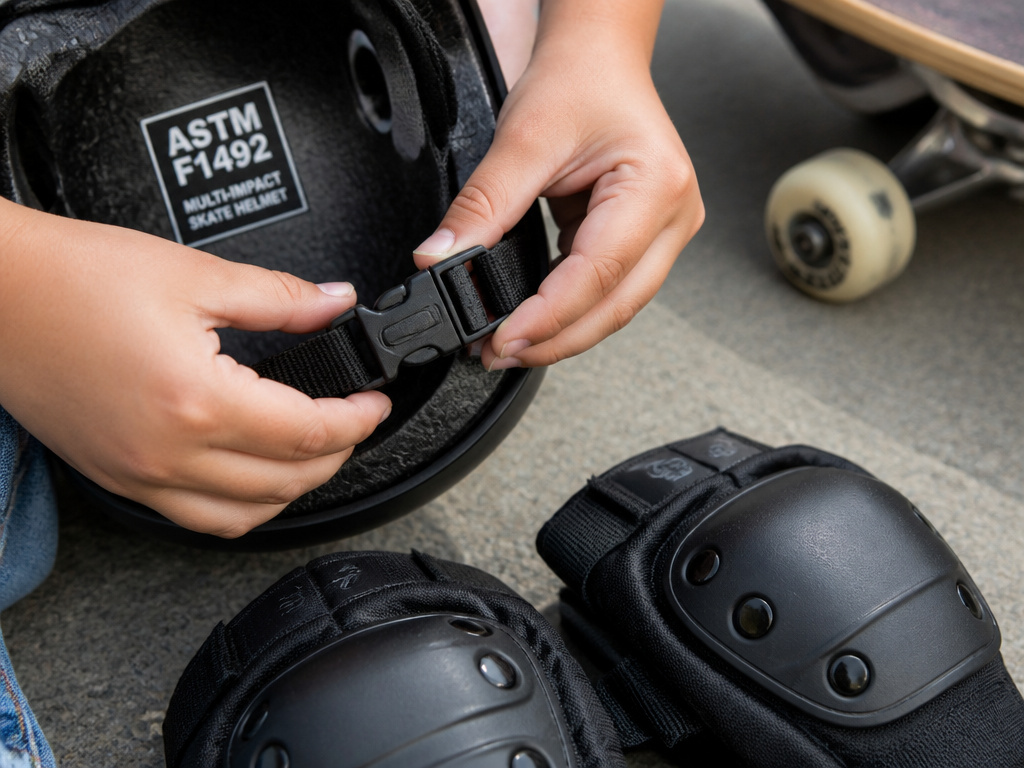
You cannot talk about the what age should a kid start skateboarding question without talking about gear. The statistics here are not subtle. According to the AAP, wrist guards reduce injuries by almost 90%. Elbow pads cut injuries by 80%, knee pads by 30%. A Parachute study found a skateboarding helmet cuts traumatic brain injury risk by 45%.
To be specific. The helmet is the most important piece, and not just any bike helmet will do.
| Gear Piece | Certification to Look For | Why It Matters for Skateboarding |
|---|---|---|
| Helmet | ASTM F1492 (Skateboard standard) or Snell B-95 | Covers more of the back of the head; designed for multiple impacts from falls, not single crashes. |
| Wrist Guards | CE or ASTM F1430 | Prevent hyperextension during forward falls, which are most common for beginners. |
| Knee & Elbow Pads | Hard shell with foam lining | Absorb impact from sideways or backward spills on concrete. |
Seattle Children’s Hospital specifies helmets should meet the ASTM F1492 skateboard helmet standard. The CDC mentions the Snell B-95 standard. This is a point of source disagreement: Seattle Children’s Hospital specifies the ASTM F1492 standard, while the CDC mentions the Snell B-95 standard. In practice, choose a dual-certified helmet (like those from Triple Eight) that meets both CPSC bike and ASTM F1492 skate standards. It’ll say so right on the label.
The sensory reality here is the click of a buckled helmet strap and the solid thump of a knee pad taking a hit during a practice fall. That thump is the sound of the gear working. Without it, the sound is a cry.
Where and How to Start Those First Sessions
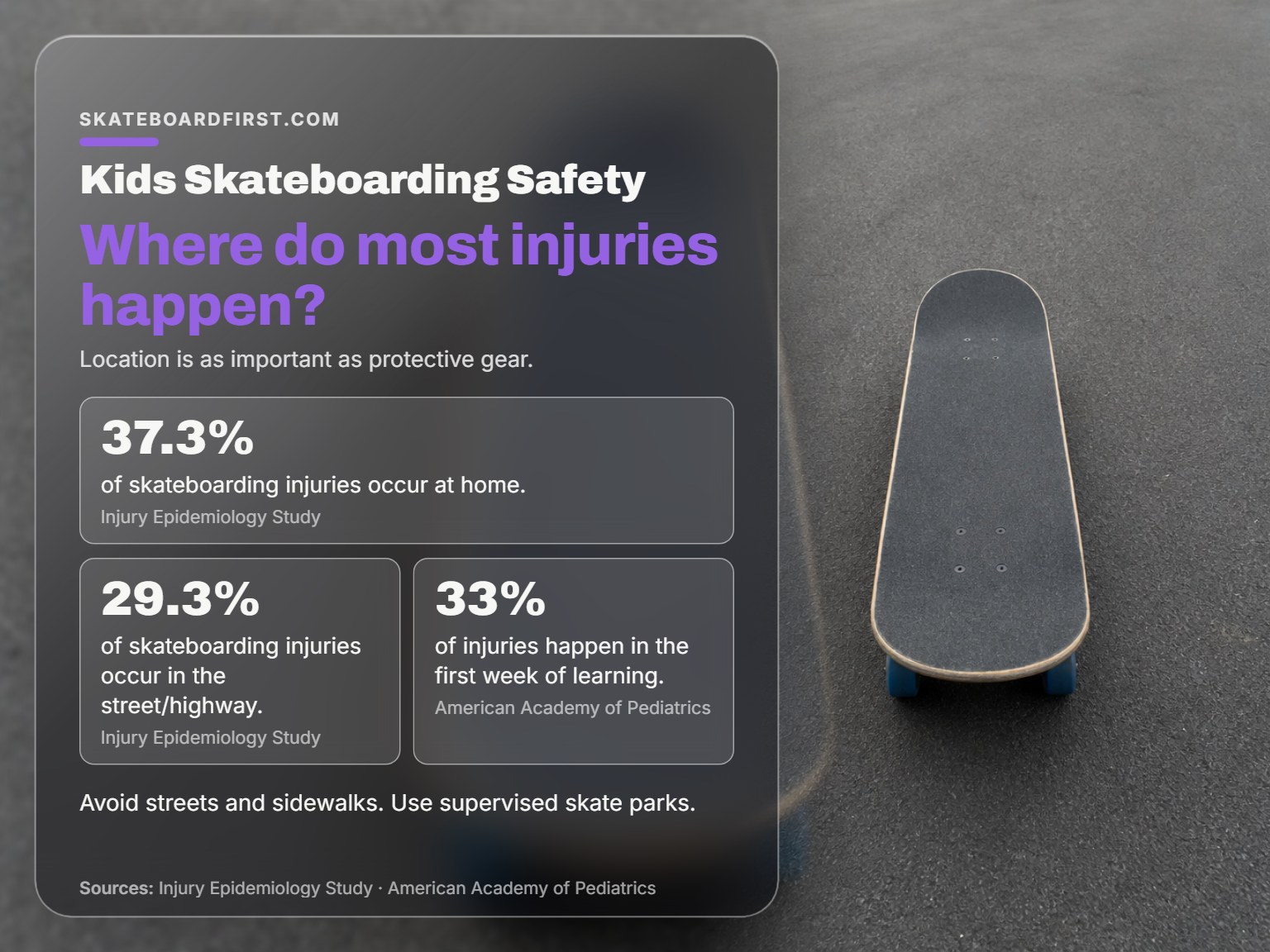
Location decides safety as much as gear does. An Injury Epidemiology study found most skateboarding injuries occur at home (37.3%) or in the street/highway (29.3%). Younger kids get more face injuries; older kids break more arms and legs.
Avoid skateboarding on city streets, public sidewalks and parking lots. Skateboard only in supervised, specially designed skateboarding parks. – Parachute Canada
The ideal starter spot is a smooth, flat, empty parking lot or a driveway with a gentle slope. Schoolyards after hours can work. The surface needs to be predictable, no gravel, wet patches, or cracks wide enough to swallow a wheel.
The first session isn’t about skating. It’s about standing.
- Gear up. Full kit: helmet, wrist guards, knee and elbow pads.
- Place the board on grass or a rubber playground surface. Let them step on and off, rock side to side, and feel the board tilt without it rolling.
- Practice stepping off. Teach them to step forward off the nose, not jump off randomly. Do this twenty times. It builds the muscle memory for a safe bail.
- Find a flat, smooth pavement. Hold their hands while they stand on the board, then pull them gently so they feel the roll. Keep sessions to 15-20 minutes. Quit while they’re still having fun.
One Reddit user shared a great tip: they taught a 3-year-old on a very gentle bank because the slight slope helped her find her balance naturally, which worked better than flat ground. The lesson? Follow the child’s comfort. If they’re scared of the roll, go back to the grass.
Is 12 Too Old to Start Skateboarding?
This question pops up constantly in “People also ask” boxes. The short answer is no. Twelve is not too old. It’s a fantastic age to start.
A 12-year-old has better strength, coordination, and cognitive ability to understand risk than a 6-year-old. They can watch a tutorial, process the steps, and practice deliberately. The injury statistics shift, too, older adolescents sustain more lower extremity injuries, while younger kids get more upper body and face injuries. The risks change, but the passion is the same.
I started much later than 12. The advantage you have as an older beginner is patience. You’re choosing the sport, not being guided into it by a parent. You’re less likely to throw the board down in frustration after one fall. The community might feel intimidating, but most skaters respect anyone who shows up and puts in the work, regardless of age.
If a 12-year-old is asking, they’re ready. Get them the right gear, find a safe spot, and let them progress at their pace. They might even catch up to the kids who started at 6 within a year.
Frequently Asked Questions
What is the youngest age to start skateboarding?
Most medical and safety authorities recommend skateboarding only for children ages five and up. The American Academy of Pediatrics explicitly states children younger than 5 years should not ride skateboards due to underdeveloped balance and judgment.
At what age did Tony Hawk start skateboarding?
Tony Hawk received his first skateboard at age 9 from his older brother. He began skating regularly shortly after, which aligns with the upper end of the common “6-10 with supervision” guideline. His early start is legendary, but the skateboards and safety culture of the 1970s were very different.
Is 12 years old too late to start skateboarding?
No, 12 is not too late. Many skaters begin in their early teens. At 12, a child has better physical control and can understand safety concepts more deeply than a younger kid. The key is the same as for any age: proper gear, a safe practice area, and patience.
What size skateboard is best for a 6-year-old?
For an average 6-year-old, a shorter, wider deck is ideal. Choose a pre-assembled complete skateboard with softer wheels (around 78A-85A durometer) for stability. Brands like Element and Powell Peralta offer quality completes in these sizes. Always consult a skateboard size chart for height-based recommendations.
How can I find skateboarding lessons for kids?
Search for local skate shops or indoor skateparks, as they often host clinics or know certified instructors. Community centers and YMCAs sometimes offer beginner programs. You can also look for dedicated skate schools in your area. An instructor teaches safety and fundamentals first, not tricks. Our guide to skateboarding lessons for kids breaks down what to look for.
Before You Go
The number one rule isn’t about age at all. It’s about the helmet strap. If you remember nothing else, remember this: a helmet certified for skateboarding, worn correctly every single time, is the line between a scary story and a life-changing injury. The data from the AAP skateboarding safety guide and the CPSC skateboarding safety fact sheet is unanimous on that point.
Start small. A fifteen-minute session in the driveway with full gear is a better foundation than an hour at a crowded park. Let the child’s interest drive the pace, not your ambition. And if you take away one actionable step from this whole guide, make it this: visit a real skate shop, not a toy store, for that first board. The person behind the counter will help you choose a skateboard for a child that actually rolls, and that single choice changes everything.
Now go watch them push. That’s the whole point.
