
Skateboard Size Chart by Age: How to Choose Correctly
This post contains affiliate links. As an Amazon Associate, we earn from qualifying purchases.
Match three things: the child’s age, their shoe size, and the type of skating they’ll do. Age gives you a starting width range, like 7.5 to 7.75 inches for ages 6-8. Shoe size refines it within that range. The skating style, just riding versus trying tricks, locks in the final pick. A board that’s too wide turns clumsily; one that’s too narrow feels twitchy under big feet.
That age-to-width link is a proxy, not a law. Manufacturers use it because height and coordination generally track with age. But a tall 8-year-old in size 6 shoes needs a different board than a petite 8-year-old in size 3. The charts get you in the ballpark, which is why you’ll often consult a skateboard size chart by age. Shoe size and intention get you to home plate.
What follows: a breakdown of the major brand charts, where they disagree, and how to use shoe size as your tiebreaker. We’ll also cover the special case of learner skateboards with handles, and the one safety rule that overrides all sizing.
Key Takeaways
- Start with the manufacturer’s age chart, but treat it as a range, not a single answer. Sources disagree on the age range for a 7.5-inch deck: Santa Cruz recommends it for ages 4-8, evo for ages 6-8, and Meow for ages 6-11.
- Use US men’s shoe size to narrow the choice within the age range.
- Learner/toy skateboards like the Ookkie or Fisher-Price Grow-to-Pro have strict age and weight limits (e.g., 5-7 years, 100 lbs) and are a separate category from standard deck sizing.
- Stability trumps trickability for beginners. If a child is between two sizes, size up for a more comfortable, confidence-building platform.
- Truck width must match deck width. Pairing an 8.0-inch deck with narrow trucks hurts balance and can cause wheel-bite. Independent, Tensor, and Thunder make trucks labeled for specific deck widths.
The Core Age-to-Width Chart (and Why It’s a Starting Point)
Here are the numbers. These come straight from the retailer and manufacturer guides people actually use.
| Age Range | Deck Width Range | Key Source & Notes |
|---|---|---|
| 5 years or younger | 7.0″ – 7.5″ (evo) | evo.com recommends 7.0″-7.5″, Santa Cruz recommends 7.25″, and Meow recommends 6.50″. Also correlates to height under 3’4″ and shoe size US men’s 3 or smaller. |
| 6 – 8 years | 7.5″ – 7.75″ | evo.com retailer chart. Also correlates to height 3’5″-4’4″ and shoe size US men’s 4-6. |
| 8 years and older | 7.75″ – 8.25″ | evo.com retailer chart. Also correlates to height 4’5″-5’2″ and shoe size US men’s 7-8. |
This 50-60 word technical summary covers the primary age-to-width correlations from a major retailer. Deck width is the primary sizing metric, with supporting correlations to rider height and US men’s shoe size provided for further refinement. These ranges serve as the baseline for standard popsicle-shaped skateboards.
You’ll notice the ages overlap. That’s the first clue these are guides, not gospel. An 8-year-old appears in two rows. That’s fine. It means you have a 7.75-inch deck as a potential pivot point.
The reason width matters is simple physics. A wider deck gives a bigger platform for the feet. It feels more stable when pushing, rolling, and learning to turn. A narrower deck is more nimble for flip tricks, ledges, and technical skating. Beginners are focused on staying balanced rather than performing those tricks.
Where Brand Charts Disagree (And How to Read Them)
If you look up “Santa Cruz Skateboards size guide” or “Meow Skateboards complete specs,” you’ll get different numbers. These differences reflect each brand interpreting the same basic idea through their product line.
Santa Cruz breaks it into named sizes with specific lengths and wheelbases, which is useful if you’re buying their completes. Their “Micro” size (7.5″ wide) is for ages 4-8. Meanwhile, evo’s chart puts a 7.5-inch deck squarely in the 6-8 range. Meow Skateboards suggests a 7.5-inch deck for the broad span of ages 6-11.
Common mistake: Picking a deck based solely on a single brand’s age label. A “Mini” board from one brand might be a “Mid” from another.
The table below shows how the same deck width gets different age brackets.
| Deck Width | evo.com Recommendation | Santa Cruz Skateboards | Meow Skateboards |
|---|---|---|---|
| 7.5 inches | Ages 6 – 8 years | Micro size: Ages 4 – 8 years | Ages 6 – 11 years |
| 7.75 inches | Ages 8 years and older | Mini size: Ages 6 – 10 years | Part of range for older kids |
Why the difference? Brand lineups and target audiences. Santa Cruz’s “Micro” is part of a full range starting at “Super Micro” (7.25″) for toddlers. Their scale is finer at the little-kid end. Meow’s 7.5-inch complete is often a popular, affordable first board, so they cast a wider net. The takeaway: width is consistent, age labels are flexible. A 7.5-inch deck is a 7.5-inch deck. The age suggestion helps you sort through options, but the physical measurement doesn’t change.
What About Height and Shoe Size?
Age is easy to know. Height is easy to measure. But for board feel, consulting a skateboard size chart by age is just the first step; shoe size is the dark horse that wins the race. Your foot tells you how much room you need to stand comfortably.
Evo’s chart links them directly: a US men’s shoe size 4-6 correlates to the 6-8 age range and that 7.5-7.75-inch width. Here’s the translation: if your child wears a size 5 shoe, a 7.5-inch deck will likely feel just right. If they’re in a size 6, leaning toward the 7.75-inch end of the range gives their toes and heels a bit more real estate. This is where the skateboard deck width for shoe size logic really pays off.
Height matters less than people think for deck width. A taller kid might have longer legs, but their feet might still be a size 5. Height is more useful for considering the board’s length and wheelbase (the distance between the trucks). Width is king for control.
The Special Case of Learner and Toy Skateboards
This is where the standard charts stop. Products like the Ookkie Skateboard or the Fisher-Price Grow-to-Pro 3-in-1 are engineered as learning tools with specific age and weight limits, not sized by deck width.
- The Ookkie has a 7-inch wide deck but is designed for two modes: Parent Assist (12-36 months, up to 20kg) and Child Only (age 3+, up to 50kg). Its instructions state it must be used “under the direct supervision of an adult at all times” for the 3+ age group.
- The Fisher-Price Grow-to-Pro is for ages 5-7 with a strict 100 lb (45 kg) weight limit. Its manual notes the trucks are factory-adjusted to the stiffest setting for beginner stability.
These aren’t bad choices. They serve a different purpose. They bridge the gap between a toddler ride-on toy and a real skateboard. The key is recognizing they exist in a separate category with hard limits. You don’t use the standard skateboard size for height and weight charts for them. You follow the manufacturer’s age, weight, and supervision rules to the letter.
The U.S. Consumer Product Safety Commission (CPSC) recommends children under 8 be supervised closely, a guideline echoed in the CPSC skateboarding safety fact sheet. For products like the Ookkie, supervision is essential.
How to Choose: A 3-Step Decision Flow
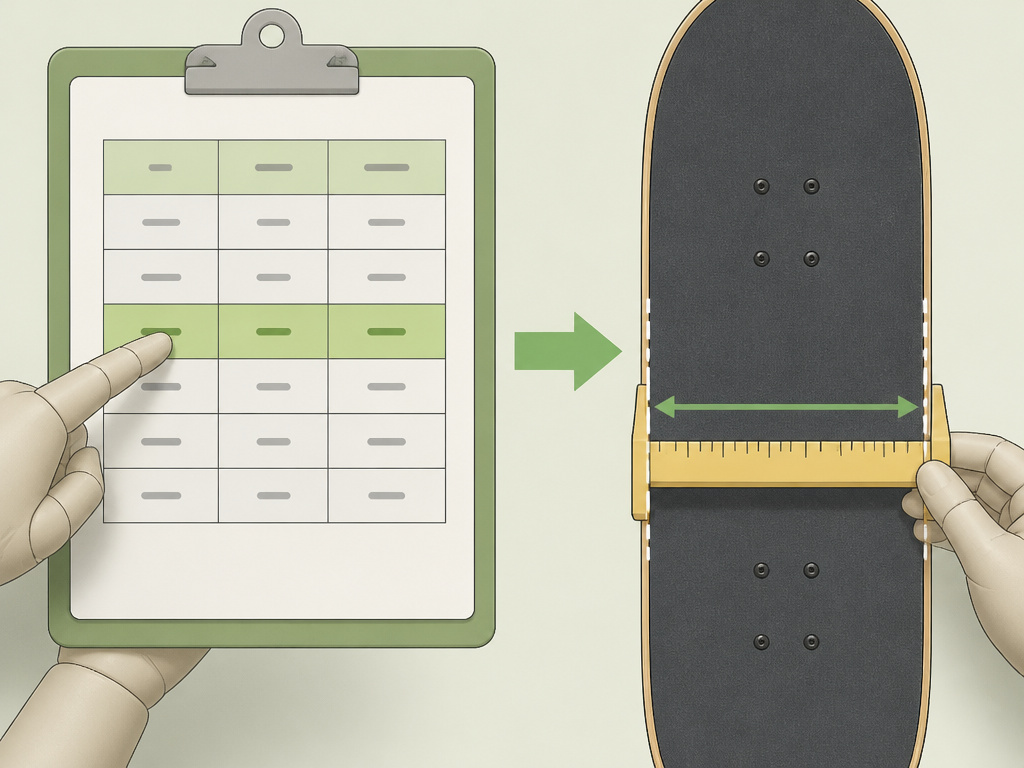
So you have a skateboard size chart by age, a shoe size, and maybe a specific product in mind. How do you actually decide?
- Lock in the width range from age. Is your kid 7? The charts point you to the 7.5-7.75″ zone.
- Refine with shoe size. Are they in a men’s size 6? That pushes you to the upper end of that range, the 7.75″ option.
- Finalize with skating intent. Is the goal just to ride up and down the driveway? A 7.75″ deck from a brand like Real or Element will be perfect. Are they interested in technical skating? A narrower deck within the range is more nimble for tricks, but a wider deck is more stable for riding.
This process also answers the common parental dilemma: buy for now or buy for growth? If the child is squarely in the middle of an age/shoe range, get the board that fits them now. A well-fitting board accelerates learning. If they’re at the very top edge of a range, about to jump a shoe size, sizing up slightly is reasonable.
Safety, Supervision, and the Law

Sizing is about performance. Safety is about prevention. They work together.
A correctly sized board is inherently safer because the rider has better control. But protective gear is the essential requirement. This is especially critical for young kids whose coordination is still developing. A skateboard safety gear for kids setup, helmet, knee pads, elbow pads, wrist guards, is an essential requirement.
Supervision levels vary by age and local law. The CPSC recommends children under 8 be supervised closely, while products like the Ookkie Skateboard require direct adult supervision for ages 3+. More specific is something like New Jersey state law, which requires helmet use for skateboarders under 17, as cited in the New Jersey toy safety consumer brief. Your local municipality may have its own rules about where you can skate. Know them.
Where this goes sideways: Assuming a helmet is enough.
Frequently Asked Questions
What size skateboard for a 10-year-old?
Check the charts: the 8+ range suggests 7.75″ to 8.25″. Most 10-year-olds will do great on an 8.0″ deck. Use shoe size to confirm: if they’re in a men’s size 7 or 8, an 8.0″ is ideal. If they have smaller feet (size 6), a 7.75″ might be a better fit.
Is a 7.75 skateboard good for a 12-year-old?
It can be, especially if the 12-year-old is smaller, a beginner, or interested in technical street tricks. However, many 12-year-olds, particularly those who have gone through growth spurts, will find an 8.0″ or 8.25″ deck more comfortable and stable for general riding.
How do I know if a skateboard is too small?
The main signs are physical. The rider’s feet (especially the balls of the feet and heels) hang noticeably off the edges of the deck when in a normal standing position. It’s like wearing shoes that are a size too small, you can technically stand, but you can’t walk comfortably.
My child is between sizes. Should I size up or down?
Size up. A slightly wider deck offers more stability and a comfier platform, which builds confidence for a beginner. The upside, feeling secure, is everything. The risk of sizing down is a board that feels uncontrollable, which can lead to frustration and quitting.
Are skateboard size charts accurate?
They are accurate as a starting point. They aggregate typical child development to give you a valid range. Their weakness is they can’t account for individual differences in height, shoe size, coordination, and personal comfort. Use the chart to narrow the field, then use shoe size and a honest assessment of the child’s coordination to make the final call from within that range.
The Bottom Line
Forget finding one perfect number. The right size comes from a quick three-step filter: age gives you the range, shoe size points you within it, and skating intention makes the final call. When in doubt, go wider for stability. And remember, the charts from evo, Santa Cruz, and Meow are all useful, their disagreements just prove that a 7.5-inch deck can work for a span of ages, not just one.
The one hard rule? Safety gear is essential, and for young kids, so is supervision. Everything else, the exact width, the brand, the graphic, is secondary to getting a board that feels solid under their feet. That feeling is what turns a wobbly first push into a real ride.
Start there. The tricks come later.
