
Skateboard Storage Ideas for Small Spaces
This post contains affiliate links. As an Amazon Associate, we earn from qualifying purchases.
Skateboard storage in a small space means using vertical air, not floor space. The best options are wall-mounted racks, multi-level hooks, or freestanding floor stands that tuck into corners. For a truly tiny spot, a simple deck stand or under-bed storage works, but you trade quick access for tidiness.
That vertical rule primarily protects your board from the three things that ruin gear in cramped quarters: accidental kicks, moisture from a floor-level draft, and dust bunnies that collect under furniture. A board leaning against a wall gets scuffed every time someone passes. One on the floor is a toe-stub magnet. This is why skateboard storage ideas for small spaces focus on getting your gear off the ground.
What follows is a breakdown of five proven storage types central to skateboard storage ideas for small spaces, each with a real product example and the specific trade-off it asks of you. This guide includes wall mounts, freestanding racks, DIY builds, compact stands, and hidden storage, along with how to choose an option based on your room and skating frequency.
Key Takeaways
- Mounting boards on the wall with a rack like the Trifecta Skateboard Storage Rack clears floor space completely and turns your board into display art.
- A freestanding unit like the Nojima SBP-0110 is movable and doesn’t need wall holes, but its powder-coated steel can rust if kept in a damp garage.
- The FORMUFIT PVC rack plan allows you to build a custom, floor-standing holder for about five boards, but it requires tools and time.
- A simple deck stand is the cheapest and most compact option for a single daily rider, but it offers zero protection from dust or pets.
- Storing a board under your bed or in a closet is free, but comes with a high probability of dust-bunny contamination and warp risk from temperature shifts.
Wall-Mounted Racks: The Space-Saving Gold Standard
When floor space is the enemy, you go up. Wall-mounted racks use the vertical plane you’re already paying for but not using. The physics are simple: get the board off the ground and secure it flat against the wall.
The classic design is outlined in U.S. Patent US5305897A, which describes a rack with support arms for the wheels and guide members to keep the board vertical. That’s the blueprint most commercial racks follow.
A wall-mounted rack isn’t just a hook. It’s a system that cradles the trucks or deck at two or more points to prevent the board from swinging out and scratching your wall, or crashing down.
I learned this after mounting a board on two simple hooks. It looked fine for a week. Then a door slammed, the vibration traveled through the wall, and the board pivoted on one hook and gouged a two-inch scrape in the drywall. The fix was a rack with proper spacing.
What to Look For (and What to Avoid)
A rack like the Trifecta Skateboard Storage Rack does two things well: it holds the board securely and it protects your wall. The Trifecta Skateboard Storage Rack is a common pick. Its specs tell the story: it’s made of ABS plastic, measures 6.5” L x 1.5” W x 16.5” H, and has an adjustable stud spacing so you can fit it on any wall stud layout. The weight limit is 40 lbs, which covers any standard setup.
The Nojima SBP-0110 is a different take, a floor-standing unit, but its wall-mount sibling models follow the same principle of specific truck compatibility. The SBP-0110 is designed for trucks with inner axle widths from 11.6cm, like Independent 129s. If your trucks are wider or narrower, the board won’t sit flush. That’s the kind of spec you must check.
The part nobody mentions: Moisture against an exterior wall. If you mount a board on a cold, exterior wall in a humid room, condensation can form between the deck and the wall over time. You’ll see a faint water stain on the grip tape after a few months. Leave a half-inch air gap if you can.
Freestanding & Floor Stands: No-Drill Mobility
Not everyone can drill into their walls. Landlords, concrete construction, or just rental anxiety, it’s a real barrier. That’s where freestanding options come in. They sit on the floor but are designed to be space-efficient.
The Nojima SBP-0110 Skateboard Storage is the archetype here. It’s a powder-coated steel stand measuring 20cm wide by 28cm tall. It holds a board by the trucks, keeping it upright and stable. Its rated weight capacity is 2.50 kg.
| Feature | Nojima SBP-0110 | Generic Floor Stand |
|---|---|---|
| Material | Powder-coated steel | Often plastic or thin metal |
| Weight Capacity | 2.50 kg (per spec sheet) | Often unrated |
| Key Risk | Coating wears from truck contact, leading to rust | May tip with heavier longboards |
| Best For | Dry, indoor spaces; specific truck sizes | Light boards, temporary use |
Where this goes sideways: The Nojima manufacturer explicitly warns that its powder coating can wear off from contact with trucks and hard surfaces, leading to rust. This isn’t for a damp garage or balcony.
Freestanding racks are easy to move. You can slide them from a bedroom corner to a closet when guests come over. But that mobility has a cost: they still claim floor space, and a top-heavy one can tip if a board is removed roughly. Choose a rack with a wide, weighted base.
DIY Skateboard Racks: Custom Fit, Sweat Equity
If you have tools and a free afternoon, a DIY rack cuts the cost to materials alone. You can also build exactly what you need, such as a rack for two boards, five boards, or boards plus helmets.
The FORMUFIT PVC Skateboard Rack plan is a popular free guide. It uses 1-inch Furniture Grade PVC pipe and fittings. The default design is a floor-standing rack about 22 inches tall that holds up to five boards.
Why PVC? It’s light, easy to cut, and the fittings are friction-fit, no glue required if you want to disassemble it later. A 10-foot pipe and the elbow and tee fittings are readily available. The whole build can be inexpensive.
The process is straightforward:
- Cut the PVC pipes to the lengths in the plan (a hacksaw or PVC cutter works).
- Dry-fit the pieces to form the rack’s frame, usually a vertical spine with horizontal arms.
- If it’s solid, you can glue the joints with PVC cement for a permanent rack, or leave it friction-fit for portability.
- Sand any rough cut edges so they don’t scratch deck graphics.
I built a version of this rack five years ago. The arms were spaced for 8.5-inch decks. When I switched to an 8.0 deck last year, the board wobbled in the wider slot. Measure your deck width before you cut.
The trade-off is time and appearance. A PVC rack is functional, but it won’t win design awards. It’s a garage or closet solution. For a cleaner look, you could wrap the pipes in grip tape or spray paint them.
Ultra-Compact & Hidden Storage
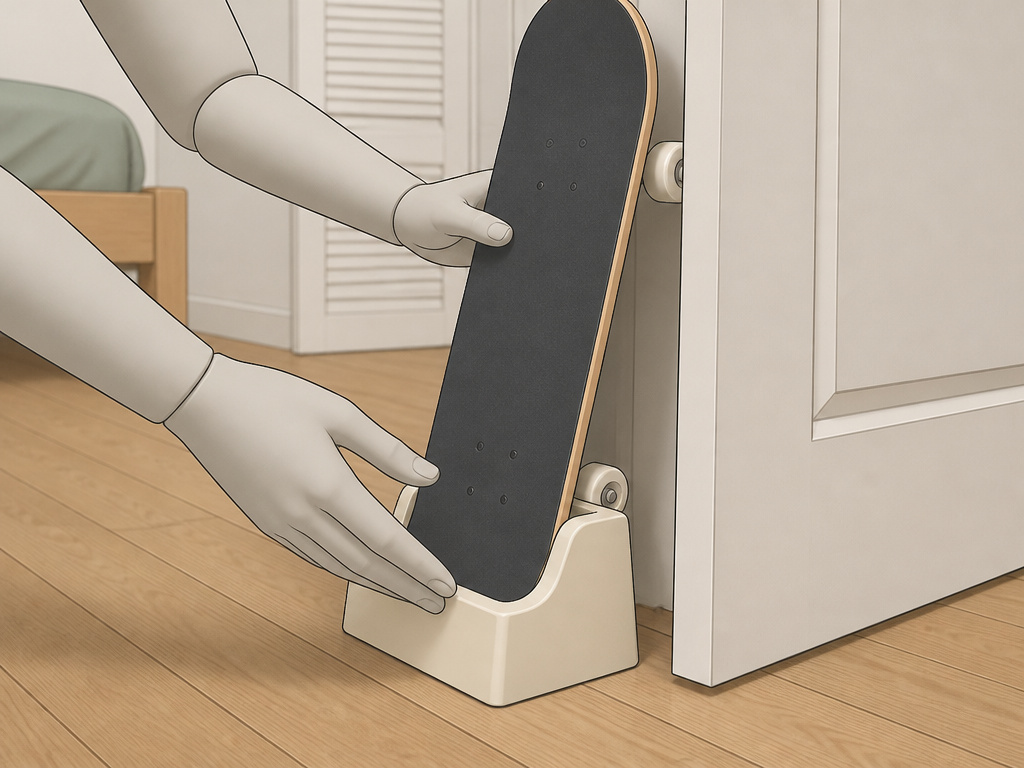
Sometimes you need the board to disappear completely. This is for tight studios, shared spaces, or when you just hate visual clutter.
Deck Stands: These are the simplest option. A deck stand is a small, often plastic or metal, kickstand that holds the board upright by the deck. It takes up very little space. You can tuck it behind a door or in a corner. The downside is zero protection, the board is exposed to dust, pets, and anything else floating in the air.
Under-Bed Storage: This is the classic “out of sight” move. You can slide the board under a bed frame. The risk, as noted in general storage advice, is a high probability of dust-bunny contamination and potential warping if the floor is cold and the room is warm. A long, flat storage bin adds a layer of protection.
Vertical Closet Storage: If you have a closet with vertical space, you can lean the board against the wall inside. Use a padded hook or a strip of foam on the wall to protect the graphic. This keeps it hidden but still reasonably accessible.
| Method | Space Saved | Access Speed | Protection Level |
|---|---|---|---|
| Deck Stand | Maximum | Instant | Very Low |
| Under Bed | Maximum | Slow (retrieve) | Low (dust, warp) |
| Closet Lean | High | Medium | Medium |
| Wall Rack | High | Fast | High |
The choice here is between convenience and concealment. A deck stand offers the fastest grab-and-go but leaves the board vulnerable. Under-bed storage hides it perfectly but adds friction to taking it out, which can mean fewer spontaneous sessions.
Storing Multiple Boards & Accessories
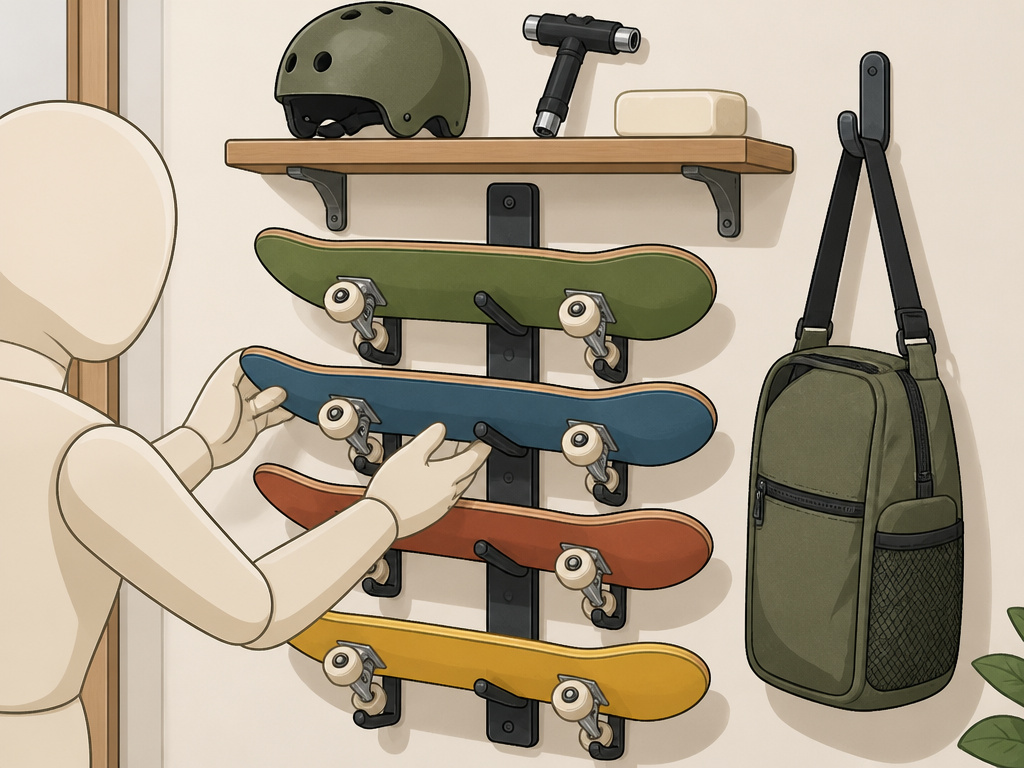
A quiver of boards changes the problem. Now you need organization, not just a single spot. The goal of skateboard storage ideas for small spaces is to store them without turning your room into a skate shop backstock area.
For two or three boards, a multi-level wall rack like the Trifecta is ideal. You mount it once, and it holds all your setups.
For a larger collection, think vertical stacks. You can buy or build a tall, narrow rack with multiple arms. The critical detail is spacing, leave enough vertical distance between arms so the trucks of one board don’t bump the deck of the board below.
Accessory storage is the final piece. Helmets, pads, tools, and wax don’t need much room. A single shelf above your rack, a small bin on the floor, or even a skateboard travel bag hung on a hook can hold it all. The travel bag is perfect because it’s designed for gear and has pockets for tools.
Keeping your tools with your board is a small habit that helps extend your skateboard’s life. A loose kingpin gets tightened before it strips. A rusty bearing gets noticed before it seizes. Storing everything together means maintenance happens naturally.
Protecting Your Board in Storage
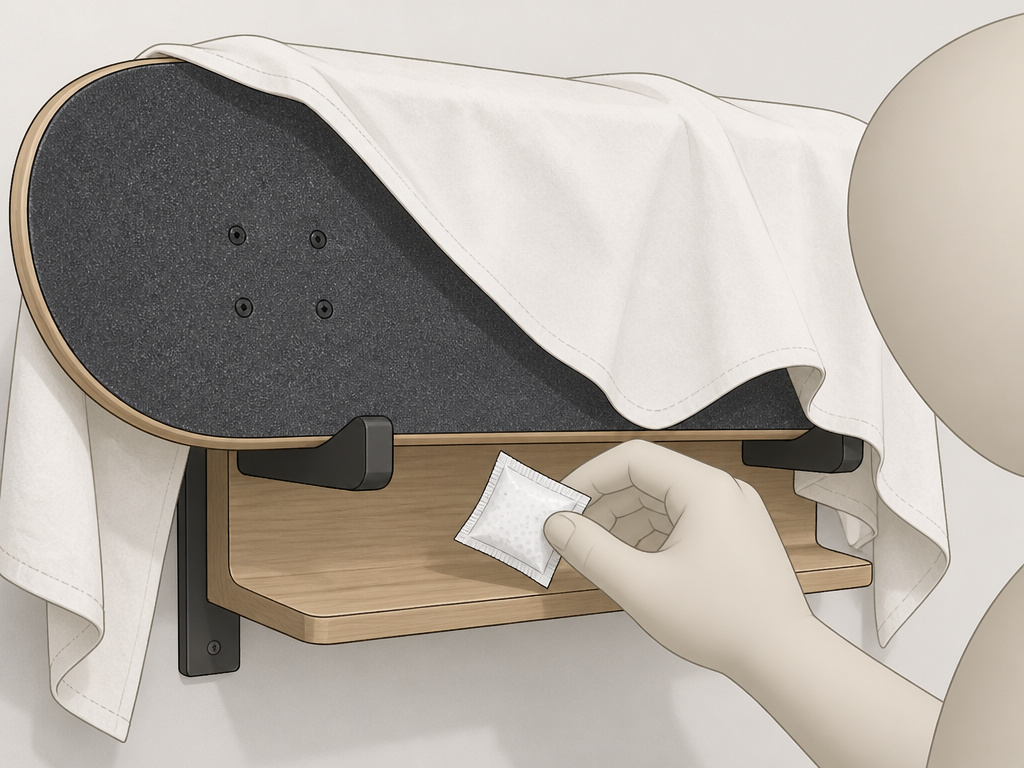
Storage isn’t just about location; it’s about environment. The three enemies are moisture, dust, and extreme temperatures.
Moisture warps wood decks and rusts hardware. Don’t store a board in a damp basement, an uninsulated garage, or directly against a cold exterior wall. A silica gel packet in your storage area helps in humid climates.
Dust and grit grind down bearings and dirty up grip tape. A board stored under a bed or in a corner will collect a fine layer. A simple cotton sheet thrown over a wall-mounted rack stops most of it.
Temperature swings, like in an attic or a car trunk, can weaken the epoxy in a deck over time. Consistent, room-temperature storage is best. If you must use a seasonal space like a shed, a weatherproof storage box is the minimum.
Easy to miss: The graphic side facing the wall. If you store a board with its graphic against a wall or rack arm, pressure points can create small cracks in the laminate over months. Face the grip tape outward when possible.
Following these principles for proper skateboard storage does more than save space. It keeps your setup ride-ready, which means you’re more likely to grab it and go. That’s the real win.
Pegboard Skateboard Storage
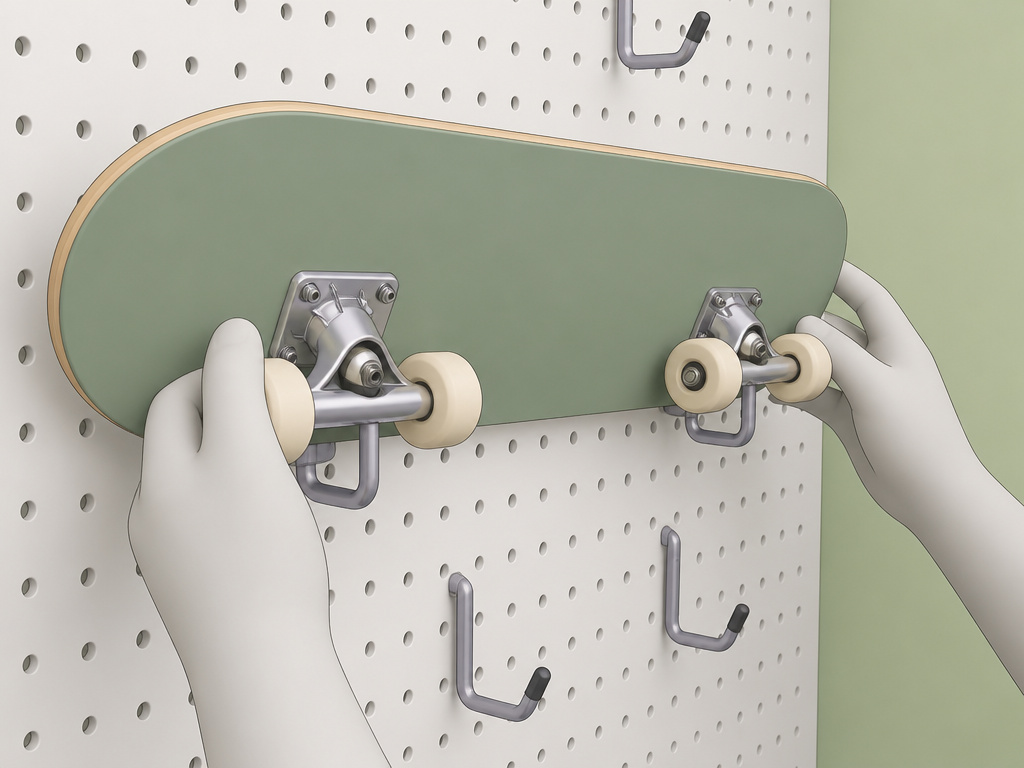
Pegboard systems offer a highly customizable and modular way to store skateboards on a wall. You can arrange hooks and arms to hold the board securely by its trucks or deck. This method uses vertical space efficiently and keeps your board easily accessible while displaying it. When setting up a pegboard system, ensure the hooks are strong enough to support the board’s weight and that the board is held firmly to prevent it from swinging or falling. This approach not only saves floor space but also helps protect your board from environmental factors like moisture and dust that can warp the deck or rust the hardware over time.
Frequently Asked Questions
What is the cheapest way to store a skateboard in a small apartment?
Simple deck stand is a cheap option. It holds the board upright in a corner. For a free option, lean the board vertically in a closet corner with the trucks resting on a small piece of foam to protect the floor. The trade-off is minimal protection from dust and bumps.
Can I use a snowboard wall mount for my skateboard?
Yes, many multi-sport wall mounts are designed for surfboards, snowboards, and skateboards. Some multi-sport wall mounts are designed for surfboards, snowboards, and skateboards. Check the weight rating and the arm spacing. Skateboard trucks are narrower than snowboard bindings, so ensure the cradle or hooks are adjustable or small enough to grip the trucks securely.
How do I store a skateboard without damaging the walls?
Use a rack designed for the job, like the Trifecta, which spreads the load. Always use the provided drywall anchors for plasterboard walls, and mount directly into studs when possible. For truly zero-damage storage, a freestanding floor stand is the only sure bet, as even adhesive hooks can pull paint off when removed.
Is it bad to store a skateboard on its side?
Storing a board on its side (with the deck vertical and the wheels facing sideways) is generally fine for short periods. Long-term, it can cause the board to develop a very slight warp or ‘belly’ over years due to uneven wood support. A rack that supports the trucks is a better long-term solution than leaving it on the floor.
How should I store my skateboard for the winter?
Clean it first: wipe down the deck, remove dirt from the wheels and trucks. Loosen the trucks a quarter turn to relieve pressure on the bushings. Store it in a climate-controlled space, away from dampness. A wall rack in a closet or under a bed in a sealed bag works. Avoid attics or sheds where temperatures fluctuate wildly.
Before You Go
The best storage idea is the one you’ll actually use. If a rack requires a complex install, you’ll put it off. If the stand is in an awkward spot, you won’t grab the board. Start with the simplest solution that solves your biggest annoyance, tripping over the board or not having floor space.
For most people in a small space, that’s a basic wall mount. It’s a one-time install that clears the floor forever. If drilling is off the table, a compact floor stand tucks into a corner and moves when you need it to. The goal is a clear path to the door, not a perfect system.
