
How to Charge an Electric Skateboard Safely: Step-by-Step
This post contains affiliate links. As an Amazon Associate, we earn from qualifying purchases.
To charge an electric skateboard safely, use only the manufacturer-provided charger, never charge unattended or overnight, and follow your manual’s plug-in sequence on a flat, non-flammable surface. For daily battery health, aim for a 20% to 80% charge cycle and store the board at 40-60% charge if unused for more than a week.
That specific plug-in order isn’t just a suggestion. Parsec and Onewheel manuals give opposite instructions, and getting it wrong can send a power surge into your board’s battery management system (BMS). This is why knowing how to charge an electric skateboard safely is critical. The BMS is the circuit that prevents overcharging, but it needs the right voltage from the start.
What follows: the one-charger rule backed by 156 fire reports, a side-by-side table of conflicting manufacturer steps, the daily charge range that actually extends battery life, and what to do when your board won’t hold a charge.
Key Takeaways
- The U.S. CPSC received 156 fire reports linked to “universal” chargers in 16 months, use only your board’s original charger.
- Never charge unattended or overnight. Multiple manufacturers (ONSRA, Boosted, Parsec) explicitly warn against this due to fire risk.
- Manufacturers recommend different ranges for long-term storage: Onewheel advises 40-50%, ONSRA advises 40-60%, and Parsec advises around 50%.
- The charging sequence matters: Parsec says connect to the board first, then the wall; Onewheel says wall first, then board. Follow your manual.
- Daily partial charges (20% to 80%) put less strain on lithium-ion cells than full 0-100% cycles.
The One Charger Rule (And the 156 Fires Behind It)
Forget compatibility for a second. A charger that physically fits your board’s port can still be electrically incompatible. Your battery expects a specific voltage and current profile. A universal charger guesses, and when it guesses wrong, the battery can ignite.
The U.S. Consumer Product Safety Commission (CPSC) tallied 156 reports of fire and thermal incidents involving universal chargers for e-bikes, e-scooters, and electric skateboards between January 2023 and May 2024. Their September 2024 warning is blunt: do not buy or use them.
Common mistake: Using a charger that came with a different board. “It fits” is not the same as “it’s compatible.” The CPSC states this can cause the battery to ignite.
Every manual in our fact sheet echoes this. ONSRA says use only the original CE-certified charger. Onewheel specifies exact part numbers: the FY7562500 Home Charger, FY7561600D Car Charger, or FY7565200 Hypercharger for the GT model. Boosted’s manual warns that using any other charger voids your warranty and may cause damage.
If you’ve lost your charger, contact your board’s manufacturer for a certified replacement. Do not gamble on a third-party universal model.
The Critical Plug-In Order: Wall First or Board First?
Here’s where manufacturer advice splits. This detail is about managing inrush current, the sudden surge of electricity when a circuit connects.
- Parsec’s manual instructs: “Connect the charger’s output cable to the board first. Next, plug the charger’s input cable into a power outlet.” Unplugging is the reverse: outlet first, then board.
- Onewheel’s manual for the GT states: “Connect the charger to an ‘AC’ supply and then to the Onewheel GT charging port.”
Why the disagreement? It likely depends on how the charger’s circuitry is designed. Parsec’s sequence might ensure the charger is “live” and stable before connecting to the sensitive BMS. Onewheel’s method might prevent arcing at the board’s port. The consequence of getting it wrong isn’t always immediate failure, but repeated stress on the BMS can lead to a board that won’t charge or hold power.
| Brand | Instruction | Likely Reason | Risk If Done Backwards |
|---|---|---|---|
| Parsec | Board first, then wall outlet. | Stabilizes charger output before connecting to battery. | Potential voltage spike to BMS. |
| Onewheel | Wall outlet first, then board. | Ensures full power stability before completing circuit. | Possible arcing at board’s charge port. |
Technical Snippet: The Battery Management System (BMS) is an internal circuit board that regulates cell voltage and temperature during charging. An incorrect plug-in sequence can expose the BMS to an unstable voltage source, potentially damaging its balancing or protection circuitry over time.
Never Charge Unattended: What “Present” Really Means
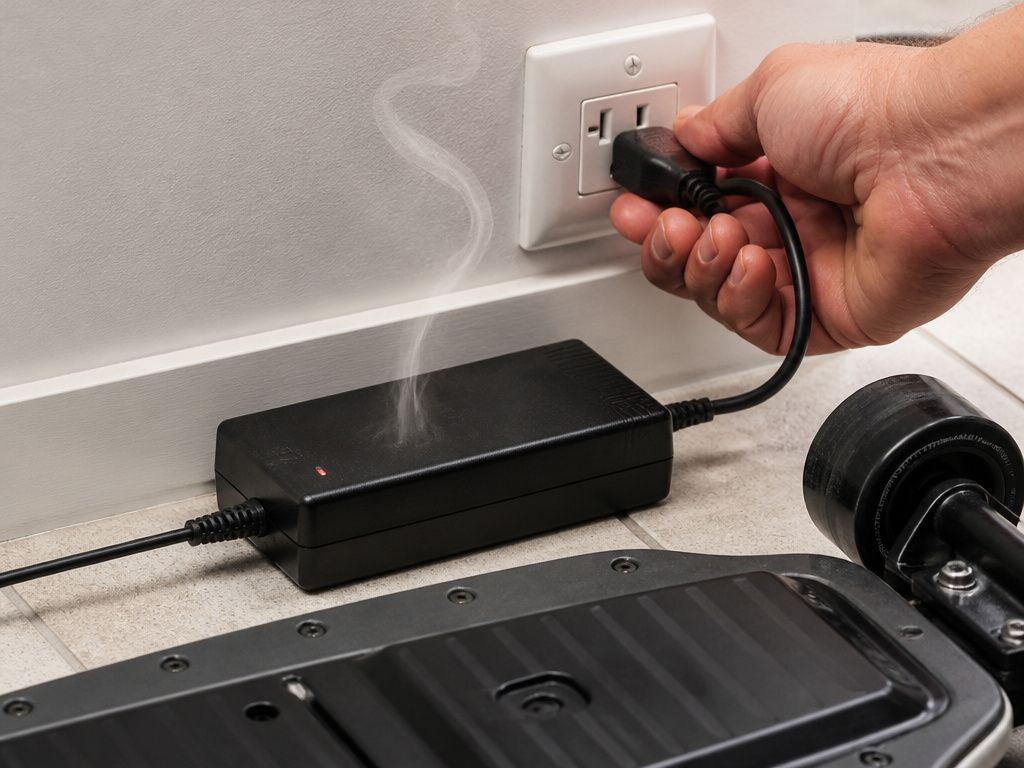
“Always be present” doesn’t mean being in the next room. It means being in the same room, awake, and aware. The CPSC, ONSRA, Boosted, and Parsec all explicitly say not to charge while sleeping, a core part of how to charge an electric skateboard safely.
Why? But faults happen. A failing cell can overheat, a damaged charger can over-deliver current, or a loose connection can spark. These events can escalate to thermal runaway, a chemical fire that’s difficult to extinguish, in minutes.
- Sound cue: A healthy charger has a low hum. A high-pitched whine or buzzing is a stop-now signal.
- Smell cue: The first sign of an electrical problem is often a faint, sweet smell like burnt plastic or ozone. If you smell it, unplug everything immediately.
- Touch cue: Chargers get warm, not hot. If the case is too hot to keep your hand on, unplug it.
Charge on a hard, non-flammable surface like concrete, tile, or a metal table, never on a bed, couch, or carpet. Keep the area clear of paper, curtains, or other combustibles.
The Daily Charge Sweet Spot (20-80%)
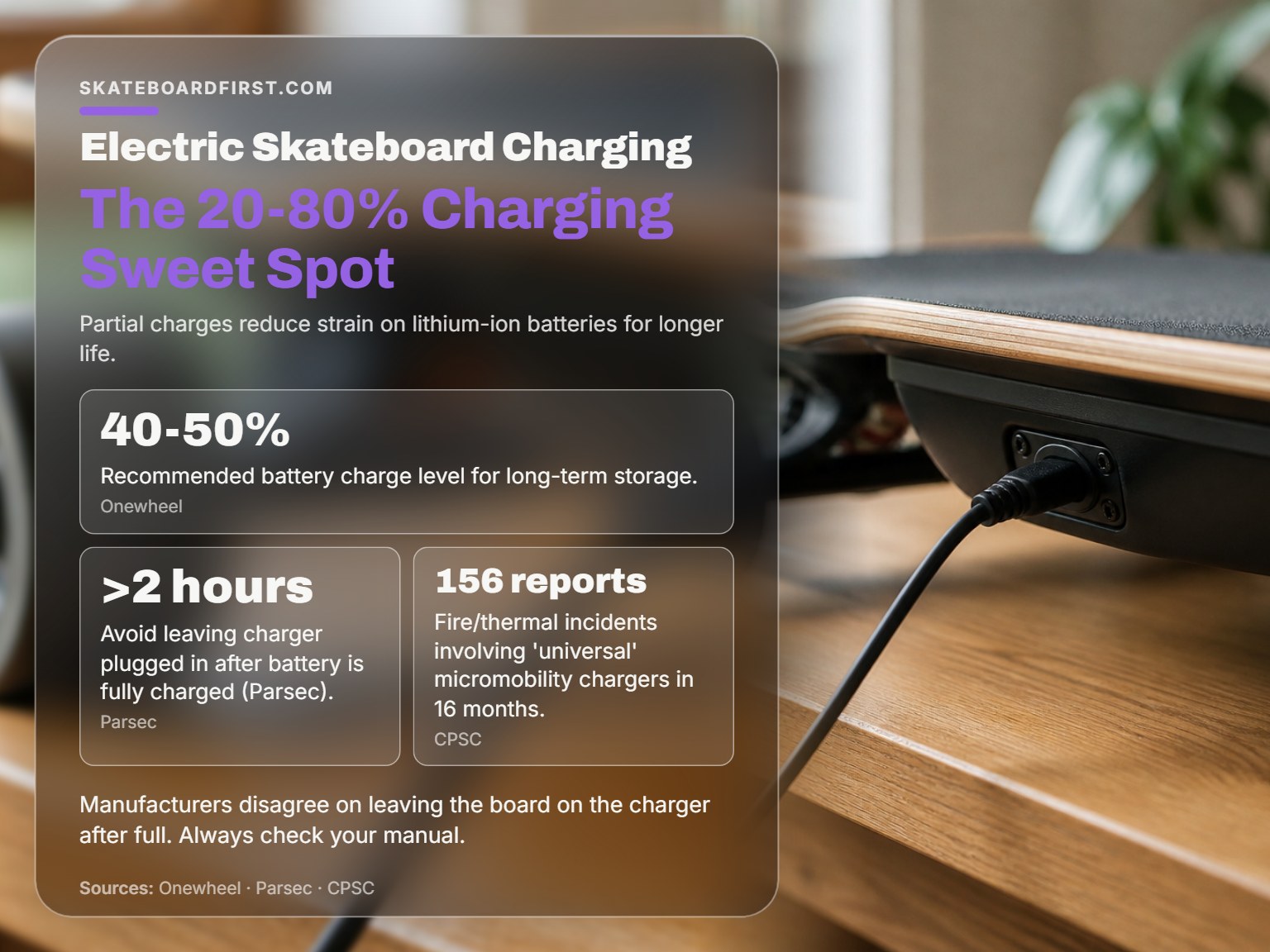
Lithium-ion batteries, which power every mainstream electric skateboard, hate extremes. Fully draining to 0% or sitting at 100% for extended periods accelerates chemical degradation.
Parsec’s manual puts it clearly when explaining how to charge an electric skateboard safely: “Charging from 20% to 80% puts less strain on the battery than from 0% to 100%.” This is the partial charge method. It reduces the stress on the anode and cathode materials inside each cell, which directly translates to more charge cycles over the board’s lifetime.
Think of it like stretching a rubber band. A gentle pull from 20% to 80% causes less permanent fatigue than stretching it from completely slack to its absolute limit every single time.
Here’s a simple routine:
- Ride until your battery indicator shows roughly 20-30%.
- Plug in and charge until it reaches 80-90%.
- Unplug and ride.
Some manufacturers recommend periodic full charges for battery balancing; consult your board’s manual. This allows the BMS to balance the individual cell groups, which is important for maintaining overall pack health and accurate range estimation.
Storing Your Board: The 40-60% Rule
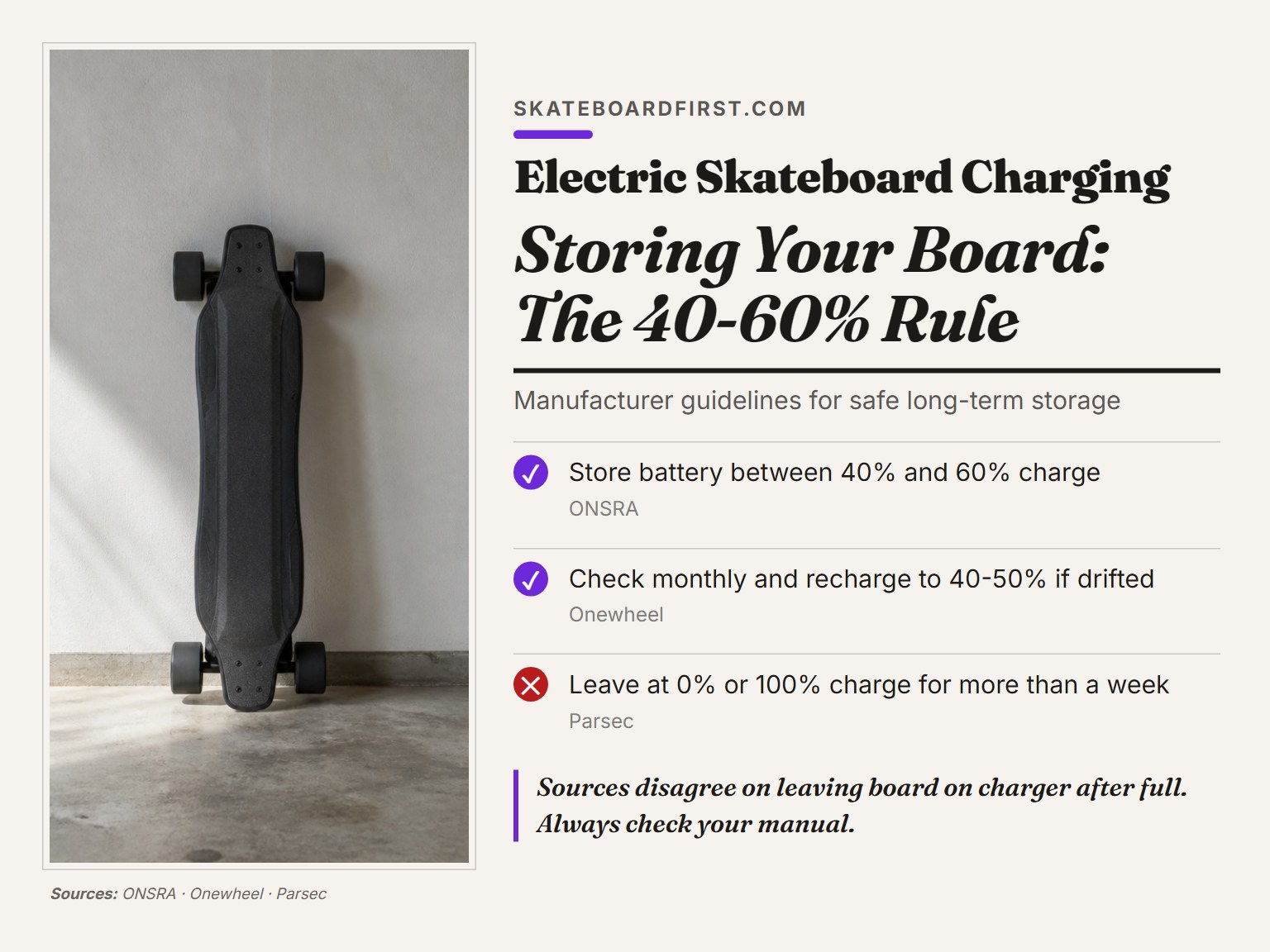
You won’t ride every day.
Quotable Rule: For long-term storage, manufacturers recommend a mid-range charge: Onewheel advises 40-50%, ONSRA advises 40-60%, and Parsec advises around 50%.
The procedure is straightforward:
- Before storing, charge or discharge the board to around 50%.
- Power the board completely off.
- Store it in a dry place within the temperature range specified by your manufacturer; for example, Parsec recommends 5°C to 25°C (41°F to 77°F) and Onewheel recommends 50°-60°F (10°-15°C).
- Check monthly. Recharge it back to 50% if it has drifted. ONSRA warns to never store the board with an empty battery for more than 24 hours, as deep discharge causes permanent damage.
What To Do When Your Board Won’t Hold a Charge
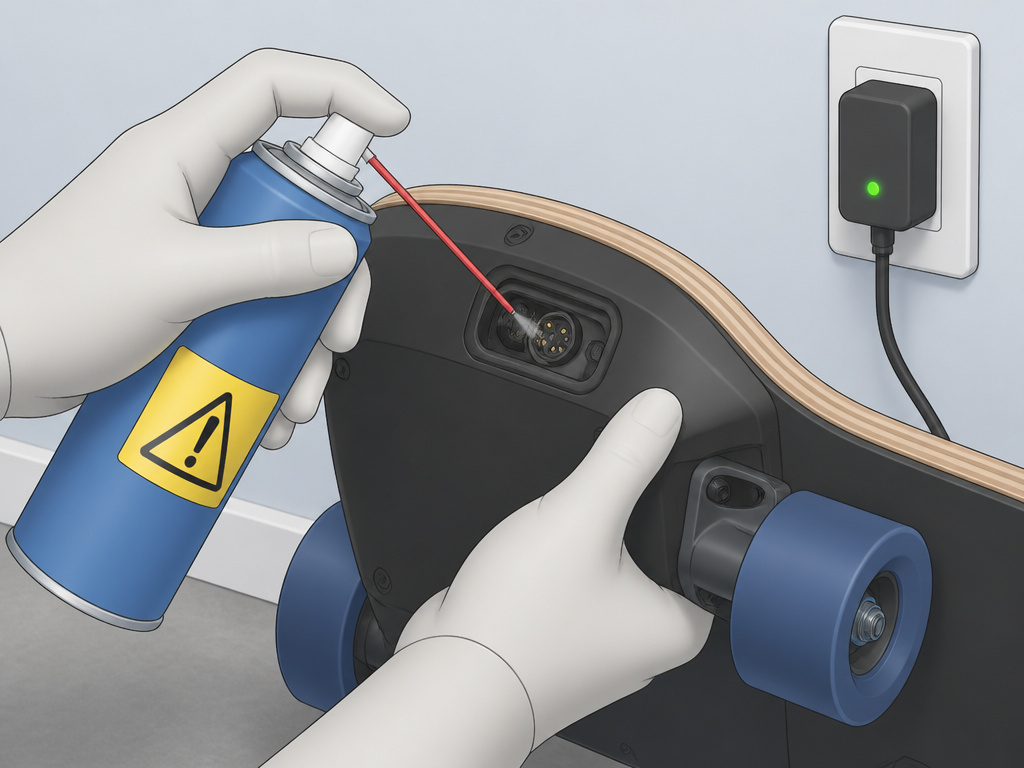
A board that dies quickly isn’t always a dead battery. Run through this diagnostic list before you decide it’s finished.
- Check the charger and outlet. Try a different wall outlet. Ensure the charger’s LED lights up. Inspect the cable for kinks or exposed wires.
- Check the charge port. Look for debris, dirt, or bent pins inside the board’s charging port. Use a can of compressed air to clean it out gently.
- Try a full balance charge. Leave the board plugged into the correct charger for an extended period while you are present and awake to allow the BMS to balance the cells. This gives the BMS extra time to balance any lagging cell groups, which can recover “lost” capacity.
- Check the remote. Sometimes the battery indicator on the remote is miscalibrated. Use a phone app (if your board has one) or track your mileage versus known range for a more accurate assessment.
- Consider temperature. Cold batteries temporarily lose capacity. If your board sat in a cold car overnight and seems dead, let it warm up to room temperature for an hour before charging or diagnosing.
If you’ve done all this and range is still down by over 30%, the battery pack may be nearing the end of its life. Contact the manufacturer for service options.
Navigating Wet Conditions and Humidity
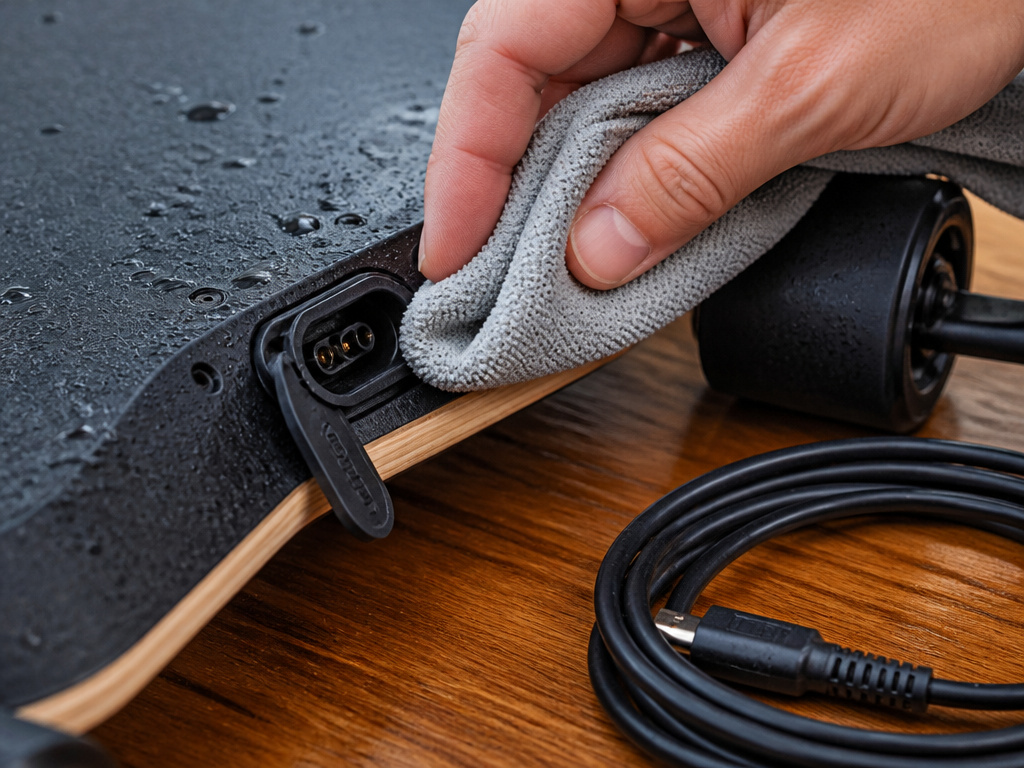
Water and electricity are a dangerous mix. Every manual prohibits charging if the port, cord, or outlet is wet.
- ONSRA: “Never plug in the power cord if the charging port, power cord or outlet is wet.”
- Boosted: “For indoor use only. Do not charge outdoors or in the rain.”
- Parsec: “Avoid charging in wet or humid conditions.”
If your board gets caught in the rain, do not charge it that day. Wipe it down and move it to a dry, warm area with good airflow for at least 24-48 hours to allow internal moisture to evaporate. Look for more detailed steps in our guide to electric skateboard waterproofing.
For commuters, this is the biggest argument against using a car inverter or large power bank for on-the-go charging. Those environments are uncontrolled, a sudden drizzle, high humidity, or a dusty outlet can introduce risk. It’s safer to plan your trips within a single charge cycle.
Why you should let your battery cool before charging
Your skateboard’s battery heats up during a ride. Charging it while it’s still hot adds more heat, which can stress the battery cells and reduce their lifespan. While the fact sheet doesn’t specify a cooldown time, the principle is universal: let the board sit in a cool, dry place for a while after your session. This simple habit helps maintain your battery’s health over time. Always check that the charging port and the area around it are dry and at a normal room temperature before you plug in.
Frequently Asked Questions
How safe are electric skateboards?
They are safe when used and maintained correctly, with charging being the highest-risk activity. Using the designated charger, following the plug-in sequence, never charging unattended, and storing the battery properly mitigate most risks. The CPSC data highlights that user error with chargers is a primary cause of incidents.
How long does it take to charge an electric skateboard?
Charge time varies by battery size and charger amperage. For example, an ONSRA VELAR uses a 4A 14S charger; charge times vary based on battery capacity. Their optional 7.6A fast charger cuts that to about 2.5 hours. A smaller board like the ONSRA BLACK Carve 2 with a 2.5A charger will take longer. Always refer to your specific board’s specs.
My electric skateboard isn’t holding a charge. What should I do?
First, perform a full balance charge (6-8 hours attended). If capacity doesn’t improve, review your habits for battery care; have you been storing it at 100% or 0%? If the board is older, some capacity loss is normal. A drop of more than 30% likely indicates a battery needing service or replacement.
Can I use a fast charger with any electric skateboard?
No. Only use a fast charger sold and certified by your board’s manufacturer for your specific model. The ONSRA VELAR 1.0 and 2.0, for instance, require different versions of their 14S fast charger. Using an incorrect fast charger can overheat and destroy your battery.
Before You Go
Safety is a continuous habit, like plugging into the wall before the board because your manual says so. It’s walking past your board charging in the hallway and pausing to listen for that quiet, normal hum. It’s checking the weather and deciding not to ride if there’s a chance of rain, because you know your waterproofing guide says it’s not worth the risk.
The numbers have stakes: 156 fires, one original charger, 40-60% for storage, 20-80% for daily use. Your board’s manual is the result of engineers who know where that specific battery’s weak points are. Start there.
