
Skateboard Glossary of Terms: Parts, Tricks, and Slang
This post contains affiliate links. As an Amazon Associate, we earn from qualifying purchases.
A skateboard glossary needs about twenty terms to get you started: deck, trucks, wheels, bearings, grip tape, nose, tail, regular, goofy, switch, fakie, ollie, kickflip, grind, slide, vert, street, rail, half-pipe, and durometer. Memorizing hundreds of slang words is less useful than knowing these core parts, stances, and trick types, they’re the language of the park and the manual.
The difference between a grind and a slide, or a regular and a goofy stance, decides what you call a trick and how you learn it. Consult a skateboard glossary of terms to prevent this. Getting those wrong is how you end up watching a tutorial for the wrong move for twenty minutes.
What follows is a shortlist built from official sources, competition rulebooks, safety guides, and manufacturer specs, not just internet slang. You’ll get the clear definitions, the common mix-ups, and the few numbers that actually matter.
Key Takeaways
- A quality deck is 7-ply maple, the industry standard per Portland Parks & Recreation, not the flexible plastic of toy-store boards.
- Wheel durometer ranges from 76a (soft) to 101a (hard), with softer wheels absorbing rough pavement vibrations.
- The CPSC defines speed wobble as a dangerous side-to-side shimmy; riding forward, crouching, and tightening trucks reduces the risk.
- In competition, a skateboard cannot exceed 122 cm (48″) in length or 6 kg (11.2 lbs) in weight, as per World Skate rules.
- ASTM F1492-22 is the official standard for skateboarding helmets, covering impact tests on flat and hazard anvils.
The Core Parts of a Skateboard
Knowing the parts isn’t about sounding cool. It’s about fixing things when they feel wrong and buying the right stuff when you need more, as explained in any good skateboard glossary of terms. The Exploratorium skateboard glossary calls these the fundamentals, and they’re right.
Deck: The wooden board you stand on. The industry standard, according to Portland Parks & Recreation, is 7 plies, or layers, of Canadian Maple. A deck that flexes too much under your weight is either too thin or damaged. The front is the nose, the back is the tail.
Trucks: The T-shaped metal axles mounted underneath the deck. They hold the wheels and let you turn. Each truck has a kingpin (the main bolt), a hanger (the part that holds the axle), and urethane bushings that control how easily it turns. The CPSC notes that wider trucks (hangers farther apart) give riders greater control, especially at speed.
Wheels: Made of polyurethane, they’re sized by diameter and hardness (durometer). Sources vary on typical wheel diameter ranges: the Exploratorium states wheels are usually sized between 39 and 66 millimeters, while Surfertoday states they are sized between 39 and 70 millimeters. For hardness, Portland Parks & Recreation specifies a durometer range from 76a (softest) to 101a (hardest), while the Exploratorium notes the scale ranges from 0 to 100, with hard wheels being 97 or higher. Softer wheels (lower number) are easier on rough streets; harder wheels are for smooth parks and slides.
Common mistake: Cranking your trucks down until they won’t turn. The CPSC recommends keeping trucks “tightened properly” for stability, but overtightening makes carving impossible. Start snug, then loosen a quarter-turn until you can lean comfortably.
Bearings: The small metal rings inside the wheels that let them spin. There are two per wheel, eight total. The Arbor Collective guide states it’s best to keep them clean and free of debris by avoiding water, dirt, and sand. A gritty, grinding sound means they need cleaning or replacement.
Grip Tape: The gritty, sandpaper-like sheet adhered to the top of the deck. It keeps your feet from slipping. Without it, you can’t pop an ollie. It wears down over time and needs replacing when it looks shiny and smooth in the spots where your feet go.
Stance and Direction: Regular, Goofy, Switch, Fakie
This is where most beginners get tangled. The terms describe which foot is forward and which direction you’re moving. Mix them up, and every trick name after that will be wrong.
Regular vs. Goofy: This is about your natural stance, not a skill level. If you stand with your left foot forward, you ride “regular.” Right foot forward is “goofy.” There’s no “correct” one. You don’t choose it; you just step on the board and see which way feels balanced.
Switch vs. Fakie: These describe riding in your non-natural stance or direction.
- Switch: Riding with your opposite foot forward. If you’re regular, switch means riding goofy. Everything is mirrored.
- Fakie: Riding backwards but with your natural stance. A regular rider going fakie is still left-foot-forward, but the board’s tail is now leading the way.
The mix-up happens because both feel awkward. The rule of thumb: if your front foot is on the nose, you’re probably in nollie stance, which is different. For now, just know that “switch” flips your feet, and “fakie” flips your direction.
| Stance | Foot Position | Board Direction | Feels Like |
|---|---|---|---|
| Regular | Left foot forward | Moving forward | Natural |
| Goofy | Right foot forward | Moving forward | Natural |
| Switch | Opposite foot forward | Moving forward | Unnatural, mirrored |
| Fakie | Natural foot forward | Moving backward | Awkward, but familiar |
Reddit threads in r/NewSkaters show this confusion daily. One user summarized the beginner frustration: “I spent a week trying to learn a trick switch before realizing I was actually just riding fakie poorly.” Start by just pushing around in your natural stance. The other terms matter when you start learning specific tricks like “fakie ollies” or “switch flips.”
Trick Terminology: From Ollie to Grind
Trick names can seem like a secret code. They’re really just descriptions of what the board and your feet do, which is why you need a skateboard glossary of terms. You only need a handful to follow a conversation or a tutorial.
The Foundation: The Ollie
The ollie is the first and most important trick. It’s the act of jumping and making the board snap into the air with you by tapping the tail and sliding your front foot. Every flip, spin, and grind trick builds on this motion. Without a solid ollie, you can’t progress to most other street tricks.
Flips and Rotations
- Kickflip: An ollie where you flick the edge of the board with your front foot, causing it to spin laterally along its length.
- Heelflip: Similar to a kickflip, but you flick with your heel, making the board spin the opposite direction.
- Pop Shove-it: The board spins 180 degrees under you without flipping. A “frontside shove-it” spins toward your toes; “backside” spins toward your heels.
Grinds and Slides
This is a major point of confusion. Both involve the board contacting an obstacle, but with different parts.
- Grind: The trucks scrape along the edge of an obstacle (like a curb or rail). A 50-50 grind uses both trucks.
- Slide: The deck itself slides along the surface. A boardslide has the deck’s underside sliding on a rail.
Where this goes sideways: Calling a boardslide a “grind.” If your trucks aren’t touching, it’s a slide. This mix-up will get you corrected at any skatepark.
Vert and Transition Tricks
These happen on ramps, half-pipes, and bowls where you use the transition (the curved wall) to gain air.
- Drop-in: The committed first push down a ramp.
- Rock to Fakie: Rolling up a ramp, balancing the trucks on the coping (the metal edge), then rolling back down backwards.
For more details on specific maneuvers, our guide on types of skateboard tricks breaks down each category.
Skatepark and Obstacle Lingo
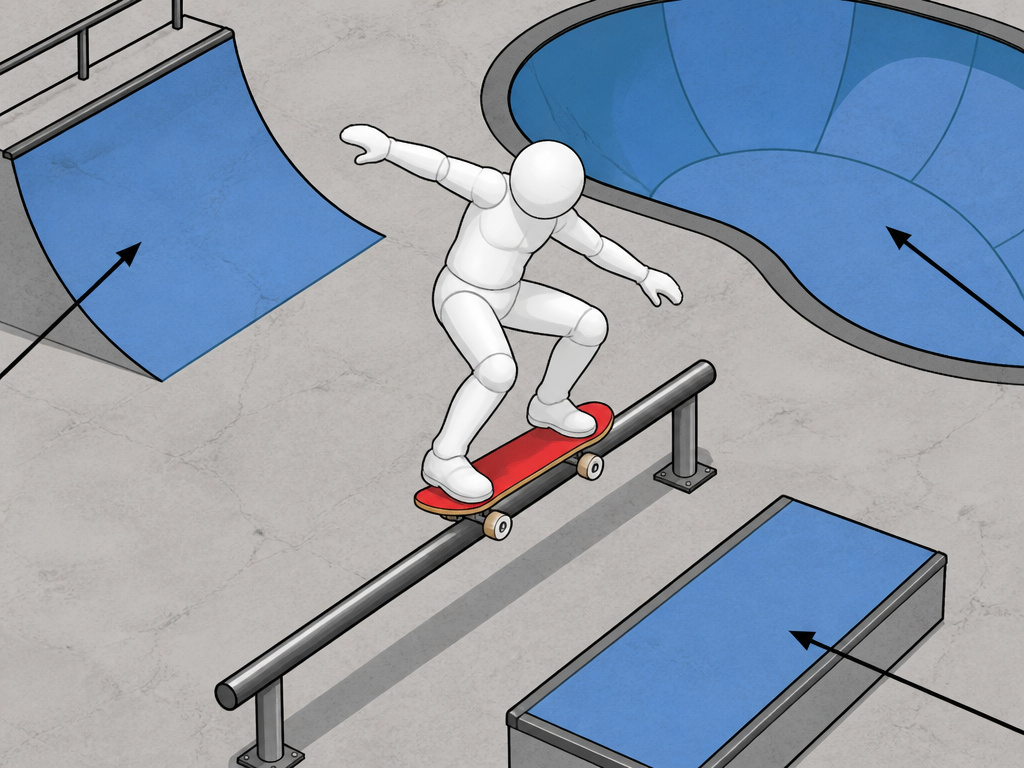
The park has its own geography. Knowing what to call an obstacle means you can ask for advice or describe a line.
Half-pipe: A large U-shaped ramp with two facing transitions and a flat bottom. It’s used for gaining speed and performing aerial tricks.
Quarter-pipe: One side of a half-pipe, essentially a single ramp with a transition leading to a vertical (or nearly vertical) face.
Rail: A metal or concrete bar, often round or square, used for grinds and slides. A “flat bar” is low to the ground; a “handrail” is steeper and attached to stairs.
Ledge: A low, flat, raised edge, often concrete or marble, used for slides and grinds. Similar to a rail but wider and flatter.
Bowl: A deep, swimming-pool-like structure with curved transitions and sometimes varying depths. It’s for flowing, carving, and gaining speed without pushing.
Manny Pad (Manual Pad): A small, low platform used to practice manuals (riding on two wheels) or as a launch for small jumps.
When you’re checking out a new park, a quick scan for common skatepark features helps you plan your session. Are you working on rail grinds today, or bowl carving?
Skateboard Types and Styles
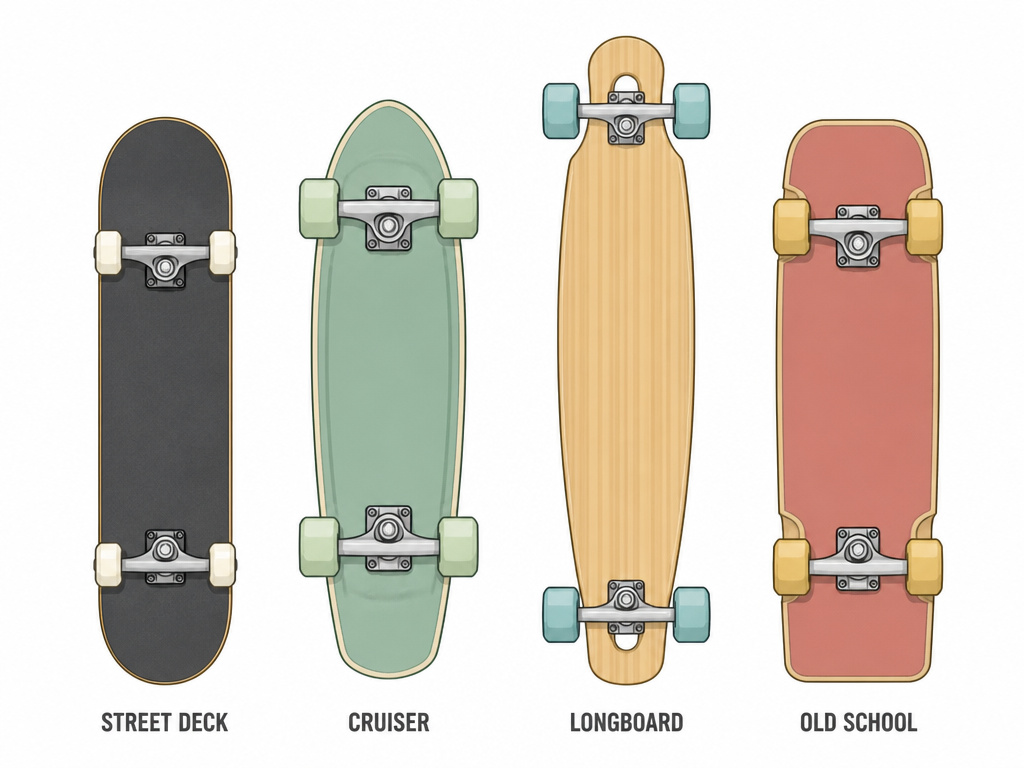
Not all boards are for all things. The gear shapes the style.
Street Skateboard: The standard “trick board.” Typically has a symmetrical shape and double kicktails (nose and tail). Built for ollies, flips, and technical tricks on streets, ledges, and parks.
Cruiser: Often slightly wider and longer, with softer, larger wheels. Designed for comfortable riding over longer distances on rough pavement. Turning is easy, but flipping the board is harder.
Longboard: Longer still, built for stability at high speed, downhill racing, or long-distance pushing (commuting). The World Skate rulebook sets the maximum competition length at 122 centimeters (48 inches).
Old School vs. New School: This refers more to shape and era than a separate type. “Old school” decks from the 80s were wider with a squared-off tail. “New school” is the modern, symmetrical, double-kick shape that dominates today.
Choosing between these types of skateboards comes down to what you want to do most. Don’t try to bomb a hill on a tiny street deck.
Safety Gear and Maintenance Terms
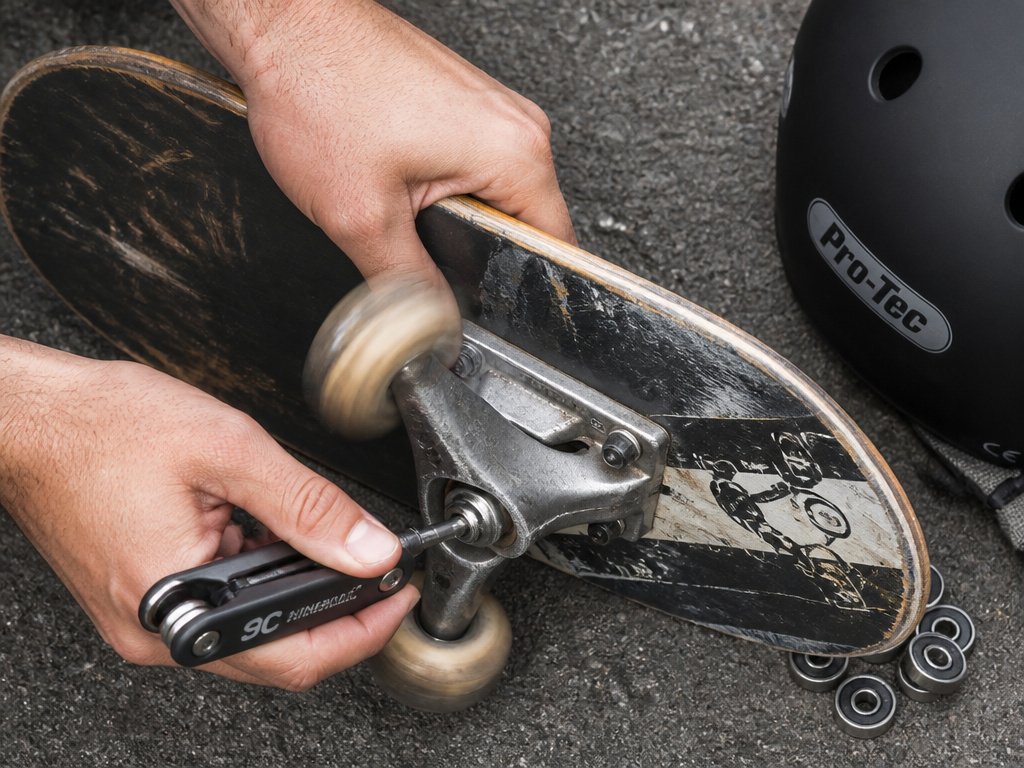
The right gear and upkeep keep you rolling. These terms come straight from official standards.
Helmet Standard (ASTM F1492-22): This is the official specification for helmets used in skateboarding and trick roller skating. A helmet meeting this standard has passed tests for impact absorption on flat and hazard anvils. The CPSC adds that it should fit snugly with the chin strap fastened and sit level on your head.
Speed Wobble: Defined by the CPSC as when a skateboard “begins to shimmy from side to side unexpectedly.” It’s a stability failure at higher speeds. Their recommendations to reduce risk: ride forward and crouch, use a longer board, and keep trucks properly tightened.
Pre-ride Inspection: The CPSC advises checking for “excessive play (looseness) and any broken or cracked parts” before you skate. A quick shake of the board can reveal loose trucks or wheels.
Board Maintenance:
- Delamination: When the plies (layers) of a wooden deck begin to separate. Portland Parks & Recreation warns that storing a board in direct sunlight or moist conditions can cause warping or delamination.
- Bushing Hardness: The urethane cushions inside your trucks. If they’re too hard, the board will be nearly impossible to turn. Softer bushings are often recommended for lighter riders.
- Bearing Service: The Arbor Collective guide notes that if bearings get slower or too loud over time, cleaning, lubricating, and servicing them is recommended.
Keeping your setup dialed isn’t just about performance. Loose hardware is a safety issue. A quick check with a skate tool before you session is a five-second habit that prevents a lot of problems.
What do 180, 360, and 540 mean in skateboarding?
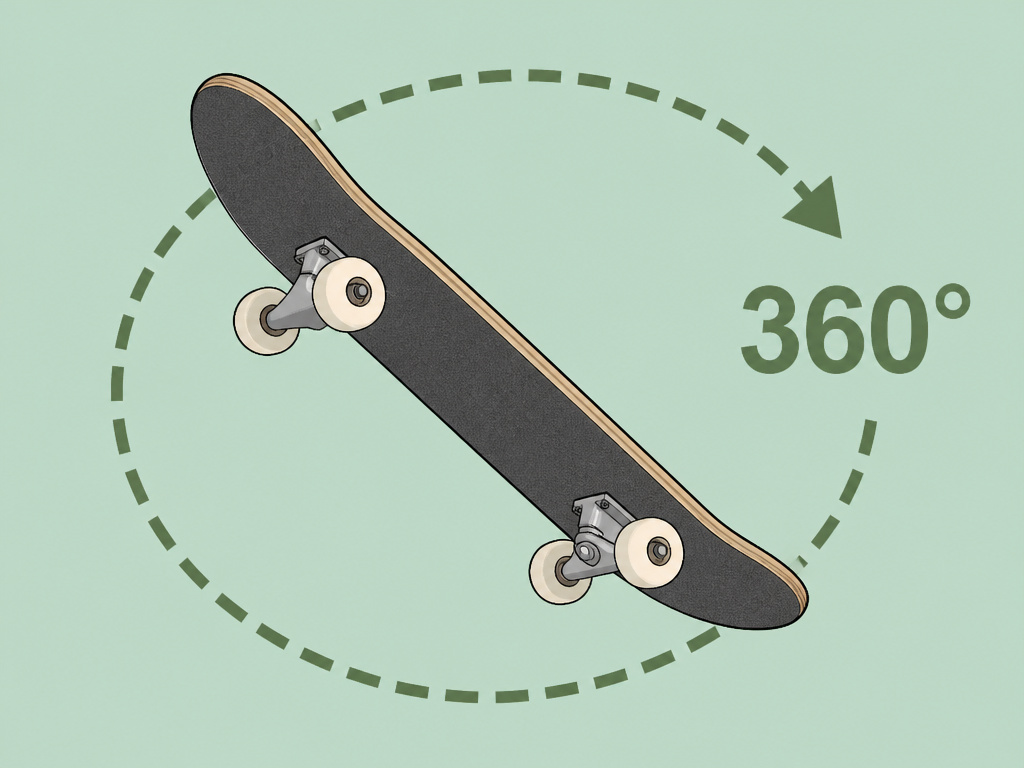
These numbers describe the degrees of rotation a skater and board complete during a trick. A 180 is a half-spin, landing backwards from your starting stance. A 360 is a full rotation, landing facing the same direction you started. A 540 is one and a half full spins. These rotations apply to both horizontal spins on flat ground and vertical spins in the air, like in a 540 McTwist. The number is a precise way to communicate the trick’s difficulty and visual style. Mastering these rotations is a fundamental progression in skateboarding, building from basic ollies to complex aerial maneuvers.
What do bail, boned, burly, and mongo mean?
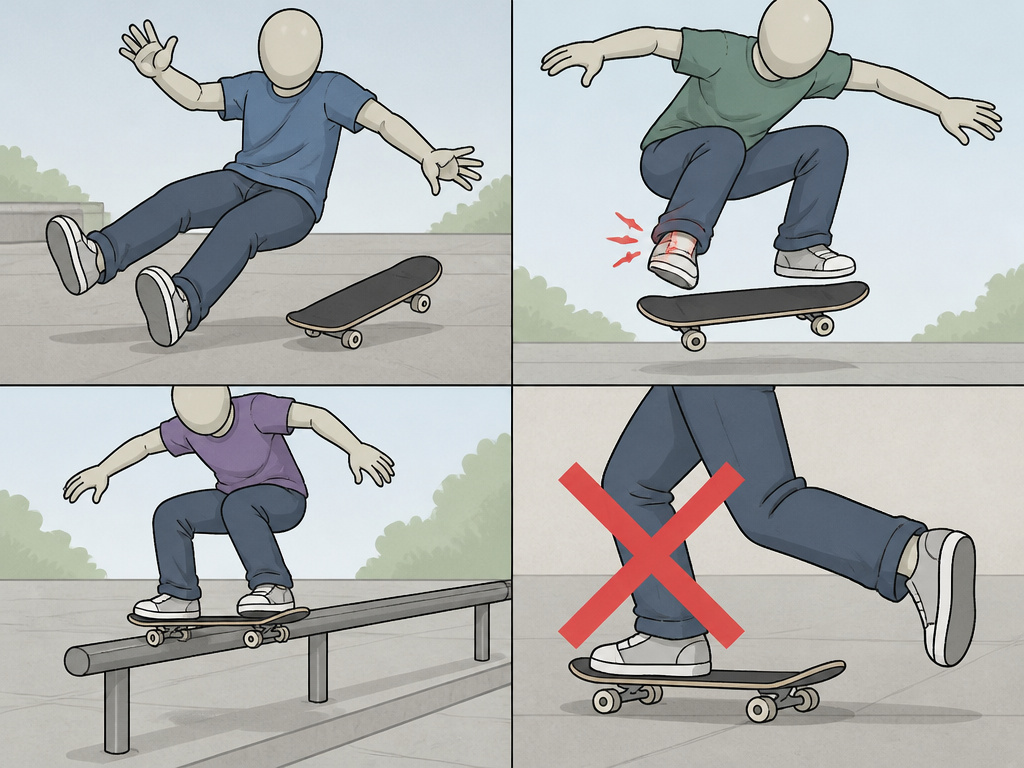
Skate slang describes specific actions and styles. To ‘bail’ is to abort a trick, often by jumping off the board to avoid a fall. ‘Boned’ refers to extending a trick, like an ollie, with the front leg stretched out for style. ‘Burly’ describes something extremely difficult, risky, or physically demanding. ‘Mongo’ is a term for pushing the board with your front foot while your back foot stays on the deck, which is generally considered a less stable and efficient technique compared to pushing with the back foot. This vocabulary is shorthand for the nuances of skateboarding culture.
Frequently Asked Questions
What’s the difference between “regular” and “goofy” stance?
Your “regular” stance is your natural, comfortable foot-forward position. If you push with your right foot and stand with your left foot forward on the board, you’re “regular.” If you push with your left foot and stand with your right foot forward, you’re “goofy.” It’s not a choice; it’s how you naturally balance.
Is an “ollie” the same as a “kickflip”?
No. An ollie is the fundamental jump trick where the board rises into the air without the rider’s hands. A kickflip is an ollie where you add a flick of your front foot to make the board spin 360 degrees along its length before you catch it. The ollie is the foundation; the kickflip is a more advanced trick built on top of it.
What does “durometer” mean for skateboard wheels?
Durometer is the measurement of a wheel’s hardness, rated on the “A” scale. According to Portland Parks & Recreation, urethane wheels range from 76a (softest) to 101a (hardest). Softer wheels (lower number) absorb vibrations from rough ground and grip better. Harder wheels (higher number) slide more easily and are faster on smooth surfaces like skatepark concrete.
What is “speed wobble” and how do I stop it?
The CPSC defines speed wobble as a dangerous, uncontrollable side-to-side shaking of the board at higher speeds. To reduce risk, ride forward (not sideways), crouch to lower your center of gravity, ensure your trucks are properly tightened, and consider a longer board or wider trucks for more stability. If you feel it start, gently carve to slow down, don’t panic and jump off at high speed.
Are all skateboard helmets the same?
No. For skateboarding, you need a helmet that meets the ASTM F1492-22 standard, which is specifically designed for the types of impacts common in skating and trick roller skating. Bike helmets are tested for different impact patterns and may not provide adequate protection for the back of the head during a skate fall. Always look for the ASTM F1492 certification inside the helmet.
Before You Go
Forget memorizing a dictionary. If you know the twenty terms in the first paragraph, you can walk into any skate shop or park and hold your own. The rest you’ll pick up as you go, when you need to describe a new trick you saw or figure out why your board feels weird.
One final piece of advice grounded in the specs: if you’re buying your first real board, look for that 7-ply maple deck and ask about wheel durometer. Everything else is tuning.
Now you know what the words mean. The only term left to learn is the sound your board makes when you finally land that trick. Go find out.
