
Skateboarding Muscles Worked: Your Body’s Key Sections
This post contains affiliate links. As an Amazon Associate, we earn from qualifying purchases.
Skateboarding builds muscle through a combination of explosive power, dynamic balance, and endurance. The primary movers are the quadriceps, glutes, and calves, while the core and ankle stabilizers work constantly to maintain control. A 2007 study found that 76.3% of the variance in Ollie height for beginners is explained by power from a Counter Movement Jump, directly linking jump training to skateboarding performance.
That link between off-board power and on-board height is the whole game. Most guides list muscles, but they miss the why, the specific mechanical actions that turn a push into a carve, a pop into a flip. Understanding the skateboarding muscles worked is key to this.
What follows is a breakdown of not just which muscles fire, but when they fire, why they matter, and how the demands shift from cruising to complex tricks in the skateboarding muscles worked. You’ll see where science confirms the soreness and where it reveals a few surprises.
Key Takeaways
- Your quadriceps and glutes are the primary engines for popping and landing; a 2024 study found one synergy involving the vastus lateralis and rectus femoris is consistent across Ollies, Kickflips, and 360-flips.
- Core engagement is essential for balance, not just static strength; you’ll feel it most during carves and landings when your torso fights rotation.
- Ankle stability separates pros from amateurs; research shows professional skaters exhibit a significantly smaller ankle inversion angle, meaning better joint control under load.
- Skateboarding meets vigorous-intensity exercise guidelines; riding an electrically powered board like the Summerboard has a MET value of 10.5, comparable to high-intensity interval training.
- Leg strength asymmetry is common; a 2021 study found male recreational skaters had a mean Squat Jump asymmetry of 20.5%, highlighting the need for targeted off-board training.
The Core Engine: Quadriceps, Glutes, and Hip Flexors
Your legs do the heavy lifting in the skateboarding muscles worked. Every push, pop, and landing starts here. The sensation is a deep burn in the front of your thighs after a long session, or a specific tightness right above the knee the morning after you’ve been working on ollies.
A 2024 study in Scientific Reports put electrodes on skaters to see how muscles team up. It found one muscle synergy, a coordinated team of muscles firing together, was shared across Ollies, Kickflips, and 360-flips. This team was led by the vastus lateralis and rectus femoris (parts of your quads) from both legs, and it activated in the first third of the trick.
This shared synergy, primarily activated in the first third of the movement and involving the vastus lateralis and rectus femoris from both legs, is responsible for the ‘basic movement’ of the jump to elevate the board. Task-specific synergies handle the board rotation afterward.
That means your quads are the universal foundation. The pop is the same basic jump; the flip or spin is what comes after. This is why leg exercises that build explosive power translate directly to your skating.
The glutes and hip flexors are the other half of the engine. They initiate the hip extension and flexion needed to snap the board up and pull your knees toward your chest. The glutes and hip flexors are crucial power sources for achieving high ollies.
Where this goes sideways: Neglecting hip mobility. Tight hip flexors from sitting all day limit your ability to get your knees up high, capping your pop height and making landings less stable. A simple daily couch stretch can improve hip mobility, which may support better ollie technique.
| Muscle Group | Primary Skateboarding Action | Consequence of Weakness |
|---|---|---|
| Quadriceps (Vastus Lateralis, Rectus Femoris) | Extending the knee for pop and stabilizing the landing. | Low ollie height, shaky landings that buckle inward. |
| Glutes (Gluteus Maximus, Medius) | Hip extension for power and hip abduction for board control. | Lack of pop power, board veers off axis during tricks. |
| Hip Flexors (Iliopsoas) | Pulling knees up to allow the board to rise. | Board doesn’t level out; it stays tail-high. |
Stability and Control: Ankles and Calves
If your quads are the engine, your ankles and calves are the steering and suspension. This is where the micro-adjustments live. The feeling is a subtle, constant tension along your shin and the outside of your calf as you balance in a manual.
The science here gets specific. A 2021 study compared professional and amateur skateboarders. It found that professional skateboarders exhibited a significantly smaller ankle inversion angle compared to amateur players. A smaller inversion angle means their ankle joints didn’t roll outward as far under stress, a direct measure of better muscular control and ankle stability.
Your calves (gastrocnemius and soleus) and the muscles along your shin (tibialis anterior) are in a constant tug-of-war to keep your foot flat on the board. When you carve, your calves fire to press onto your toes. When you land, your shin muscles engage to keep you from rolling your ankle.
Common mistake: Thinking strong calves alone prevent ankle rolls. Stability comes from the reactive strength of the peroneal muscles on the outside of your ankle. If they’re slow to fire, a small twist becomes a sprain.
This is why skaters often have defined calves but still get sprains. The solution isn’t just calf raises; it’s balance exercises that train those stabilizers to react quickly, like single-leg stands on a wobble board.
The Central Platform: Core and Obliques
Your core isn’t just for show. It’s the platform that transfers force from your legs to your board and keeps your upper body quiet. You’ll notice it most when you carve, a deep, bracing tension in your entire midsection to resist being thrown off.
Core engagement in skating is dynamic and anti-rotational. During frontside turns on an electrically powered skateboard (Summerboard), inner quadriceps peak activation averaged 145% MVC, according to a 2020 study. Your core has to brace against that tremendous unilateral force to keep your shoulders squared.
For street skating, the core’s job is to prevent your upper body from over-rotating during flip tricks, allowing your legs to do the work. A weak core leads to “ghost rides” where the board flips away from you because your torso twisted.
Three core functions in skating:
- Force Transfer: Channels leg power efficiently into the board pop.
- Anti-Rotation: Keeps shoulders aligned during spins and flips.
- Balance Recovery: Engages automatically to recenter your weight after landing off-center.
This is why generic crunches do little for skaters. You need core training that mimics these functions: planks with resistance bands pulling from the side, or landmine rotations.
Upper Body and Grip: Shoulders, Arms, and Hands
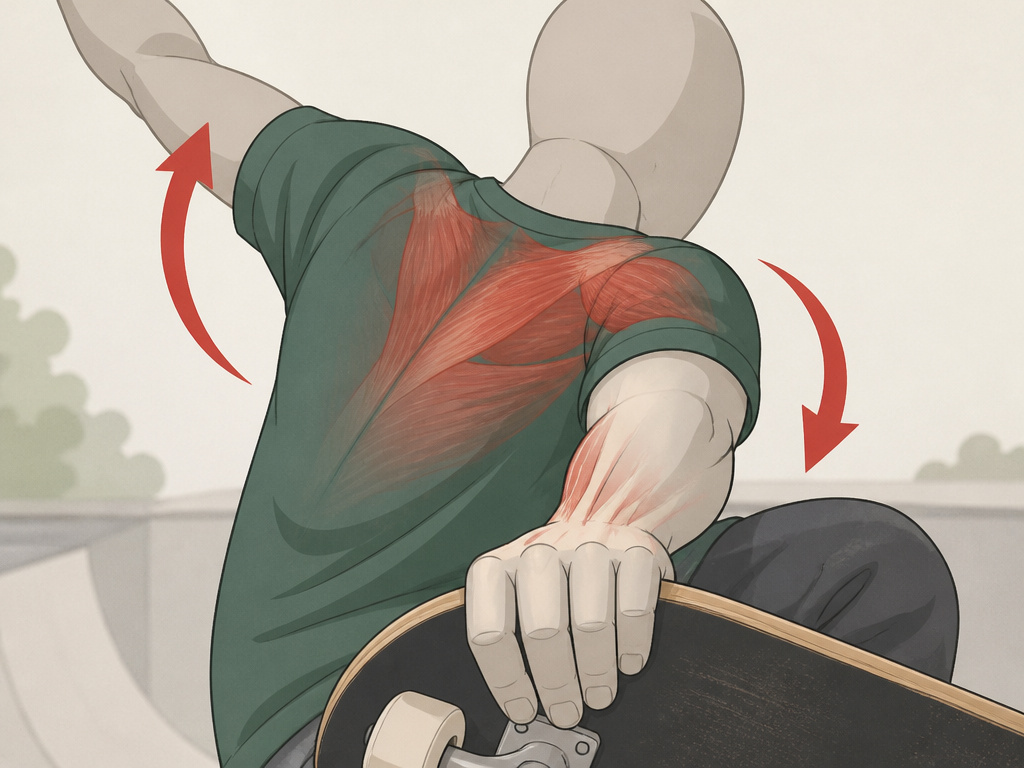
Your upper body is the counterweight and the catcher. It doesn’t generate power, but it manages momentum. The upper body is engaged during bails and pumping maneuvers.
During an ollie, your arms swing opposite your leg motion to provide angular momentum. It’s a natural, unconscious movement. Your shoulders and back muscles work to control that swing. When you fall, your arms and hands instinctively reach out to absorb impact, which is why wrist guards are a smart move for beginners.
Grip strength matters more than arm size. Holding onto the board during flip tricks, or gripping the coping during a stall, relies on forearm and hand strength. Grip strength is important for holding onto the board during flip tricks and stalls.
Skateboarding as Exercise: Cardio and Calorie Burn
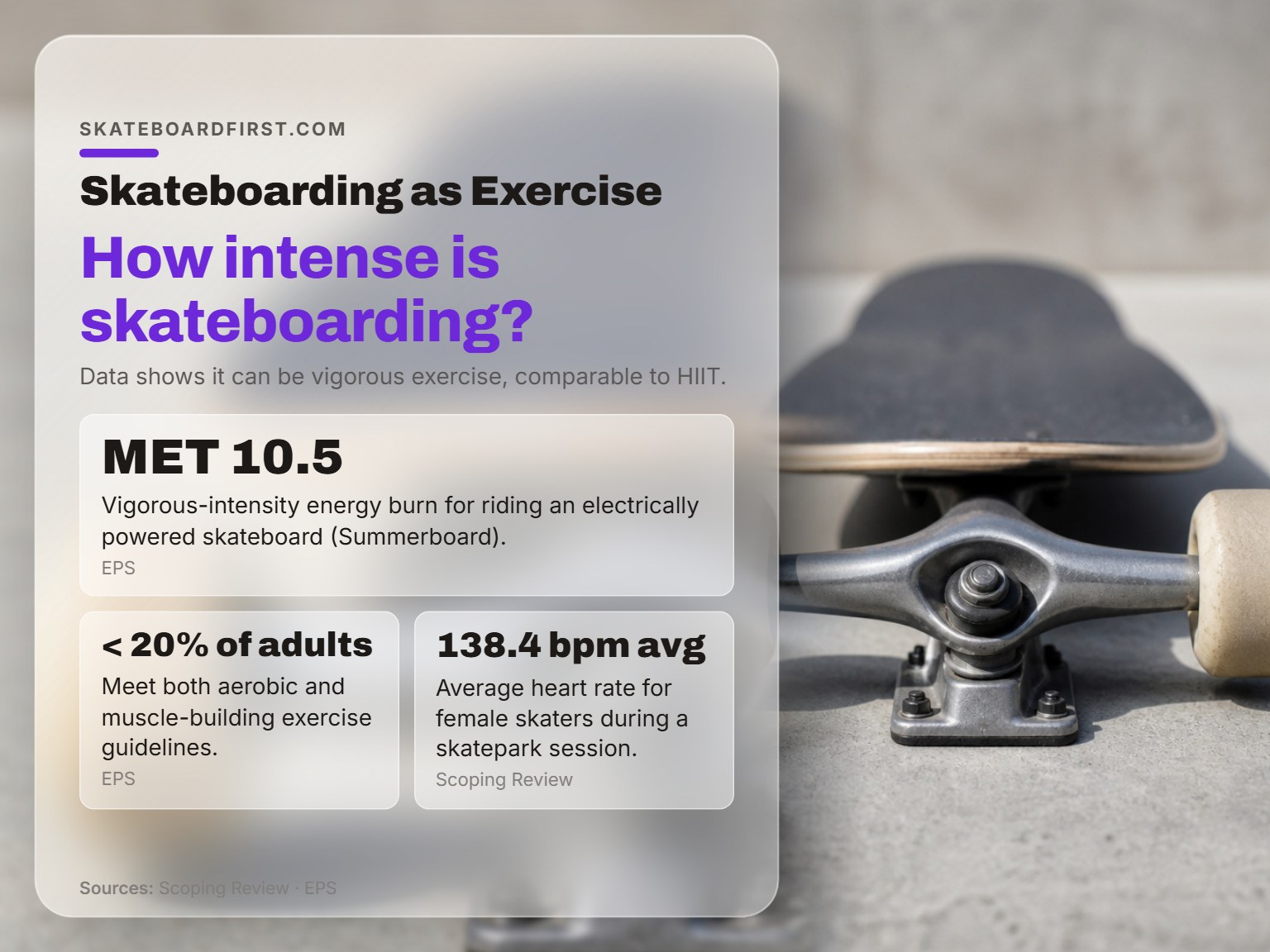
Is skating a workout? The data says yes, intensely so. The same 2020 study on electrically powered skateboards found that riding one has a vigorous-intensity MET value of 10.5. MET (Metabolic Equivalent of Task) measures energy expenditure.
This matters because less than 20% of adults meet both aerobic and muscle-building guidelines. Skateboarding, especially session-based skating at a park, can tick both boxes. A 2023 study noted that youth recreational skateboarders at community skateparks meet governmental exercise recommendations and their activity resembles high-intensity interval training.
| Skateboarding Activity | Primary Energy System | Muscle Focus | Fitness Benefit |
|---|---|---|---|
| Park Session (Carving, Tricks) | Anaerobic / Aerobic | Full-body, power endurance | Improves cardiovascular health, builds muscle stamina. |
| Technical Trick Practice (Ollies, Flips) | Phosphagen (Explosive) | Fast-twitch quads, glutes, calves | Builds explosive power and neural coordination. |
| Long-Distance Cruising | Aerobic | Slow-twitch calves, quads, core | Boosts endurance, active recovery, low-impact cardio. |
The vigorous-intensity exercise is a benefit, not just a side effect. But the combination of explosive efforts and sustained activity means you’re getting a potent physical demands session that few traditional gym routines can match.
Injury Prevention and Asymmetry
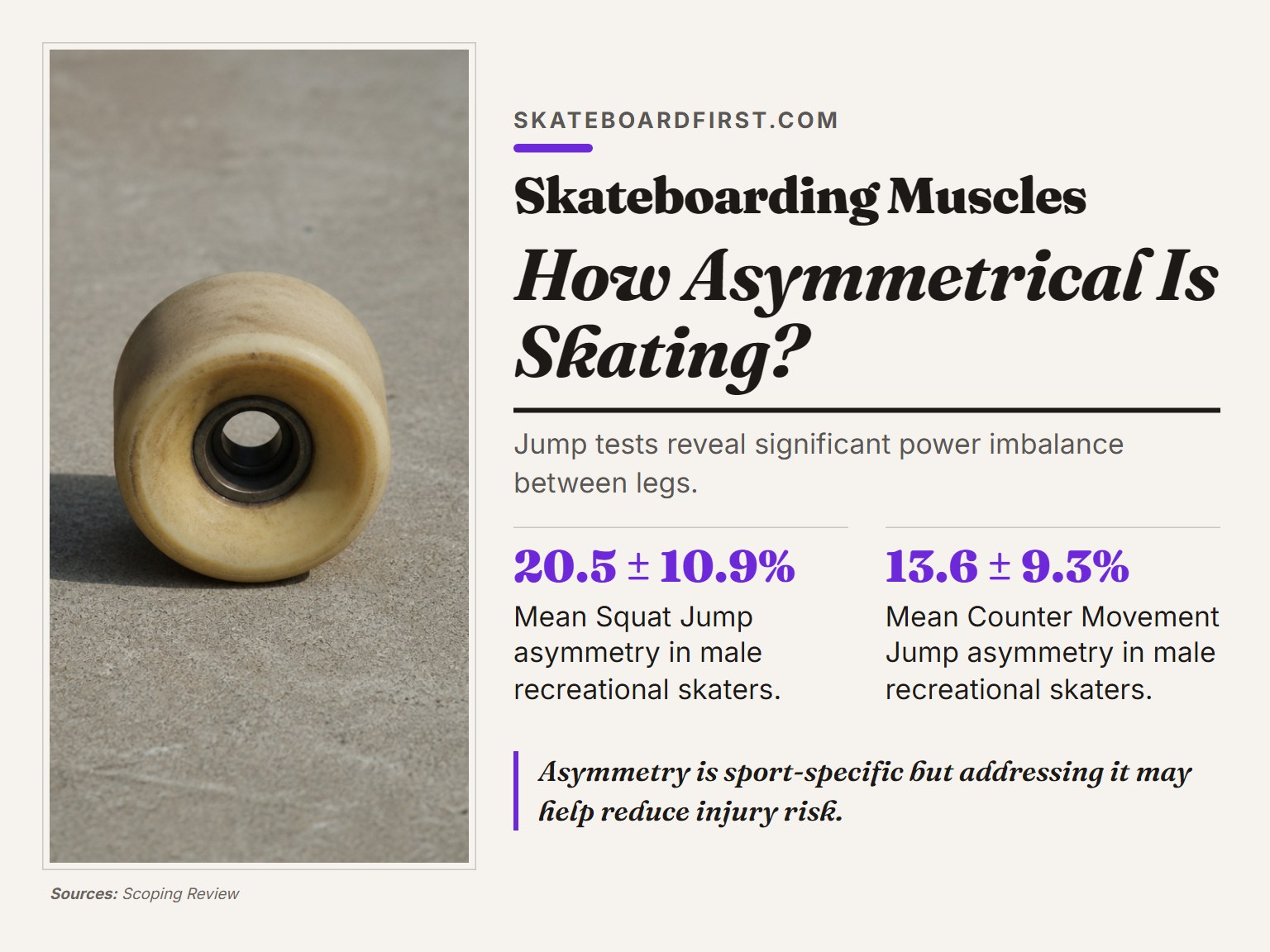
Skating is asymmetrical by nature. You push with one foot, pop with the other. This leads to muscle imbalances. A 2021 study measured male recreational skaters and found a mean Squat Jump asymmetry of 20.5% and a mean Counter Movement Jump asymmetry of 13.6%.
That asymmetry is sport-specific, but addressing it may help reduce injury risk.
Skating’s asymmetrical nature can lead to muscle imbalances that require targeted off-board training.
Addressing asymmetry may involve targeted unilateral exercises. Pair this with unilateral plyometrics like single-leg box jumps to address the power gap.
Training to Skate Better
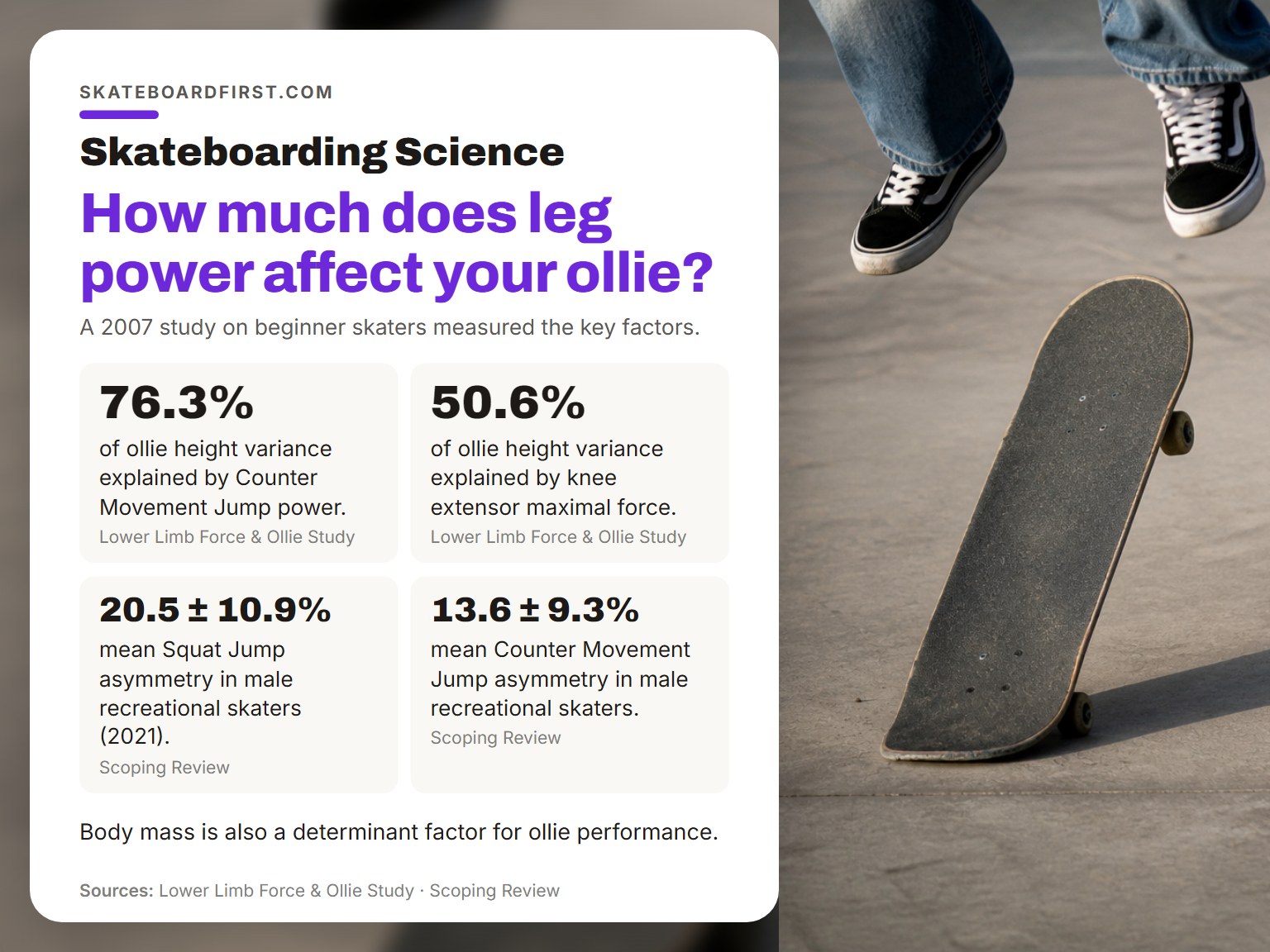
You don’t get better at skating by only skating. The research makes that clear. If 76.3% of your ollie height is tied to your vertical jump power, then improving your Counter Movement Jump will improve your ollie.
Here’s a simple, science-backed approach:
- Build a Power Base: Focus on explosive power exercises like squat jumps and box jumps twice a week. This directly targets the CMJ power link shown in the 2007 study.
- Address Imbalances: Incorporate single-leg exercises like Bulgarian split squats and single-leg calf raises. This mitigates the natural asymmetry skating creates.
- Train Stability: Add ankle strength drills like resisted ankle inversions/eversions and balance exercises on a wobble board.
- Don’t Skip Mobility: Your hips and ankles need range of motion to perform. Include dynamic stretches like leg swings and deep squat holds in your warm-up.
Supplemental training can build the physical qualities, like power and stability, that research links to skateboarding performance.
How skateboarding compares to weightlifting
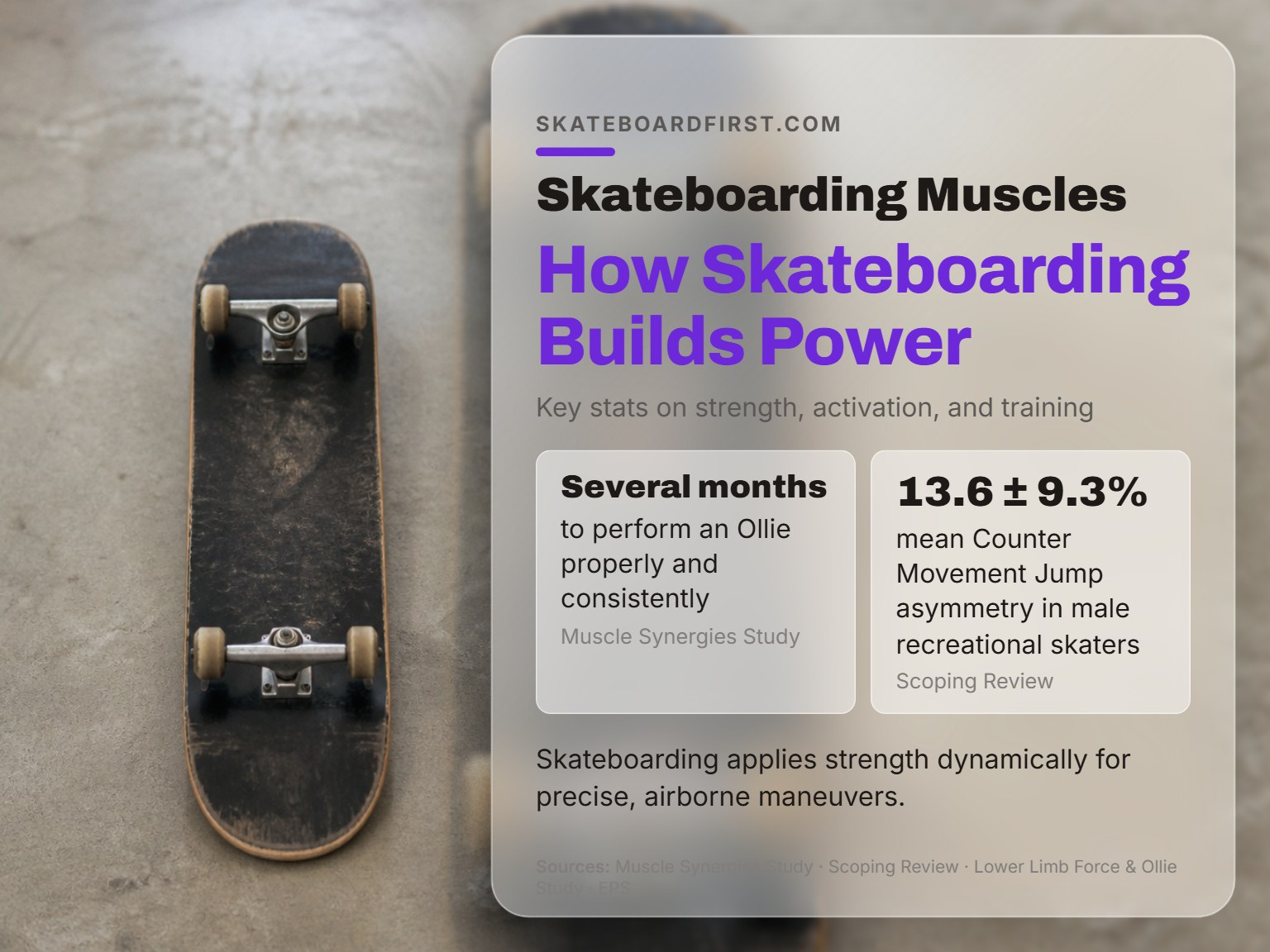
Skateboarding builds athletic power differently than structured weightlifting. Skateboarding demands explosive, coordinated movements that integrate strength, balance, and timing. Research shows that a skater’s ability to jump high off the board, known as ollie height, is strongly linked to their lower-body power from exercises like a Counter Movement Jump. The maximal force of the knee extensor muscles explains a significant portion of ollie performance for beginners, and skateboarding applies that force dynamically. The goal isn’t just to be strong, but to use that strength for precise, airborne maneuvers.
Skateboarding for long-term fitness and aging
Skateboarding offers a vigorous form of exercise that can contribute to lifelong health. Studies classify the activity as high-intensity, with sessions often resembling interval training and meeting government exercise recommendations. Engaging in regular leisure-time physical activity, like skateboarding, is associated with a significantly lower risk of mortality compared to being inactive. Professional skateboarders exhibit a significantly smaller ankle inversion angle compared to amateur players, indicating better joint control. This combination of cardio, strength, and balance work makes skateboarding a complete activity for maintaining fitness.
Frequently Asked Questions
What are the main muscles worked when skateboarding?
The quadriceps, glutes, and calves are the primary movers for generating power and absorbing impact. The core and ankle stabilizers are constantly engaged for balance and control. Upper body muscles like the shoulders and arms act as counterweights and aid in momentum.
Will skateboarding keep you in shape?
Yes. Research indicates skatepark sessions meet vigorous-intensity exercise guidelines, resembling high-intensity interval training (HIIT). It builds leg and core strength, improves cardiovascular endurance, and enhances balance and coordination.
Why do my ankles hurt after skateboarding?
Ankle pain often stems from the constant micro-stabilization required. Weak or slow-reacting peroneal muscles on the outside of the ankle can lead to strain. Ankle pain often stems from the constant micro-stabilization required. Proper warm-up and targeted stability training can help.
How does skateboarding change your body?
Skateboarding typically develops powerful, defined legs and calves, a strong core, and improved overall balance. It can also lead to sport-specific muscular asymmetries, with the push leg and pop leg developing different strengths. Consistent skating increases lower-body power and joint resilience.
Should I lift weights to improve my skating?
Yes, but strategically. Focus on exercises that build explosive leg power (like jumps and plyometrics) and single-leg stability. Focus on exercises that build explosive leg power (like jumps and plyometrics) and single-leg stability. Strength training should complement, not replace, board time.
The Bottom Line
Skateboarding is a full-body neuromuscular workout disguised as play. The science confirms what your soreness hints at: your quads and glutes launch you, your core and ankles steer you, and everything works in precise, often asymmetrical, synergy.
A 2021 study found male recreational skaters had a mean Squat Jump (SJ) asymmetry of 20.5 ± 10.9%, highlighting a common imbalance. Measure it, then address it with targeted leg workouts.
Everything above assumes you’re building a body that can handle the sport. The best gear setup can’t compensate for a weak link in that chain. Start small, add five minutes of mobility work before your next session. Incorporating mobility work can support joint health and skating technique.
