
Skateboard Wheel Shapes Explained: The 3 Key Variables
This post contains affiliate links. As an Amazon Associate, we earn from qualifying purchases.
Skateboard wheel shape is defined by three interacting variables: the contact patch (how much urethane touches the ground), the overall width (slim, standard, or wide), and the sidewall cut (classic round, conical, or radial). A wider contact patch and a conical sidewall give more grip for transition skating, while a slim width and a classic round cut prioritize slide and lightness for technical street tricks.
That gap between grip and slide is where your whole board feel lives. A wheel isn’t just a round thing that spins. Its profile decides whether your noseslide locks in or slips out, whether your board feels planted in a bowl or flickable off a curb. This is the essence of skateboard wheel shapes explained.
What follows: a breakdown of the three shape variables, a decoder for common shape names, and a straightforward guide to matching shape to the skating you actually do. By the end, you’ll be able to look at a wheel and predict how it will ride.
Key Takeaways
- The contact patch is the part of the wheel that touches the ground. A larger patch means more grip; a smaller one makes slides easier.
- Wheel width adds weight and stability. Wide wheels grip best for transition, while slim wheels are lighter for street.
- The sidewall cut, classic, conical, or radial, changes how the wheel engages the ground and locks into grinds. Conical cuts offer more support.
- For most beginners skating street and park, a standard width classic shape is a versatile starting point.
- Never mix different wheel profiles on one board. Manufacturers like Powerslide warn this disturbs how the skate reacts.
The 3 Key Shape Variables: Contact Patch, Width, and Cut
Forget memorizing a dozen brand-specific shape names. Every wheel design plays with three core variables, which is the heart of skateboard wheel shapes explained. Master these, and you can decode any wheel on the shelf.
Contact Patch: Your Grip and Slide Governor
The contact patch is the strip of urethane that actually meets the pavement. This isn’t a minor detail. It’s the primary governor between sticking and sliding.
A large contact patch provides more grip than a small contact patch. On the other hand, a small contact patch sacrifices some grip for the ability to slide easier for tricks like noseslides, tailslides and powerslides.
That trade-off is absolute. A wide, flat contact patch, like on a OJ Super Juice wheel, plants you to the ground. It’s why cruiser and longboard wheels feel so stable. A narrow, rounded patch, like on a slim street wheel, wants to break free. When you shift your weight for a slide, that smaller patch allows the wheel to pivot rather than grip.
You don’t need to measure it. Just look. A wheel with a fat, square-looking riding surface has a big contact patch. One that looks almost pointed where it touches the ground has a small one. Your first clue about a wheel’s personality is right there.
Wheel Width: The Stability vs. Weight Trade-Off
Width is the measurement from the wheel’s inner face to its outer face. It’s usually grouped into three categories: slim, standard, and wide.
| Width Category | Typical Range | Best For | Feels Like |
|---|---|---|---|
| Slim | (Slim width) | Technical street skating, flip tricks | Light, quick, easier to get airborne |
| Standard | (Standard width) | All-around street and park | Balanced weight and grip |
| Wide | (Wide width) | Transition skating, cruising, downhill | Planted, stable, holds speed |
Wide wheels have the biggest contact patch, so they provide the most grip. They also add a little more rotational weight to your setup. That extra mass helps you carry speed through a bowl’s corners, but it can make your kickflips feel a bit heavier. Slim wheels are the opposite. Their lightweight and smaller riding surface make them feel flickable for street tricks, but they can get sketchy on rough ground or in a fast pool.
I got this wrong for a year. I skated nothing but wide wheels because I liked the stability, but my flatground game suffered. My board felt like a tank. Switching to a standard width was the solution, providing enough grip for the park without making my tricks feel heavy.
Sidewall Cut: Classic, Conical, and Radial
The cut is the profile of the wheel’s side, the shape you see when the wheel is mounted on the truck. This is where terms like “classic” and “conical” come from, and it directly affects how the wheel engages with curbs, coping, and the ground.
- Classic (Round): The original. A continuously rounded sidewall from the lip to the bearing. This creates a smaller contact patch and allows the wheel to roll over obstacles like coping at an angle without catching. It’s the default, slide-friendly choice.
- Conical: Features a flat, angled sidewall that cuts off sharply. This design creates a wider contact patch for more grip. The flat wall also provides a solid surface to lock into grinds on ledges or coping. It’s a favorite for transition skaters.
- Radial: A hybrid. The sidewall has a rounded curve like the classic, but it’s shorter and stubbier, leading to a wider contact patch. It offers more support than a classic for grinds, but less than a conical, with a touch more slide.
Where this goes sideways: Choosing a wheel based only on the sidewall name without checking its width. A “classic” shape from one brand might be wider than a “conical” from another. Always look at the width spec (in mm) to know what you’re really getting.
Common Wheel Shapes Decoded
Brands have their own naming, but most shapes fit into the buckets below. Here’s how the major ones translate to real-world skating.
The Classic Shape (Spitfire Formula Four Classics, Bones STF)
This is the baseline. The sidewall is fully rounded, leading to a smaller, rounded contact patch. It’s the go-to for street skaters because it slides predictably and wears evenly. When you see a pro skating a 54mm Spitfire Formula Four Classic, this is what they’re on. It’s a neutral shape that doesn’t force a specific style, which is why it’s so popular. For a first set of real wheels, you can’t go wrong here.
The Conical Shape (Spitfire Formula Four Conical Full)
Conical wheels have that distinctive flat, angled sidewall. The angle pushes the urethane out, creating a wider contact patch. This gives you more grip in transition. The flat wall also gives you a defined locking point for grinds like smiths or feebles. If you spend more time in bowls and pools than on flat bars, a conical is worth the experiment. The trade-off is a slightly heavier feel and a touch more resistance when you want to slide the wheel sideways.
The Radial Shape & Newer Profiles
Radial shapes offer a middle ground. The rounded sidewall is truncated, giving you some of the locking benefit of a conical with some of the slide of a classic. Other profiles have emerged for specific jobs:
- Lock-Ins: Asymmetrical shapes with a conical outer profile and a sharply cut-off inner profile. The idea is maximum support for locking into tricks like crooks.
- Tablet: A sharply cut-off profile that results in a slim wheel with a surprisingly wide contact patch. It’s a shape aimed at technical skaters who still want a stable platform.
I’ve come around on radial shapes. For skating a mix of street and mellow transition, they give me just enough extra support on grinds without making the board feel locked to the ground. It’s a subtle difference, but after a session, my confidence on coping is higher.
How to Match Shape to Your Skating Style
This is the practical part of skateboard wheel shapes explained. Your wheel shape should match the terrain you skate most, not the graphic you like best.
Street & Technical Park Skating
For ledges, flat bars, and technical flip tricks, you want a wheel that gets out of the way.
- Priority: Slide and lightness.
- Recommended Shape: Classic or slim Radial.
- Width: Slim to Standard.
- The rounded profile slides consistently, and the standard width keeps the board flickable. A Bones STF V5 in a similar size does the same job.
Transition & Bowl Skating
For pools, bowls, and vert ramps, grip and a solid lock-in point are king.
- Priority: Grip and stability at speed.
- Recommended Shape: Conical or wide Radial.
- Width: Standard to Wide.
- The flat sidewall and wider contact patch keep you glued to the transition. The extra diameter helps maintain speed with fewer pumps.
Cruising & Rough Ground
Getting from A to B comfortably over cracks and bumps is a different game.
- Priority: Smooth roll and vibration dampening.
- Recommended Shape: Often a wider Classic or a specific cruiser shape.
- Width: Wide.
- The softer durometer and wider profile absorb shocks. The shape is less critical here than the softness and size, but a wider base adds stability.
| Your Main Terrain | Best Shape | Width | Why It Works |
|---|---|---|---|
| Street Ledges & Flatground | Classic | Slim to Standard | Promotes easy slides, lighter for flip tricks |
| Skatepark (Mix of Street & Transition) | Radial or Classic | Standard | Balanced grip/slide for varied obstacles |
| Bowls, Pools, Vert | Conical | Standard to Wide | Maximum grip and a defined lock-in point for coping |
| Commuting & Rough Pavement | Wide Classic | Wide | Stability and comfort trump specific shape |
Wheel Shape vs. Size and Durometer: The Full Picture
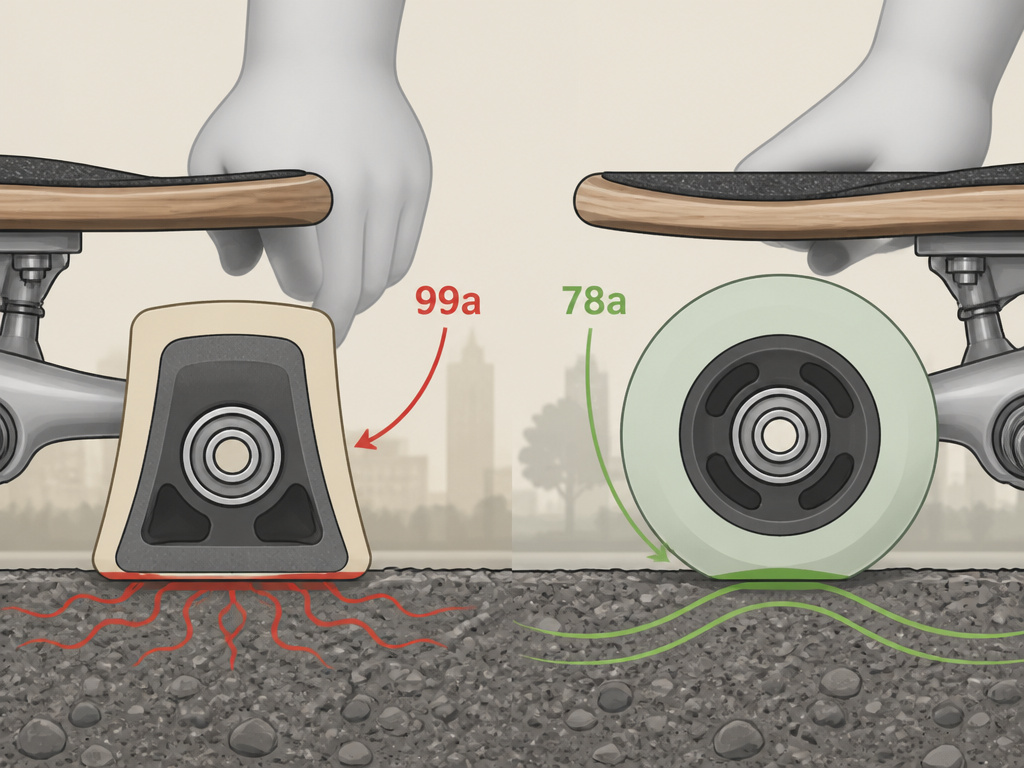
Shape doesn’t work in a vacuum. It interacts with the wheel’s diameter and hardness. A high-durometer (e.g., 99a+) small conical wheel will still slide and feel hard. A 78a 60mm classic wheel will still grip and feel soft. But the shape fine-tunes that core behavior.
Common mistake: Picking a hard, small wheel for street, but choosing a wide conical shape. You get the hard, fast roll you want, but the wide conical contact patch fights you on every slide attempt, making the board feel sticky and unpredictable.
Here’s the interaction rule: Size and durometer set the core performance; shape fine-tunes it for your terrain. If you skate rough ground, a larger, softer wheel is your first fix. Once you have that, a shape with a wider contact patch will further smooth the ride. If you skate smooth park concrete, a harder, smaller wheel is your base. Then, a classic shape will enhance slide, while a conical will add a bit more park grip.
The Exploratorium skateboard wheel design guide explains the physics behind this: a harder wheel can lose energy by deforming the pavement instead of itself, while a softer urethane wheel deforms and rebounds efficiently. Your shape choice decides how that energy transfer feels under your feet.
How does wheel shape affect weight?

The shape of a wheel directly influences its weight, and that weight changes how your board feels. Slim shaped wheels are targeted towards technical street skating because of their lightweight nature. They have a smaller riding surface, which means less material and a lighter wheel overall. This makes the board feel quicker to flip and easier to maneuver for tricks. In contrast, a wider wheel with a larger contact patch uses more material, adding weight. Larger wheels are also heavier and make tricks more difficult. So, a slim, classic, or tablet shape generally means a lighter wheel for street tech, while wider conical or radial shapes add stabilizing weight at the cost of flick speed.
Frequently Asked Questions
What do different skateboard wheel shapes mean?
They describe the profile of the wheel’s sidewall and riding surface. “Classic” means a fully rounded sidewall for easy slides. “Conical” means a flat, angled sidewall for more grip and grind support. “Radial” is a rounded but shorter sidewall that offers a mix of both.
Does wheel shape really matter for beginners?
It matters less than getting the right size and hardness. As a beginner, a standard width classic shape in 54mm-56mm is the most forgiving and versatile choice. It won’t hold you back. Once you have board control and start focusing on specific tricks or terrain, then shape becomes a useful tuning tool.
How does wheel shape affect grinds?
Shape with a flat sidewall, like a conical or lock-in, gives you a solid, defined surface to press against the ledge or coping. A rounded classic shape can feel more vague or slippery on grinds because the curved surface wants to roll off. If you love grinding, a conical or radial shape provides more confidence.
Can I mix different wheel shapes on my board?
No. Manufacturers like Powerslide explicitly warn against mixing different profiles on one skate, stating it will “disturb a lot the way the skate reacts.” It creates an uneven, unpredictable ride. Always use four identical wheels.
Is a wider wheel always better for grip?
Yes, within the same shape and durometer. A wider wheel has a larger contact patch, which means more urethane touching the ground. However, both a softer durometer and a wider wheel increase grip independently. For maximum grip, you want a softer durometer AND a wider shape.
Before You Go
One rule most guides skip: if you’re still working on riding comfortably and basic ollies, ignore shape jargon entirely. Buy a standard wheel in a size and durometer appropriate for your terrain. That covers 90% of beginner and intermediate skating on smooth ground. The subtle differences between a classic and a radial won’t matter until you’re consistently landing tricks that demand a specific board feel.
Everything above assumes you’re skating decent pavement or park concrete. If your local ground is rough and chunky, all the shape theory flips, your first priority becomes a larger, softer wheel for comfort. The recycled plastic wheel materials study points to a future where material science might change the game again, but for now, urethane and these three shape variables are your toolkit. Pick the shape that solves the problem you actually have.
