
Skateboarding Laws Explained: What You Need to Know
This post contains affiliate links. As an Amazon Associate, we earn from qualifying purchases.
Skateboarding laws are a patchwork of state, city, and safety regulations that define where you can ride, how you must ride, and the penalties for violations. The core legal framework often delegates authority to local governments, creating a maze of ordinances that vary by block, with specific rules for lighting, speed, age, and riding position that carry real fines.
That delegation is the key to the confusion. California state law, for example, explicitly tells cities they can make their own rules. This means the answer to “can I skate here?” changes at the city limit, not the state line, which is why having skateboarding laws explained is so important.
What follows is a breakdown of that framework, the specific rules you’ll find in major cities, the critical safety laws that apply everywhere, and a clear guide on how to find and follow the ordinances in your own town.
Key Takeaways
- State laws often delegate authority to local governments, making your city or county code the final word on where and how you can skate.
- Motorized skateboards face different, often stricter rules, like Virginia’s 20 mph speed limit, and are banned entirely in some states like Delaware.
- Night riding rules vary: Portland mandates a white light visible from 500 feet and a red reflector visible from 600 feet, while Oakland simply bans riding from sunset to sunrise or when visibility is less than 1,000 feet.
- Violations carry concrete fines: Portland sets a $115 minimum for breaking roadway rules and a $25 maximum for riders under 16 skipping a helmet.
- Prohibitions often depend on posted signs; in cities like Los Angeles, an area isn’t officially “no-skate” until the signs go up, regardless of the ordinance.
The Core Legal Framework: State vs. Local Laws
Skateboarding exists in a legal gray area between pedestrian and vehicle. Most states don’t have a single, blanket “skateboarding law.” Instead, they set a baseline and let local governments fill in the details. This creates the patchwork system skaters navigate.
California is the prime example. The California Vehicle Code 21967 statute, amended in 2016 to include electric boards, states that “a local authority may adopt rules and regulations by ordinance or resolution regulating the operation of skateboards.” This is a pure delegation of power. The state isn’t saying yes or no; it’s saying “ask your city council.”
This delegation creates a regulatory patchwork where a perfectly legal maneuver in one city can be a ticketable offense in the next. You must check your local municipal code, not just state law.
Other states take a more uniform approach. Virginia sets clear, statewide rules for motorized devices. Its Virginia motorized skateboard law (§ 46.2-908.1) imposes a 20 mph speed limit and says no one under 14 can drive one without adult supervision. Some states, like Delaware, effectively ban motorized skateboards on public ways except under very limited conditions, while others, like Virginia, permit them with restrictions.
The takeaway? Always start with your state’s vehicle code. If it defers to local authority, your city’s municipal code becomes your skateboarding bible, and a thorough skateboarding laws explained guide is essential.
Specific City Rules: A Patchwork of Ordinances
Once you drill down to the city level, the rules get specific, sometimes bizarrely so. You’re not just dealing with “no skating” signs; you’re dealing with coded ordinances that dictate your stance, your speed, and the exact lumens of your headlight.
Los Angeles has one of the most detailed codes. The Los Angeles Municipal Code mandates you skate only “in the upright, standing position,” prohibiting sitting, lying down, or kneeling. In contrast, the CPSC advises ‘Never lie down on a skateboard in motion’ but does not prohibit other positions. More importantly, the code states that prohibitions in specific areas, like plazas or parking structures, only become enforceable after the city posts signs. No sign, no ticket, at least for that specific location ban.
Portland’s rules, detailed in Portland skateboard ordinance 16.70.410, are a masterclass in precision. The city bans skating in a defined downtown box (SW Jefferson to NW Hoyt, 13th Ave to Naito Pkwy) and on specific stretches of 5th and 6th Avenues. It also imposes time-based bans from 10 p.m. To 7 a.m. On listed streets in the West Hills. Their lighting rules are exact: a white light visible from 500 feet to the front, and a red reflector or light visible from 600 feet to the rear during limited visibility or from sunset to sunrise.
Oakland takes a simpler, stricter view on night riding. Its code doesn’t specify lighting equipment; it just says skateboarding is prohibited from sunset to sunrise, or anytime a person or vehicle isn’t clearly visible from 1,000 feet away.
| City | Key Rule | Specificity | Penalty Insight |
|---|---|---|---|
| Los Angeles | Upright standing only; 10 mph at uncontrolled intersections. | High – regulates body position. | Prohibitions require posted signage. |
| Portland | Bans in specific geographic zones and times; precise lighting specs. | Very High – lists exact streets and light distances. | $115 minimum fine for breaking roadway rules. |
| Oakland | No riding from sunset to sunrise. | Moderate – uses a 1,000-foot visibility threshold. | Focuses on time-of-day over equipment. |
The pattern is clear. Cities don’t just ban skating; they regulate the how, when, and where with surprising detail, a key point in any skateboarding laws explained overview. This is why understanding local sidewalk laws and bike lane laws is essential for street skaters.
Safety Laws and Equipment Requirements
Beyond the “where,” laws also govern the “how safely.” These rules are often backed by safety data from agencies like the Consumer Product Safety Commission and carry penalties designed to prevent injury.
The most universal rule is the helmet law for minors. Many cities, like Portland, mandate protective headgear for skaters under 16. The penalty for skipping it there is a maximum fine of $25. It’s a minor fine, but the real penalty is the risk it’s meant to mitigate. The CPSC Skateboarding Safety Fact Sheet is blunt: “Wearing a helmet can mean the difference between life and death.” It also stresses that wrist guards are especially important for skateboarding.
Lighting laws, as seen in Portland, are safety rules with measurable specs. They exist because a skater at dusk is nearly invisible to a driver. The 500-foot white light requirement is a measurable safety specification designed to make skateboarders visible to drivers.
Portland’s code also forbids anyone from knowingly driving a car that is towing a skateboarder. The penalty for failing to follow rules A through G (e.g., lighting, yielding) in Portland is a minimum fine of $115.
Common mistake: Assuming “ride during the day” is just good advice. In cities like Oakland, it’s generally prohibited from sunset to sunrise, unless a person or vehicle is clearly discernible at 1,000 feet.
These laws aren’t there to ruin your session. They’re a regulatory response to documented hazards. Following them isn’t just about avoiding a ticket; it’s about integrating into traffic and protecting yourself. This is the core of skateboarding safely around cars.
Motorized vs. Non-Motorized: A Legal Split

The law draws a bright line between a traditional skateboard and an electric one. That line changes everything, where you can ride, how fast you can go, and how old you need to be.
For traditional, human-powered boards, the main legal hurdles are location-based (sidewalks, streets, parks) and behavior-based (reckless riding, traffic violations). An electric skateboard, however, is often classified as a “motorized vehicle” or “Personal Transportation Device.” This triggers a different set of rules.
Virginia’s law is a clear example of this split. The 20 mph speed limit and the age-14 restriction apply only to “motorized skateboards or scooters.” The law also bans these motorized devices from interstate highways.
Other states are far less welcoming. Delaware’s code effectively prohibits operating a motorized skateboard on any public way unless it’s being pushed with the power off or used in a permitted special event. This isn’t a regulation; it’s a near-total ban on using the device as intended.
This split means you must know your board’s classification. If you’re riding an electric model, you need to research electric skateboard laws specifically. Relying on the rules for a standard skateboard could leave you facing much steeper penalties for operating an unregistered motor vehicle on a prohibited roadway.
How to Find and Follow Your Local Laws
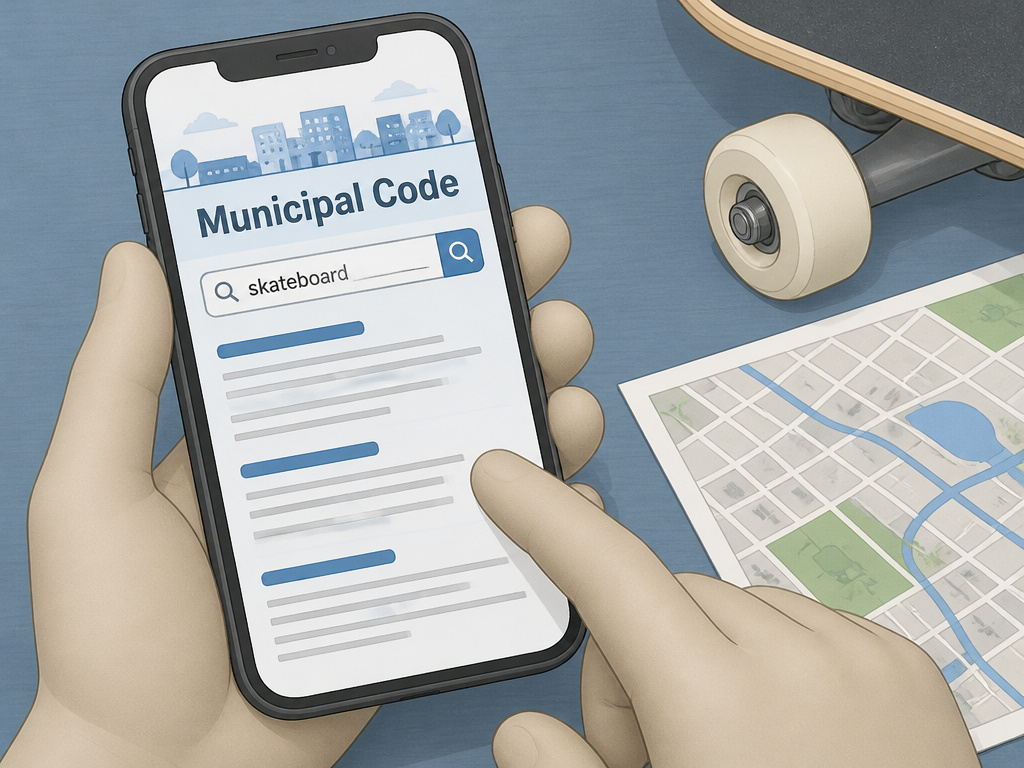
You don’t need a law degree to figure this out. You just need a method. Start online. Search for “[Your City] municipal code” or “[Your City] ordinances.” Once you find the code, search for keywords like “skateboard,” “roller skates,” or “personal transportation devices.”
Look for sections like “Traffic” or “Public Ways.” Pay close attention to:
- Definitions: How does the city define a skateboard? Is there a separate definition for motorized versions?
- Prohibited Areas: Are there lists of streets, parks, or business districts?
- Equipment Requirements: Are there rules about lights, reflectors, or helmets?
- Operational Rules: Are there mandates on riding position, speed, or yielding?
If the code is confusing, call your city clerk’s office or the non-emergency line for the local police. Ask directly: “Can you point me to the ordinance that regulates skateboarding on public streets?” Sometimes, the answer is simpler than the legal text implies. In many towns, enforcement is complaint-driven. You might be technically violating an obscure ordinance, but if no one calls, no officer will appear.
This diligence is especially important if you’re planning something beyond casual street skating. Building a DIY spot, organizing a group ride, or filming in a busy area can attract attention. Knowing the exact legal responsibility and permit requirements beforehand is how you avoid being the example in a future ordinance.
Penalties and Enforcement: What Actually Happens

The law books list fines, but reality is messier. Enforcement is inconsistent and often depends on context.
The fines themselves are concrete. Portland’s code lays them out clearly: a minimum $115 fine for failing to follow rules A through G, a maximum $25 fine for a minor without a helmet, and a $250 fine for other violations, though first-time offenders can take a “Share the Road” course instead. These aren’t theoretical numbers; they are the prescribed penalties.
But will you get a ticket? It depends. In a residential neighborhood early on a Sunday morning, you’ll likely be left alone. On a crowded downtown sidewalk during business hours, an officer or security guard will probably ask you to leave. The real legal trouble starts if you ignore that request or return after being told to leave, that’s when a simple trespass warning can turn into a fine.
Community reports back this up. Skaters on forums note that respectful interaction is key. If a property owner or officer asks you to leave, apologize and go. Arguing or trying to finish your line is what escalates a request into a citation. Most illegal skateboarding stops are about trespass and nuisance, not traffic court.
The system is designed to be reactive, not proactive. The laws exist so that when a complaint is made or an accident occurs, there is a clear rule to enforce and a defined penalty to apply. Your best defense is to know those rules, so you can argue from knowledge, not ignorance, if the situation arises.
Do skateboarders have to follow traffic laws?
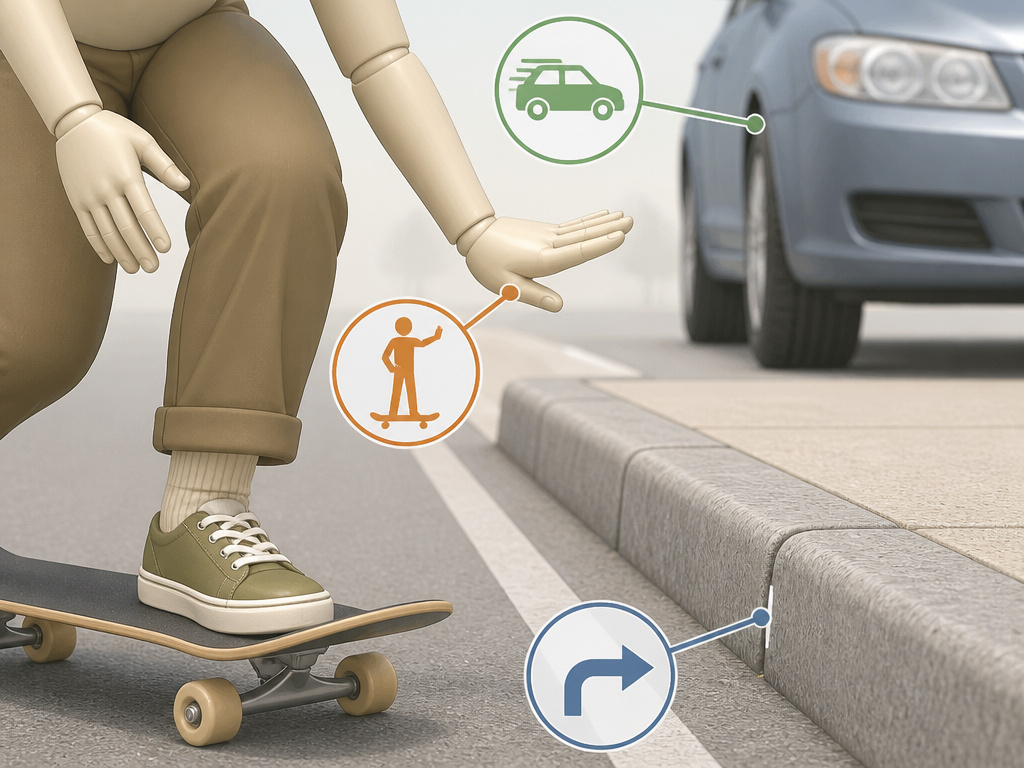
Skateboarders are typically expected to follow basic traffic rules, but the specifics are set by your local city or county. For example, a common rule requires skateboarders traveling slower than the speed limit to yield to vehicles from behind by moving to the right curb or shoulder. Rules about stopping at stop signs or obeying right-of-way are also determined locally. Because state law often delegates authority to local governments, you must check your own city’s municipal code to know exactly which traffic rules apply to you. Ignoring these local rules can result in fines.
How do skateboarding laws differ from bike or scooter laws?
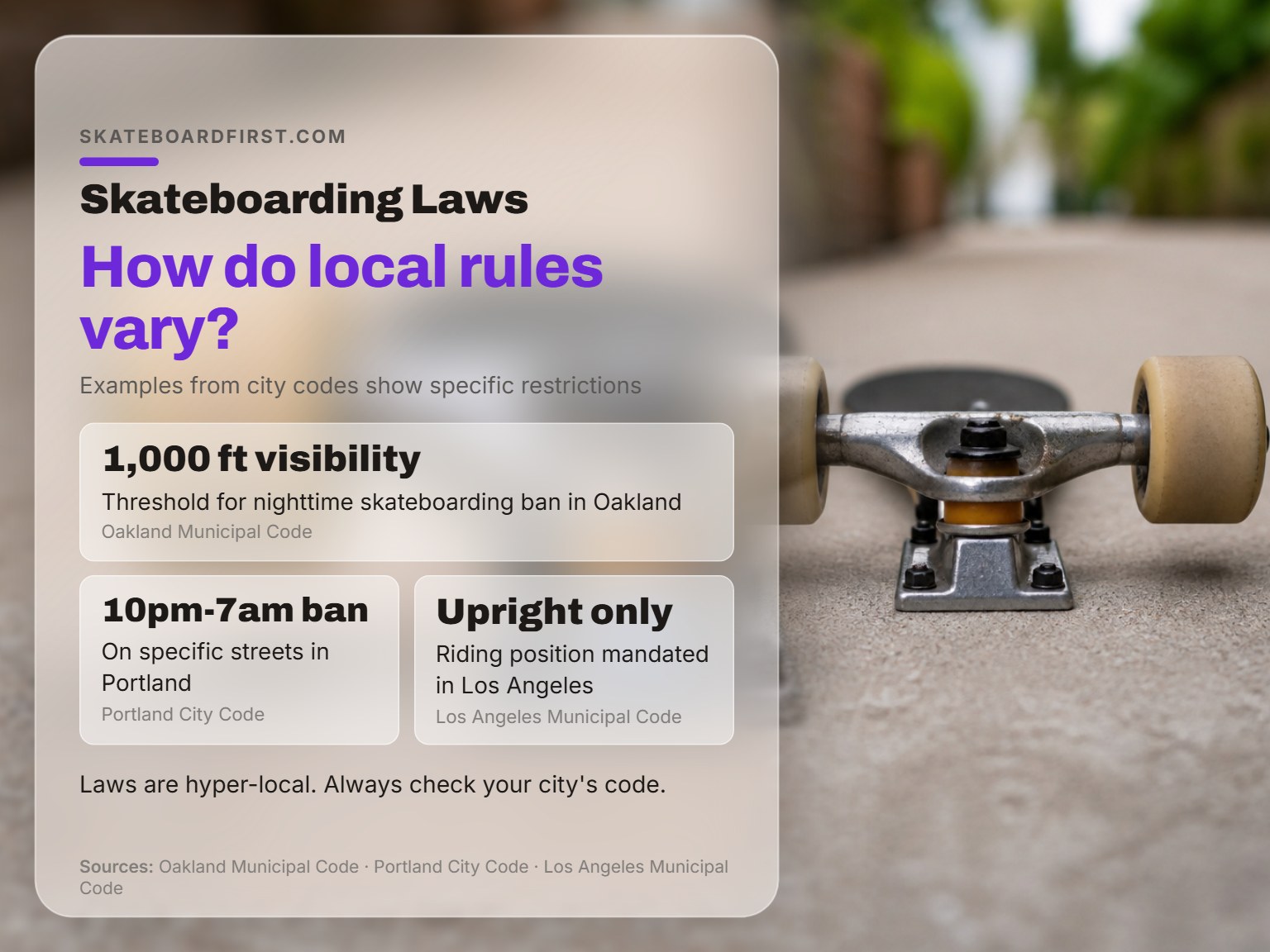
Skateboarding laws are distinct and often more restrictive than those for bicycles or electric scooters. While many states have specific vehicle codes for bikes and scooters, skateboarding is frequently governed by a patchwork of local ordinances. For instance, some cities explicitly prohibit skateboarding on certain sidewalks or streets, impose strict riding position rules, or ban it entirely at night. In contrast, laws for motorized scooters or skateboards might be set at the state level, covering things like speed limits and age restrictions. The key difference is that skateboarders must pay closer attention to hyper-local rules that can vary block by block.
Why is skateboarding often banned or restricted?
Public opposition to skateboarding stems from concerns about safety, noise, and property damage. This leads to a wide array of local prohibitions designed to mitigate conflict. Common restrictions include bans on specific downtown sidewalks, major streets, or areas near businesses. Many cities also outlaw skateboarding at night, citing visibility and safety concerns. Activities like hitching a ride on a vehicle are also universally prohibited due to extreme danger. These rules are often enforced in response to complaints, making skateboarding’s legality highly dependent on location and time of day.
Frequently Asked Questions
Do I need a helmet to skateboard?
Helmet laws are almost always local. Many cities require helmets for skaters under a certain age (commonly 16 or 18). Portland, for example, mandates them for riders under 16, with a maximum $25 fine for violation. Even if not legally required, agencies like the CPSC strongly recommend a properly fitted skateboarding helmet for all riders.
Can I skateboard on the sidewalk?
This is dictated by city ordinance. Some cities prohibit it entirely, some allow it, and some only ban it in specific commercial districts. Los Angeles and Portland have downtown areas where sidewalk skating is illegal. Always check your local municipal code for the definitive answer.
Are electric skateboards legal on the road?
It varies drastically by state. Virginia permits them with a 20 mph speed limit. Delaware effectively bans them. In states like California, where regulation is local, you must check your city’s rules. They are almost never allowed on sidewalks and are often subject to different equipment and age requirements than regular skateboards.
What’s the penalty for skating where it’s not allowed?
Penalties range from a simple request to leave to fines. Portland sets a $115 minimum fine for violating its operational rules. More serious inflections, like reckless riding that endangers others, can result in higher fines or even misdemeanor charges. Trespassing on private property after being warned can also lead to fines.
How can I find out the skateboarding laws in my town?
Search online for “[Your City Name] municipal code.” Navigate to the traffic or public ways sections and search for “skateboard.” You can also call your city clerk’s office or local police department’s non-emergency line for guidance. Checking your city’s official website or parks and recreation department page can also yield information, especially about skatepark-specific rules.
Before You Go
One rule cuts through the patchwork: if an area is marked with “No Skateboarding” signs, it’s off-limits. In many cities, such as Los Angeles and Oakland, signage is required for certain area prohibitions to be enforceable.
Your local skate shop often has the best, most current intel. They hear from everyone, the skaters who got tickets, the cops who gave them, and the city council members proposing new ordinances. They’re a living database of local sidewalk ordinances and enforcement trends.
Finally, treat this knowledge as part of your gear. Knowing the law is as crucial as tightening your trucks. It lets you skate with confidence, minimizes conflict, and keeps the session going. Roll smart.
