
Do You Need Knee Pads for Skateboarding? How to Pick Them
This post contains affiliate links. As an Amazon Associate, we earn from qualifying purchases.
You need knee pads for skateboarding if you want to cut your risk of a serious knee injury by nearly a third, according to a peer-reviewed study, and they are legally required for entry in supervised skateparks in states like North Carolina. For street cruising, many experienced skaters prioritize wrist guards, but the official safety stance from the U.S. Consumer Product Safety Commission and the American Academy of Orthopaedic Surgeons is clear: knee pads are essential protective equipment.
That 32 percent reduction is not a marketing number. It comes from a 1996 study in the New England Journal of Medicine that the American Orthopaedic Society for Sports Medicine still cites. It means that for every ten knee injuries that happen without pads, wearing them prevents about three. The gap between that medical fact and what you see at your local street spot is where the real decision lives, and it directly informs the question: do you need knee pads for skateboarding?
This guide walks through the data, the law, and the practical trade-offs between protection and mobility that inform the question, do you need knee pads for skateboarding. You will see where the rules are black-and-white, where skaters disagree, and how to pick a pad that you will actually wear.
Key Takeaways
- Knee pads reduce knee injuries by 32 percent according to a cited medical study, a specific, verifiable figure.
- In North Carolina, knee pads are legally required for skatepark use, with operators facing fines for non-compliance.
- For street skating, wrist guards offer an 87 percent injury reduction and are often the first priority for new skaters learning to fall.
- The CPSC and AAOS list knee pads as essential, creating a clear divide between official safety advice and common street-skating practice.
- Hard-shell knee pads are the benchmark for vert skating, while slimmer models work better under street clothes.
The 32 Percent Rule: What the Data Says
Wearing knee pads can reduce the number of knee injuries by 32 percent. This figure comes from a 1996 study in the New England Journal of Medicine (Schieber RA, et al.) that analyzed the effectiveness of safety gear for inline skaters, a population with similar fall dynamics to skateboarders. The American Orthopaedic Society for Sports Medicine continues to cite this data in its current safety materials.
That number is the foundation. It is not an estimate or a guideline. It is the result of a published analysis of real injuries. When the U.S. Consumer Product Safety Commission says “Use knee and elbow pads,” and the American Academy of Orthopaedic Surgeons lists them as “essential protective equipment,” this 32 percent reduction is the evidence they are leaning on.
The study also found wrist guards reduce wrist injuries by 87 percent and elbow pads cut elbow injuries by 82 percent. These numbers create a brutal hierarchy of effectiveness. If you only get one piece of gear after a helmet, the data screams for wrist guards. But that does not make knee pads optional from a pure injury-prevention standpoint. It just means they are the third-most effective piece in the set.
Think about the force involved. A knee hitting concrete from a failed ollie absorbs your entire body weight plus the downward momentum of the fall. The impact is a sharp, localized crack. A pad spreads that force across a hard plastic cap and a thick foam liner. The difference is between a deep bone bruise that sidelines you for weeks and shaking it off to try again.
Street Skating vs. Park Riding: A Pad Priority Shift
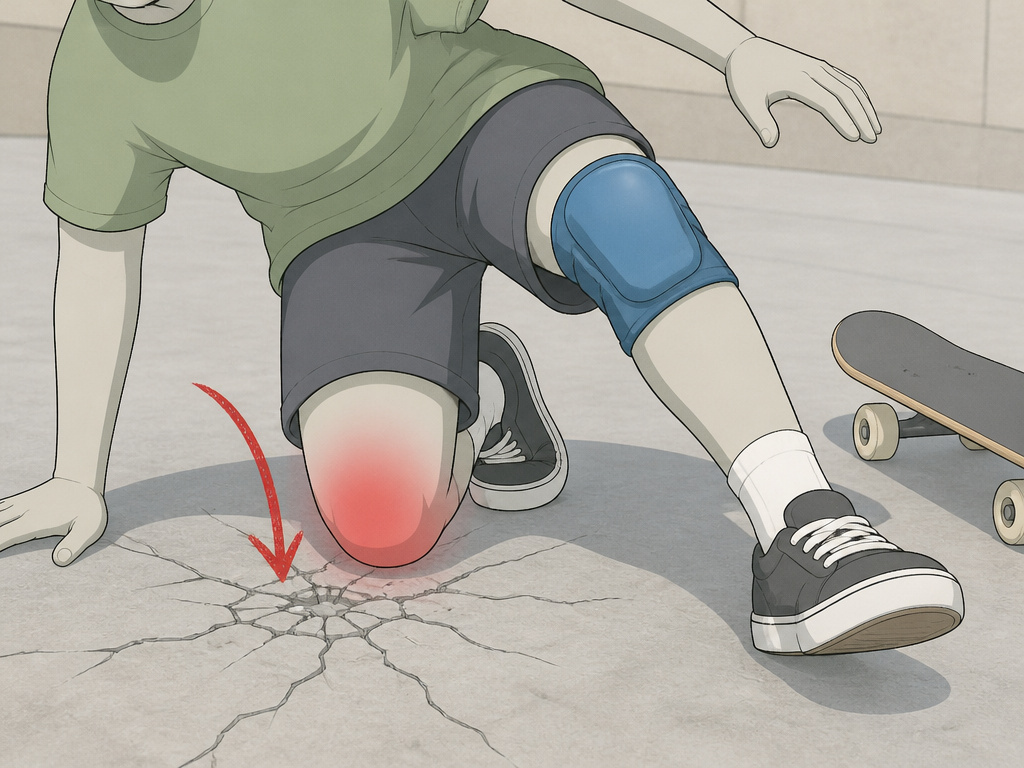
Here is where the official advice collides with the skatepark. Ask any street skater who has been at it for a few years, and you will get a common answer: knee pads are for transition skating.
On flat ground, your falls are different. You rarely slam directly onto your kneecap. You stumble forward onto your hands or twist to land on your hip or shoulder. A thread on r/NewSkaters highlights this: One view shared in the skating community is that “You only fall on your knees when skating vertical or Big transition… Wrists and hips and head and collarbones are a street skaters impact zones.” This perspective changes the calculus for some skaters, though official sources recommend knee pads for all disciplines.
For pure street skating, many in the skating community often prioritize wrist guards. The reasoning is practical. Bulkier hard-shell pads, which are standard for vert, can restrict the deep knee bend needed for a high ollie. As some skaters note, bulkier pads can bunch up behind the knee and restrict motion, which can throw off your pop. Others find slip-on pads comfortable and unobtrusive for street skating.
Where this goes sideways: Assuming you can always control your fall. Even on flat ground, a wheel can catch a pebble or crack unexpectedly. Your instinct might be to put a knee down to stabilize, and without a pad, that single impact can scrape you to the bone or cause a prepatellar bursitis, “housemaid’s knee”, that swells up and takes weeks to drain.
A Quick Comparison: Street vs. Transition Needs
| Skating Style | Primary Impact Zones | Common Pad Choice | Why It Works |
|---|---|---|---|
| Street / Flat Ground | Wrists, hands, hips, tailbone | Slim knee pads (optional), wrist guards (essential) | Low-profile protection that doesn’t hinder trick motion. |
| Park / Ramp / Bowl | Knees, elbows, wrists | Full-coverage knee & elbow pads (e.g., 187 Killer) | Hard caps allow for intentional knee slides to control falls on transition. |
| Downhill / Longboard | Knees, elbows, palms, head | Full pad set, slide gloves, full-face helmet | High-speed falls require maximum coverage for slides across pavement. |
The table shows the shift. For transition skating, knee pads are essential. They protect from impacts, and learning to knee slide is a fundamental bail technique that allows you to slide out safely instead of catching and tumbling.
When the Law Says “Yes,” Even If You Say “No”
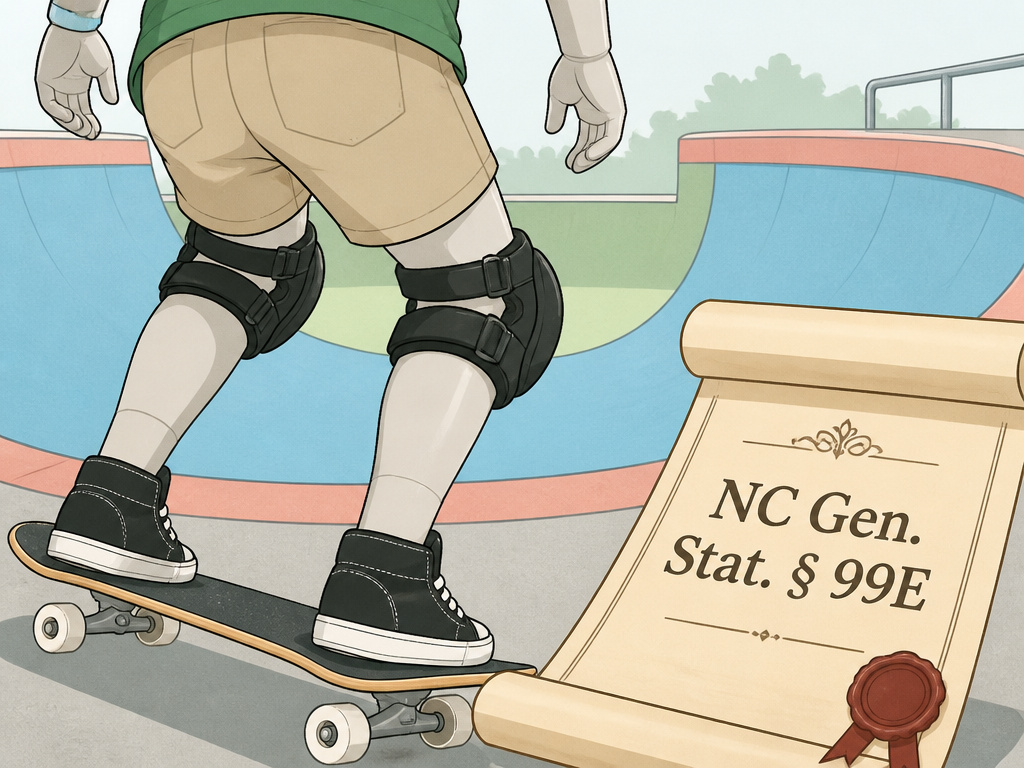
Safety recommendations are one thing. The law is another. In North Carolina, the statute is unambiguous. Chapter 99E, Article 3 states that no operator of a skateboard park shall permit anyone to ride “unless that person is wearing… Kneepads.” An operator who fails to enforce this can be fined.
This creates a fascinating split. The CPSC fact sheet offers a suggestion: “Use knee and elbow pads.” North Carolina law turns that suggestion into a ticketable requirement at supervised parks. The law has a practical loophole for unsupervised, public parks, compliance shifts to the rider, who must heed posted signage, but the intent is clear. In that state, if you want to skate in a managed park, you wear knee pads.
This legal layer is almost never mentioned in general safety guides that ask, do you need knee pads for skateboarding. It means the answer to “do you need knee pads” can literally be “yes, or you cannot skate here,” depending on your zip code. It is a powerful, if localized, argument for making them a standard part of your gear bag.
How to Pick Knee Pads You Will Actually Wear
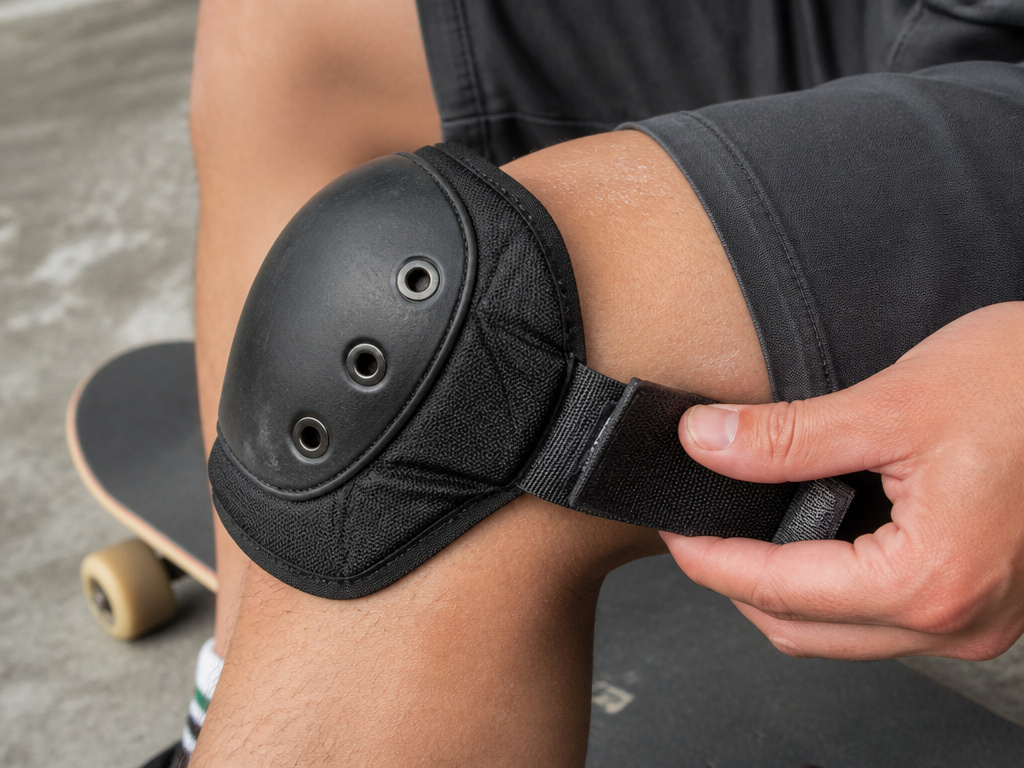
A pad in your closet offers no protection. The goal is to find protection you do not mind putting on. This comes down to fit, profile, and strap design.
First, measure the circumference around your knee, about two inches above the kneecap. This is the sizing number brands like Triple Eight use. A pad that is too loose will spin around your leg; one that is too tight will cut off circulation behind your knee. The sweet spot is snug enough that you can jump without it shifting, but not so tight it leaves a deep red ring when you take it off.
Common mistake: Buying pads a size too big “to grow into” or for comfort. A loose pad slides down your shin on the first hard fall, leaving your knee exposed exactly when you need it most.
For street skaters, the play is often a low-profile pad. Brands like Triple Eight and Pro-Tec make “slip-on” or “soft cap” models that fit under loose jeans. You barely feel them until you need them. They lack the hard plastic cap of a vert pad, so they will not facilitate a knee slide down a ramp, but they will absorb the impact of an unexpected knee-to-concrete meeting.
For park and vert, you need the hard shell. The 187 Killer Pad is the industry standard for a reason. The cap is durable, the straps are wide and secure, and the foam is thick enough to handle repeated knee slides. They are hot, they are bulky, and you will notice them. That is the trade for learning to drop in on a nine-foot bowl with confidence.
Here is a quick checklist for choosing knee pads:
- Know your discipline: Street = slim profile. Vert = hard cap.
- Measure your knee: Use a soft tape measure and follow the brand’s size chart.
- Check the straps: Wide, non-elastic straps with solid buckles won’t slip.
- Test the range of motion: Do a deep squat. The pad should not pinch or restrict you.
- Consider the liner: Moisture-wicking fabric is worth the extra few dollars for long sessions.
Once you have them, securing knee pads properly is the final step. The top strap goes above the knee, the bottom strap below the calf muscle. They should be tight enough that you cannot rotate the pad with your hand. If you are pulling them on over pants, make sure the fabric is smooth underneath to prevent chafing.
The Full Gear Ecosystem: Where Knee Pads Fit In
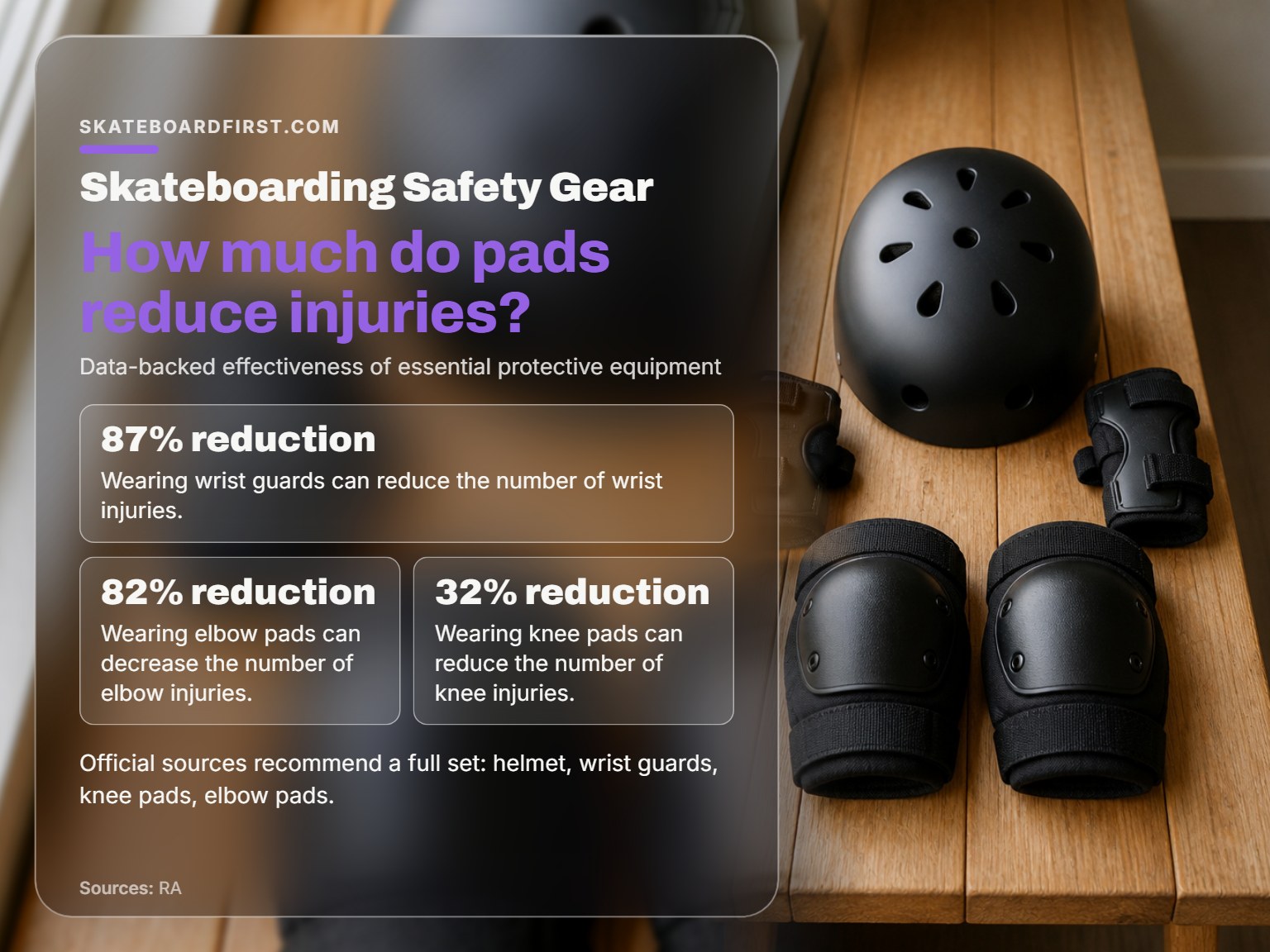
Knee pads are not a standalone decision. They are part of a system. The National Safety Council and CPSC outline the full suite: a CPSC-certified helmet, wrist guards, knee pads, and elbow pads. For beginners, this can feel like overkill. It is not.
Think of it like this. Your helmet protects against a catastrophic, life-changing injury. Your wrist guards protect against the most statistically common serious injury (fractures). Your knee and elbow pads protect against the injuries that are most likely to bench you for a season, the deep bruises, the road rash, the burst bursa sacs that keep you off your board for weeks.
If you are building a protective gear for new skaters setup from scratch, the purchase order based on data and common failure modes is:
- Helmet (essential, for obvious reasons)
- Wrist Guards (87 percent fracture reduction)
- Knee Pads (32 percent injury reduction)
- Elbow Pads (82 percent reduction, but elbows are less frequently the primary point of impact in beginner falls)
This order acknowledges the stats while accepting that full coverage from day one is the safest path. Many quality skateboard pads are sold as sets, which simplifies buying and ensures a consistent fit.
How to Choose and Fit Knee Pads
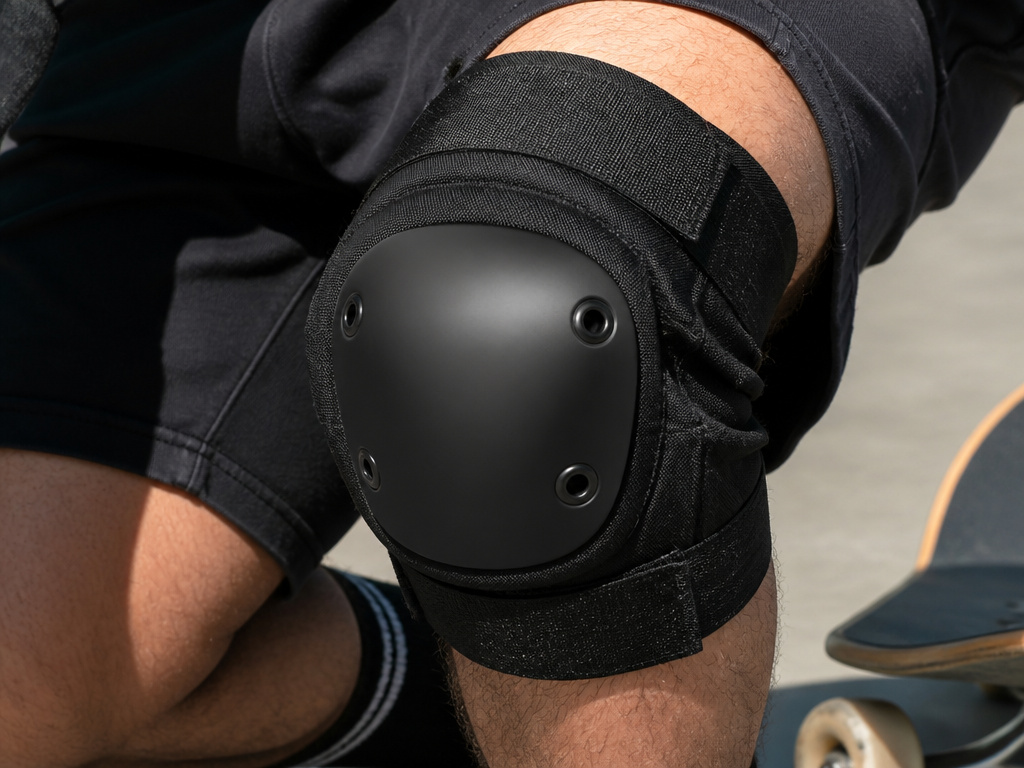
Proper fit is what makes a knee pad functional. A pad that slides down or shifts on impact offers little protection. To find the right size, measure the circumference of your leg at the center of your kneecap. Use this measurement against the manufacturer’s sizing chart. A well-fitted knee pad should sit securely over your knee without pinching or restricting your movement. The hard cap should stay centered over your kneecap when you bend your leg into a skating crouch. Straps should be snug but not cut off circulation. The goal is to find a pad you will keep on.
Frequently Asked Questions
Should you wear knee pads when skateboarding?
Yes, according to official safety bodies like the CPSC and AAOS. The data shows they reduce knee injuries by 32 percent. For street skating, many experienced skaters prioritize wrist guards, but for any transition, ramp, or park skating, knee pads are considered essential and are legally required in some jurisdictions.
What happens if you don’t use knee pads?
You accept a one-third higher risk of a knee injury. This ranges from painful road rash and bruising to more serious conditions like prepatellar bursitis (fluid swelling on the kneecap) or fractures from direct impact. In supervised skateparks in states like North Carolina, you may be denied entry or fined.
Are knee pads or wrist guards more important?
From a pure injury-reduction statistic, wrist guards are more important. The same 1996 study shows they reduce wrist injuries by 87 percent, compared to 32 percent for knees. For a beginner learning to fall, protecting the wrists is the top priority after the helmet. However, for skating on ramps or bowls, knee pads become equally critical for controlled slides.
Can I wear volleyball-style knee pads for skateboarding?
You can, but they offer less protection. Volleyball pads are designed for cushioning impacts on gym floors, not for sliding on concrete or taking direct hits from a high-speed fall. They lack the hard plastic cap that distributes force and facilitates a slide. For casual street cruising, they are better than nothing, but for any park skating, proper skateboard-specific knee pads are the only safe choice.
How tight should skateboard knee pads be?
Tight enough that they do not rotate around your leg when you shake it, but not so tight that they cut off circulation or pinch behind the knee. You should be able to fit a finger between the strap and your skin. Perform a deep knee bend to test for restriction, if you cannot squat comfortably, they are too tight or poorly designed for your range of motion.
The Bottom Line
The medical and legal answer is unambiguous: yes, you need knee pads for skateboarding. The 32 percent injury reduction is a real, studied benefit, and in places like North Carolina, that recommendation is backed by law.
The street-skating community’s pragmatic take is also valid. If you are only pushing around on flat ground, your knees are not the first thing to hit. In that case, wrist guards are your most important piece of protective gear after a helmet.
Your decision hinges on a simple threshold: the moment you step into a skatepark or onto a ramp, the knee pads go on. For pure street, a slim, low-profile pad under your jeans is a smart compromise between safety and mobility. Ignoring them entirely means betting against a one-in-three chance, and that is a odds game your knees will lose eventually. Start with the basics, protect your joints, and you will have more time on the board to actually learn.
