
Electric Skateboard Range Explained
This post contains affiliate links. As an Amazon Associate, we earn from qualifying purchases.
Electric skateboard range is the distance you can ride on a single battery charge, but the advertised number is a best-case, controlled-environment figure. Your real-world range depends on rider weight, speed, hills, temperature, and riding style, most riders will get 60 to 70 percent of the advertised spec in normal conditions.
That gap between the lab and the street is simply physics. Every pound you add, every hill you climb, and every burst of acceleration pulls more energy from the battery. A spec sheet gives you a ceiling; your habits and route decide how close you get. This is the electric skateboard range explained.
What follows: a breakdown of the six things that actually drain your battery, how manufacturers get their range numbers, and a simple method to estimate your own ride distance before you head out.
Key Takeaways
- Plan your trips using 60 to 70 percent of the advertised range, that’s a realistic buffer for weight, hills, and stops.
- A 130 lb vs 220 lb rider on the same board can see a 20 to 30 percent difference in range.
- Cold weather reduces range, top speed, and acceleration; the ONSRA manual warns it may cause permanent battery damage.
- For maximum range, ride in a lower power mode (Eco vs Sport/Turbo) and maintain a steady, moderate speed.
- Long-term battery care, like storing at a partial charge, is the single biggest factor for preserving range over years.
The Manufacturer’s Range Test vs. Your Reality
Manufacturers test range under ideal, repeatable conditions: a light rider (often 75kg/165lbs), a flat surface, no wind, a steady moderate speed (like 20km/h), and optimal temperature (around 30°C/86°F). This creates a standard benchmark, not a promise for your commute.
That’s a specific, controlled lab test.
Your ride is not a lab. You have a backpack. You stop at lights. The pavement has cracks and slight inclines. A headwind kicks up. The battery is six months old and has seen a few dozen charge cycles. Each of those variables pulls your real-world number down from that pristine spec, which is the core of the electric skateboard range explained.
The short version: The spec sheet tells you the board’s potential in a vacuum. Your job is to understand what subtracts from it.
The Six Factors That Actually Drain Your Battery
These are the variables that decide whether you’re gliding home or pushing. They don’t work in isolation, a heavy rider going up a hill in the cold is hitting the battery with a triple-whammy.
1. Rider Weight and Load
This is the biggest lever you control. Physics is simple: more mass requires more energy to move. The best electric skateboards for adults are rated for high weights, but that doesn’t mean range stays the same.
That’s not a small margin, it could be the difference between a round trip and a one-way ride. Add a backpack with a laptop and books, and you’re adding another 10-15 lbs of load the motors have to carry.
2. Terrain and Hills
Flat ground is efficient. Hills are not. Climbing even a gentle slope forces the motors to work harder, drawing a heavy, sustained current from the battery. While many boards have regenerative braking that recovers some energy on the descent, it never fully offsets the uphill cost. A route that looks short on a map but includes a few long inclines can murder your range.
3. Speed and Riding Style
Speed costs you exponentially due to wind resistance. Riding at a steady 15-18 mph is far more efficient than pushing 25+ mph. Your throttle finger also matters. Jackrabbit starts from every stop sign and hard, frequent acceleration create massive current spikes. Smooth, gradual acceleration is kinder to your battery and extends your miles.
| Riding Habit | Impact on Range | Why It Happens |
|---|---|---|
| Steady, moderate speed (Eco mode) | Maximizes range | Minimizes wind resistance & continuous power draw |
| Frequent hard acceleration | Significantly reduces range | Creates high current spikes that drain the battery faster |
| Sustained top speed | High reduction | Wind resistance increases with the square of speed |
| Using regenerative braking on descents | Slight recovery | Recoups a small percentage of energy used on the climb |
4. Temperature
Lithium batteries hate the cold. The chemical reactions inside slow down, reducing the battery’s ability to deliver power. On a freezing day, you might feel the board sluggish and see your range indicator drop faster than usual. The opposite is also true, extreme heat can stress the battery and is bad for long-term health.
5. Wheel and Tire Choice
This is a major trade-off. Large, soft, pneumatic (air-filled) all-terrain tires absorb bumps and ride over rough paths, but they create more rolling resistance. Harder, smaller street wheels are far more efficient on smooth pavement. Swapping from AT tires to street wheels on a 2-in-1 board can add significant distance to your ride. If you’re chasing range on pavement, stick with the street setup.
6. Battery Health and Age
A battery is a consumable part. Its capacity to hold a full charge diminishes over time with each charge cycle. How quickly it degrades depends almost entirely on how you treat it. That’s why a consistent battery care routine is the best investment in your board’s long-term mileage.
How to Estimate Your Real-World Range
You don’t need to be an engineer. You just need to be pessimistic. Take the manufacturer’s number and start subtracting.
First, identify the advertised range for your specific board. Let’s say your Onewheel+ XR claims 12-18 miles, or your ONSRA VELAR 2.0 claims up to 37 miles.
Now, run through a mental checklist:
- Your weight vs. Test weight: Are you heavier than the 165lb / 75kg standard test rider? If yes, deduct 10-20%.
- Your route: Is it flat, or does it have hills? A hilly route can cut range by 25% or more.
- Your speed: Will you be cruising or racing? Plan for high-speed bursts to cut range by another 15%.
- The weather: Is it below 50°F (10°C)? Expect a cold-weather penalty of 10-20%.
Common mistake: Assuming you’ll get the “up to” number. Start with the lower end of the advertised range (12 miles, not 18), then apply your deductions. The result is your planning range.
That means a board advertised for 20 miles becomes a 12-14 mile board for realistic trip planning. Always leave yourself a safety margin, don’t plan a 14-mile trip on a board you hope can do 14 miles.
Battery Capacity: Watt-Hours Are Your Best Clue
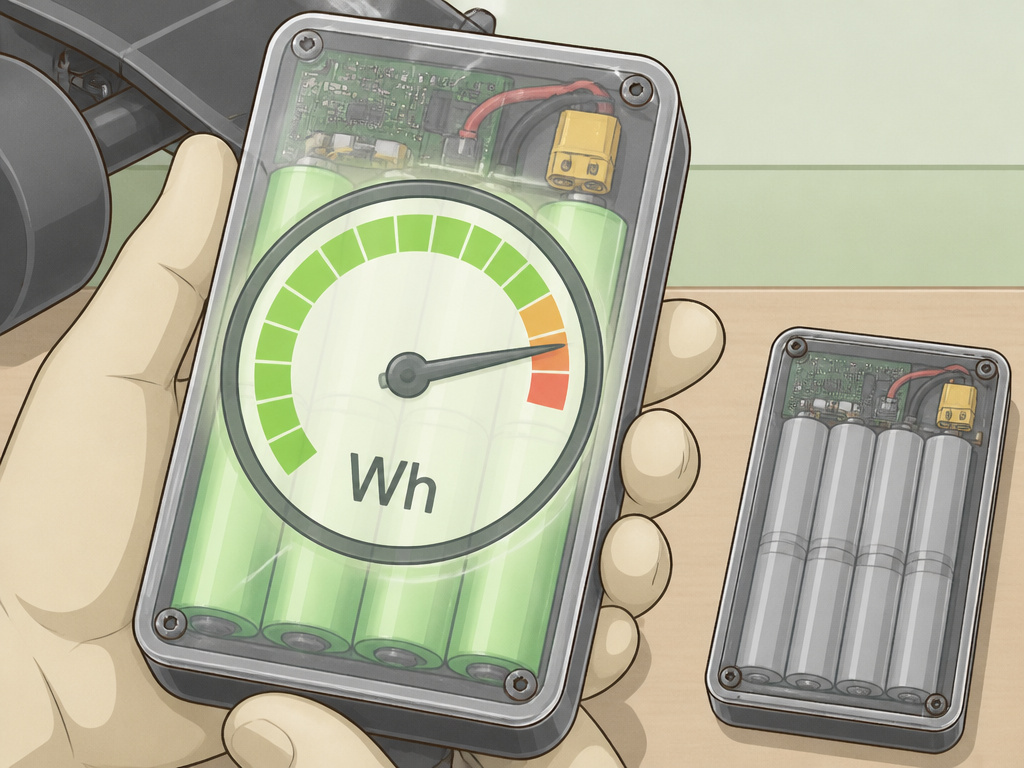
While advertised range is variable, the battery’s watt-hour (Wh) rating is a concrete, comparable number. It tells you how much energy is in the tank. A higher Wh rating generally means more potential range, all else being equal.
| Board Model | Battery Capacity (Wh) | Advertised Range | Notes |
|---|---|---|---|
| Inboard M1 | 97 Wh | 7-10 miles | Compact, swappable battery |
| Onewheel+ XR | NMC Battery (est. ~300 Wh) | 12-18 miles | Single-wheel design |
| Ownboard W/C-series | Samsung 30Q 6.0Ah (est. ~220 Wh) | ~14 miles | Tested with 70kg rider |
| ONSRA VELAR 2.0 | 1036 Wh | 37-44 miles | High-capacity, performance board |
Think of Wh like the size of a gas tank. A bigger tank (higher Wh) lets you go farther, but it also adds weight and cost. When comparing electric longboards or off-road skateboards, the Wh rating is a more honest starting point than range claims in the electric skateboard range explained.
Riding Modes: Eco, Sport, and Turbo’s Trade-Off
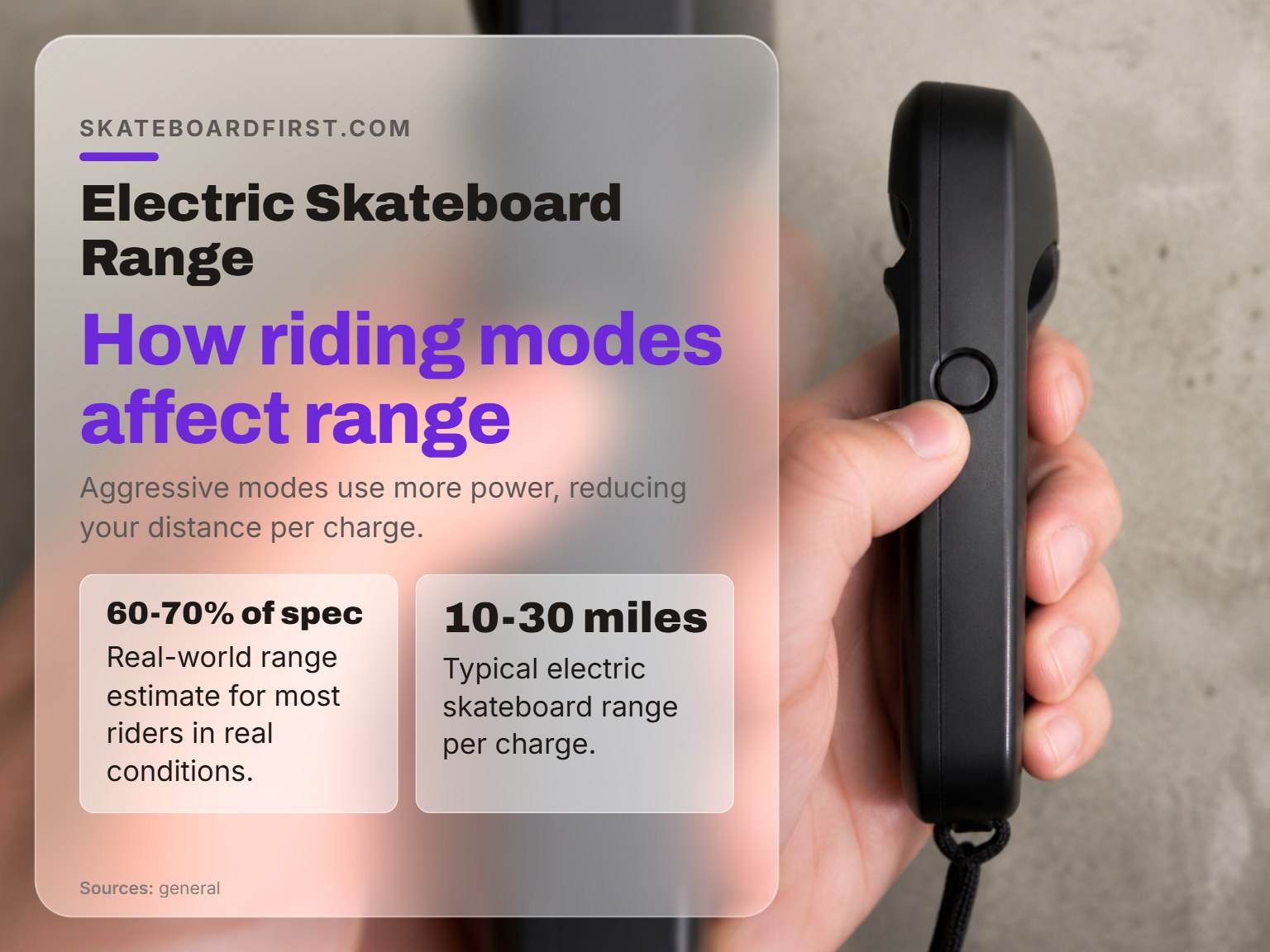
Most boards offer multiple riding modes. Eco mode limits top speed and acceleration to conserve battery. Sport or Turbo mode provides full power for thrill-seeking. The range difference between them isn’t trivial.
Eco mode might cap your speed at 12-15 mph and soften acceleration. This dramatically reduces the motor’s average power draw. Switching to Turbo might double your fun but easily cut your achievable range by 30-40%. It’s not just about top speed, the aggressive acceleration curve in Turbo uses energy in big gulps.
If you’re commuting and need predictable range, start in Eco. Use the higher modes for shorter joyrides or when you know you have plenty of charge to spare. This is also a critical point in the electric skateboard pros and cons calculus: more power and thrill often come at the direct cost of practical range.
Preserving Your Range Over the Long Term

Your board’s range on day one is its peak. From there, it’s a game of preservation. Battery degradation is inevitable, but you control the rate.
Storage is everything. Both the Onewheel XR and ONSRA manuals agree: never store a battery fully charged or completely dead for long periods. For long-term storage, the Onewheel XR manual advises storing the battery at 10-15°C.
Charge smart. Use the charger that came with your board. Regular, slower charging is gentler on the battery’s chemistry. Our guide on charging safely covers this in detail.
Avoid extreme discharge. Don’t regularly run the battery down until the board stops. Try to recharge when you have 20-30% left.
Follow these habits, and you’ll slow the decline, keeping your board’s range usable for years. For a full routine, see our storage guide.
What boards have the longest range?

Looking at manufacturer specs, a few models stand out for their high published range. The ONSRA VELAR 2.0 claims a range of up to 37 miles, with optimal conditions allowing for up to 44 miles. For a more traditional electric skateboard, The Onewheel+ XR, a different type of electric board, offers a typical range of 12 to 18 miles. Remember that these numbers come from controlled tests. Your actual range will be lower due to factors like rider weight, terrain, speed, and battery age.
Frequently Asked Questions
What is a good range for an electric skateboard?
For most commuters and casual riders, a realistic 10-20 miles of real-world range is sufficient. Boards advertising 30+ miles often achieve that only under ideal conditions; expect 18-25 miles in practice. High-capacity boards like the ONSRA VELAR 2.0 are exceptions, built for extended rides.
Can I increase my electric skateboard’s range?
You can maximize the range you have by riding lighter (shed backpack weight if possible), using Eco mode, maintaining steady speeds, and avoiding hills. You cannot increase the battery’s inherent capacity, that’s fixed by its Wh rating.
How does regenerative braking affect range?
It recovers a small amount of energy, usually 5-10%, when you brake or ride downhill, feeding it back into the battery. It helps, but don’t rely on it to offset major range drains like climbing a big hill beforehand.
Why did my range suddenly drop?
Sudden drops usually point to battery health, extreme cold, or a mechanical issue like stuck brakes or under-inflated tires (on AT boards). If it’s not cold weather, check tire pressure and ensure your wheels spin freely. A gradual drop over months is normal battery aging.
Is a long-range electric skateboard worth it?
It depends on your use. If your daily round-trip is under 10 miles, a standard-range board is fine and often more portable. If you plan longer recreational rides or have a hilly commute, investing in a higher Wh battery, as seen in some long-range scooters and premium e-skateboards, pays off in reduced “range anxiety.”
The Bottom Line
Range is a calculation. Start with the hard number on the spec sheet, the watt-hour rating, then layer on the realities of your weight, your hills, and your need for speed.
The single most important thing you can do is test your own board. Ride a known, measured loop and see what percentage of the battery you use. That personal number is worth ten spec sheets. Once you know you get 14 miles on your regular route, you can plan a 12-mile new adventure with confidence.
And remember, the battery is the heart of the system. How you charge it, store it, and care for it determines how many miles you get today and two years from now. Treat it well, ride with a buffer, and you’ll spend less time pushing and more time gliding.
